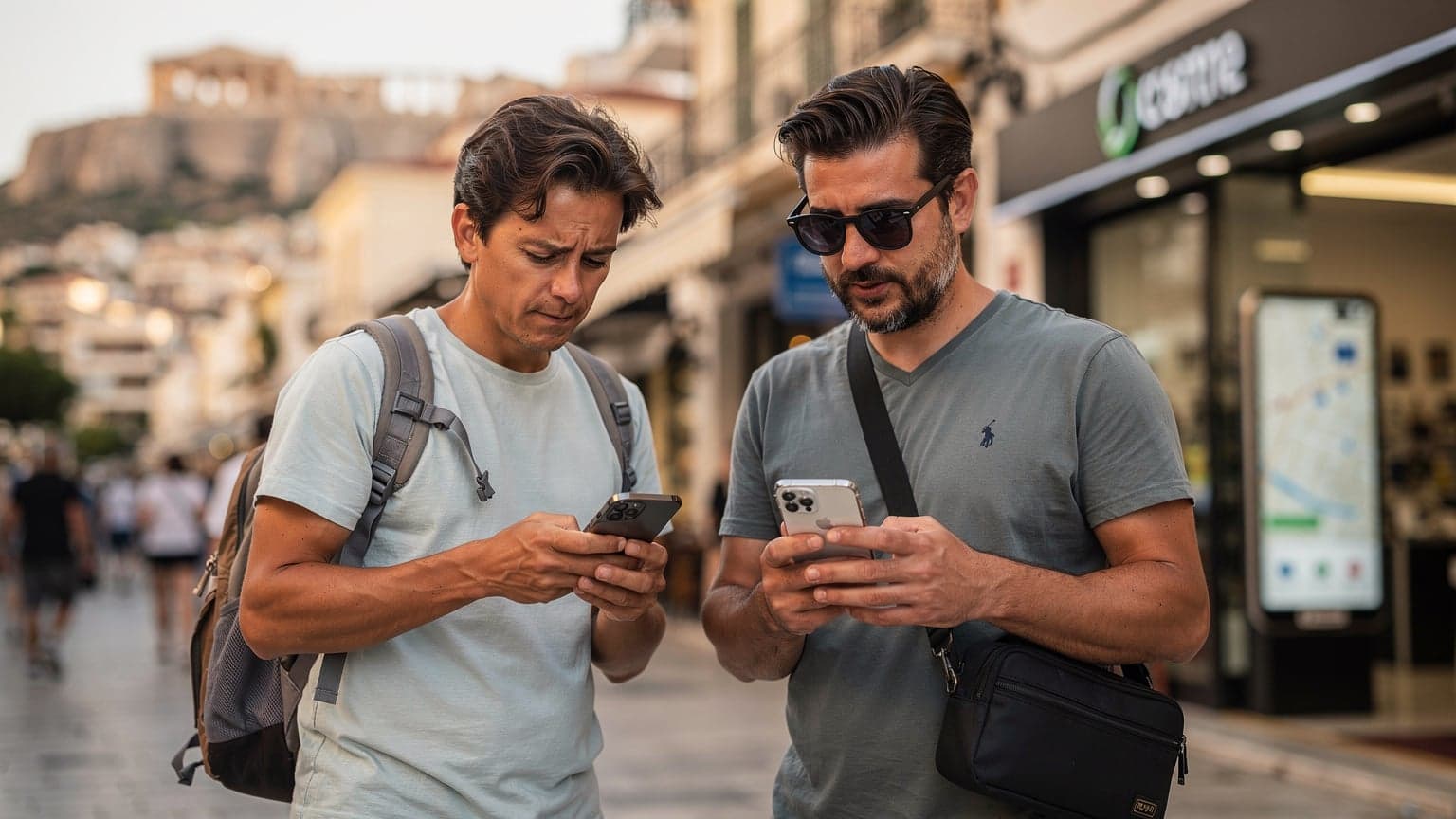
Cosmote eSIMs for Greece offer local rates, but often mean jumping through hoops for activation and come with short validity periods. A general travel eSIM, like the ones from Cellesim, usually makes activation easier, provides coverage across multiple countries, and offers more flexible data plans. For most budget-conscious travelers, this often makes them the more cost-effective choice.
The Real Cost of Data in Greece, What I Spent
Let's get straight to it: every euro counts when you're traveling. My last 8-day trip, bouncing between Athens, Santorini, and a quick ferry to Crete, cost me a total of €280 for data. That's for 20GB over eight days, which works out to about €35 a day, or roughly 2.5GB daily. And yes, that included all the map navigation through those winding Oia alleyways, uploading a few dozen photos to my Substack, and endless WhatsApp calls with friends to coordinate hostel bookings in Paros.
You might think, "Emma, that's a lot," and you'd be right if I hadn't gone with a flexible travel eSIM. I've done the physical SIM card dance in Greece before, standing in line at Athens International Airport, trying to explain my data needs to a salesperson in broken English. It's a hassle, often comes with hidden fees, and you end up with a local number you'll never use. For this trip, I chose a regional European eSIM from Cellesim. It gave me seamless coverage not just in Greece, but also in case I decided to spontaneously hop over to Albania or North Macedonia, which, let's be honest, is always a possibility for a budget backpacker.
The cheapest local physical SIM I could find, just to be fair, was a Cosmote prepaid SIM at a kiosk in Syntagma Square. For about €15, you could get 10GB for 15 days. Sounds great, right? Until you factor in the mandatory top-up for more data, the activation dance, and the fact that 10GB for 15 days often isn't enough if your phone is your lifeline for navigation, entertainment, and communication. That's less than 1GB a day, which, in my experience, means running out of data halfway through your trip and frantically searching for Wi-Fi.
Breaking Down My Data Usage in Greece
I track every penny, and every megabyte. Here's a rough breakdown of what used up my data:
- Mapping & Navigation (Google Maps, HERE WeGo): Around 500MB/day, especially when exploring new cities like Thessaloniki or driving through the rural Peloponnese.
- Social Media (Instagram, WhatsApp, checking hostel reviews): About 800MB/day, for keeping up with my Substack and sharing my finds.
- Streaming (Spotify, occasional YouTube for background noise in hostels): Roughly 1GB/day, because sometimes you just need a podcast on a long bus ride from Athens to Kalamata.
- Emails & Work (Substack, light admin): 200MB/day.
So, 0.5 + 0.8 + 1 + 0.2 = 2.5GB per day. Over eight days, that's 20GB. My Cellesim plan for Europe, which included Greece, gave me exactly that, and I didn't have to worry about running out of data. Cellesim plans are budget-friendly for 20GB, which made my total data spend for the trip much more palatable. Always compare the total cost per GB, not just the upfront price, especially if you're a heavy user like me.
Cosmote eSIM for Tourists: The Local Option
Cosmote is one of Greece's major mobile providers, along with Vodafone Greece and Wind (now Nova). They have solid coverage, particularly in popular tourist areas and big cities. For years, a physical Cosmote SIM was the way to go if you wanted a local number and decent rates. Now, they offer eSIMs for tourists, which sounds convenient in theory.
But here's the catch: local eSIMs for tourists often come with a few hurdles. You might still need to register in person, show your passport, and deal with limited plans specifically designed for short-term visitors. Last I checked, a Cosmote tourist eSIM would give you something like 10GB for 15 days, priced around €15-€20. That's a good deal if you're a light user and staying for a short time, but for longer trips or heavier data use, it quickly becomes restrictive.
Benefits of a Cosmote eSIM
- Local Rates: Generally, the per-GB cost can be lower than some global travel eSIMs, especially if you snag a good promotional package.
- Strong Local Coverage: Cosmote has excellent network infrastructure across mainland Greece and many islands.
- Local Phone Number: Useful if you need to make local calls, like booking a hostel or calling a local tour operator (though WhatsApp often does the trick these days).
Drawbacks of a Cosmote eSIM
- Activation Hassle: You might need to visit a physical store for identity verification, which eats into valuable travel time. This isn't always the case for all plans, but it's a common hurdle for tourist SIMs in many countries.
- Limited Validity: Tourist plans often expire quickly, forcing you to top up or buy a new plan if your trip extends.
- No Multi-Country Roaming: If you're planning to cross borders into, say, Bulgaria or Turkey, your Cosmote eSIM won't help you there. You'll need a separate solution for each country, which is a pain. This is why I prefer a regional eSIM for European trips, as it covers multiple countries like Greece, Italy, and even some non-EU spots, as explored in "Middle East eSIM 2026: Seamless Multi-Country Data for Your Journey" when I was looking at options for my Jordan and Egypt trip.
- Top-Up Complexity: Reloading data can sometimes be a clunky process, especially if you're not fluent in Greek.
Travel eSIMs for Greece: My Go-To for Flexibility
This is where Cellesim and other global travel eSIM providers really shine. For me, the convenience and flexibility easily outweigh any small price difference (if there even is one). You buy your eSIM online, scan a QR code, and you're connected. No waiting in lines, no language barriers, no hidden fees.
My Cellesim plan for Europe usually uses local networks like Cosmote, Vodafone, or Nova in Greece. This means I get the same great coverage without the local SIM hassle. Prices vary, but I've consistently found Cellesim to offer competitive rates, often beating out other popular providers like Holafly when you compare the actual GB per euro. Check out "Cellesim vs. Holafly 2026: Why You'll Pay Less for More Data" for a deeper comparison.
Benefits of Travel eSIMs
- Instant Activation: Buy, scan, connect. Usually takes less than 5 minutes. No physical store visits required.
- Multi-Country Coverage: One eSIM can cover Greece and many other countries, perfect for a European backpacking trip. This is a lifesaver when you're doing something like road tripping the US-Canada border.
- Flexible Plans: Choose from various data amounts and validity periods, tailored to your trip duration and data needs. Need 5GB for a week? Or 30GB for a month? It's all there.
- No Identity Verification: Generally, no passport registration is needed, ensuring privacy and convenience.
- Keep Your Primary SIM Active: You can use your travel eSIM for data and keep your home country's physical SIM or eSIM active for calls/texts, receiving SMS for bank verifications, etc.
Drawbacks of Travel eSIMs
- No Local Phone Number: You won't get a Greek phone number, but with WhatsApp and other VoIP apps, this is rarely an issue for tourists.
- Slightly Higher Per-GB Cost (Sometimes): While Cellesim often beats the competition, some hyper-local SIMs might offer a fractionally lower per-GB rate for very specific, limited plans. However, the convenience factor usually makes up for this.
How to Calculate Your Greece Data Needs
Don't just guess. Overestimating means you're wasting money, and underestimating means you're stuck looking for Wi-Fi or buying expensive top-ups. I've been there, staring blankly at my phone in a remote village in Crete, praying for a signal.
First, think about your daily habits. Are you just occasionally checking emails, or are you constantly streaming Netflix on night buses? My 2.5GB/day average is probably on the higher end for a budget backpacker, but I rely heavily on my phone for work and entertainment.
| Activity | Estimated Data Usage per Hour | Daily Impact (2 hours) |
|---|---|---|
| Google Maps/Navigation | 10-20 MB | 20-40 MB |
| Social Media (browsing) | 100-200 MB | 200-400 MB |
| WhatsApp Calls | ~5 MB/minute | ~600 MB |
| Streaming Music (Spotify) | 50-150 MB | 100-300 MB |
| Streaming Video (SD) | 500-700 MB | 1-1.4 GB |
| Email/Light Browsing | 10-30 MB | 20-60 MB |
| Photo Uploads (high-res) | 2-5 MB per photo | Varies greatly |
So, let's do the math for a typical 7-day trip:
Light User (checking maps, emails, occasional social media):
0.5 GB/day x 7 days = 3.5 GB total. A 5GB plan would be plenty. (For more on this, see "Is 5GB Data Enough for a Week Abroad? Your Real-World Needs in 2026").
Moderate User (maps, regular social media, some video calls):
1.5 GB/day x 7 days = 10.5 GB total. A 10GB or 15GB plan would be a safe bet.
Heavy User (my category: all of the above + streaming, uploading large files):
2.5 GB/day x 7 days = 17.5 GB total. A 20GB or 30GB plan is what you'd need.
Always choose slightly more data than you think you'll need. It's cheaper to buy a larger plan upfront than to scramble for an expensive top-up in the middle of your trip. Trust me, I've seen friends get caught out in the middle of nowhere, unable to look up bus schedules, because they skimped on data.
Picking Your eSIM Provider for Greece: Cosmote vs. Travel eSIM
When it comes down to it, your choice depends on your travel style and priorities. Are you staying in one spot for a month, or are you zipping across the Balkans? (Because if it's the latter, a multi-country eSIM is a no-brainer).
| Feature | Cosmote Tourist eSIM | Cellesim Travel eSIM |
|---|---|---|
| Activation Process | Potentially in-person registration, passport required. | Online purchase, instant QR code scan. |
| Local Number | Yes, Greek phone number provided. | No, uses data for VoIP. |
| Multi-Country Use | No, Greece only. | Yes, covers multiple countries (e.g., EU-wide). |
| Data Plan Flexibility | Limited tourist packages, fixed validity. | Wide range of data/validity options, often cheaper per GB. |
| Customer Support | Local support, potentially language barrier. | Multilingual online support, easy access. |
| Cost (per GB) | Can be cheap for small plans, but higher for top-ups. | Highly competitive, often better value for larger plans. |
My advice? For any trip longer than a week, or if you plan on visiting more than just Greece, a travel eSIM is the smarter, more economical choice. The upfront cost might seem a little higher for a big data plan, but the peace of mind and flexibility are priceless. I mean, not having to worry about finding a Cosmote store in a small island village after missing a ferry connection is worth a few extra euros any day.
How to Activate Your eSIM in Greece: A Step-by-Step Guide
This is where eSIMs really shine, especially for avoiding those airport queues or the frantic search for a phone shop in a new city like Heraklion.
Activating a Travel eSIM for Greece
Assuming you've purchased a Cellesim plan (or similar) before you even leave home:
- Purchase Your eSIM: Go to the Cellesim website, select a Greece or Europe-wide plan that matches your data needs and trip duration. Pay online.
- Receive QR Code: Cellesim will email you a QR code (or provide it directly on the app/website). Make sure you have access to this, either printed or on another device.
- Scan QR Code: Once you land in Greece (or even before you leave, just don't activate until you're ready to use it), open your phone's Settings.
- Add Cellular Plan: For iPhone, go to Settings > Cellular > Add eSIM. For Android (Samsung/Pixel), it's usually Settings > Network & Internet > SIMs > Add eSIM. Choose to 'Use QR Code'.
- Scan and Confirm: Scan the QR code. Your phone will detect the new cellular plan. Name it something clear, like 'Greece Travel Data'.
- Set as Primary for Data: In your phone's cellular settings, ensure your new eSIM is set for 'Cellular Data' and your home SIM is set for calls/texts (if you want to receive those). Turn on Data Roaming for the eSIM.
- Connect: Within minutes, you should connect to a local network (Cosmote, Vodafone, Nova). You're online!
Activating a Cosmote Tourist eSIM in Greece
This process can be a bit more involved:
- Locate a Cosmote Store: Find one at Athens Airport (Eleftherios Venizelos) or in a major city like Athens (e.g., Ermou Street) or Thessaloniki.
- Bring ID: You will absolutely need your passport for registration.
- Choose a Plan: Ask for a 'Tourist eSIM' plan. Be specific about data allowance and validity.
- Fill Out Forms: Expect some paperwork. This is standard for local SIMs in many countries for identity verification.
- Activation: The store assistant will typically activate the eSIM for you, which might involve scanning a QR code onto your phone.
- Test Connection: Make sure you have a signal and can access the internet before you leave the store.
See the difference? One is a few taps on your phone, the other involves queues and paperwork. For me, time is money, especially when you're trying to catch a ferry from Piraeus.
Border Crossing and Multi-Country Trips: What You Need to Know
This is a big one for backpackers. If your Greece trip is just a slice of a larger European adventure, local SIMs become a massive headache. Imagine getting off a bus at the Greek-Albanian border, trying to find a local SIM in Kakavia, and dealing with a new currency and language all over again. No thanks.
I've done border crossings where having a multi-country eSIM literally saved my skin. Like when I was crossing from Turkey into Greece on a night bus, and the border agents had a few questions. Being able to quickly pull up my travel insurance documents or translate something on the fly because I had continuous data, without needing to swap SIMs or find Wi-Fi, was invaluable. (Speaking of Turkey, if you're heading there, check out "Turkcell eSIM for Tourists 2026: Navigating Turkey with Family Data".)
With a regional eSIM, like a Cellesim Europe plan, you just keep going. As your bus or train crosses the border, your phone automatically connects to a partner network in the new country. No interruption, no fuss, no extra cost. This is especially crucial if you're planning to visit neighboring countries like Italy, Bulgaria, or even a ferry hop to Turkey from Rhodes.
I once saw a guy miss his connection in Thessaloniki because his local SIM stopped working at the border, and he couldn't access his train ticket confirmation. Don't be that guy. Always plan for seamless data if you're crossing borders.
The Dual-eSIM Advantage for Border Crossings
Most modern smartphones (iPhone 11 and newer, many Samsung Galaxy and Google Pixel models) support dual SIM functionality. This means you can have your home physical SIM (or eSIM) and a travel eSIM active simultaneously. This is the ultimate budget backpacker hack.
- Stay Connected to Home: You can still receive calls and texts on your home number, which is vital for things like two-factor authentication from your bank.
- Dedicated Travel Data: Your travel eSIM handles all your data needs, ensuring you're always online at local rates.
- Emergency Backup: If one network has issues, you can quickly switch to the other for essential communication.
This setup is particularly useful for complex itineraries or if you're passing through countries with vastly different data regulations, like from Greece into Egypt, where you might need a dedicated eSIM for Egypt.
My Final Verdict on Greece eSIMs
For the vast majority of travelers heading to Greece in 2026, especially those who count their euros and value flexibility, a dedicated travel eSIM from a provider like Cellesim is the clear winner over a local Cosmote tourist eSIM. The ease of activation, multi-country coverage, and straightforward pricing make it a no-brainer.
While a Cosmote tourist eSIM might offer a slightly cheaper per-GB rate for very specific, short-term, low-data plans, the hidden costs of time spent activating, potential language barriers, and the lack of multi-country flexibility quickly outweigh any perceived savings. My 8-day trip with 20GB for €28 speaks volumes. The math simply adds up in favor of the travel eSIM.
So, whether you're island hopping the Cyclades, exploring ancient ruins, or hitting the vibrant nightlife of Mykonos, make sure your data plan is as stress-free as your itinerary. Don't compromise your travel experience for a few euros only to find yourself stranded without data when you need it most. Get your travel eSIM sorted before you even pack your backpack, and enjoy Greece connected, the smart way.
Frequently Asked Questions
Can I buy a Cosmote eSIM for Greece as a tourist?
Yes, Cosmote offers eSIMs for tourists, but activation often requires an in-person visit to a Cosmote store with your passport for identity verification. Plans are typically short-term and data-limited.
How much does a Cosmote tourist eSIM cost in Greece?
A typical Cosmote tourist eSIM package might cost around €15-€20 for 10GB of data with a 15-day validity. Prices can vary based on promotions and specific plans available at the time of purchase.
Are travel eSIMs cheaper than local Cosmote eSIMs for Greece?
For short, low-data trips, a local Cosmote eSIM might appear cheaper upfront. However, for longer trips or higher data needs, travel eSIMs often provide better per-GB value and significantly more convenience, avoiding activation hassles and offering multi-country coverage.
Do I need a Greek phone number with an eSIM?
For most tourists, a local Greek phone number is not essential. Travel eSIMs provide data connectivity, allowing you to use VoIP apps like WhatsApp or Messenger for calls and texts, effectively negating the need for a local number.
What's the best eSIM for island hopping in Greece?
For island hopping, a regional travel eSIM that covers multiple European countries (including Greece) is ideal. It ensures continuous connectivity as you move between islands and potentially other countries, without needing to swap SIMs or activate new plans.
Can I use my Cellesim travel eSIM in other European countries from Greece?
Absolutely. Many Cellesim travel eSIM plans are regional, meaning they cover Greece and numerous other countries across Europe. This is perfect for multi-country trips, providing seamless data as you cross borders.