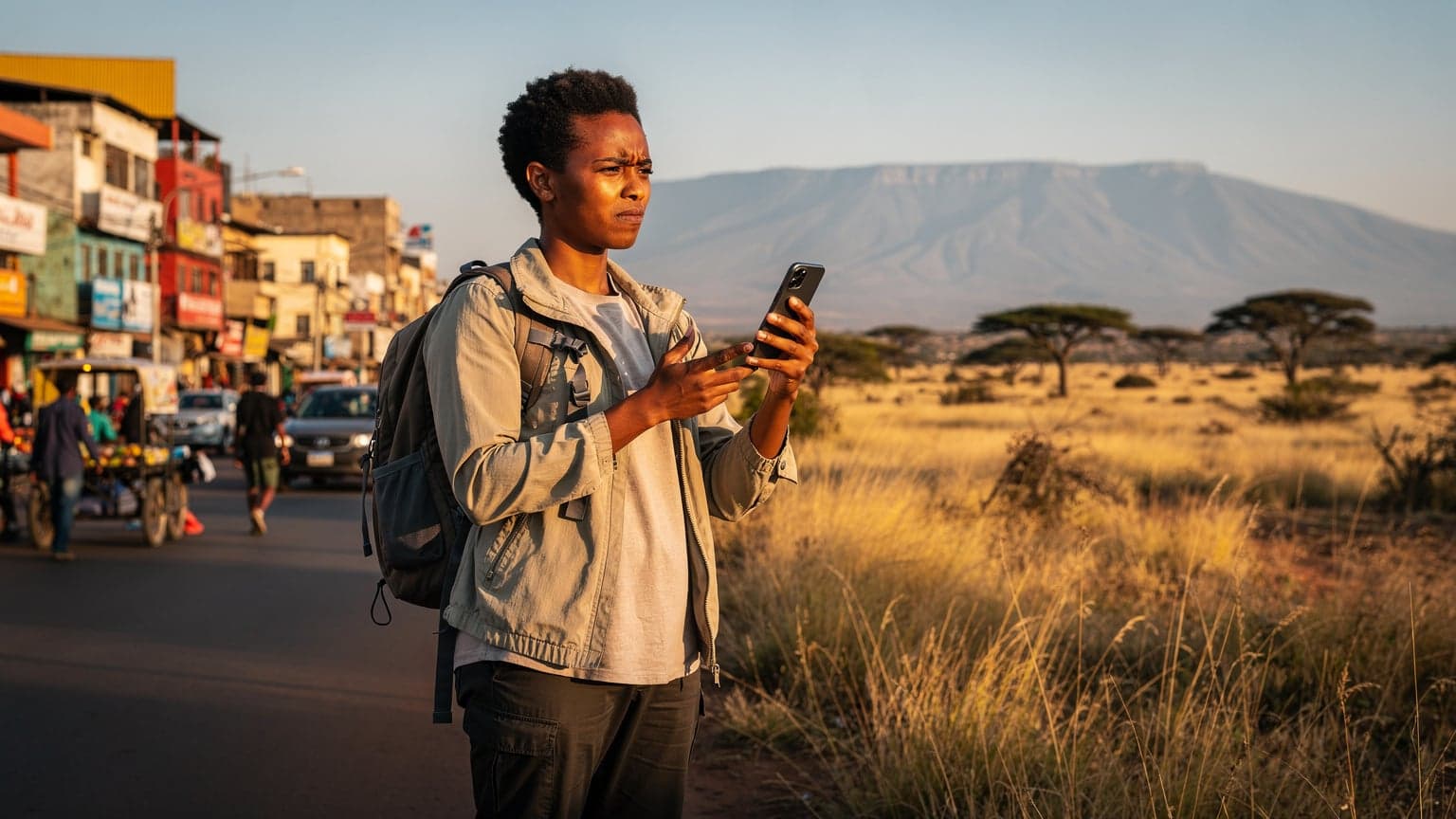
Short answer: MTN is the largest mobile operator in Africa, and that fact misleads more travellers than it helps. MTN is not one network. It is a group of separately licensed national operators, each with its own prices, its own SIM registration law, and its own idea of what a visitor has to produce at the counter. An MTN SIM bought in Lagos does not work in Accra without roaming charges, and the document you needed in Johannesburg is not the document Ghana will ask for.
This guide covers what MTN actually costs in the countries visitors go to most, the registration rules country by country — including the ones that quietly deactivate your line after 30 days — and when a travel eSIM is the more sensible tool for a multi-country African trip.
MTN is a group, not a network
MTN operates in around twenty markets across Africa and the Middle East: Nigeria, South Africa, Ghana, Uganda, Rwanda, Cameroon, Ivory Coast, Zambia, Benin, South Sudan and others.

Each of those is a separate company holding a separate national licence. What follows from that is the thing travellers get wrong:
- Your bundle does not travel. Data you bought from MTN Nigeria is Nigerian data. Cross into Benin or Cameroon and you are roaming, at roaming prices.
- Prices are not comparable. The same brand sells wildly different value in different markets.
- Registration rules are national law, not company policy. MTN cannot waive them and neither can any competitor.
MTN does market regional roaming products, and they exist, but they are aimed at business subscribers with a home line in one MTN country rather than at a visitor flying in from outside the continent.
If your trip stays in one country, a local MTN line can be excellent. If it crosses borders, "I will just use MTN everywhere" is not a plan — it is three or four separate SIM purchases, each with its own paperwork.
Registration: the rules that actually differ
This is the section worth reading before you fly, because the requirements range from trivial to trip-shaping.
Nigeria — passport and visa page, and the NIN question
Nigeria's SIM rules are tied to the National Identification Number, and the NIN-SIM linkage story caused enough confusion that travellers still arrive expecting to be turned away.
The regulator's position for visitors is clear: foreigners on a visitor or tourist visa of under two years do not need a NIN. Operators register the line against your international passport bio-data page and your visa page, and that is the whole requirement.
Where NIN becomes mandatory is if your status changes — a residence or work permit — at which point you are no longer a tourist and you enrol at a NIMC centre like everyone else.
So Nigeria is straightforward in law. The friction is practical: you are producing documents at a counter, and the registration is done for you at the point of sale.
South Africa — RICA wants an address
South Africa's RICA legislation requires every SIM to be registered against a verified identity and a residential address. That second element is the one that catches visitors, because most arrive with no address of any kind.
In practice, a hotel booking or a tour voucher is accepted as proof of address for tourists. You will not be asked for a utility bill. But you do need to have the booking to hand — not "the hotel my agent arranged," but a document you can show.
Enforcement has been tightening, which has one clear practical implication: buy from an official operator store or an authorised dealer. Pre-activated SIMs sold informally on the street are exactly what the tightening is aimed at, and a line registered to a stranger is a line that can vanish.
Ghana — the 30-day cliff
Ghana runs biometric SIM registration linked to the Ghana Card. Visitors without one register against a passport instead, and this is the rule that matters:
A passport-registered SIM in Ghana works for 30 days and is then deactivated. Staying longer on the same line means obtaining a Non-Citizen Ghana Card, which is a residency-track document, not a tourist errand.
Registration itself is biometric and done at the point of sale — airport, service centre or phone shop — and takes ten to fifteen minutes. Bring the physical passport; a photo on your phone will not do.
For a two-week holiday the 30-day limit is invisible. For anyone doing repeat trips and hoping to keep a Ghanaian number alive between them, it is a wall.
The pattern across the rest
Uganda, Rwanda, Cameroon, Zambia and Ivory Coast all run some version of registration against an identity document, most now biometric. The details vary and they change, so treat any specific claim about them — including any you read online, this page included — as something to confirm at the counter.
What does not vary is the shape of it: a physical errand, with your passport, before the line works.
What MTN costs, where the numbers are public
South Africa. The clearest published tourist pricing of the MTN markets. A SIM costs a few rand, and prepaid bundles run roughly:
- R99 — around 2 GB plus 60 minutes, one month
- R169 — around 4.5 GB plus 100 minutes
- R299 — around 7.5 GB plus 200 minutes
- R399 — around 15 GB plus 400 minutes
That is roughly $5.50 to $21 at recent rates. Genuinely reasonable value for a stay of a few weeks, and the voice minutes are worth something if you are calling local guides, lodges and drivers.
Nigeria. Data is cheap and the bundle structure is unusual: alongside standard data plans, MTN Nigeria sells app-specific bundles — WhatsApp, TikTok, Facebook — for around ₦150 each. That tells you who the market is designed for, and it is not the visitor who needs maps and email. Buy a normal data bundle rather than trying to assemble a trip out of app passes.
Ghana. MTN is the dominant network and, at the time of writing, the main operator offering a local eSIM. Prices are keen by regional standards. The 30-day registration limit above is the real constraint, not the cost.
The general shape across MTN markets: local data is cheap, and the price of that cheapness is the counter. That is a fair trade if you are staying weeks in one country. It is a poor one if you are crossing three borders in ten days.
Coverage: cities are fine, the interesting places are not
MTN typically has the largest or second-largest network in the countries where it operates, with 4G across cities and main roads and 5G in the major metros — Lagos, Abuja, Johannesburg, Cape Town, Accra.
Away from that, the honest picture is the same everywhere on the continent, whichever logo is on your SIM: coverage follows population and roads. National parks, deserts, mountains, long overland stretches and small islands have gaps, and no purchase decision changes the location of the towers.
Two practical habits are worth more than any operator choice:
- Download offline maps before leaving a city, every time.
- Assume your lodge Wi-Fi is satellite. Many rural camps and lodges now run Starlink or VSAT, which means you are often connected in the evening even when you had no signal all day. Plan the day around no data, not around a big bundle.
Multi-country trips: where the arithmetic changes
This is where the MTN-is-a-group problem stops being trivia and starts costing money.
Take a fairly ordinary itinerary — Nigeria for business, Ghana for a few days, then South Africa. Done with local SIMs that is three purchases, three registrations, three passport presentations, three sets of leftover data you cannot transfer, and three phone numbers you will never use again. Roaming between them on a single MTN line is billed as roaming.
A regional plan collapses that into one purchase. Our Africa regional eSIM covering 29 countries starts at $12.49 and follows you across borders without a new SIM at each one. If your trip is one country, a country plan is cheaper. If it is three or more, the regional plan is usually both cheaper and considerably less trouble.
What it costs to just have data
If all you need is connectivity rather than a local number, the country plans are inexpensive:
- Nigeria eSIM plans from $1.65
- South Africa eSIM plans from $2.38
- Ghana from $2.44, Kenya from $1.61, Tanzania from $2.38
All install with one tap and connect on landing, before immigration and before any queue. Every active plan includes a free VPN, which matters more here than in most regions given how much of your browsing will happen on hotel, lodge and airport Wi-Fi.
Two honest caveats. First, per gigabyte a local MTN bundle is often cheaper — R399 for 15 GB is hard to beat if you are staying a month. Second, a travel eSIM does not give you a local phone number. If you need to receive local SMS — some domestic services and delivery apps insist on it — a registered local SIM is the right answer and no travel eSIM replaces it.
One more piece of honesty specific to this region: a travel eSIM connects to whichever local network our provider has a wholesale agreement with, which is not always MTN. In Ghana, for example, the connection may run on a different national network. For data that is immaterial — you are on a licensed local network either way — but it is worth knowing if you specifically wanted MTN's footprint.
How much data will you actually use?
Rough hourly figures for planning:
- Maps and navigation — around 5 MB per hour of active guidance
- Messaging and email — a few MB a day
- Social media — 100–150 MB per hour, more with autoplay
- Video calls — 500 MB to 1 GB per hour
- Photo backup — the usual trap. Set it to Wi-Fi only, or one evening of uploads eats the bundle
A two-week trip of sightseeing, maps and messaging with Wi-Fi at the hotel typically lands at 3–5 GB. Working remotely with daily video calls is 15–20 GB, and at that volume a local MTN bundle in a single country genuinely is the cheaper answer.
How to install an eSIM, whichever one you choose
- Check your phone is eSIM-capable and carrier-unlocked. A locked handset will accept the profile and then refuse to connect.
- Install over Wi-Fi — at home before you fly, or on airport Wi-Fi. The eSIM cannot install itself without a connection.
- Scan the QR or use one-tap install. iPhone: Settings → Mobile Service → Add eSIM. Android: Network & Internet → SIMs, path varies by manufacturer.
- Label the line by country so you can tell profiles apart on a multi-stop trip.
- Set the data line and turn data roaming off on your home SIM — otherwise your home carrier bills you alongside the plan you just bought.
Failed installs are nearly always one of four things: a carrier-locked phone, no Wi-Fi during install, a single-use QR already used, or a handset variant with eSIM disabled. Our eSIM compatibility checker rules most of that out in seconds.
Frequently asked questions
Does one MTN SIM work across Africa?
No. MTN's national operators are separate companies with separate licences. A SIM bought in one MTN country roams in the next and is billed accordingly. There is no single MTN bundle that covers the continent for a visitor.
Do I need a NIN to buy a SIM in Nigeria as a tourist?
No. Visitors on a visa of under two years register with the passport bio-data page and visa page. NIN applies to residents and to anyone whose status changes to residence or work.
What does South Africa require from tourists?
RICA requires an identity document and proof of address. For visitors a hotel booking or tour voucher is accepted, so bring the confirmation with you and buy from an official store rather than an informal seller.
Why did my Ghana SIM stop working after a month?
Because that is the rule. A passport-registered SIM in Ghana is valid for 30 days and is then deactivated. Continuing on the same line requires a Non-Citizen Ghana Card.
Does a travel eSIM need registration in these countries?
No. A travel eSIM connects your device as a visiting handset rather than registering you as a local subscriber, so the national registration requirements and their time limits do not apply to it.
Can I get a local number with a travel eSIM?
No. Data only. If you need to receive local SMS for a domestic service, buy a registered local SIM — that is the one thing an eSIM cannot substitute for.
Is MTN better than Airtel, Vodacom or Telecel?
It depends on the country. MTN leads in Nigeria and Ghana; in South Africa it competes closely with Vodacom; Airtel is strong in East Africa. For a visitor staying in cities and on main roads, the differences are small next to the difference between queueing at a counter and not.
Which is cheaper, a local SIM or a travel eSIM?
Per gigabyte, usually the local SIM — particularly for long single-country stays. Per trip, often the eSIM, once you count airport markup, the counter time, unused data and the number of borders you cross.
Will my phone work with an eSIM?
Most phones released since 2018: iPhone XS and later, Google Pixel 3 and later, Samsung Galaxy S20 and later, and many mid-range models since. The handset must also be carrier-unlocked.
Should I buy at the airport?
You can, and staff will handle the registration for you, but airport pricing is rarely the best available and queues after a wide-body landing are real. If you only need data, buying before you fly means walking past the queue already connected.
Planning the trip? Compare country and regional plans on our Africa eSIM page, install in one tap before you fly, and land online. Free VPN included.