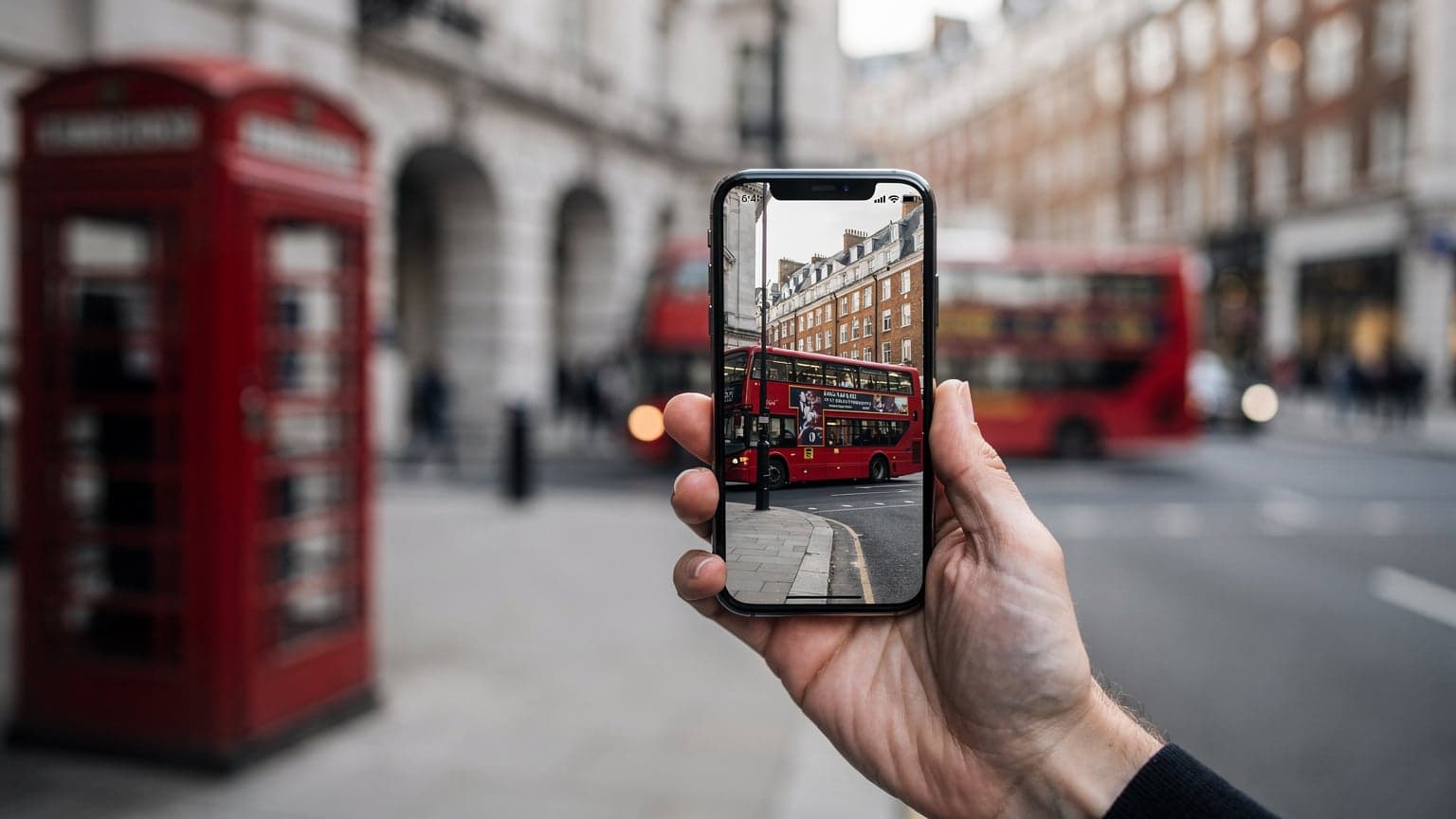
Short answer, and it is not the one you expect from an eSIM company: Three's UK pay-as-you-go packs are outstanding value, and the UK asks visitors for no paperwork at all. No passport, no registration, no counter. You can buy a SIM in a supermarket. That combination makes the UK one of the few destinations where the case for a travel eSIM is genuinely narrow rather than obvious.
It is not zero, though, and the line falls in a specific place: trip length and how many countries you are visiting. This guide covers what Three actually charges, what Go Roam does and does not include, what the Vodafone merger means for a visitor arriving in 2026, and the honest boundary where each option wins.
Three's pay-as-you-go packs: the real numbers
Three publishes its pay-as-you-go pricing openly, which makes this refreshingly easy to check. The auto-renewing data packs at the time of writing:

- £10 — 60 GB per month, includes 6 GB of roaming in 70+ destinations
- £13.50 — 120 GB per month, 12 GB roaming
- £18 — 240 GB per month, 18 GB roaming
- £31.50 — unlimited, 30 GB roaming
One-month packs without auto-renew are slightly different — £10 for 40 GB, £15 for 100 GB, £20 for 200 GB — and run at up to 25 Mbps rather than 50 Mbps. All of them include unlimited UK minutes and texts, and Three sells them as eSIM as well as plastic.
Read those numbers as a traveller and one thing is obvious: 60 GB for about $13 is a lot of data for very little money. By the standards of tourist SIMs anywhere in the world, that is a strong offer. Anyone telling you the UK is expensive for mobile data is working from an outdated impression.
The UK asks visitors for nothing
In most of the destinations we write about, the paperwork is the story. The Philippines deactivates a tourist SIM after 30 days by law. Ghana does the same. South Africa wants proof of address. Kenya wants your passport at an official shop.
The UK has no SIM registration requirement at all. You walk into a Three store, a supermarket, a phone shop or an airport kiosk, hand over money, and leave with a working line. Nobody asks who you are.
That removes the single strongest argument travel eSIMs have elsewhere, and we would rather say so than pretend otherwise. In the UK the decision is about price, convenience and trip shape — not about avoiding a queue with your passport in your hand.
Go Roam: what it actually covers
Go Roam is Three's roaming proposition, and it is genuinely useful if you are travelling onward from the UK rather than into it. It lets you use your UK allowance abroad across three tiers: 49 destinations in Europe, 22 more around the world, and a further 92 in an extended tier, for something over 160 in total.
Three points to note before relying on it:
- Roaming allowance is capped and smaller than your UK allowance. The £10 pack gives 60 GB in the UK but 6 GB abroad. The cap, not the headline, is your travel budget.
- Which tier you get depends on the plan. The lower-priced packs cover Europe; worldwide coverage sits on the higher tiers. Check the specific destination, not the "160 destinations" number.
- Pay-as-you-go does get Go Roam. This is worth saying because it is often assumed to be a contract-only perk. It is not.
For a visitor doing London then Paris then Amsterdam, a Three PAYG pack with 6 GB of EU roaming is a perfectly sound answer. For a visitor doing London for three days and flying home, Go Roam is irrelevant.
The Vodafone merger: what changes for you
Three UK and Vodafone UK have merged, creating the largest UK mobile network by subscriber count. For a traveller arriving in 2026, three things follow.
Coverage should improve, slowly. The combined network has more spectrum and more sites than either company had alone, and the shared 5G rollout is the stated point of the deal. That is a multi-year programme, not something you will notice on a week's holiday.
There is a transition period, and transitions are messy. Overlapping masts are being decommissioned as the networks are integrated. This is normal engineering, but it does mean coverage in any given spot may behave differently from what an older review reported.
Plan branding is in flux. The two operators' propositions are being brought together, and reporting suggests Go Roam's structure is being reworked alongside Vodafone's roaming tiers. Three's own support pages still describe Go Roam as Go Roam at the time of writing. Check the current terms on Three's site before buying rather than trusting any guide, this one included — merger-period pricing moves faster than the pages describing it.
Where each option actually wins
Here is the honest split, and it turns almost entirely on how long you are staying.
Buy a Three PAYG SIM if
- You are staying a week or more. £10 for 60 GB is difficult to beat on any measure.
- You want a UK phone number — for a landlord, a delivery, a local business, a bank verification.
- You use a lot of data: streaming, tethering a laptop, working remotely.
- You are continuing into Europe and can use the Go Roam allowance.
- You are a student or long-stay visitor. This is not really a travel decision at that point; get a local line.
Buy a travel eSIM if
- Your trip is short — a weekend, a few days, a stopover. Paying £10 for 60 GB to use two is not a bargain, it is a rounding error you paid for.
- The UK is one stop among several countries. One regional plan beats a SIM per border.
- You want to land connected. Heathrow to central London is an hour on the Piccadilly line with your maps already working, versus finding a shop first.
- You want to keep your own number live on your primary SIM while data runs on the eSIM.
- You are arriving late at night or at a smaller airport where the kiosk is shut.
For reference on the short end: UK eSIM plans start at $0.95 and Ireland from $1.12, with a Europe regional plan covering 41 countries from $1.35 for trips that cross borders. Every active plan includes a free VPN, which is worth having given how much of a UK trip runs on café, hotel and rail Wi-Fi.
And the trade-off stated plainly, as in every one of these guides: a travel eSIM does not give you a UK phone number. Data only. If you need to receive UK SMS, buy the Three SIM — the UK makes that easy, and this is one country where "just get a local SIM" is genuinely low-friction advice.
Coverage: London is not the test
Every UK network works well in London, Manchester, Birmingham and Edinburgh. 5G is widespread in city centres and the London Underground now has mobile coverage across much of the network, which was not true a few years ago.
The differences show up elsewhere:
- Rural Wales, the Scottish Highlands, the Lake District, Cornwall, the North York Moors. All UK networks thin out, and Three has historically been weaker than EE outside cities. The merger is expected to help this over time; it has not fixed it yet.
- Trains. UK rail connectivity is patchy on almost every network, particularly on long stretches of the West Coast and Great Western lines. Download before you board.
- The islands. Skye, the Hebrides, Orkney, Shetland — expect gaps whatever you buy.
A travel eSIM does not solve this either, and any provider claiming otherwise is selling you something that does not exist. Data connects to the same physical towers whichever profile is on your phone.
How much data will you actually use?
Rough hourly figures for planning:
- Maps and navigation — around 5 MB per hour of active guidance
- Messaging and email — a few MB a day
- Social media — 100–150 MB per hour, more with autoplay
- Video calls — 500 MB to 1 GB per hour
- Streaming — around 1 GB per hour at standard definition, 3 GB or more at HD
A long weekend in London on maps, messaging and searches, with Wi-Fi at the hotel and in most cafés, is comfortably under 1 GB. A fortnight touring the country lands around 3–5 GB. Streaming on trains or working remotely takes you to 20 GB and beyond, and that is exactly the point at which Three's 60 GB for £10 stops being oversized and starts being the obvious purchase.
Three, EE, O2 or Vodafone?
EE has the strongest rural coverage and charges accordingly. Vodafone and Three are now one company, and their combined footprint is the largest by subscriber numbers. O2 sits in the middle on both coverage and price.
Among the low-cost sub-brands, SMARTY runs on Three's network, Voxi on Vodafone's, and Giffgaff on O2's. They are frequently better value than the parent networks for a stay of a month or more, and they are worth knowing about if you are here for a season rather than a holiday.
For a visitor spending their time in cities, the differences between all of these are small. For anyone heading to the Highlands, EE remains the safest choice.
How to install an eSIM, whichever one you choose
- Check your phone is eSIM-capable and carrier-unlocked. A locked handset will accept the profile and then refuse to connect.
- Install over Wi-Fi — at home before you fly, or on airport Wi-Fi. The eSIM cannot install itself without a connection.
- Scan the QR or use one-tap install. iPhone: Settings → Mobile Service → Add eSIM. Android: Network & Internet → SIMs, path varies by manufacturer.
- Label the line "UK data" so you can tell profiles apart.
- Set the data line and turn data roaming off on your home SIM — otherwise your home carrier bills you alongside the plan you just bought.
Failed installs are nearly always one of four things: a carrier-locked phone, no Wi-Fi during install, a single-use QR already used, or a handset variant with eSIM disabled. Our eSIM compatibility checker rules most of that out in seconds.
Frequently asked questions
Do I need to register a SIM card in the UK?
No. The UK has no SIM registration requirement for visitors or residents. You can buy a pay-as-you-go SIM in a shop or supermarket without showing any identification.
Is Three still Three after the Vodafone merger?
The Three brand and its pay-as-you-go packs are still on sale, but the two companies are now one and their propositions are being brought together. Check current terms on Three's own site before buying, because merger-period pricing changes faster than guides can track.
Does Go Roam work on pay as you go?
Yes. Go Roam is available to pay-as-you-go customers, not just contract customers. The roaming allowance is capped well below the UK allowance — typically 6 GB on the £10 pack — so check the cap rather than the headline data figure.
Is a Three SIM cheaper than a travel eSIM in the UK?
For stays of a week or more, almost certainly. £10 for 60 GB is exceptional value per gigabyte. For a weekend or a stopover, a small eSIM plan costs a fraction of that and you are not paying for data you cannot use.
Can I get a Three eSIM as a tourist?
Yes. Three sells its pay-as-you-go packs as eSIM, and since there is no registration requirement there is no document check to complete. The practical difference from a travel eSIM is that a Three plan starts when you buy it, so buying before you fly wastes days of validity.
Will my UK plan work in Europe?
On Three, within the Go Roam allowance, yes — 49 European destinations at the lower tiers. Post-Brexit this is a genuine benefit rather than an assumption; several UK networks reintroduced EU roaming charges, and Three did not on these packs.
Is there signal on the London Underground?
On much of it now, yes. Coverage has been rolled out across a growing share of the network on all major operators, though it is not yet universal across every line and tunnel section.
Can I keep my own number while in the UK?
Yes, on any dual-SIM phone. Keep the home SIM active for calls and bank verification codes and use the eSIM for data. Turn data roaming off on the home SIM so it cannot bill you in the background.
Will my phone work with an eSIM?
Most phones released since 2018: iPhone XS and later, Google Pixel 3 and later, Samsung Galaxy S20 and later, and many mid-range models since. The handset must also be carrier-unlocked.
What about Ireland — same plan?
No. The Republic of Ireland is a separate country and a separate market; a UK plan roams there. Three operates in Ireland as a separate business with its own pricing. If your trip covers both, a plan covering the UK and the EU together avoids buying twice.
Planning the trip? Compare data plans on our UK eSIM page, install in one tap before you fly, and land online. Free VPN included.