What is a SIM Card? The Tiny Brain of Your Phone
You've probably seen a SIM card, maybe even pulled one out or struggled to insert it. But have you ever really stopped to think: what actually is a SIM card? Simply put, a SIM card (that stands for Subscriber Identity Module) is a tiny smart card that securely stores your unique identity on a mobile network.
Think of it as your phone’s digital passport. Without it, your phone is just a fancy mini-computer that can connect to Wi-Fi. But with a SIM card, it becomes a true mobile communication device, ready to make calls, send texts, and access cellular data wherever your network reaches.
So, what does it do? Essentially, your SIM card:
- Identifies you to the network: It holds your unique subscriber identity (IMSI) and a special authentication key that tells your chosen mobile network, "Hey, it's me, let me on!"
- Stores network-specific information: This is how your phone knows how to chat with your carrier's cell towers.
- Enables mobile services: Once the network knows who you are, you can use your phone number for calls, texts, and, crucially, mobile internet.
A Brief History of SIM Card Sizes: From Credit Card to Nano
SIM cards weren't always the tiny chips we carry today. Their history reflects how much our phones have shrunk, constantly getting smaller to make room for all the other cool tech packed inside our devices.
- Standard SIM (2FF): These were as big as a credit card back in the early days of mobile phones. You'd punch out a smaller piece to fit it into the phone itself.
- Mini-SIM (2FF): Some people still call this "standard." It was the first truly removable SIM, smaller than the credit card original but still pretty chunky.
- Micro-SIM (3FF): As phones got thinner, the Micro-SIM arrived. It cut down on plastic but kept the same size contact chip.
- Nano-SIM (4FF): This is the smallest physical SIM card we've seen. The Nano-SIM is basically just the metal contact chip with a tiny plastic border. This is the common size you'll find in most modern smartphones today.
Each time they got smaller, it was because manufacturers wanted more internal space for bigger batteries, better cameras, and more powerful processors in our phones.
Physical SIM vs. eSIM: The Modern Evolution
For decades, the only way to connect to a mobile network was with a physical SIM card. You'd buy a little plastic card, pop it into your phone's SIM tray, and you were all set. But technology keeps moving forward, and mobile connectivity has seen a big step up: the eSIM.
What is a Physical SIM?
A physical SIM is a tangible, removable plastic card that you slide into your phone. If you want to switch carriers or use a local number when you travel, you usually have to swap out this card. That can be a pain, especially if you juggle multiple numbers or travel often.
What is an eSIM?
An eSIM (embedded Subscriber Identity Module) is a digital SIM that's built right into your phone's hardware. Instead of a plastic card, your phone has a small, reprogrammable chip that can download and store multiple SIM profiles. Imagine a digital SIM tray that can hold many different phone numbers and data plans at the same time.
Here's why eSIM is the modern way to go:
- No physical swapping: Activate a new plan or switch carriers with just a few taps on your phone. No more opening a SIM tray or fumbling with tiny cards.
- Multiple profiles: You can store several different eSIM profiles on one device. This is super handy for keeping work and personal numbers separate, or for travelers who use different local plans.
- Enhanced security: An embedded chip is less likely to get lost, stolen, or damaged compared to a tiny, removable plastic card.
- Environmental benefits: It cuts down on the plastic waste that comes from making and distributing millions of physical SIM cards.
- Space-saving: It frees up internal space in phones, giving manufacturers more room to add other cool components.
How Your SIM Stores Your Digital Identity
Your SIM card is essentially a tiny, secure identification chip. It stores crucial information that uniquely identifies you to your mobile network. This includes:
- Your unique subscriber identity (IMSI): This is like your digital passport number. It tells the network who you are and which home network you belong to.
- An authentication key (Ki): This is a secret code that verifies your SIM card is legitimate and allowed to connect to the network, stopping anyone from using your services without permission.
- The ICCID (Integrated Circuit Card Identifier): This is a unique serial number for the SIM card itself.
When you make a call, send a text, or use data, your phone talks to the network using the info on your SIM card. The network checks this information, confirms it's you, and then lets you use its services, connecting your phone number to your device.
Seamless Connectivity for Travelers: Why eSIM is a Game-Changer
For anyone who loves to travel, the question "what is a SIM card" takes on a whole new meaning, and the benefits of eSIMs become incredibly clear. Traditionally, getting mobile data abroad meant:
- Paying huge roaming fees from your home provider.
- Hunting for a local physical SIM card when you arrive, often dealing with language barriers and confusing activation steps.
- Taking out your home SIM, possibly losing it, and maybe missing important calls or texts to your main number.
- Juggling different phone numbers in every country you visit.
This is exactly where a travel eSIM truly shines. With a travel eSIM, you can:
- Buy and activate a data plan before you even leave home: Arrive at your destination already connected.
- Keep your primary number active: Most modern phones support both a physical SIM and an eSIM at the same time. This means you can keep your home SIM active for calls and texts, while using your travel eSIM for affordable data abroad.
- Avoid roaming fees: Travel eSIMs offer local data rates, which are much cheaper than international roaming.
- Switch plans easily: If you're visiting several countries, you can switch between country-specific or regional eSIM plans with just a few taps, all without ever touching a physical card.
- No more plastic: A digital solution means no more fumbling with tiny physical SIM cards or ejector tools.
An eSIM makes international travel connectivity easy and stress-free. It's a smart, efficient, and environmentally friendly way to stay connected no matter where your adventures take you.
Q
Is my phone compatible with an eSIM?
A
Most modern smartphones, especially those released in the last few years, work with eSIMs. Popular models like the iPhone XS and newer, Google Pixel 3 and newer, and many Samsung Galaxy and other Android devices now support eSIM. Check your phone's settings or the manufacturer's website to be sure.
Q
Can I have both a physical SIM and an eSIM in my phone at the same time?
A
Yes, many eSIM-compatible phones offer "Dual SIM" functionality, letting you use both a physical SIM and an eSIM at the same time. This is perfect for keeping your home number active while using an eSIM for data when you travel.
Q
How do I activate an eSIM?
A
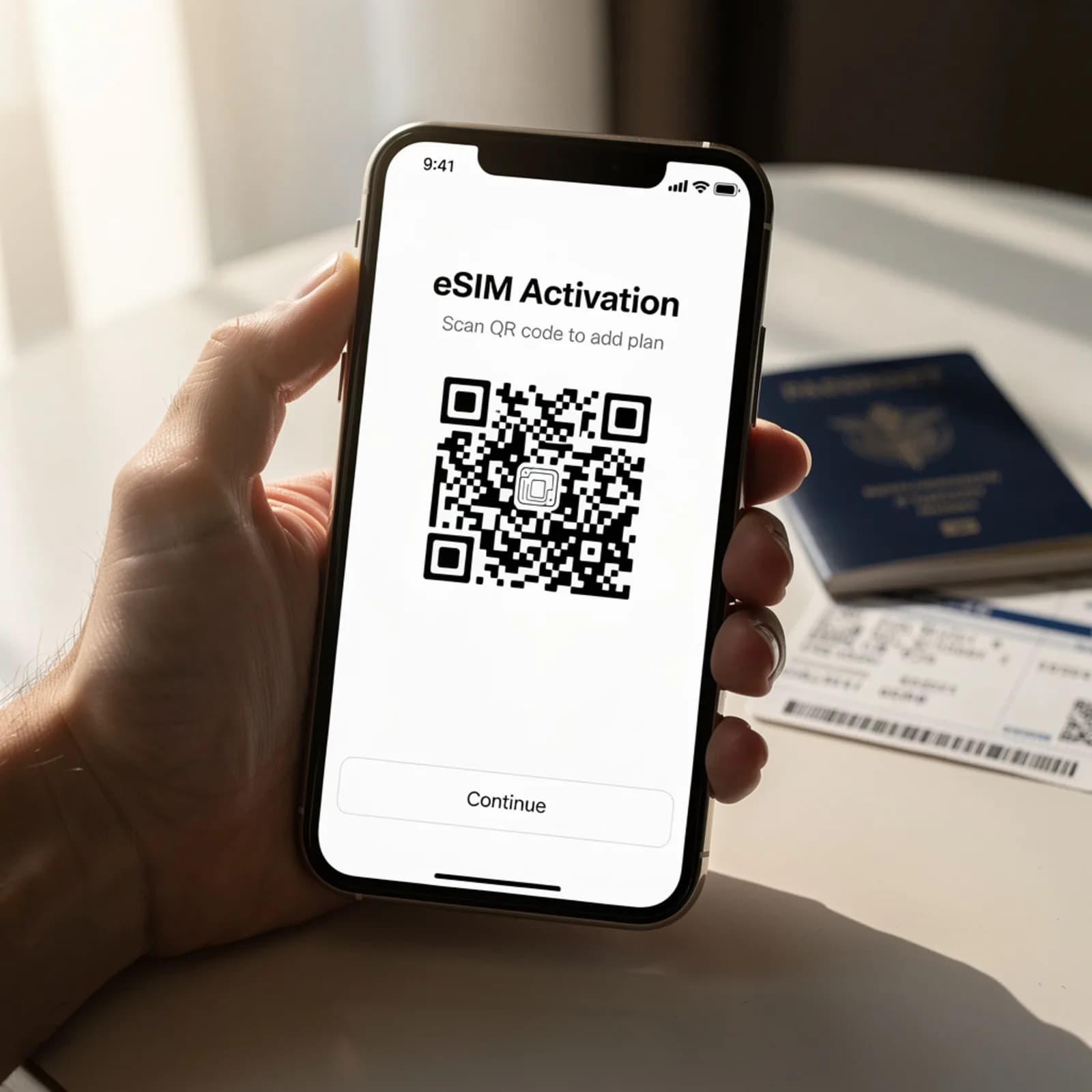
Activating an eSIM usually involves scanning a QR code from your eSIM carrier or manually entering activation details into your phone's settings. The process is typically quick and your device will guide you through it.
Q
Can I switch eSIM providers easily?
A
Absolutely! One of the biggest perks of eSIMs is how flexible they are for switching providers or plans. You can simply delete an old eSIM profile and download a new one from a different provider without needing a new physical card.