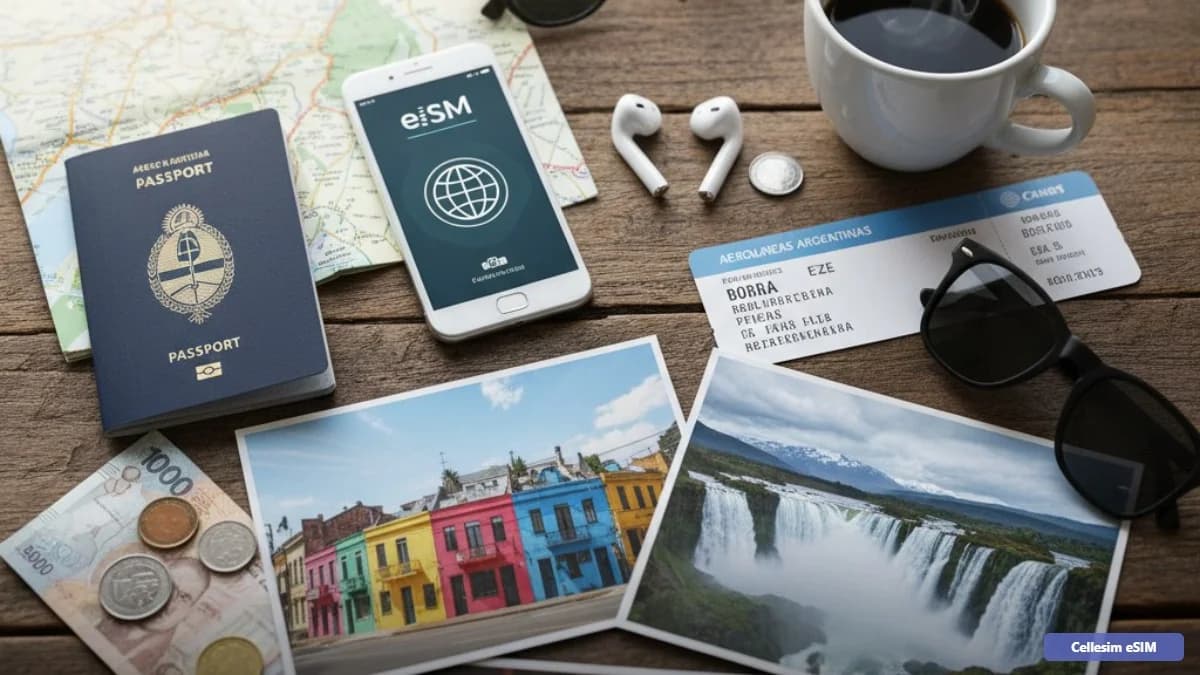
Argentina, a country that immediately conjures images of passionate tango, the towering Andes, and the raw beauty of Patagonia, is calling. Whether you are navigating the lively streets of Buenos Aires, sipping Malbec in Mendoza, or trekking through the stunning landscapes near Ushuaia, staying online is essential. You will need it for directions, keeping in touch, and sharing your amazing trip. In 2026, an eSIM is absolutely the easiest and most affordable way to get reliable mobile data across Argentina.
Forget the hunt for local SIM cards or the shock of huge roaming bills. With Cellesim's Argentina eSIM plans, you can set up your data package before you even board your flight. That means you will be connected the moment you land, and your adventure can start without a hitch.
- Exploring Argentina in 2026: An Overview for Travelers
- Argentina's Connectivity Landscape: Network Coverage & Speed in 2026
- How to Get Your eSIM for Argentina: A Step-by-Step Cellesim Guide
- Top Argentine Destinations: Connectivity Insights for Your Itinerary
- Seamless Arrival: Getting Connected Immediately at Argentina's Airports
- Day Trips & Regional Exploration: eSIM Coverage Beyond the Cities
- Local SIM vs. Roaming vs. Cellesim eSIM: The Smart Choice for Argentina in 2026
- Argentina Travel Budget: Data Costs & Tourist Connectivity Spending in 2026
- Practical Argentina Travel Tips: Payments, Safety & Staying Connected
- Beyond Argentina: Related Destinations & Multi-Country eSIM Options
- Frequently Asked Questions
Exploring Argentina in 2026: An Overview for Travelers
Argentina is the eighth-largest country on Earth, offering an incredible variety of landscapes and cultures. Picture subtropical rainforests around Iguazu Falls in the north, then imagine glacial wonders in Patagonia and the world's southernmost city, Ushuaia. Its sheer geographic scale is astounding. You will find the fertile Pampas plains, the rugged Andes mountains, and the vibrant cosmopolitan heart of Buenos Aires, each providing unique experiences.
Travelers in 2026 are drawn to Argentina for its rich history, the fiery passion of its tango culture, its world-class Malbec wines, and truly spectacular natural wonders. If you love wildlife, the Valdés Peninsula is a must-see. Adventurers will want to conquer Andean peaks, and foodies will savor the country's famous beef and lively culinary scene. Argentina's special charm comes from mixing European elegance with Latin American energy, making it a truly captivating place.
When to visit Argentina really depends on what you want to do. For exploring Patagonia and the Andes, the warmer months from October to April are perfect. You will get pleasant hiking weather and longer daylight hours. Buenos Aires and the Mendoza wine regions are great year-round, though summers (December to February) in the capital can be hot and humid. If you plan to visit northern areas like Iguazu, the shoulder seasons (spring and autumn) offer milder temperatures and fewer crowds. Also, check for local events and festivals, like Buenos Aires' lively Carnival celebrations, as these can affect your travel dates and how much you will need to be connected.
Argentina's Connectivity Landscape: Network Coverage & Speed in 2026
Argentina's mobile network is pretty solid in cities, but coverage can definitely thin out in the country's vast, remote areas. The main local providers are Claro AR, Movistar AR, and Personal. Cellesim eSIMs use these networks, so you get the best possible connection. As of 2026, Argentina mostly runs on 4G LTE, which is fast enough for what most tourists need. While 5G is slowly rolling out in big cities like Buenos Aires and Cordoba, 4G is still what powers most of the country.
Generally, expect download speeds of 10-30 Mbps on 4G networks in cities and towns. That is plenty for clear video calls, smooth navigation, posting to social media, and streaming music or standard-definition video. Inside cities, you will find great signal and consistent speeds. But once you head out to remote parts of Patagonia, the high Andes, or sparsely populated areas of the Pampas, your network might cut out or drop to 3G. Major roads between cities usually have decent coverage, but if you are really going off-grid, it is smart to plan for limited connectivity.
Before you dive into Argentina's huge wilderness, like hiking in Los Glaciares National Park or driving stretches of Ruta 40, download offline maps and any important travel info. Even with a reliable eSIM like Cellesim, which uses the best local networks, truly rural spots can be challenging for connectivity. Always check local advice for specific trekking routes. Also, the Buenos Aires metro, or Subte, might have spotty or no signal underground, so map out your stops before you go down.
How to Get Your eSIM for Argentina: A Step-by-Step Cellesim Guide
Getting an eSIM for your Argentina trip through Cellesim is designed to be super easy and convenient, helping you avoid all the usual headaches of physical SIM cards. An eSIM lets you activate a data plan digitally. No need to swap out your existing SIM or try to explain what you need in a local shop. Here is how to get connected:
- Check Device Compatibility: First, make sure your phone or tablet is eSIM compatible. Most newer models from Apple, Samsung, Google, and others support eSIM. You can quickly check on our website or right in your device settings.
- Visit Cellesim.com: Head over to the Cellesim Argentina eSIM page. You will find various data plans there, made for different trip lengths and data needs.
- Select Your Plan: Pick the data package that fits your travel style best. Cellesim has options from smaller bundles, great for short city trips, to larger ones perfect for long Patagonia treks or business travel. Think about plans with 5GB, 10GB, or even more, based on how much you expect to use.
- Purchase Securely: Complete your purchase using our easy payment methods, like credit/debit cards, PayPal, or Alipay. Cellesim also supports local payment options, and you can see prices in different local currencies for clarity.
- Receive Your eSIM: Within minutes of buying, you will get an email with a QR code. This digital code is your eSIM.
- Install Your eSIM: Scan the QR code with your device's camera or type in the details manually in your phone settings. Our step-by-step installation guide makes it simple for both iPhone and Android users. It is a really good idea to install your eSIM before you travel, ideally when you have a strong internet connection.
- Activate Upon Arrival: Your Cellesim eSIM plan will turn on once it connects to a local network in Argentina. Just make sure your eSIM line is enabled in your phone settings when you arrive. This means you can land, turn on your data, and be online right away.
Stay Connected Across Argentina with Cellesim eSIM
Get instant, reliable data from Ushuaia to Iguazú. Join 50,000+ travelers worldwide.
Buy Argentina eSIMTop Argentine Destinations: Connectivity Insights for Your Itinerary
Argentina is huge, which means mobile coverage can really change depending on where you are. Knowing what to expect for connectivity in key spots helps you manage your digital life while traveling in 2026:
- Buenos Aires: The bustling capital, Buenos Aires, has excellent 4G and growing 5G coverage across all its lively neighborhoods. You will have no problem navigating the city's grid with Google Maps, calling an Uber or Cabify, booking tables at great restaurants, or instantly sharing your tango experiences. Coverage is strong in popular areas like Palermo, Recoleta, San Telmo, and La Boca. Just remember that the underground metro (Subte) lines might have spotty signal, so plan your routes before you go underground.
- Mendoza (Wine Region): Mendoza city and its immediate surroundings, home to countless vineyards, have strong 4G connectivity. This is super important for booking wine tours, finding your way between bodegas, and researching the perfect Malbec. If you head further into the remote Uco Valley or the Andean foothills for outdoor activities, the signal might drop occasionally, but the main tourist areas are well-covered.
- Patagonia (Bariloche, El Calafate, Ushuaia): Connectivity in Patagonia is generally good within the main towns and tourist hubs. Think San Carlos de Bariloche, El Calafate (your jumping-off point for Perito Moreno Glacier), and Ushuaia, the "End of the World." These towns usually have reliable 4G service. However, once you are out on the hiking trails in national parks like Los Glaciares or Tierra del Fuego, or driving on isolated roads, expect coverage to be sparse or non-existent. Always download offline maps and critical info before heading into the wild. An eSIM is crucial for any signal you might pick up, allowing for emergency contact if needed.
- Iguazu Falls: Around Puerto Iguazú and inside the Argentine side of Iguazu National Park, you will find consistent and reliable 4G coverage. This means you can easily upload stunning photos and videos of the majestic waterfalls to social media, look up park information, and stay in touch with your travel companions. Connectivity also extends well to the Brazilian side of the falls.
For other destinations like Cordoba and Salta in the north, the pattern is similar: strong coverage in urban centers, but less reliable as you get into more rural or mountainous areas. Always manage your expectations and be ready for times when you will be offline when exploring Argentina's magnificent, wild landscapes.
Seamless Arrival: Getting Connected Immediately at Argentina's Airports
Those first few minutes after landing in a new country can feel a bit crazy. You need to check your hotel, figure out transport, or just let family know you have landed safely. In Argentina, having immediate connectivity can really cut down on stress, especially if it is your first time in Buenos Aires.
Argentina's main international airports, like Ezeiza International Airport (EZE) and Aeroparque Jorge Newbery (AEP) in Buenos Aires, usually have free public Wi-Fi. While it is nice to have, its reliability and speed can be hit or miss, especially during busy arrival times. It might be okay for a quick WhatsApp message, but it often struggles with loading maps or downloading ride-sharing apps. Not exactly ideal for those critical first-hour tasks.
This is where a Cellesim eSIM really shines. By buying and installing your Argentina eSIM before your flight, you completely skip the usual airport headaches. No long lines at local SIM card kiosks, no potential language barriers with vendors, and no guessing if the airport Wi-Fi will actually work. The moment your plane touches down at EZE, AEP, or other regional airports like Mendoza (MDZ) or Bariloche (BRC), you just enable your eSIM line, and your phone connects to the local network. You can instantly open maps, call a taxi or ride-share, confirm your accommodation, and tell loved ones you are safe. This immediate connection gives you peace of mind and makes your entry into your Argentine adventure smooth and stress-free.
Day Trips & Regional Exploration: eSIM Coverage Beyond the Cities
Argentina offers endless opportunities for day trips and longer excursions away from its major cities. For these adventures, reliable eSIM connectivity is key for navigating, doing research, and staying safe. Here is what to expect for coverage on popular regional trips:
- Cordoba and the Sierras Chicas: Cordoba, a lively university city in central Argentina, boasts excellent 4G coverage. Day trips into the nearby Sierras Chicas mountain range, with charming towns like La Cumbrecita or Villa General Belgrano, also generally keep a strong connection. This is handy for finding hiking trails, discovering local artisan shops, or coordinating with tour groups.
- Salta & Jujuy (Northwest): The stunning landscapes of Argentina's Northwest, including the Quebrada de Humahuaca and the high-altitude salt flats, are becoming more and more popular. Major towns like Salta and Purmamarca have good 4G coverage. However, as you climb into the more remote, picturesque valleys and desert-like terrain, especially near the Bolivian border, coverage can become spotty. It is really smart to download offline maps for this region, even with a Cellesim eSIM getting you onto the best local networks.
- The Atlantic Coast (Mar del Plata, Pinamar): If you are a beach lover heading to Argentina's eastern coastline, cities like Mar del Plata and Pinamar offer robust 4G coverage, especially during the busy summer season (December to February). This means you can stay connected while relaxing on the beach or exploring the coastal towns.
Many travelers combine their trip to Argentina with visits to neighboring South American countries. Cellesim makes this easy with country-specific or regional eSIM options. If your trip includes a quick ferry ride to Uruguay, or a journey overland to explore Chile's side of Patagonia, think about getting individual eSIMs for those places. For bigger multi-country trips, like exploring Brazil, Peru, or Bolivia, Cellesim offers a comprehensive South America eSIM plan. This regional option covers 17 countries, so you can cross borders without constantly changing plans. It truly lets you explore the continent with continuous data.
Local SIM vs. Roaming vs. Cellesim eSIM: The Smart Choice for Argentina in 2026
When you are planning your connectivity for a 2026 trip to Argentina, you basically have three options: buy a local SIM card, rely on international roaming from your home provider, or go with a Cellesim eSIM. Each has its pros and cons, but for most travelers, an eSIM offers the best balance and efficiency.
Local SIM Card (Claro AR, Movistar AR, Personal)
- Pros: Can be budget-friendly if you are staying for a very long time or use a ton of data, and it gives you a local Argentine phone number.
- Cons: You will need to find a seller when you arrive (often at the airport with higher prices, or in city centers). You have to physically take out your home SIM, meaning you might lose access to your primary number for calls or texts. Importantly for Argentina, local SIM cards need formal registration, which can be a slow, bureaucratic process for tourists, often involving showing your passport and waiting. Plus, while local SIM prices are in Argentine Pesos (ARS), the country's unique "Blue Dollar" unofficial exchange rate can make cash purchases tricky. You might end up paying more than advertised if you use official exchange rates or credit cards.
International Roaming (Home Provider)
- Pros: Super convenient; your phone just works automatically when you land, with your existing number.
- Cons: Insanely expensive. Many international day passes from US, UK, or Australian carriers charge $10-15+ USD per day for limited data. That quickly adds up to hundreds of dollars for a typical trip. Beyond daily passes, per-MB rates can lead to a "ghost roaming trap" with shocking bills. Speeds are often slowed down after a small amount of data, leading to really frustratingly slow internet.
Cellesim eSIM
- Pros: Instant digital delivery right to your email. No physical SIM swap needed (your home SIM stays in your phone, allowing dual SIM use). You keep your primary number active for calls and WhatsApp messages while using the eSIM for data. Cellesim offers competitive, clear pricing, and you skip the local SIM registration hassle. Activation is fast and easy, taking just minutes. Cellesim uses the best local networks (Claro AR, Movistar AR, Personal) for optimal 4G/5G speeds and coverage.
- Cons: You need an eSIM-compatible device. It does not give you a local Argentine phone number for calls (though VoIP apps like WhatsApp work perfectly for communication).
Here is a comparison table to help you see the differences:
Argentina Travel Budget: Data Costs & Tourist Connectivity Spending in 2026
When you are putting together your Argentina travel budget for 2026, do not forget about connectivity costs. Good news: with Cellesim, they are surprisingly affordable compared to your other expenses. Figuring out how much data you will need can help you pick the perfect eSIM plan and keep your spending in check.
Let us break down what different data allowances usually get you on a trip:
- 5 GB Data (e.g., ~$5-15 USD for 10-15 days, Cellesim): This is a great starting point for most tourists on a week-long trip. It is enough for daily navigation with Google Maps (about 100 hours), sending thousands of WhatsApp messages, checking social media for a few hours a day (around 20 hours total), and staying on top of emails. You can even sneak in a few short video calls. This plan ensures you are never truly out of touch. For a more exact estimate of your usage, check Cellesim's Smart Data Calculator.
- 10 GB Data (e.g., ~$10-25 USD for 15-30 days, Cellesim): This is perfect for longer trips (2-3 weeks) or if you tend to use more data. You will have plenty for more social media, uploading more photos and videos, more frequent video calls with friends and family, and even occasional music streaming. If you plan to work remotely or stream content regularly, this is a safer bet.
- 20 GB+ Data (e.g., ~$20-40+ USD for 30 days, Cellesim): For digital nomads, content creators, or anyone planning an extended stay in Argentina who relies heavily on the internet for work or entertainment. This package gives you plenty of data for pretty much anything, including often sharing your internet connection with laptops or tablets (eSIM personal hotspot).
Compared to other travel expenses, Cellesim eSIM plans are a small, but incredibly valuable, part of your budget. For instance, a decent dinner for one in Buenos Aires could easily cost ARS 10,000-15,000 (about $10-15 USD, depending on the Blue Dollar rate). That is often comparable to, or even more than, a full week or two of reliable data connectivity from Cellesim. Given how expensive international roaming can be (potentially $70-150+ USD for just a week), getting an eSIM is a smart, budget-friendly choice that makes your whole trip better without costing a fortune.
Practical Argentina Travel Tips: Payments, Safety & Staying Connected
Traveling through Argentina in 2026 is an incredibly rewarding experience, but a few practical tips, especially concerning connectivity, can make your trip even smoother:
- Payment Methods & The Blue Dollar: While credit and debit cards are accepted in many places, cash is king in Argentina, especially when you are using the "Blue Dollar" unofficial exchange rate. This parallel market rate typically gives you significantly more Argentine Pesos (ARS) for US Dollars (USD) cash than the official bank rate. Tourists often bring USD cash and exchange it at "cuevas" (unofficial exchange houses) or with trusted contacts. Having an eSIM is vital here: it lets you quickly check the current Blue Dollar rate online before you exchange money and access your banking apps if you do use cards. Mercado Pago is a very popular local digital payment app, but it usually needs an Argentine bank account, so it is not a primary option for tourists.
- Safety First: Argentina is generally safe, but like any major travel spot, pickpocketing and petty theft can happen, particularly in busy tourist areas like La Boca, San Telmo market, or crowded public transport hubs in Buenos Aires. Always be aware of your surroundings and keep your phone secure. With an active Cellesim eSIM, you can quickly contact local emergency services (dial 911) or your embassy if needed, which is an essential safety net.
- Transportation Navigation: Getting around Argentina's cities and regions is much simpler with mobile data. In Buenos Aires, ride-sharing apps like Uber and Cabify are widely used, and you will need data to request rides. For public transport (Subte, colectivos), apps like Moovit or "BA Cómo Llego" are incredibly useful for real-time routes and schedules. An eSIM ensures these apps work perfectly, helping you get where you need to go efficiently.
- Power Plugs: Argentina uses Type C (two round pins, common in Europe) and Type I (three flat pins, similar to Australia/New Zealand) power outlets. Bring a universal travel adapter to keep all your devices, especially your eSIM-enabled smartphone, charged and ready.
- WhatsApp is Key: In Argentina, WhatsApp is the main messaging app for personal communication, coordinating with tour guides, and even some businesses. Your Cellesim eSIM lets you keep using WhatsApp with your original phone number, meaning uninterrupted communication. This is a big advantage over switching to a local SIM, which might make you re-register WhatsApp with a new number.
- Offline Maps Strategy: While your eSIM provides great connectivity, especially in cities, Argentina's huge natural parks and remote areas in Patagonia might still have limited or no signal. Always download offline maps (like Google Maps, Maps.me) for these areas before you head out. This way, you can navigate safely even without an active data connection.
Beyond Argentina: Related Destinations & Multi-Country eSIM Options
Argentina often forms the base for a bigger South American adventure. Its location makes it a natural starting point to explore various neighboring countries. Planning how to stay connected across multiple destinations is crucial for a smooth journey.
If your Argentine trip includes nearby nations, Cellesim has specific eSIM solutions for each:
- Chile: Sharing the magnificent Andes mountains, Chile is a common next stop. Many travelers combine a Patagonian adventure in Argentina with exploring Chile's stunning landscapes, from the Atacama Desert to its own Patagonian fjords.
- Brazil: Just a short hop from Iguazu Falls, Brazil is an obvious choice if you want to experience the vibrant culture of Rio de Janeiro or the Amazon rainforest. A dedicated Brazil eSIM ensures you are connected the moment you cross the border.
- Uruguay: A quick ferry ride across the Rio de la Plata from Buenos Aires brings you to Uruguay, famous for its charming colonial towns like Colonia del Sacramento and its sophisticated capital, Montevideo. A Uruguay eSIM is perfect for a short, connected visit.
- Peru: For those heading further north to explore ancient Incan ruins and the vibrant culture of Cusco and Machu Picchu, a Peru eSIM would be essential.
- Bolivia and Paraguay: Less commonly combined but offering unique experiences, Cellesim also provides eSIM coverage for Bolivia and Paraguay, perfect for more adventurous travelers.
For the ultimate flexibility and convenience across South America, Cellesim offers a comprehensive South America eSIM plan. This regional eSIM covers 17 countries, letting you travel from the very south of Argentina all the way to Colombia without needing to buy a new data plan every time you cross a border. This multi-country option makes managing your connectivity simple, giving you continuous data so you can focus on your journey rather than worrying about your phone plan.
Explore the World with Seamless Cellesim Connectivity
From Buenos Aires to over 200+ countries, Cellesim keeps you connected with flexible, affordable eSIM plans.
Explore All eSIM PlansTrusted by 50,000+ travelers globally.
Frequently Asked Questions
Which eSIM is best for Argentina?
Cellesim offers some of the best eSIM plans for Argentina in 2026. We have competitive pricing, reliable 4G/5G connectivity because we partner with top local carriers like Claro AR and Movistar AR, and instant digital delivery. Our plans are flexible, designed to meet different data needs and trip lengths, making us a top choice for easy connectivity.
How to buy eSIM in Argentina?
The easiest way to get an eSIM for Argentina is online, before you even leave. Just go to cellesim.com/en/esim-argentina, pick a data plan, buy it securely, and you will get a QR code via email in minutes. Then, you install the eSIM on your compatible device, and it will automatically activate when you arrive in Argentina.
Do I need an eSIM for Argentina?
While it is not absolutely required, an eSIM is highly recommended for traveling to Argentina in 2026. It gives you instant, affordable data without having to buy a physical local SIM card or pay expensive international roaming fees. An eSIM keeps you connected for navigation, communication, and emergencies from the moment you land, making your whole travel experience much better.
How do Americans use cell phones in Argentina?
Americans can use their cell phones in Argentina in a few ways: either by turning on international roaming through their home carrier (which is usually very expensive), buying a local physical SIM card after arriving (which requires registration and might involve language barriers), or, most conveniently, by using an eSIM. A Cellesim eSIM lets American travelers keep their US number active for calls/texts while using the eSIM for affordable data, making it the most practical choice.
Does Claro AR offer eSIM for tourists?
Yes, local Argentine carriers like Claro AR have started to offer eSIM services. However, getting a local eSIM as a tourist usually means going to a store, going through lengthy registration processes with your passport, and potentially dealing with language barriers. Cellesim simplifies this by giving you a prepaid eSIM digitally, and it still uses Claro AR and other local networks without all the local purchase hurdles.
Can I use WhatsApp with an eSIM in Argentina?
Absolutely. One of the biggest perks of using an eSIM like Cellesim in Argentina is that you can keep your main physical SIM card active in your phone at the same time (if your device has dual SIM support). This means your WhatsApp account, which is linked to your original phone number, will continue to work perfectly using the eSIM's data connection. You will not have to re-register WhatsApp or tell your contacts about a new number.
See also: how to set up an eSIM
See also: Colombia eSIM
See also: Uruguay eSIM
See also: Brazil eSIM
See also: Peru eSIM