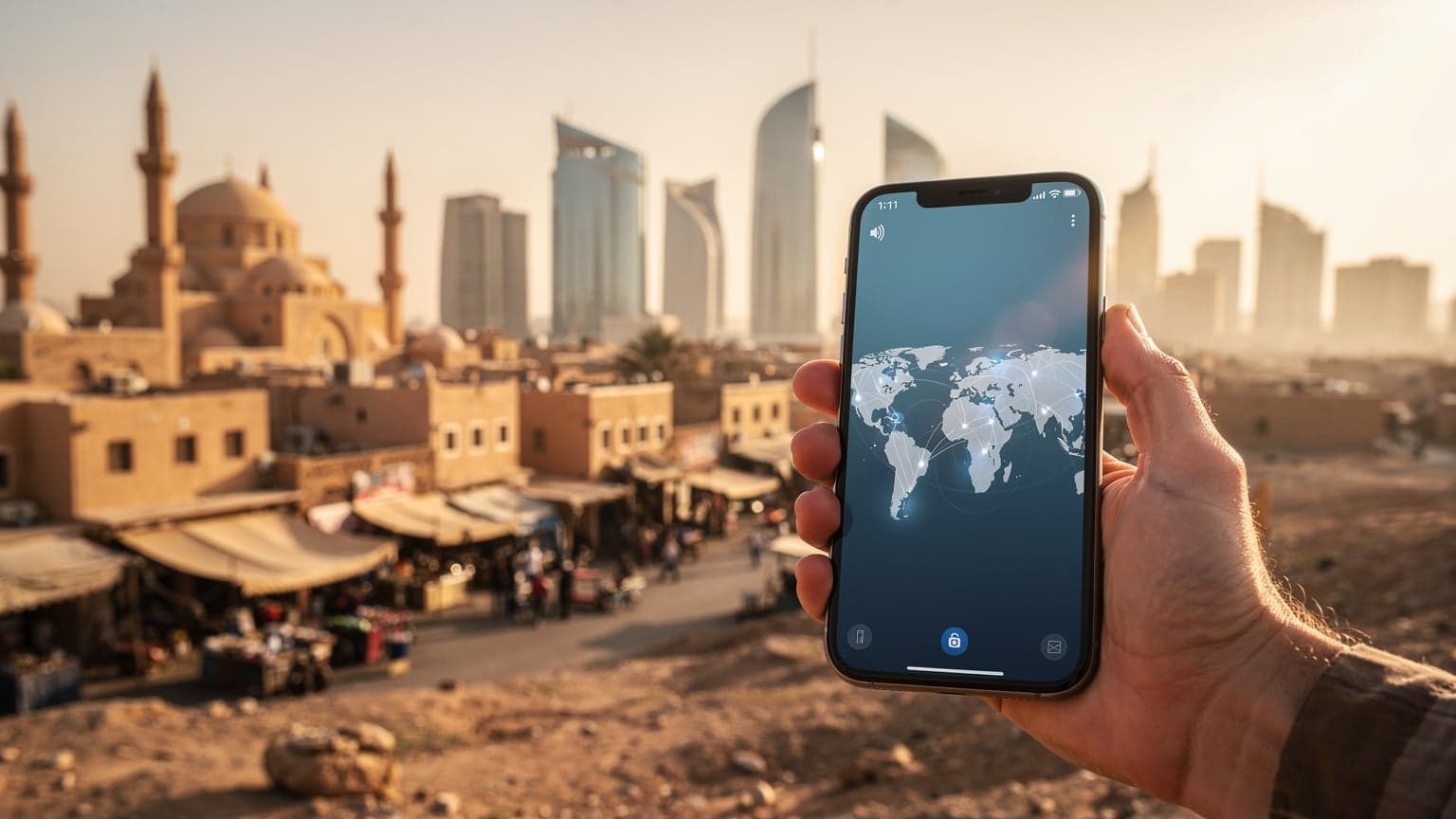
Why a Multi-Country eSIM is Your Best Bet for the Middle East
Traveling the Middle East is an experience unlike any other. One minute you're wading through the sprawling Grand Bazaar in İstanbul's Fatih district, the next you're soaring over the Hajar Mountains en route to Muscat. The sheer diversity of landscapes, cultures, and even time zones means your phone's connection needs to be just as adaptable. This is exactly why a multi-country eSIM makes so much sense.
I've been on the road for more than 15 years, and I've certainly had my share of mobile data headaches. There was that time in Cairo's Zamalek neighborhood, trying to buy a local SIM at a Vodacom store that was supposed to open at 9 AM but actually opened closer to 11 AM, all while my taxi meter was running. Or the frantic rush at Dubai International Airport (DXB) to find a Du kiosk before my connecting flight to Riyadh. Those moments, believe me, really chip away at the joy of travel. With an iPhone 15 eSIM Guide: Your Concierge Checklist for Seamless Global Data, you can avoid these frustrations entirely.
A multi-country eSIM for the Middle East means you buy one plan, activate it before you even board your flight, and then land with instant access to the internet. No hunting for local SIMs, no wrestling with tiny trays, and most importantly, no language barriers when all you're trying to do is get online. It's about saving your precious travel time for what really matters, whether that's haggling for spices in Souq Waqif or coordinating a business meeting in Abu Dhabi's financial district.
The Convenience Factor: Seamless Transitions
Imagine this: you've just landed at King Khalid International Airport (RUH) in Riyadh, cleared immigration, and before you even hail a taxi through the Careem app, your phone is already connected. That's the power of an eSIM. When your itinerary includes bouncing between, say, Amman, Jordan, and then on to Beirut, Lebanon, a multi-country plan automatically switches you to the best available network in each new territory. No more fumbling for a new SIM card when you cross borders, a scenario I often faced back in my Lonely Planet days.
Cost-Effectiveness for Extended Trips
While a local SIM might seem cheaper initially for a single country, the costs quickly add up when you're buying a new one in every new destination. Plus, many local plans have hidden fees or limited international roaming. Multi-country eSIMs often give you better per-gigabyte rates for extensive regional coverage. For instance, if you're like me and often find yourself working remotely, say, from a café in Jumeirah Beach Residence, a solid data plan across multiple Gulf states is far more economical than piecing together individual country plans. I once saved a significant amount on data while working from Bangkok Remote Work: How I Saved 280 EUR on eSIM Data for a Month in 2026, and the same principle holds true everywhere.
Mapping Your Middle East Adventure: Key Destinations and Data Needs
The Middle East is vast and varied, from the ancient wonders of Luxor to the futuristic skyline of Doha. Your data needs will naturally change based on where you're headed and what you're doing. A business traveler flying into Jeddah for a conference will have different requirements than a backpacker exploring Petra.
The UAE and Gulf States: High Data Demands
Cities like Dubai, Abu Dhabi, and Doha are bustling hubs of modern commerce and tourism. Here, 5G is everywhere, and you'll rely heavily on data for navigation (Google Maps is essential, but local apps like RTA Dubai for transit are also key), ride-sharing (Careem, Uber), and staying connected for work. If you're planning on streaming a live concert from a stadium in Abu Dhabi, you'll need ample bandwidth, as I've learned from my own experiences covering events. The networks here, like Etisalat and Du, are generally excellent, but a robust eSIM plan ensures you're not caught off guard.
Egypt, Jordan, and Lebanon: Balancing Connectivity and Exploration
In countries like Egypt, Jordan, and Lebanon, connectivity might be a bit more variable, especially outside major urban centers like Downtown Cairo or Amman's Rainbow Street. While 4G is generally available, 5G might be less common. Here, data is crucial for booking tours, translating phrases, and staying in touch with family. If you're venturing into the desert or exploring remote archaeological sites, having a plan that covers multiple networks can be a lifesaver. My last trip to Petra had me thankful for a multi-carrier option when one network dropped out completely.
Saudi Arabia: Pilgrimage and Tourism
With the increasing focus on tourism and the ongoing importance of pilgrimage (Hajj and Umrah), Saudi Arabia's connectivity is rapidly improving. In cities like Mecca and Medina, especially during peak seasons, network congestion can be a real issue. A reliable eSIM is paramount for pilgrims needing to stay in touch with loved ones or access religious apps. For more on this, consider reading eSIM for Umrah 2026: Stay Connected in Saudi Arabia Affordably. For tourists exploring Al-Balad in Jeddah, data will be essential for navigating the ancient streets and finding local eateries.
Choosing the Right eSIM Plan: Data, Validity, and Coverage
Picking an eSIM isn't just about grabbing the cheapest option. It's about finding the right balance for your specific travel style and needs. A business trip might demand more data and a shorter validity, while a leisurely backpacking journey might prioritize less data over a longer period.
Data Allowance: How Much Do You Really Need?
This is often the trickiest part. For light users who primarily check emails and use messaging apps, 5-10 GB for a two-week trip might be enough. If you're navigating constantly, streaming video, or on video calls, you'll want at least 20-30 GB. Content creators, like myself, often need upwards of 50 GB, especially if I'm uploading raw footage or live streaming from events. Always think about your typical usage habits at home, then add a buffer for unforeseen circumstances (like suddenly needing to download a large map file when you're lost in Marrakech's medina).
Validity: Matching Your Itinerary
eSIM plans typically come with validity periods ranging from 7 days to 30 days, or even longer for extended stays. If you're doing a quick two-country hop, a 15-day plan might be perfect. For a month-long exploration of the Levant, a 30-day plan makes more sense. Always make sure your plan's validity covers your entire trip, plus an extra day or two, just in case of unexpected delays.
Coverage Across Multiple Countries
This is the main benefit of a multi-country eSIM for the Middle East. Look for plans that explicitly list all the countries you intend to visit. Cellesim, for instance, often partners with major regional carriers like STC, Mobily, Etisalat, and Orange to ensure broad coverage. Don't just assume 'Middle East' means every single country; always check the fine print for the specific inclusions.
| Region | Key Countries Covered | Typical Data Needs (per 2 weeks) | Primary Local Carriers (Examples) |
|---|---|---|---|
| Gulf States | UAE, Saudi Arabia, Qatar, Bahrain, Kuwait | 20-50 GB (high usage for streaming, business) | Etisalat, Du, STC, Mobily, Ooredoo |
| Levant | Jordan, Lebanon, Israel, Palestine | 10-25 GB (moderate usage for navigation, social) | Orange, Zain, Jawwal, Cellcom |
| North Africa (Middle East Adjacent) | Egypt, Morocco | 15-30 GB (moderate to high, depending on city/rural) | Vodafone EG, Etisalat Misr, Maroc Telecom, Orange MA |
Activating Your eSIM Like a Pro: A Step-by-Step Guide
One of the best things about an eSIM is how easy it is to activate. No more struggling with SIM ejector tools or visiting local shops. You can do it all from your couch before you even pack your suitcase.
- Purchase Your eSIM Plan: Head to the Cellesim website and select a multi-country Middle East plan that fits your data and validity needs.
- Receive Your QR Code/Manual Details: After purchase, you'll typically get an email with a QR code or manual activation details. Keep this email handy, or better yet, print it out or save it to another device. I learned this the hard way when my phone battery died at a crucial moment.
- Scan the QR Code: On your compatible device (make sure your phone supports eSIM, most modern iPhones and Androids do), go to your Settings > Cellular/Mobile Data > Add eSIM/Add Data Plan. Use your phone's camera to scan the provided QR code.
- Follow On-Screen Prompts: Your phone will guide you through the rest of the steps, like labeling your new eSIM (e.g., "Middle East Travel") and setting it as your primary line for data while abroad. Remember to set your physical SIM for calls/texts if you want to receive them from your home number.
- Enable Data Roaming for eSIM: This is crucial. Once installed, make sure data roaming is enabled for your new eSIM line in your phone's settings. This allows it to connect to partner networks in the Middle East. Don't worry, with a Cellesim plan, this won't lead to unexpected charges.
- Switch Data to eSIM Upon Arrival: Once you land in your first Middle Eastern country, switch your cellular data preference to your new eSIM. Your phone should then connect to the local network automatically.
Real-World Connectivity Challenges and How to Overcome Them
Even with the best eSIM, travel isn't always smooth sailing. I've navigated my share of dead zones and crowded networks. Here's what to watch out for and how to handle it.
Network Congestion During Peak Times
Just like at Coachella, where tens of thousands try to livestream at once, major tourist attractions or large public gatherings in the Middle East can strain local networks. Think the Corniche in Doha during a national holiday, or the bustling souks of Old Cairo on a Friday afternoon. Your eSIM connects to the local infrastructure, so if that infrastructure is overloaded, even the best plan can struggle. One trick I've found, especially useful when navigating the Riyadh Metro, is to download offline maps and content beforehand. Also, consider using a Why We Bundled a Free VPN Into Every Cellesim eSIM, which can sometimes help stabilize your connection.
Rural and Remote Area Limitations
While major cities boast excellent coverage, venture into rural areas, say, the Wadi Rum desert in Jordan or the vast Empty Quarter in Saudi Arabia, and you might find spots with limited or no signal. This isn't an eSIM flaw; it's a limitation of the local network infrastructure. Always manage your expectations and inform your travel companions or family if you're heading off-grid. A satellite messenger device might be overkill for most, but for truly remote expeditions, it's worth considering.
Device Compatibility Checks
Before you even think about buying an eSIM, double-check your device's compatibility. Most newer smartphones, especially those released in the last few years, support eSIMs, but it's not universal. Apple iPhones from the XS onward, and many Samsung Galaxy, Google Pixel, and Huawei models are compatible. A quick search for "[Your Phone Model] eSIM compatibility" will give you the answer. Nothing's worse than buying a plan only to find your phone can't use it, a painful lesson I learned with an older model back when eSIMs were just emerging.
eSIM Versus Physical SIM: Making the Smart Choice
The debate between eSIMs and traditional physical SIMs continues, but for multi-country travel in a region as dynamic as the Middle East, the eSIM usually wins.
The Physical SIM Hassle
I remember landing in Dubai, heading straight to the arrivals hall, and spending a good 30 minutes trying to buy a SIM card. Then another 15 minutes trying to activate it, which usually involved me fumbling with my passport and a registration form in a language I barely understood. This process repeats in every country. Plus, you have to keep track of your tiny home SIM card, hoping you don't lose it in your bag. This is a common pain point, and one reason why the convenience of eSIMs has been a game-changer for frequent travelers.
The eSIM Advantage
With an eSIM, it's all digital. You download and activate your plan remotely. No physical card means no risk of losing it, no fumbling with tiny parts, and no waiting in lines. You can even store multiple eSIM profiles on your phone, allowing you to switch between plans for different regions or purposes with a few taps. For someone like me who might be in Dubai one week and then flying to Cairo the next, the ability to pre-load and activate regional data plans saves hours of precious time and reduces travel stress considerably.
| Feature | eSIM (Multi-Country) | Physical Local SIM (Single Country) | International Roaming (Home Provider) |
|---|---|---|---|
| Activation Process | Digital, instant, via QR code/app before travel | Manual, in-person purchase, registration (often with passport) | Automatic, no activation needed |
| Flexibility | Seamless switching between countries, multiple plans stored | Country-specific, requires new SIM for each country | Covers multiple countries, but often expensive |
| Cost | Cost-effective for multi-country trips, transparent pricing | Potentially cheaper for single-country, long stays; costs add up per country | Very expensive, often with low data caps |
| Convenience | High, no physical handling, instant connectivity upon arrival | Low, requires physical purchase and installation | Moderate, but bill shock risk is high |
Maximizing Your eSIM Experience: Tips from a Road Warrior
After years of traversing continents, I've picked up a few tricks to get the most out of your travel connectivity. An eSIM is a powerful tool, but a little preparation goes a long way.
Before You Go: Pre-Trip Checklist
- Verify eSIM Compatibility: As mentioned, this is step one. Don't assume your older phone supports it.
- Download Essential Apps Offline: Google Maps allows you to download entire city or region maps for offline use. Do this for every major city on your itinerary, from Downtown Dubai to the Corniche in Abu Dhabi. This is a lifesaver when you hit a patch of no signal, or if you're trying to save data.
- Set Up Wi-Fi Calling: If your home carrier supports it, enable Wi-Fi calling on your primary SIM. This allows you to make and receive calls on your home number over Wi-Fi, without using your eSIM data or incurring roaming charges.
- Check Network Frequencies: While Cellesim handles most of this, if you're a tech-head, understanding the local carrier bands (e.g., 4G LTE bands B3, B7, B20 are common in the Middle East) can help you troubleshoot rare issues.
On the Ground: Smart Data Usage
Once you're actually in the Middle East, smart data management becomes key. You don't want to burn through your allowance on day two.
- Prioritize Wi-Fi: Whenever reliable Wi-Fi is available, use it. Most hotels, cafes, and even transit hubs (like Dubai Metro stations) offer free Wi-Fi. It's a great way to save your eSIM data for when you truly need it, like navigating a bustling souk or calling an Uber.
- Monitor Data Usage: Regularly check your data usage through your phone's settings or the Cellesim app. This helps you stay within your limit and avoid unexpected top-ups.
- Disable Background App Refresh: Many apps consume data even when you're not actively using them. Go into your phone's settings and disable background refresh for non-essential apps to conserve data.
- Use Data Saver Modes: Most smartphones have a data saver mode that restricts background data usage and reduces data consumption by apps. Activate it when you're trying to stretch your data.
The Future of Middle East Connectivity: What's Next for eSIMs
The Middle East is a region quickly adopting new technology, and mobile connectivity is no different. eSIM technology is set to become even more integrated into travel experiences, especially as more countries invest in digital infrastructure.
5G Expansion and Enhanced Speed
Expect to see 5G networks continue to roll out across more cities and even some regional routes. This means faster downloads, smoother streaming, and more reliable connections, which will be a huge plus for business travelers and digital nomads alike. As 5G becomes the norm, eSIMs will easily tap into these high-speed networks, offering an even more robust experience than today.
More Integrated Travel Experiences
In the coming years, I foresee eSIMs being bundled with other travel services, creating an even smoother experience. Imagine booking your flight, hotel, and an eSIM for your destination all in one go, with the eSIM profile automatically delivered to your device. The goal is to remove every single point of friction, letting you focus purely on the journey. This aligns perfectly with the Cellesim vision of making global connectivity invisible and effortless, much like how transit apps like the RTA in Dubai already simplify urban navigation.
Sustainability and Digitalization
Beyond convenience, eSIMs contribute to a more sustainable travel ecosystem by doing away with the need for plastic SIM cards and their packaging. As the world moves towards greater digitalization, eSIMs are a natural fit, reducing waste and simplifying logistics for both travelers and network providers. It's a win-win, really, and a step towards a greener, more efficient way to stay connected globally.
Frequently Asked Questions
Which Middle Eastern countries are typically covered by multi-country eSIM plans?
Multi-country eSIM plans for the Middle East commonly cover major destinations like the UAE (Dubai, Abu Dhabi), Saudi Arabia (Riyadh, Jeddah), Qatar (Doha), Jordan (Amman), Egypt (Cairo), and sometimes Bahrain and Kuwait. Always check the specific plan details as coverage can vary by provider.
Can I make regular phone calls and send SMS with a Middle East eSIM?
Most data-only eSIMs do not include a local phone number for traditional calls or SMS. However, you can use VoIP apps like WhatsApp, FaceTime, or Skype over your eSIM data connection to make calls and send messages. Some premium eSIM plans might offer limited local call minutes, but this is less common for multi-country packages.
What kind of device do I need for an eSIM in the Middle East?
You need an eSIM-compatible smartphone, tablet, or smartwatch. Generally, iPhones XR and newer, most Samsung Galaxy S20 series and newer, Google Pixel 3 and newer, and various other Android flagships support eSIM. Always verify your specific device model's compatibility before purchasing an eSIM plan.
Is data speed good with an eSIM in the Middle East?
Data speeds with an eSIM in the Middle East are generally excellent, mirroring the speeds of local networks (3G, 4G LTE, and increasingly 5G) that the eSIM connects to. Performance can vary by specific location, network congestion, and the local carrier's infrastructure, but major cities typically offer very fast connections.
What if my eSIM doesn't connect after activation in a Middle Eastern country?
First, ensure data roaming is enabled for your eSIM line in your phone's settings. If it still doesn't connect, try manually selecting a network operator from your phone's cellular settings (e.g., Etisalat or STC). If issues persist, restart your device or contact your eSIM provider's customer support, as they can often troubleshoot remotely.
Can I top up my multi-country eSIM plan if I run out of data?
Yes, most multi-country eSIM providers, including Cellesim, offer convenient top-up options directly through their website or app. You can usually add more data or extend the validity period of your existing plan, ensuring continuous connectivity without needing to purchase a new eSIM.