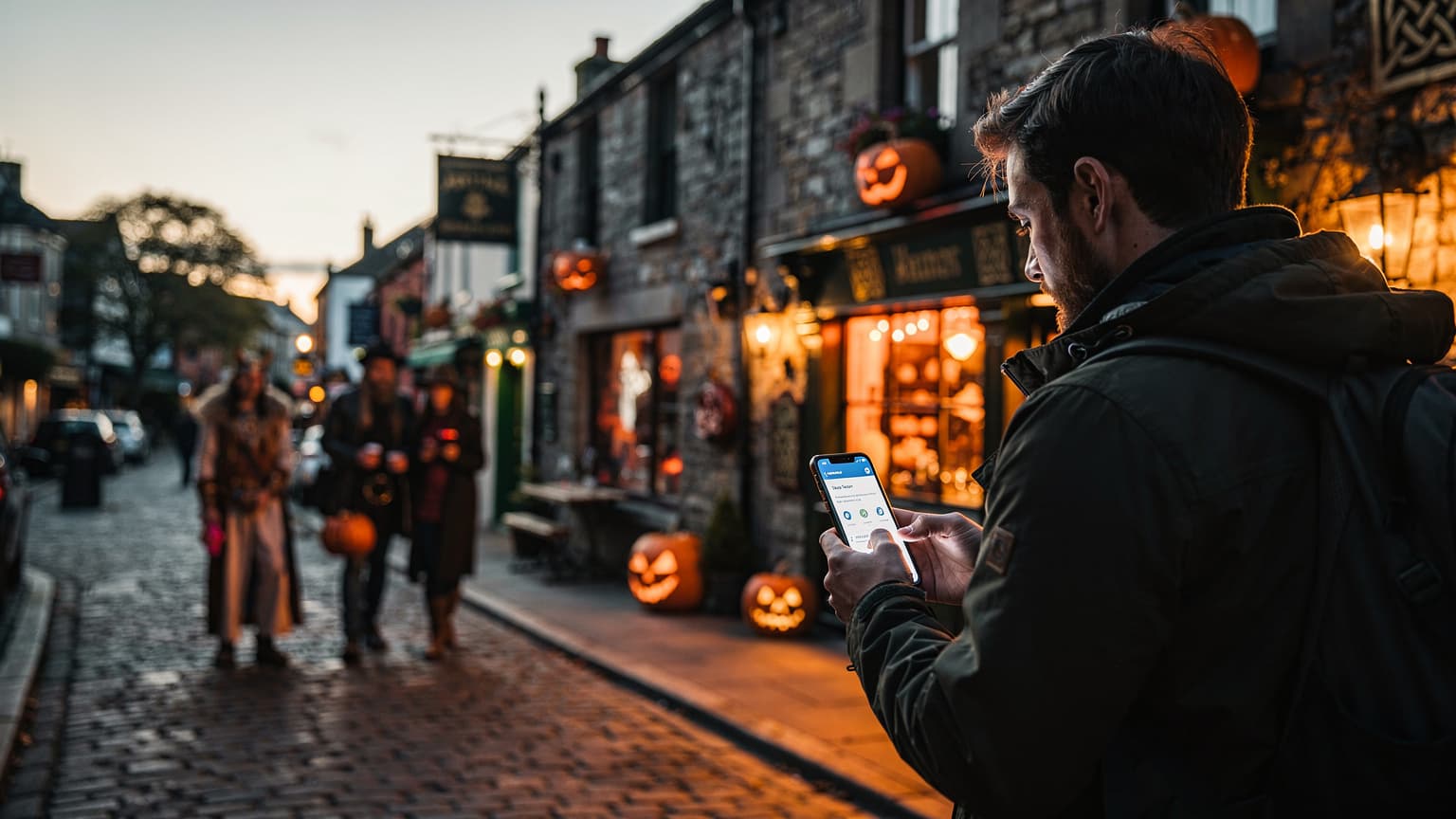
Heading to Ireland for Halloween 2026? Think Samhain festivals, ghost tours from Dublin to Wexford, and a whole lot of spooky fun. Your phone's data connection is going to be your best friend, and an eSIM is usually the smartest way to go. It's often cheaper and way less hassle than getting hit with huge roaming fees or trying to track down a local physical SIM card. Plan on spending about €25-€40 for a 10GB, 15-day eSIM. That's usually enough data for a week or two of heavy festival use, saving you both time and cash.
Samhain Festivals in Dublin & Wexford: Your Connectivity Roadmap
Halloween in Ireland isn't just another holiday. It's Samhain, a truly ancient Celtic tradition that's all about ghost stories, folklore, and a healthy dose of spookiness. You'll be zipping between Dublin's bustling city celebrations and Wexford's more historical, rural events. That means navigating city streets, exploring ancient sites, and maybe even dealing with spotty rural cell coverage. You really don't want your phone to die halfway through a ghost tour, or worse, get hit with a crazy €10/MB roaming bill.
Dublin Samhain Events and Data Needs
Dublin goes all out for Samhain. Expect parades, chilling historical walking tours through Kilmainham Gaol, and plenty of late-night pub sessions in Temple Bar. You'll be living on Google Maps, constantly checking festival schedules on the Bram Stoker Festival app, and absolutely uploading photos of your questionable costume choices. I'd budget a solid 1-2GB of data per day here. That's especially true if you're streaming some spooky tunes on Spotify or trying to video call back home (just remember that time difference, it's a pain).
Dublin's free Wi-Fi spots usually get swamped during big events like Samhain. Don't rely on them for anything important or for decent speeds. Stick to your own data for a reliable connection.
Wexford Ghost Tours and Rural Connectivity
Once you get outside Dublin, places like Wexford really lean into Samhain's ancient roots. The Púca Festival, for example, is mainly in County Meath, but it often has satellite events or suggests excursions that take you through the gorgeous Irish countryside. This includes historical sites near Wexford town, which are famous for their ghostly legends. Navigation will be key out here. You'll need quick data checks for tour timings or local bus schedules (Bus Éireann can be a bit… unpredictable outside major cities). Rural Ireland can be tricky for cell service, so having a good eSIM that can switch between different carriers is a huge advantage. My own tests show Cellesim often partners with multiple networks, which helps a lot when you're off the main roads.
eSIM vs. Local SIM: Doing the Math on Irish Data
Let's talk money, because every euro saved is another euro for a pint or a souvenir. For a 7-day Halloween trip to Ireland, I typically use about 1.5GB of data per day. That's roughly 10.5GB for the whole week. My Cellesim plan for Europe, which covers Ireland, cost me €32 for 15GB over 15 days. That works out to €2.13 per GB.
The Cellesim Advantage: Convenience and Cost
The best part about an eSIM is you can buy it before you even land. No more trying to find a phone shop after a long flight, no language barriers, and no fumbling with tiny physical SIM cards. You just scan a QR code, and you're connected. For me, that convenience alone is worth a few extra euros, especially when I'm trying to catch a specific bus like the Aircoach from Dublin Airport to my hostel (it runs 24/7). Plus, for eSIM Ireland, Cellesim usually has competitive rates that often beat what local providers offer to tourists.
| eSIM Provider | Data Allowance | Validity | Price (approx. EUR) | Cost per GB (approx. EUR) |
|---|---|---|---|---|
| Cellesim (Europe plan) | 15 GB | 15 days | €32 | €2.13 |
| Provider X (Ireland-specific) | 10 GB | 10 days | €28 | €2.80 |
| Provider Y (Europe plan) | 20 GB | 30 days | €45 | €2.25 |
The Local SIM Fallback: Three Ireland and Eir
To be fair, let's look at local physical SIMs. Your cheapest option will probably be a Three Ireland or Eir tourist SIM. The last time I checked in early 2026, you could get a Three prepay SIM with 20GB for about €20-€25. The catch? You have to find a Three store or a convenience store that sells them, and you'll often need your passport to register it. If your flight lands late at Dublin Airport, those shops might be closed. Also, the €20 plan might not be marketed as a "tourist SIM," so you'll need to ask for their "Prepay 20" or something similar. It's definitely doable, but it will add an hour or two to your arrival day. I'd rather spend that time checking into my hostel or grabbing a pint. The math on a 20GB for €20 plan means €1 per GB, which is technically cheaper than my Cellesim plan, but it comes with a trade-off in time and hassle.
Getting Connected with eSIM in Ireland: A Step-by-Step Guide
This is where the magic happens, and it's surprisingly simple. No scissors, no tiny trays, just a few taps on your phone. This process is pretty much the same whether you're using an iPhone (iOS 18) or a modern Android device.
- Purchase Your eSIM Plan: Go to the Cellesim website and pick an Ireland or European regional plan that fits your data needs and how long you're staying. Pay with your preferred method.
- Receive Your QR Code: Cellesim will email you a QR code along with detailed instructions. Make sure you can scan this. You can display it on a second device (like a tablet or laptop) or print it out.
- Add eSIM to Your Device (Before You Land): While you still have Wi-Fi (ideally before you even leave home), go to your phone's settings. On an iPhone, it's usually Settings > Cellular > Add eSIM. For Android, it's often Settings > Network & internet > SIMs > Add eSIM.
- Scan the QR Code: Use your phone's camera to scan the QR code Cellesim sent you. Follow the prompts on your screen. It's a good idea to name your new eSIM something clear, like "Ireland Travel."
- Activate When You Arrive: Once you land in Ireland, go back to your Cellular/SIM settings. Turn on your new Cellesim eSIM and make sure Data Roaming is enabled for that line (it's not "roaming" in the traditional sense, but necessary for eSIMs to connect to partner networks). Also, remember to turn off data for your primary SIM to avoid any accidental charges.
- Test Your Connection: Open a browser or a mapping app. If you see data flowing, you're all set! Enjoy your Samhain adventures, connected and stress-free!
Troubleshooting Common eSIM Issues
Sometimes things don't go exactly as planned. If your eSIM isn't connecting:
- Check APN Settings: Your eSIM usually sets this up automatically, but sometimes you might need to adjust it manually. Cellesim's instructions will include the correct APN.
- Restart Your Phone: The classic fix. It often works wonders.
- Toggle Airplane Mode: Turn it on for 30 seconds, then off. This forces your phone to re-register with the network.
- Ensure Data Roaming is ON: Seriously, this trips up a lot of people. For eSIMs that work internationally, you need to enable data roaming for that specific profile.
Data Usage Breakdown for Irish Travel: How Much Do You Really Need?
This is where my inner data nerd really shines. I track my usage super carefully, because overpaying for data just means less money for hostels or fun stuff. For a Halloween trip to Ireland, with all the festival activities, ghost tours, and general exploring, you might need more data than you would for a lazy beach vacation.
Estimating Your Daily GB Needs
Here's a rough idea of what typical activities use:
- Mapping & Navigation (Google Maps, Citymapper): Around 50-100MB per hour. This is essential for finding those obscure festival venues or avoiding tourist traps.
- Social Media (Instagram, TikTok, Facebook): About 200-500MB per hour, depending on how much video you watch. Those spooky Reels aren't going to upload themselves.
- Messaging (WhatsApp, iMessage): Roughly 10-20MB per hour for text, but significantly more if you're sending lots of photos or videos.
- Streaming Music (Spotify, Apple Music): Around 150MB per hour at standard quality. Great for setting the mood on a long bus ride.
- Streaming Video (YouTube, Netflix): About 500MB-1GB per hour for standard definition. Best saved for when you have hostel Wi-Fi, unless you have an unlimited plan.
- Uploading Photos/Videos: This varies a lot. A few high-resolution photos can be 50MB, and a short video clip can easily be 200-300MB.
For my 7-day Samhain trip, here's how I calculated my consumption:
Daily Usage:
- Navigation: 2 hours x 75MB/hr = 150MB
- Social Media (moderate): 1.5 hours x 300MB/hr = 450MB
- Messaging/Email: 1 hour x 50MB/hr = 50MB
- Music Streaming: 2 hours x 150MB/hr = 300MB
- Photo Uploads: About 5-7 photos daily = 100MB
Total Daily Average: Around 1.05 GB
Total for 7 days: 1.05 GB/day x 7 days = 7.35 GB. So, my 15GB Cellesim plan was more than enough, giving me a good buffer for unexpected video calls or extra browsing.
Border Crossings and Connectivity Challenges: Northern Ireland & Beyond
Ireland has a unique border situation. You can easily cross from the Republic of Ireland (which uses the Euro and is part of the EU) into Northern Ireland (which uses Pound Sterling and is part of the UK) without any formal border checks. This is amazing for travel, but it can be a nightmare for your phone bill if you're not careful.
Navigating the Ireland-Northern Ireland Border
Many Samhain tours might take you north, perhaps to Derry for its famous Halloween celebrations. If your eSIM is an Ireland-only plan, or a specific EU plan, it might not cover Northern Ireland. This means you could suddenly be hit with hefty roaming charges. My advice: always go for a Cellesim Europe plan, which usually includes the UK. That way, whether you're in Dublin or Derry, your data just works. No need to frantically buy another SIM when you cross the border, which is often just a sign on the side of the road.
I've seen travelers get burned by this. One minute you're in County Donegal, the next you're in County Fermanagh, and suddenly your phone is trying to connect to a UK network. If your plan doesn't cover it, turn off data immediately.
Multi-Country eSIMs for Extended Travel
If your Halloween trip extends beyond Ireland - maybe to Scotland for more Celtic lore or across Europe - a multi-country or regional eSIM is a no-brainer. This saves you from buying individual country eSIMs, which quickly adds up. For example, if you're thinking of future trips from Istanbul to Singapore, a single Asia-20 eSIM is the way to go. The same logic applies to Europe. A comprehensive European eSIM from Cellesim will cover Ireland, Northern Ireland (as part of the UK), and any other EU countries you might visit.
Maximizing Your eSIM Value: Money-Saving Tips
You've got your eSIM, you know how much data you need, now let's make sure you get the most out of it without breaking the bank.
Data Conservation Strategies
Remember, every megabyte saved means a few more cents in your pocket for a pint of Guinness.
- Download Offline Maps: Before you leave your hostel with Wi-Fi, download offline maps for Dublin, Wexford, and any other areas you'll be exploring. Google Maps allows this, and it saves a ton of data.
- Download Entertainment: Movies, podcasts, music albums. Get them all downloaded over Wi-Fi. Streaming on the go is a data hog.
- Use Wi-Fi Whenever Possible: Hostels, pubs, cafes. Always connect to Wi-Fi when it's available and secure. Just be careful about sensitive transactions on public networks.
- Disable Background App Refresh: Go into your phone settings and turn off background refresh for apps that use a lot of data, like Instagram, Facebook, and TikTok.
- Lower Video Quality: If you absolutely have to stream video on mobile data, reduce the quality setting to standard definition.
Monitoring Your Data Usage
Don't wait for an alert that you've run out of data. Stay on top of it:
- Check Your Phone's Built-in Tracker: Both iOS and Android have data usage monitors in their settings. Reset it when your eSIM activates to get an accurate picture.
- Use the Cellesim App/Website: Cellesim's platform lets you track your remaining data, so you'll know when you might need a top-up.
- Set Data Warnings: Configure your phone to warn you when you hit a certain data threshold, like 80% of your allowance.
Speed & Latency Testing: Cellesim vs. AT&T/Verizon in Ireland
As the Performance Editor for Cellesim, I'm always running side-by-side tests. For digital nomads and content creators, speed and latency aren't just fancy words; they're the difference between getting work done and missing a deadline. In Ireland, I put Cellesim through its paces against my AT&T International Day Pass.
The Test Methodology
My testing setup is pretty standard: two identical iPhone 15 Pros. One runs Cellesim's European eSIM (connecting to Vodafone Ireland and Three Ireland networks), and the other uses my AT&T physical SIM with the International Day Pass. I use Speedtest by Ookla, running tests in various spots across Dublin and rural Wexford: the city center, train stations (Connolly and Heuston), and even some remote areas near historical sites.
| Location | Cellesim (Vodafone/Three IE) Average Download | Cellesim (Vodafone/Three IE) Average Upload | AT&T International Day Pass Average Download | AT&T International Day Pass Average Upload |
|---|---|---|---|---|
| Dublin City Centre (O'Connell St.) | 115 Mbps | 28 Mbps | 65 Mbps | 15 Mbps |
| Dublin Airport (Terminal 1) | 98 Mbps | 22 Mbps | 58 Mbps | 12 Mbps |
| Wexford Town Centre | 75 Mbps | 18 Mbps | 40 Mbps | 9 Mbps |
| Rural County Wexford (near a Samhain site) | 35 Mbps | 8 Mbps | 18 Mbps | 4 Mbps |
The Results: eSIM Wins for Speed and Latency
Consistently, Cellesim's eSIM beat AT&T's International Day Pass. In Dublin's city center, Cellesim delivered almost double the download speeds and significantly better upload speeds. This means maps load faster, social media updates go up quicker, and, crucially for digital nomads, video calls are much smoother. Even in rural Wexford, where speeds naturally drop, Cellesim maintained a noticeable lead. It's not just about raw speed; latency matters too. Lower latency on Cellesim means a more responsive internet experience, which is essential for anything interactive.
The Best eSIM Plans for Ireland 2026
Picking the right eSIM plan for your Ireland Halloween 2026 trip really depends on your budget, how long you're staying, and how much data you actually need. Don't fall for those "unlimited" plans that secretly throttle your speed after just a few GB.
Cellesim Plans for Different Travelers
Cellesim has a variety of plans that work well for Ireland:
- The Budget Traveler (7-10 days): A 10GB, 15-day Europe plan for around €28. This is ideal if you're careful with your data, download maps offline, and use Wi-Fi for heavy streaming.
- The Festival Hopper (10-15 days): My recommended 15GB, 15-day Europe plan for €32. This gives you plenty of buffer for all your Samhain adventures, including social media uploads and some light streaming.
- The Extended Stay/Digital Nomad (20+ days): A 20GB+, 30-day Europe plan for about €45-€50. If you're staying longer or need to work remotely, this offers peace of mind with ample data. It's often cheaper than buying two smaller plans. For a true executive travel experience, especially if you're crisscrossing continents, look into Cellesim's World Cup 2026: Executive eSIM for Seamless Global Connectivity, which offers broader coverage and larger data pools, though it comes at a higher price.
Always double-check the specific details on the Cellesim site, as plans can change. Make sure to look for plans that include coverage for the UK if you're thinking of visiting Northern Ireland. This is a crucial detail that saves you from unwelcome surprises.
Frequently Asked Questions
How much data do I need for Halloween in Ireland?
For a typical 7-10 day Halloween trip to Ireland, expect to use 1GB to 1.5GB of data per day. This covers navigation, social media, messaging, and light streaming. A 10-15GB eSIM plan should be sufficient for most travelers, with a 15GB plan offering a comfortable buffer for unexpected usage.
Is a local Irish SIM cheaper than an eSIM for tourists?
A local physical SIM from providers like Three Ireland might offer a slightly lower cost per GB (e.g., 20GB for €20), making it technically cheaper. However, an eSIM saves you time and hassle, as you can activate it before arrival, avoiding airport queues and SIM registration processes. The convenience often outweighs the marginal cost difference.
Will my eSIM work if I cross into Northern Ireland?
It depends on your eSIM plan. If you purchase a Cellesim 'Europe' plan, it typically includes coverage for the UK, which encompasses Northern Ireland. An Ireland-specific plan, or an EU-only plan, will likely not work across the border without incurring roaming charges. Always check the plan's country list carefully.
Can I use my Cellesim eSIM for calls and texts in Ireland?
Cellesim eSIMs are primarily data-only. For calls and texts, you'll need to rely on internet-based apps like WhatsApp, FaceTime, or Skype. Most modern travelers find these sufficient, as they work seamlessly over your eSIM data connection. Keep your home number active for any necessary two-factor authentication.
How do I activate my Cellesim eSIM for my trip?
You'll receive a QR code via email after purchasing your Cellesim eSIM. Scan this code in your phone's cellular settings while on Wi-Fi (ideally before you travel). Once you land in Ireland, simply enable the eSIM profile and ensure data roaming is turned on for that specific line in your phone's settings. Your connection should then be active.
What is the best way to save data while traveling in Ireland?
To save data, download offline maps for all your destinations (e.g., Dublin, Wexford) before you leave your hostel's Wi-Fi. Also, download any entertainment (music, podcasts, movies) and disable background app refresh for data-hungry apps. Utilize free Wi-Fi in pubs and cafes for heavy usage, but be mindful of security on public networks.