Short answer: SoftBank runs one of the three excellent national networks in Japan, and as a tourist you largely cannot buy it. Japan's regular mobile contracts require a residence card, which visitors do not have. What SoftBank sells travellers instead is a narrow, ageing data-only product bought at a counter with your original passport — and its value is poor enough that most visitors are better served another way.
This guide covers what SoftBank actually offers visitors, why the residence card rule shapes the whole Japanese market, where pocket Wi-Fi still makes sense, why Japan's free Wi-Fi is worse than its reputation, and how good the coverage really is once you leave Tokyo.
The residence card rule shapes everything
Start here, because it explains why buying a phone plan in Japan feels strange compared with almost anywhere else.
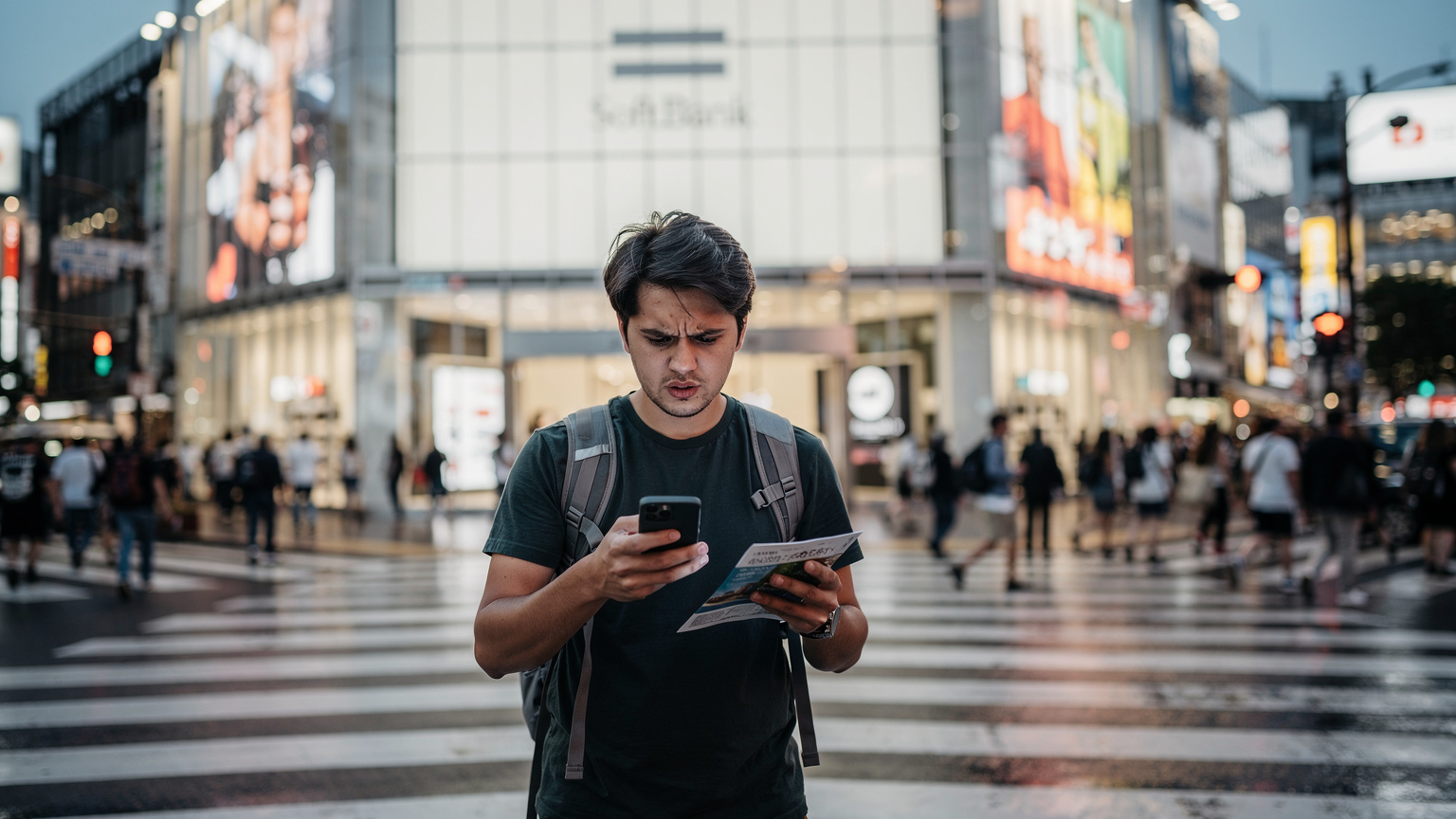
To sign a normal Japanese mobile contract — the kind with a phone number, monthly billing and a proper data allowance — you generally need a Japanese residence card. A tourist visa does not qualify. That is not SoftBank being difficult; it is how the market is structured across all the major operators.
The consequence is that Japan has an unusually separate visitor market: data-only prepaid SIMs, rented pocket Wi-Fi devices, and travel eSIMs. A Japanese phone number is effectively off the table for a two-week trip, whichever brand you approach.
This is worth internalising before you land, because a lot of advice written for residents does not apply to you at all.
What SoftBank actually sells to travellers
SoftBank's visitor product is called Prepaid SIM for Travel, and its terms are specific:
- Data only. Voice calling is not available on it.
- Your original passport is required — no other document is accepted.
- A SIM-lock-free handset with a camera is needed; the camera is used in activation.
- Minimum age 18, and a Visa, Mastercard or JCB card for buying additional plans.
- Sold at SoftBank shops, consumer electronics stores and SoftBank rental counters at the airport.
The pricing tells its own story. The additional-data plan on this product was 500 MB for 31 days at ¥1,650 — roughly $11 for half a gigabyte — and SoftBank posted a notice that this add-on stopped accepting new applications in February 2025.
Read that carefully: it is a legacy product that has not kept pace. SoftBank the network is excellent. SoftBank the tourist offer is not what you want to build a trip around.
There is one more practical catch worth knowing if you were considering a SoftBank eSIM: the eSIM path in Japan has historically been iPhone-oriented, with Android support lagging. If you are travelling with an Android handset, check before you count on it.
Pocket Wi-Fi: why Japan still rents boxes
Japan is the one country where renting a portable Wi-Fi device remained mainstream long after it faded elsewhere, and the residence card rule above is exactly why. When visitors could not buy a proper plan, renting a box was the workaround, and an entire industry grew around airport pickup counters.
It still makes sense in two situations:
- A family or group travelling together, sharing one device and one bill.
- A laptop-heavy work trip, where you want a stable hotspot rather than tethering off a phone.
The costs are real, though, and rarely stated up front: you carry a second device and its charger, you manage its battery all day, you must return it before flying home, and everyone in the group loses connectivity the moment they walk away from whoever is carrying it. For a solo traveller in 2026 it is usually the wrong answer.
Japan's free Wi-Fi is not the safety net people expect
Given how technologically advanced Japan is, visitors reasonably assume public Wi-Fi will be everywhere and easy. It is neither.
Networks exist in stations, convenience stores, some trains and many cafés, but they typically require registration through an app or a web form, sessions time out, and coverage between those points is thin. Signage is often Japanese-only. Compared with, say, Singapore — where public Wi-Fi genuinely reduces how much mobile data you need — Japan's free networks are a bonus, not a plan.
Practically: assume you need mobile data in Japan. Navigation in Tokyo and Osaka stations, train times that change, restaurant queues managed by app, cashless payment — all of it wants a live connection.
Coverage: this is where Japan earns its reputation
The good news is unambiguous. SoftBank, NTT Docomo and KDDI au all run excellent networks, and Japan is one of the best-connected countries on earth.
- Cities — comprehensive 4G and widespread 5G in Tokyo, Osaka, Kyoto, Nagoya, Fukuoka and Sapporo.
- Subways — covered, including underground platforms and most tunnel sections.
- Shinkansen — generally good along the route, with predictable dropouts in the longer tunnels.
- Rural and mountain areas — better than most countries manage. Docomo has historically had the edge in remote regions, which matters if you are heading into the Japanese Alps, rural Hokkaido or the smaller islands.
The remaining gaps are the ones geography imposes: hiking routes above the treeline, deep valleys, some island ferry crossings. Nothing you buy changes those.
Here is a point in a travel eSIM's favour that is specific to Japan and rarely made: a travel eSIM connects you to one of these same big three networks. You get Japanese-grade coverage without needing a Japanese contract — the network quality was never the thing standing between you and connectivity. The paperwork was.
What it costs to just have data
Cellesim Japan eSIM plans start at $1.05 with 52 plans to size against your trip, install in one tap and connect on landing. If you are pairing Japan with Korea — an increasingly common two-week itinerary — a Japan and South Korea plan from $3.49 covers both without a second purchase. Every active plan includes a free VPN, which is worth having given how much registration-gated public Wi-Fi you will end up joining.
Against ¥1,650 for 500 MB, the comparison does not need commentary.
The honest trade-off, stated as in every one of these guides: a travel eSIM does not give you a Japanese phone number. Data only. In Japan this matters less than almost anywhere, because as a visitor you could not easily get a Japanese number anyway — but if you need one for a domestic service, the answer is a resident contract, not any tourist product.
How much data will you actually use?
Rough hourly figures for planning:
- Maps and navigation — around 5 MB per hour, but Japan is navigation-heavy. Station transfers, train times and walking directions run almost continuously.
- Translation apps — light on text, heavier when using the camera to read menus and signs, which you will do constantly.
- Messaging and email — a few MB a day
- Social media — 100–150 MB per hour, more with autoplay
- Video calls — 500 MB to 1 GB per hour
A typical two-week trip through Tokyo, Kyoto and Osaka lands at 3–6 GB, a little above what the same trip would use elsewhere because you lean on maps and translation more heavily and cannot fall back on public Wi-Fi as readily. Add daily video calls home and 10 GB is realistic.
SoftBank, Docomo or au?
For a visitor this question matters less than it looks, because you are not choosing between their consumer plans — you cannot buy them. All three deliver excellent urban coverage.
If you are going properly rural — northern Hokkaido, the Japanese Alps, remote Kyushu or the smaller islands — Docomo has traditionally had the widest reach. In cities the three are interchangeable in practice.
How to install an eSIM, whichever one you choose
- Check your phone is eSIM-capable and carrier-unlocked. Japan is a market where handsets are frequently carrier-locked, so if you are buying a phone for the trip, confirm this explicitly.
- Install over Wi-Fi — at home before you fly, or on airport Wi-Fi. The eSIM cannot install itself without a connection.
- Scan the QR or use one-tap install. iPhone: Settings → Mobile Service → Add eSIM. Android: Network & Internet → SIMs, path varies by manufacturer.
- Label the line "Japan data" so you can tell profiles apart.
- Set the data line and turn data roaming off on your home SIM — otherwise your home carrier bills you alongside the plan you just bought.
Failed installs are nearly always one of four things: a carrier-locked phone, no Wi-Fi during install, a single-use QR already used, or a handset variant with eSIM disabled. Our eSIM compatibility checker rules most of that out in seconds.
Frequently asked questions
Can a tourist get a SoftBank contract in Japan?
Not a regular one. Japanese mobile contracts generally require a residence card, which visitors do not have. What is available to tourists is SoftBank's data-only Prepaid SIM for Travel, plus pocket Wi-Fi rental and travel eSIMs.
Does SoftBank's tourist SIM include calls?
No. Prepaid SIM for Travel is explicitly data-only; voice calling is not available on it.
What do I need to buy it?
Your original passport — no substitutes accepted — a SIM-lock-free handset with a working camera, and a minimum age of 18. A Visa, Mastercard or JCB card is needed for additional plans.
Is ¥1,650 for 500 MB really the price?
That was the additional-plan pricing on this product, and SoftBank notified that it stopped accepting new applications for that add-on in February 2025. It is a legacy offer, not a competitive one. Check current terms on SoftBank's own site if you intend to use it.
Does a travel eSIM work as well as a Japanese SIM?
It connects to the same national networks, so the coverage is the same. What differs is the paperwork, the price, and whether you get a Japanese phone number — which as a visitor you largely could not get anyway.
Is pocket Wi-Fi still worth renting?
For families and groups sharing one device, or a laptop-heavy work trip, yes. For a solo traveller, rarely — you are carrying a second device and its charger, watching its battery, and returning it before you fly.
Can I rely on free Wi-Fi in Japan?
No. It exists in stations, convenience stores and cafés but usually needs app or web registration, times out, and does not cover the space between those points. Treat it as a bonus rather than a plan.
Is there signal on the subway and the shinkansen?
Yes on the subway, including underground platforms and most tunnels. On the shinkansen coverage is generally good with predictable dropouts in the longer tunnels.
How much data do I need for two weeks in Japan?
Around 3–6 GB for most itineraries, slightly more than a comparable trip elsewhere because navigation and camera translation run constantly and public Wi-Fi is a weaker fallback.
Will my phone work with an eSIM?
Most phones released since 2018: iPhone XS and later, Google Pixel 3 and later, Samsung Galaxy S20 and later, and many mid-range models since. The handset must also be carrier-unlocked, which matters more in Japan than in most markets.
Planning the trip? Compare data plans on our Japan eSIM page, install in one tap before you fly, and land online. Free VPN included.