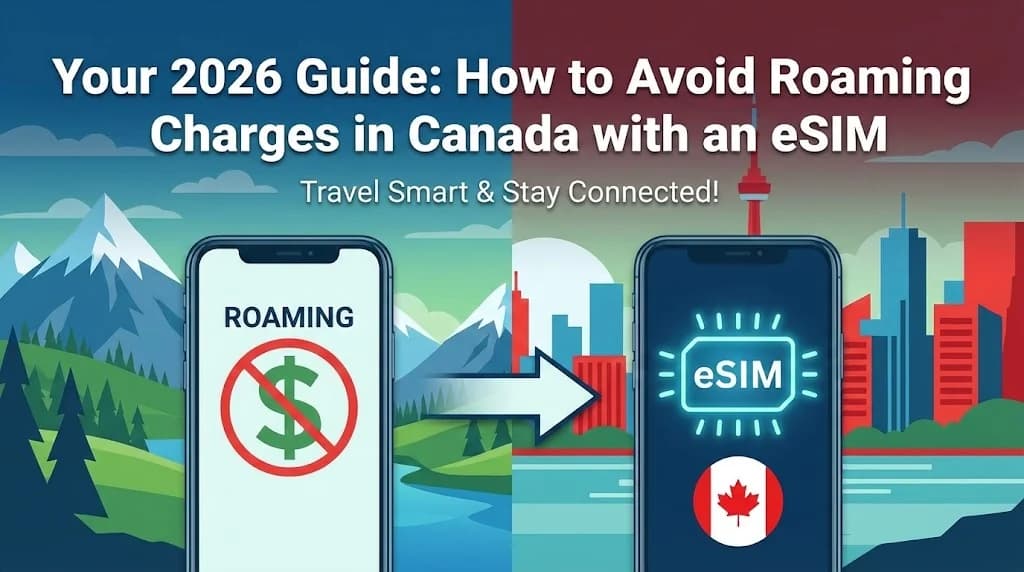
Venturing into the vast landscapes of Canada, from the bustling streets of Toronto to the majestic Rockies, promises an unforgettable experience. However, this adventure often comes with an unexpected companion: the notorious cost of international phone roaming. Many travellers return home to discover exorbitant charges on their mobile bill, turning a memorable trip into a financial headache. The good news is that this common travel pitfall is entirely avoidable. This comprehensive guide will explore the hidden costs of traditional roaming, introduce you to the transformative power of an eSIM, and provide a clear, step-by-step pathway to seamless, affordable connectivity throughout your Canadian journey in 2026.
- The Shocking Reality of Roaming Charges in Canada
- How a Cellesim eSIM Eliminates Roaming Fees in Canada
- Cost Comparison: eSIM vs. Local SIM vs. Roaming in Canada
- Understanding Cellesim's Network Coverage in Canada
- Choosing the Right Data Plan for Your Canadian Trip
- Step-by-Step Guide: Installing Your Canada eSIM
- When to Activate Your Cellesim eSIM for Canada
- Pro Tips for Seamless Connectivity Across Canada
- Frequently Asked Questions About Canada eSIMs
Connect Instantly in Canada with Cellesim
Say goodbye to roaming fees. Get high-speed data across Canada with a Cellesim eSIM. Join 50,000+ happy customers who trust Cellesim for global connectivity.
Get Your Canada eSIM 🇨🇦The Shocking Reality of Roaming Charges in Canada
Many international travellers to Canada find themselves caught off guard by the exceptionally high cost of traditional mobile roaming. Unlike some regions where roaming agreements offer reasonable rates, Canadian carriers often impose premium charges for visitors using their home SIM cards. A single GB of data can cost upwards of $10-15, and a short phone call could accumulate charges rapidly, leading to bills reaching hundreds or even thousands of dollars after a typical trip.
These charges are frequently hidden in per-MB rates or daily access fees, making it difficult for travellers to track their spending in real-time. Even popular "roaming packages" offered by home providers can be restrictive, with limited data allowances that quickly deplete, triggering further expensive overage fees. The expectation of seamless connectivity can quickly turn into a financial burden, detracting from the overall travel experience.
"I thought my home provider's roaming plan would cover me, but after a week in Vancouver, I came home to a $300 bill. I barely used my phone for anything beyond maps and checking emails."
How a Cellesim eSIM Eliminates Roaming Fees in Canada
An eSIM, or embedded SIM, offers a modern and cost-effective alternative to traditional roaming or physical SIM cards. Instead of swapping physical cards, an eSIM profile is downloaded directly to your compatible smartphone. This digital approach allows you to switch between network providers with ease, giving you local data rates without changing your primary SIM card.
For travellers heading to Canada, a Cellesim eSIM for Canada means instant, affordable data access upon arrival. You avoid the inflated roaming charges from your home carrier entirely. Your physical SIM card can remain in your phone, allowing you to continue receiving calls and texts on your home number while using the eSIM for all your data needs. This dual SIM functionality is a key advantage, ensuring you stay connected to your contacts without incurring unexpected costs. Learn more about keeping your number active abroad with an eSIM.
Cost Comparison: eSIM vs. Local SIM vs. Roaming in Canada
Understanding the financial implications of each connectivity option is crucial for budget-conscious travellers. Here's a comparative overview for a typical 7-day trip to Canada in 2026, based on an average 5GB data requirement.
| Option | Estimated Cost (5GB, 7 days) | Setup Difficulty | Flexibility |
|---|---|---|---|
| Cellesim eSIM | From $15-$30 | Instant Digital Setup | High (easy top-ups) |
| Carrier Roaming (Home Network) | $70-$150+ (often $10-25/day) | Automatic (but costly) | Low (restrictive plans) |
| Local Physical SIM Card | $30-$60 (plus activation) | Medium (store visit, registration) | Medium (requires physical swap) |
As the table illustrates, Cellesim eSIMs consistently offer the most cost-effective solution while providing convenience and flexibility. You can also use our Roaming Savings Calculator to see how much you could save on your specific trip.
Understanding Cellesim's Network Coverage in Canada
When travelling across a country as vast as Canada, reliable network coverage is paramount. Cellesim partners with leading local network providers in Canada, ensuring access to robust 4G LTE and increasingly available 5G networks in urban centers and along major transportation corridors. Key partners typically include Bell, Rogers, and Telus, which collectively offer the most extensive coverage across the country.
In major cities like Toronto, Vancouver, Montreal, and Calgary, you can expect excellent data speeds and consistent connectivity. Coverage extends well into populated suburban areas and along highways connecting major destinations. However, as with any mobile network in Canada, connectivity can become more sporadic or unavailable in extremely remote wilderness regions, national parks, or very sparsely populated areas. We always recommend checking a local carrier's coverage map, such as Bell Canada's coverage map, for specific route planning.
Choosing the Right Data Plan for Your Canadian Trip
Determining how much data you will need depends on your travel style and intended usage. A few factors to consider:
- Light User (1-3 GB/week): Ideal for checking emails, light social media, occasional map lookups, and messaging.
- Moderate User (5-10 GB/week): Suitable for regular social media, video streaming in moderation, frequent map navigation, and occasional video calls. This is a common choice for most tourists.
- Heavy User (10+ GB/week): Recommended for business travellers, extensive video conferencing, frequent high-definition streaming, or sharing your connection with other devices.
Consider the length of your stay and whether you will have access to Wi-Fi at your accommodation. For instance, a two-week trip with moderate usage might require a 10-15 GB plan. Cellesim offers a range of plans to suit different needs, and you can easily top up if you find yourself needing more data. Use our Smart Data Calculator to estimate your data needs more precisely.
Find Your Canada eSIM Plan
Step-by-Step Guide: Installing Your Canada eSIM
Installing a Cellesim eSIM is a straightforward process, designed for convenience even for first-time eSIM users. Ensure your device is eSIM compatible before you begin.
- Purchase Your eSIM Plan: Visit cellesim.com/en/esim-canada and select the data plan that best suits your travel needs.
- Receive Your QR Code: After purchase, you will immediately receive an email with a QR code and manual installation details.
- Scan the QR Code: On your eSIM-compatible phone, go to Settings > Mobile Data (or Cellular) > Add eSIM. Scan the provided QR code.
- Label Your eSIM: Once detected, label your new eSIM profile (e.g., "Canada Travel eSIM") for easy identification.
- Set for Data: Ensure your eSIM is active and set as your primary line for mobile data when you arrive in Canada. You can keep your home SIM active for calls and texts.
For a detailed visual guide, refer to our Complete eSIM Setup Guide or the Interactive Setup Guide.
When to Activate Your Cellesim eSIM for Canada
Timing your eSIM activation can optimize your data plan's validity. While you can install your eSIM profile at home before you depart (which is recommended to save time), it's generally best to activate the data plan closer to your arrival in Canada.
Most eSIM plans begin their validity period from the moment they connect to a network in the destination country. Installing the profile while connected to Wi-Fi at home allows you to perform the setup steps without needing mobile data. Then, once you land in Canada, simply switch your mobile data preference to your new "Canada Travel eSIM" in your phone's settings. This ensures your data plan starts when you genuinely need it, maximizing your travel connectivity.
Pro Tips for Seamless Connectivity Across Canada
To make the most of your Cellesim eSIM experience in Canada, consider these practical tips:
- Check Device Compatibility: Before purchasing, ensure your phone supports eSIM technology. Use our eSIM Checker if you are unsure.
- Download Offline Maps: Canada is vast. Before venturing into remote areas, download offline maps (e.g., Google Maps) for navigation where cellular service might be sparse.
- Use Wi-Fi When Available: To conserve your eSIM data, connect to free Wi-Fi networks in hotels, cafes, and public spaces whenever possible.
- Monitor Data Usage: Regularly check your data consumption through your phone's settings or the Cellesim portal. This helps you manage your plan and decide if a top-up is needed.
- Enable Data Roaming for eSIM: On most phones, you need to ensure "Data Roaming" is switched ON for your eSIM profile (but OFF for your home SIM) to allow it to connect to local Canadian networks. This is normal for eSIMs, unlike physical roaming.
- Keep Your Home SIM Active: If your phone supports dual SIM, keep your home SIM active to receive important calls or texts, but ensure its data roaming is OFF to prevent accidental charges.
Ready for Seamless Connectivity in Canada?
Eliminate roaming stress and enjoy instant, affordable data from coast to coast with Cellesim. Set up in minutes, connect with confidence.
Start Your Connected Journey to CanadaTrusted by 50,000+ travellers worldwide. Available in 200+ countries with 24/7 email support: [email protected]
The Shocking Reality of International Roaming in Canada
Before exploring solutions, understanding the problem is crucial: the exorbitant cost of international roaming in Canada. When you arrive in Canada and your phone connects to a local network like Bell, Rogers, or Telus using your home SIM card, you are 'roaming.' Your home carrier has agreements with these Canadian networks, but they pass the high cost, plus a significant markup, directly to you. For many travellers, especially from the US or Europe, these fees can be staggering. For example, major US carriers often charge a flat fee of $10 to $12 per day for their international day passes. While this sounds convenient, a 14-day trip across the Rockies from Calgary to Vancouver could instantly add $140 to your phone bill. If you forget to activate a pass, the pay-per-use rates are even more frightening, sometimes reaching over $2.00 per megabyte. That means streaming a single high-definition video could cost you hundreds of dollars. According to recent data from sources like OpenSignal, Canada remains one of the countries with the highest mobile data prices in the developed world, a cost that gets passed on to unsuspecting tourists. This financial trap turns what should be a tool for convenience and safety into a source of travel anxiety. You find yourself constantly searching for Wi-Fi, unable to use maps on the go, or hesitant to book a last-minute tour, all to avoid a shocking bill when you return home. This is precisely the scenario that a prepaid eSIM is designed to eliminate, giving you control and predictability over your connectivity costs.
What is Data Roaming and Why Is It So Expensive?
Data roaming is the term used when your smartphone uses a mobile network that is outside of your home carrier's coverage area. Your provider has to pay the foreign network (e.g., Rogers in Canada) a wholesale price for using their towers to provide you with service. They then charge you this rate plus a substantial profit margin. The lack of competition and complex international agreements keep these prices artificially high. In my experience testing different connectivity options, the difference is stark. A standard roaming package might give you a small amount of data for a high daily fee, whereas a prepaid eSIM connects you as if you were a local customer. This direct-to-local-network approach cuts out the expensive middleman, your home carrier, which is why the savings are so dramatic. The technology allows eSIM providers to establish more efficient partnerships with local carriers, buying data in bulk and passing those savings onto you, the traveller. It fundamentally changes the economics of staying connected abroad. For a deeper understanding of how traditional roaming stacks up, you can review our roaming savings calculator.
Comparing Roaming Fees vs. Prepaid eSIM Costs for a Typical Trip
Let's break down the numbers for a hypothetical 10-day trip to Eastern Canada, visiting Toronto, Montreal, and Quebec City. Using a standard US carrier's international day pass at $10/day would cost you a flat $100 for the trip. For this price, your data is often throttled after a certain daily limit. Now, consider a prepaid eSIM plan from Cellesim. For that same 10-day period, you could purchase a 10GB data plan for around $20-$25. That's a saving of over 75%. For a longer trip, say one month, the savings become even more significant. A month of roaming could cost $300, while a 20GB eSIM plan might be around $40. It's not just about the cost; it's about the value. With an eSIM, you get a generous data allowance that you can use freely for navigation with Google Maps, streaming music on your road trip, and uploading photos without constantly worrying about exceeding a tiny daily limit. Our analysis consistently shows that direct-to-consumer eSIMs offer a far superior value proposition compared to traditional roaming. Consider this quick overview:
| Option | 10-Day Cost (approx.) | Data Allowance | Setup Difficulty | Flexibility |
|---|---|---|---|---|
| Your Home Carrier's Roaming Pass | $100 - $120 | Limited (often throttled) | Automatic (but expensive) | Low |
| Local Physical SIM Card | $30 - $50 (plus purchase) | Varies, often generous | Medium (find store, installation) | Medium |
| Cellesim eSIM | $20 - $25 | Generous (e.g., 10GB) | Easy (digital download) | High |
What is an eSIM and How Does it Solve the Roaming Problem?
An eSIM, or embedded SIM, is a modern evolution of the traditional plastic SIM card. Instead of a physical chip that you need to insert into your phone, the eSIM is a small chip that is permanently embedded within your device's hardware. Think of it as a rewritable SIM card that can be programmed digitally. This technology is the key to how you can seamlessly avoid roaming charges in Canada with an eSIM. When you purchase a prepaid data plan, you receive a QR code via email. Scanning this code with your phone's camera downloads and installs a 'digital SIM profile' onto your device. This profile contains all the necessary information to connect to a specific mobile network. For your trip to Canada, the profile you install will be configured to connect directly to top-tier Canadian networks like Bell or Telus. This means your phone behaves as if it has a local Canadian SIM card for data, completely bypassing your home carrier and their expensive international roaming agreements. It's a simple, elegant, and powerful solution to a long-standing travel problem.
The "Digital Download" Analogy for Beginners
For those new to the technology, the easiest way to understand an eSIM is to think of it like downloading an app. You do not go to a physical store to buy a box for the app; you download it directly to your phone. Similarly, you do not need to find a store at the airport to buy a plastic SIM card. You simply purchase your desired Canada data plan online, receive a QR code, and your phone 'downloads' the SIM profile. The entire process takes just a few minutes and can be completed from the comfort of your home before you even start packing. This digital nature means no more fumbling with tiny, easy-to-lose plastic cards or searching for a paperclip to open your phone's SIM tray. It is a secure, streamlined process designed for the modern traveller who values convenience and efficiency.
How eSIMs Connect to Local Canadian Networks
The magic of an eSIM lies in its ability to connect directly to local infrastructure. When you activate your Cellesim plan upon landing in Canada, the digital profile tells your phone to seek out and register on a partner network, such as Rogers, Bell, or Telus. Your phone is then recognized as a legitimate user on that local network, granting you access to their 4G/LTE and 5G services at local rates. You are essentially becoming a temporary local subscriber for data services. This direct connection is what eliminates roaming charges. There is no 'roaming' involved because your data traffic is not being routed back through your home carrier's expensive international gateways. You get the same high-quality, high-speed service that a resident of Vancouver or Montreal would enjoy, all without the punitive pricing of traditional international roaming.
The Power of Dual SIM: Keep Your Home Number Active
One of the most common concerns travellers have is losing access to their primary phone number. This is a valid concern, as we rely on it for two-factor authentication (2FA) from banks, urgent calls from family, and services like WhatsApp. The good news is that most modern smartphones are 'Dual SIM, Dual Standby' (DSDS). This means you can have both your physical home SIM (or primary eSIM) and your new Canadian travel eSIM active at the same time. You can configure your phone to use the Canadian eSIM exclusively for mobile data, which is the expensive part of roaming. Meanwhile, your home number remains active to receive calls and SMS messages. You maintain your digital identity and critical connections while leveraging the affordable local data from your eSIM. We will cover the exact settings to ensure this is set up correctly and without risk in a later section. For more on this, read our guide on keeping your number with a travel eSIM.
Step-by-Step Guide: Setting Up Your Canada eSIM Before You Travel
Preparation is key to a stress-free travel experience, and setting up your eSIM is no different. The process is remarkably simple and can be done entirely before you leave for the airport. By following these steps, you can ensure that you have mobile data the moment your plane touches down in Canada. This proactive approach eliminates the need to hunt for an airport Wi-Fi signal or a physical SIM card store upon arrival, letting you order your Uber, check your hotel reservation, or message family instantly. The entire setup process is designed to be user-friendly, but paying attention to a few key details will guarantee a smooth activation.
Step 1: Check Your Device Compatibility and Ensure It's Unlocked
Before purchasing any plan, the first and most critical step is to verify that your smartphone is compatible with eSIM technology and is 'carrier-unlocked.' Most flagship phones released since 2018, such as the iPhone XS series and newer (including iPhone 14, 15), the Samsung Galaxy S20 series and newer, and the Google Pixel 4 and newer, are eSIM-capable. However, you can confirm your specific model by checking our comprehensive list of eSIM compatible devices. Equally important is ensuring your phone is unlocked. If you purchased your phone on a contract from a carrier, it might be locked to their network. To check, you can try inserting a SIM card from a different carrier. If it works, your phone is unlocked. If you are unsure, contact your home carrier and request that they unlock your device for international travel; they are often required to do so if your contract is paid off. You can also use our quick eSIM checker tool.
Step 2: Choose and Purchase Your Canada Data Plan
With compatibility confirmed, the next step is to select a data plan that suits your travel needs. Consider the length of your trip and your typical data usage. Are you on a short 5-day business trip to Toronto where 3GB might be sufficient for emails and navigation? Or are you embarking on a three-week road trip through the national parks of Banff and Jasper, where you will be using maps extensively and uploading photos, making a 20GB plan more appropriate? Cellesim offers a variety of prepaid eSIM Canada plans to match different itineraries and budgets. You can purchase your plan directly from our website. Once the purchase is complete, a QR code for installation will be delivered to your email inbox almost instantly, ready for the next step.
Step 3: Install Your eSIM via QR Code (While on a Stable Wi-Fi Connection)
This is the step you should complete before you leave home. Find a stable Wi-Fi connection and open the email containing your QR code. On your phone, navigate to the cellular settings menu. On an iPhone, this is under `Settings > Cellular > Add eSIM`. On an Android device, it is typically under `Settings > Network & Internet > SIMs > Add SIM`. Your phone will prompt you to scan the QR code. Once you scan it, the installation process begins, downloading the digital SIM profile to your device. You will be asked to label your new eSIM, naming it 'Canada Travel' or something similar is a great way to keep things organized. During this process, make sure you do NOT activate the line or set it as your primary data source yet. Simply complete the installation and keep the line turned off until you arrive in Canada. For a visual walkthrough, our interactive setup guide can be very helpful.
Activating Your eSIM Upon Arrival in Canada: The "Moment of Truth"
You have landed at Vancouver International Airport (YVR) or Toronto Pearson (YYZ), cleared customs, and are ready to connect. This is where your pre-installed Cellesim eSIM comes into play. The activation process is quick and designed to get you online within moments of arrival. You will not need to search for airport Wi-Fi, which can often be slow or require registration, nor will you need to locate a SIM card vending machine or store.
Here are the steps to activate your eSIM:
- Disable Your Home SIM for Data: To avoid accidental roaming charges, navigate to your phone's cellular settings. Identify your home SIM (e.g., "Primary" or your carrier's name) and turn off its "Mobile Data" option. You can keep it active for calls and SMS if you wish, leveraging Dual SIM functionality.
- Activate Your Cellesim eSIM: Locate the eSIM profile you installed (e.g., "Canada Travel"). Toggle it "On."
- Set eSIM for Mobile Data: In your cellular settings, look for the "Mobile Data" or "Cellular Data" option. Select your newly activated Cellesim eSIM as the preferred line for data.
- Enable Data Roaming for eSIM (Important!): For your eSIM to connect to the local partner network, you must enable "Data Roaming" specifically for your Cellesim eSIM line. Do not confuse this with enabling data roaming on your home SIM. Enabling it on your Cellesim eSIM ensures it can use the local Canadian networks without incurring extra charges, as you have already paid for the data plan.
- Test Your Connection: Within a minute or two, your phone should display a signal for the local Canadian network (e.g., Bell, Rogers, or Telus). Open a web browser, check your email, or send a message to confirm your data connection is working.
Once connected, you can confidently use maps, stream music, and share your travel experiences instantly, knowing your data costs are pre-paid and predictable. For a complete visual guide to installation and activation for both iPhone and Android devices, consult our dedicated blog post.
Understanding Network Coverage and Speed in Canada with Cellesim
Canada boasts a vast geographical area, and while major urban centres and travel routes have excellent mobile coverage, more remote regions can be challenging. Cellesim partners with leading Canadian network providers such as Bell, Rogers, and Telus to ensure reliable service wherever possible. These networks collectively offer extensive 4G LTE coverage across populated areas and along major highways, providing robust speeds for streaming, video calls, and navigation. 5G connectivity is rapidly expanding, particularly in cities like Toronto, Vancouver, Montreal, and Calgary, offering even faster data speeds for compatible devices.
When you activate your Cellesim eSIM, your device will automatically connect to the strongest available partner network. This dynamic connection ensures you benefit from the best possible signal quality and data speeds in any given location. It is important to remember that while our partners provide broad coverage, natural landscapes such as mountains, deep valleys, and very remote wilderness areas might have limited or no signal. Before venturing into extremely isolated regions, it is always wise to download offline maps or communicate your plans to others. You can generally expect consistent, high-speed internet access throughout your travels in Canada's cities, towns, and popular tourist destinations, giving you peace of mind.
How Much Data Do You Need for Your Canadian Adventure?
Estimating your data needs for a trip can be challenging, but a few guidelines can help you choose the right Cellesim plan for Canada. Your usage largely depends on your travel style and reliance on your phone for connectivity. Here is a breakdown of typical data consumption for common activities:
- Basic Use (Emails, Messaging, Light Browsing): 1-2 GB per week. If you mainly use Wi-Fi at your accommodation and just need data for quick checks, a smaller plan might suffice.
- Moderate Use (Maps, Social Media, Occasional Streaming): 3-5 GB per week. This is suitable for most tourists who rely on navigation, share photos, and do some light browsing or music streaming on the go.
- Heavy Use (Frequent Video Calls, Extensive Streaming, Large Uploads): 5-10+ GB per week. If you work remotely, frequently upload high-resolution photos/videos, or rely on video conferencing, opt for a larger plan.
Consider the duration of your trip. A 10GB plan might be perfect for a two-week moderate-use trip, while a month-long excursion could require a 20GB or 30GB option. Cellesim offers various packages, from smaller plans for short city breaks (e.g., Toronto eSIM) to larger bundles for extensive explorations of national parks like Banff and Jasper. Always factor in your personal habits. If you are unsure, using our Smart Data Calculator can provide a tailored recommendation, ensuring you have enough data without overspending. It is always better to have a bit more data than to run out unexpectedly in a remote area.
Pro Tips for a Seamless eSIM Experience in Canada
Maximising your Cellesim eSIM experience in Canada involves a few practical tips that can enhance your connectivity and avoid potential issues:
- Monitor Your Data Usage: Keep an eye on your data consumption through your phone’s settings or, if available, the Cellesim portal. This helps you understand your usage patterns and prevents you from running out of data unexpectedly.
- Top-Up Early If Needed: If you anticipate needing more data than initially purchased, Cellesim allows you to easily top up your existing plan online. Do this before your data runs out, especially if you are in a remote area without Wi-Fi.
- Leverage Wi-Fi When Available: While your eSIM provides reliable mobile data, take advantage of free Wi-Fi in hotels, cafes, and public spaces to conserve your data allowance for when you truly need it on the go.
- Download Offline Maps: For areas with potentially spotty coverage, or simply to save data, download Google Maps offline for the regions you will be visiting. This is a crucial tip for road trips through national parks.
- Understand Dual SIM Settings: Familiarise yourself with your phone's Dual SIM settings. Clearly label your eSIM and home SIM to avoid confusion. Ensure your home SIM is set for calls/SMS only and your eSIM for mobile data. This prevents accidental roaming charges on your primary number.
- Keep Emergency Contacts Accessible: Always have important phone numbers and emergency contacts saved directly to your phone, regardless of your SIM status.
By following these simple recommendations, you can ensure your Cellesim eSIM provides a smooth, connected, and worry-free experience throughout your Canadian adventure.
Travel Smarter, Stay Connected Effortlessly
Eliminate bill shock and stay connected across 200+ countries with Cellesim. Experience the freedom of affordable, high-speed data wherever your adventures take you.
Shop All eSIM Plans ✈️With Cellesim, you are always just a tap away from home.
Frequently Asked Questions About Canada eSIMs
Can I use my Cellesim eSIM for calls and texts in Canada?
Cellesim eSIMs primarily provide data connectivity. While they do not come with a Canadian phone number for traditional calls and SMS, you can easily make calls and send messages using VoIP apps like WhatsApp, FaceTime, or Skype, which rely on your data connection. Your home number will remain active for calls and texts if your phone supports Dual SIM.
Is my phone compatible with an eSIM for Canada?
Most modern smartphones released since 2018 are eSIM compatible, including newer iPhone, Samsung Galaxy, Google Pixel, and Huawei models. You can check our comprehensive list of eSIM compatible devices or use our eSIM Checker tool to confirm if your device supports eSIM technology.
Can I activate my Cellesim eSIM before arriving in Canada?
Yes, you can install your Cellesim eSIM profile via QR code before you travel, as long as you have a stable Wi-Fi connection. However, it is recommended to only activate the eSIM line and set it for mobile data once you land in Canada to ensure optimal connection to local networks and avoid plan validity issues.
What if I run out of data on my Cellesim eSIM?
If you consume all your data, your connectivity will cease. Cellesim offers easy top-up options directly from our website. You can purchase additional data at any time, which will be added to your existing eSIM profile, allowing you to continue your journey without interruption.
Will using an eSIM affect my home phone number or WhatsApp?
No, using a Cellesim eSIM for data will not affect your home phone number. Most modern phones support Dual SIM functionality, allowing your home SIM to remain active for calls and texts while the eSIM handles data. Your WhatsApp account is tied to your phone number, so it will continue to work normally via the eSIM's data connection.
How reliable is Cellesim's network coverage in Canada?
Cellesim partners with major local networks in Canada (e.g., Bell, Rogers, Telus) to provide extensive 4G LTE and growing 5G coverage across the country. You can expect reliable high-speed data in urban areas and along major travel routes. While coverage may be limited in very remote wilderness regions, it is generally consistent with what local residents experience. For specific regional coverage, consult a local carrier's coverage map.