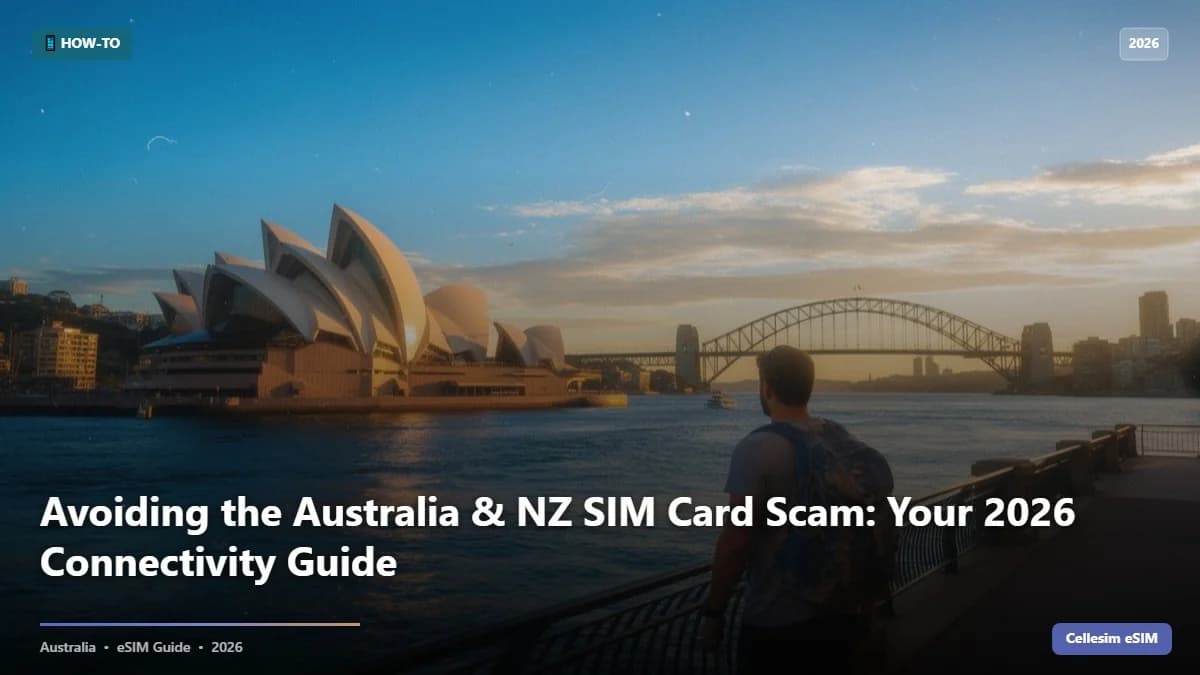
Picture this: you've just landed at Sydney Airport in 2026, probably a bit tired from the flight, and then BAM! You get hit with a $150 roaming bill just because you checked a few emails and uploaded a single photo. This isn't just a bad dream; it's a very real problem for many travelers who aren't prepared for how mobile data works in Australia and New Zealand. These incredible countries offer amazing adventures, but their typical mobile connectivity options can really drain your wallet if you're not careful.
- The Real Cost Problem: What Travelers Actually Pay in Australia & NZ
- Option 1: Carrier Roaming, The High-Stakes Bet
- Option 2: Local SIM Cards, The Airport Hustle
- Option 3: Portable WiFi / Pocket WiFi, The Rental Burden
- Option 4: eSIM with Cellesim, The Smart, Digital Solution
- Head-to-Head: Roaming, Local SIM, Pocket WiFi, vs. eSIM Comparison
- Real-World Savings Calculator: A 7-Day Australia & NZ Trip
- Hidden Costs Most People Miss When Traveling Down Under
- Best Choice by Traveler Type for Australia & New Zealand
- How to Switch and Save Right Now for Your Australia & NZ Adventure
- Frequently Asked Questions
The Real Cost Problem: What Travelers Actually Pay in Australia & NZ
Australia's bustling cities and New Zealand's stunning landscapes are huge draws, but it's easy to forget about one crucial travel detail: staying connected. Many travelers don't realize how much traditional mobile data options can cost, which leads to a nasty "bill shock" when they get home. In 2026, the average tourist might shell out $180-$250 for roaming charges on a short week-long trip. That's money you could spend on a scenic helicopter ride over Milford Sound or a surfing lesson at Bondi Beach.
This money drain isn't always obvious. It often starts with a vague "international day pass" from your home carrier or a "tourist SIM" that seems cheap but quickly runs out of data with lots of fine print. Whether you're driving through the vast outback or hiking in a New Zealand national park, you need reliable, affordable internet. It's not a luxury anymore. The real problem isn't always an obvious scam; it's usually a mix of confusing prices, tricky activation, and restrictive terms that catch travelers off guard.
Option 1: Carrier Roaming, The High-Stakes Bet
For many, the easiest choice is to just use their home mobile carrier's international roaming. But this is almost always the most expensive way to go. Big US carriers like AT&T, T-Mobile, and Verizon, along with UK providers like Vodafone and EE, offer various international day passes or monthly add-ons. However, these plans are seriously pricey for Australia and New Zealand.
For example, an "international day pass" could cost $10-$15 a day. That sounds okay until you multiply it by a 14-day trip, which quickly adds up to $140-$210. These passes usually come with a small amount of high-speed data (often 0.5GB - 2GB/day) before your speeds drop to painfully slow 2G. Go over your daily limits or make calls outside your plan, and you'll see per-minute or per-MB charges pile up fast. If you want a more detailed look at roaming, check out our blog on eSIM vs. international roaming.
Hidden fees are a big problem here too. Some plans might activate automatically even for background data refreshes, leaving you with an unexpected charge for a day you barely used your phone. Speeds can also be inconsistent because your home carrier relies on agreements with local networks like Telstra, Optus, or Vodafone AU/NZ, which might not prioritize roaming traffic. This means frustratingly slow speeds for important navigation apps or video calls, making those high costs even more annoying.
Option 2: Local SIM Cards, The Airport Hustle
When you land at Auckland or Perth Airport, you'll definitely spot kiosks selling local SIM cards from providers like Telstra, Optus, and Vodafone. Many travelers pick this option, hoping for better rates than roaming. While it's often cheaper, it's far from a smooth experience. A tourist SIM might cost $20-$40 for a plan with 10-30GB of data, valid for 28-30 days.
But here's where the "scam" comes in: the time, effort, and ID requirements. You'll stand in line, show your passport for registration, and sometimes fill out paperwork. This can easily take 30-60 minutes after a long flight. Then you have to physically swap out your SIM card, which means you lose access to your home number for calls and texts unless your phone supports two SIMs. This can be a real pain for things like two-factor authentication or just keeping in touch with people back home.
Plus, local SIMs often push "tourist plans" that aren't as good a deal as the regular local plans, which tourists usually can't get. Coverage also varies a lot between providers, especially outside of major cities. Telstra usually has the best coverage in rural Australia, but it's often more expensive. Optus and Vodafone are good in cities but might struggle in remote areas. Trying to figure all this out when you're jet-lagged right after arrival is a huge challenge. This whole process is what we call the airport convenience tax.
Option 3: Portable WiFi / Pocket WiFi, The Rental Burden
Portable WiFi devices, also known as "pocket WiFi" or "MiFi," are another choice. These small devices broadcast a WiFi signal, letting multiple gadgets connect. In Australia and New Zealand, rental costs typically run from $8-$15 a day, plus a deposit. For a 14-day trip, that can easily hit $112-$210, not counting any delivery or return fees.
While sharing data with travel buddies is a clear benefit, pocket WiFi comes with some serious downsides. First, it's another device to carry, keep charged, and worry about losing or breaking. Battery life is often short, usually only 6-8 hours, meaning you'll be constantly looking for an outlet. If this one device dies or breaks, your whole group loses internet. On top of that, rental devices often have data limits, and going over them can lead to hefty extra charges, just like with roaming.
The "scam" with pocket WiFi isn't usually the device itself, but the overall cost and the logistical headache. The daily rental fees, combined with the hassle of picking it up, dropping it off, and constantly charging it, often outweigh any perceived benefits. Coverage is also tied to a single local network, much like a local SIM, so performance can be spotty in remote spots. For a broader comparison, check out our article on eSIM vs. Pocket WiFi vs. Roaming.
Option 4: eSIM with Cellesim, The Smart, Digital Solution
Now, let's talk about the eSIM, the modern traveler's answer to all these connection headaches. Cellesim offers a truly digital and easy solution for your Australia and New Zealand trips in 2026. An eSIM means no more physical SIM cards, no more lengthy activation processes, and no more expensive roaming plans. Instead, you just buy a data plan online, get a QR code in your email within minutes, and activate it right on your eSIM-compatible smartphone.
Cellesim has dedicated eSIM plans for Australia & New Zealand. We partner with top local networks like Telstra and Vodafone AU/NZ to give you reliable 4G/5G speeds across both countries. Our plans are flexible, with different data amounts and validity periods to fit any travel need or budget. For instance, a 10GB plan for 30 days might cost around $25-$35 USD, saving you a lot compared to other options.
The advantages are clear: you get it instantly in your email, you can activate it before you even land, and you can keep your home SIM active for calls and texts (thanks to dual SIM functionality). There are no hidden fees, no queues for ID checks, and no extra devices to carry. With Cellesim, you know exactly what you're paying for, and our 24/7 email support in 24 languages means you're never stranded. We also have plans specifically for New Zealand if you're only heading to Aotearoa.
Get Connected Instantly in Australia & New Zealand
Stop worrying about roaming costs or airport queues. Get your Cellesim eSIM for seamless connectivity Down Under. Join 50,000+ satisfied travelers worldwide.
Buy Australia & NZ eSIM NowHead-to-Head: Roaming, Local SIM, Pocket WiFi, vs. eSIM Comparison
To truly see the difference, let's compare the main options for mobile data in Australia and New Zealand for 2026 side-by-side. This table looks at key factors beyond just the price, like convenience, flexibility, and potential problems.
Real-World Savings Calculator: A 7-Day Australia & NZ Trip
Let's crunch the numbers for a typical 7-day trip to Australia and New Zealand in 2026. We'll imagine a "medium user" who needs about 10GB of data for things like navigation, social media, light video streaming, and messaging over the week. All prices are estimated in USD based on 2026 market data.
Hidden Costs Most People Miss When Traveling Down Under
Beyond the advertised prices, there are several sneaky factors that can drive up your mobile data costs in Australia and New Zealand. Knowing about these "hidden scams" is vital if you're trying to stick to a budget. One common trap is when daily roaming passes automatically renew. Many carriers will charge you for a new day pass even if you just use a tiny bit of data, like checking notifications or background app refreshes. You could end up with a $15 charge just for getting a WhatsApp message.
Another cost people often overlook is unused data expiring. With local SIM cards or some prepaid plans, any data you haven't used by the end of your plan's validity period is usually gone. If you buy a 30GB plan for 30 days but only use 15GB during your 7-day trip, that remaining 15GB is money wasted. Cellesim's plans, while they do have a validity period, are clearly laid out, helping you pick a plan that closely matches how much data you'll actually use and how long you're staying.
Fair Usage Policies (FUPs) are also something to watch out for, especially with "unlimited" plans from some providers. These policies can drastically slow down your speed after you hit a certain data limit, making the service practically useless for anything more than basic messages. Always read the fine print. Cellesim offers clear data allowances and avoids these misleading "unlimited" claims, so you get the high-speed data you paid for. Also, some airport SIM card vendors might add a small "activation fee" or include mandatory call credit you don't need, quietly bumping up your total cost.
Best Choice by Traveler Type for Australia & New Zealand
The "best" way to get connected isn't the same for everyone. Your travel style, data needs, and what you prioritize will help you figure out the perfect solution for your 2026 trip to Australia and New Zealand:
-
Business Travelers: If you need constant, reliable internet and want to keep your main number for client calls, an eSIM for business travelers is essential. Cellesim offers clear costs, instant activation, and dual SIM functionality, so you can easily switch between personal and work lines. Staying connected for urgent emails or video conferences is a must, and an eSIM keeps downtime to a minimum. You might also find our guide on eSIM for constant connectivity helpful.
-
Families: Juggling multiple devices and making sure everyone stays connected (and entertained) calls for a strong solution. While pocket WiFi can be shared, an eSIM with hotspot capabilities lets one device act as a central hub, without needing extra hardware. Parents can manage data usage more easily and skip the hassle of registering individual SIMs for kids. Cellesim's plans can support multiple devices through a hotspot.
-
Backpackers & Budget Travelers: For you, cost is usually king. Roaming is definitely out. Local SIMs are an option, but they come with time and hassle. eSIM offers the best mix of affordability and convenience. For instance, Cellesim's Australia & New Zealand plans start at very competitive rates for enough data to use maps, social media, and communicate. This leaves more money for exciting experiences, like bungee jumping in Queenstown or exploring the Great Ocean Road.
-
Digital Nomads & Long-Term Stayers: For longer trips, a Cellesim eSIM gives you unmatched flexibility. You can easily check and top up your data, or switch to a new plan as your needs change. This avoids long-term contracts or repeated trips to local stores. Cellesim's partner networks offer stable and fast internet, so you can work remotely from a cafe in Melbourne or a beach on the Gold Coast without interruptions. Take a look at our digital nomad guide for more insights.
How to Switch and Save Right Now for Your Australia & NZ Adventure
Switching to an eSIM for your 2026 trip to Australia and New Zealand is actually quite simple. First, make sure your phone can use an eSIM. Most newer smartphones, like recent iPhones, Samsung Galaxy, and Google Pixel models, have eSIM technology. You can easily check if your device is compatible on our compatible devices page.
Once you've confirmed compatibility, head over to cellesim.com and look through our Australia & New Zealand eSIM plans. Pick a plan that fits your data needs and how long you'll be traveling. Payment is secure and flexible, accepting credit/debit cards, PayPal, Alipay, and local payment methods. You'll get your eSIM QR code in your email inbox just minutes after buying it.
Activating your eSIM is a super easy, 3-step process. If you have an iPhone, go to Settings → Cellular → Add Cellular Plan and scan the QR code. For Android phones, it's usually Settings → Network & internet → SIMs → Add eSIM. Our interactive setup guide has step-by-step instructions for all sorts of devices. You can even install the eSIM before you leave home and then activate the data plan when you arrive, so you're connected the second you land. If you're traveling to multiple countries, Cellesim also offers Global eSIM plans.
Don't let old, expensive connectivity options put a damper on your Australia and New Zealand adventure. By choosing a Cellesim eSIM, you're getting clear pricing, incredible convenience, and big savings. That means you can focus on the amazing sights and unique experiences these incredible places offer. Get your connectivity sorted the smart way for 2026 and avoid the hidden "scams" of traditional mobile data.
Frequently Asked Questions
Is it worth getting an eSIM for Australia?
Absolutely. Getting an eSIM for Australia in 2026 is a smart move for travelers. It saves you a lot of money compared to international roaming, is much easier than buying a physical SIM card at the airport (no queues or SIM swapping), and you don't have to carry or worry about a portable WiFi rental. For an easy start to your trip, an eSIM from Cellesim gives you instant internet access the moment you land.
Are eSIMs safe in Australia?
Yes, eSIMs are very safe to use in both Australia and New Zealand. They use the same secure local networks as physical SIM cards (like Telstra, Optus, Vodafone AU/NZ) but add extra security by removing the risk of losing a physical card or having your personal data stolen. Cellesim uses encrypted QR codes for activation, making sure your digital SIM is securely set up on your device.
How do I buy and activate a Cellesim eSIM for Australia & New Zealand?
Buying a Cellesim eSIM for Australia and New Zealand is a quick online process. Just visit cellesim.com/en/esim-australia-new-zealand, pick the data plan you want (like 10GB for 30 days), and complete your secure payment. You'll get a QR code in your email within minutes. To activate, go to your phone's cellular settings (for iPhone, it's Settings → Cellular → Add Cellular Plan) and scan the QR code. You can install it before your trip and activate the data when you arrive.
Which eSIM should I get for Australia?
For Australia and New Zealand, Cellesim has a variety of flexible eSIM plans that suit different kinds of travelers. Think about how long your trip is and how much data you expect to use (for example, 5GB for light users, 10-20GB for moderate users, or 30GB+ for heavy users/digital nomads). All Cellesim plans use reliable local networks for the best coverage and speed. Check out our specific Australia & New Zealand eSIM options to find the best one for your 2026 travel plans.
How does Cellesim compare to buying a SIM card at a Sydney airport?
Cellesim offers big advantages over buying a physical SIM card at Sydney Airport. With Cellesim, you skip long lines, annoying ID verification, and the need to physically swap your SIM card. You can buy and activate your eSIM before you even land, so you have internet right when you arrive. Plus, Cellesim lets you keep your home number active for calls and texts, a feature you often lose with a local physical SIM. The cost per GB is also very competitive, giving you better value without hidden fees. For a detailed comparison, check out our blog on Australia & New Zealand eSIM vs. SIM.
Explore eSIM Plans for 200+ Countries in 2026
Never pay outrageous roaming fees again. Cellesim connects you instantly, globally. Plan your next adventure with seamless, affordable data.
Explore All eSIM PlansJoin 50,000+ satisfied customers worldwide. Instant delivery, 24/7 support.
See also: New Zealand eSIM
See also: eSIM for Sydney