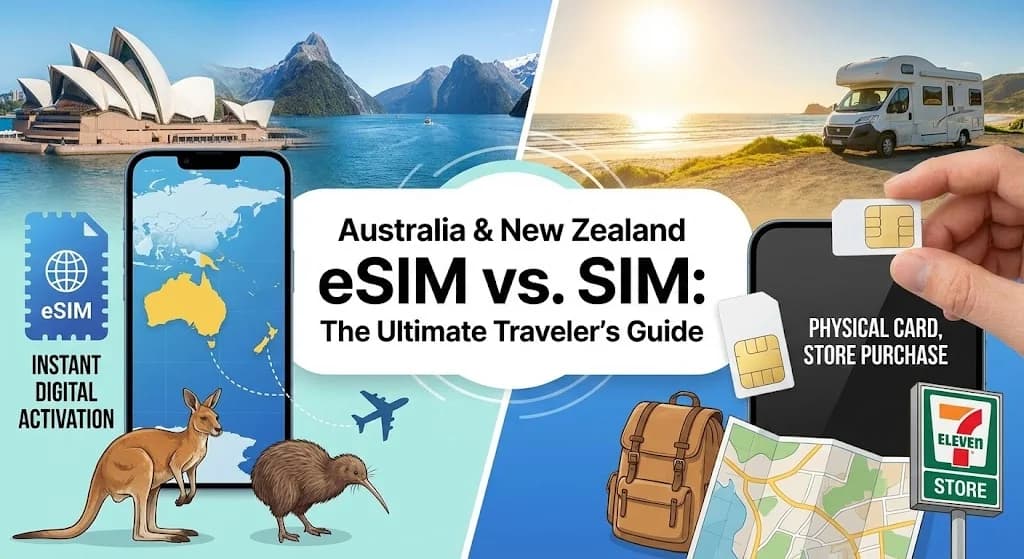
You’ve just endured a marathon flight, and the moment the plane's wheels touch down in Sydney, your mind is already racing. You need to pull up your hotel address, let family know you've arrived safely, and maybe book a rideshare to escape the airport chaos. This is the first critical decision of your trip, and it boils down to one question: what’s the smartest way to get connected?
This guide tackles the core debate for any Down Under adventure: the Australia & New Zealand eSIM vs SIM choice. Do you opt for a single, seamless regional eSIM for both countries, or do you brave the queues to buy local SIM cards twice? The answer isn't just about technology; it's about maximizing your precious vacation time. Before you even pack your bags, it's essential to ensure your phone supports eSIM, as this will be a key factor in your decision.
- Understanding Your Connectivity Choices for Australia & New Zealand
- Regional eSIM for Australia & New Zealand: The Seamless Choice
- Local SIM Cards in Australia & New Zealand: A Dual Approach
- Cost Comparison: eSIM vs. Local SIMs vs. Roaming Down Under
- Network Coverage and Performance Across Australia & New Zealand
- How Much Data Do You Really Need for Your Trip?
- Step-by-Step: Activating Your Cellesim Australia & New Zealand eSIM
- Pro Tips for Seamless Connectivity Down Under
- Frequently Asked Questions
Connect Instantly with a Cellesim Australia & New Zealand eSIM
Skip the airport SIM queue in two countries. Join 50,000+ happy travelers who connect instantly with Cellesim in over 200 countries.
Get Your Australia & NZ eSIMUnderstanding Your Connectivity Choices for Australia & New Zealand
When planning a multi-country trip like Australia and New Zealand, internet access is not just a convenience; it's a necessity for navigation, communication, and sharing your experiences. Travelers typically have three main options for staying connected:
- Regional eSIM: A digital SIM card that covers both Australia and New Zealand under a single plan, activated digitally.
- Local Physical SIM Cards: Purchasing a separate physical SIM card in each country you visit.
- International Roaming: Using your home provider's international roaming services.
Each option presents its own set of advantages and disadvantages, particularly concerning cost, convenience, and flexibility. For this guide, we focus on the most popular and practical choices for modern travelers: regional eSIMs and local SIMs.
Regional eSIM for Australia & New Zealand: The Seamless Choice
A regional eSIM offers a single connectivity solution for both Australia and New Zealand, providing a streamlined experience that many modern travelers prefer. Instead of swapping physical cards or dealing with multiple plans, your digital eSIM profile automatically connects you to local networks in both countries.
Key Benefits of a Regional eSIM for Australia & New Zealand:
- Unmatched Convenience: Purchase and activate your eSIM before you even leave home. Upon landing in Australia (or New Zealand), your phone connects instantly to a local network. When you fly between the two countries, your eSIM automatically switches to the appropriate network without any manual intervention.
- Time-Saving: Eliminate the need to search for local SIM card vendors at airports or in city centers. This frees up valuable vacation time for sightseeing and relaxation.
- Keep Your Home Number Active: An eSIM allows you to retain your primary SIM for calls and texts while using the eSIM for data. This is ideal for receiving verification codes or important communications from home.
- Predictable Costs: eSIM plans are typically prepaid, meaning you know exactly what you're paying for data upfront, with no surprise roaming charges.
- Eco-Friendly: As a digital product, eSIMs reduce plastic waste associated with physical SIM cards.
Considerations for Regional eSIM:
- eSIM Compatibility: Your device must be eSIM-compatible. Most newer smartphones (iPhone XS/XR and later, Samsung Galaxy S20 and later, Google Pixel 3 and later) support eSIM technology. Check our eSIM compatible devices list if unsure.
- Data-Focused: Regional eSIMs primarily offer data services. While some may include a local number or calling minutes, their main advantage is mobile data. For extensive local calls, you might rely on VoIP apps like WhatsApp or Messenger.
Local SIM Cards in Australia & New Zealand: A Dual Approach
Opting for local physical SIM cards means purchasing a separate SIM upon arrival in Australia and then repeating the process when you enter New Zealand. This traditional method has been a staple for travelers for years.
Key Benefits of Local SIM Cards:
- Potentially Lower Cost for Heavy Users: For travelers requiring exceptionally large data allowances or extensive local calling, purchasing a local plan in each country might sometimes offer a slightly lower per-GB rate, especially if you find promotional deals.
- Local Phone Number: Each local SIM will provide you with a local phone number for that specific country, which can be useful for making reservations or contacting local services.
- Wide Availability: Physical SIM cards are readily available at airports, convenience stores, and dedicated telecom shops in major cities.
Considerations for Local SIM Cards:
- Time-Consuming: Acquiring a local SIM card involves waiting in queues, providing identification (passport registration is common), and installation. This process can easily consume 30-60 minutes per country, detracting from your travel time.
- Loss of Home Number: Swapping your physical SIM card means your home number is inactive. This can be inconvenient for receiving important messages, calls, or banking two-factor authentication.
- Logistical Hassle: Managing two separate physical SIMs (and potentially losing them) adds a layer of logistical complexity to your trip. You must remember to switch SIMs when crossing borders and activate a new plan.
- Repeated Process: The entire purchasing and registration process must be repeated in both Australia and New Zealand, doubling the effort.
"For travelers hopping between Australia's vibrant cities and New Zealand's majestic landscapes, the appeal of a single, reliable connectivity solution like an eSIM is undeniable. It truly transforms the cross-Tasman travel experience."
Cost Comparison: eSIM vs. Local SIMs vs. Roaming Down Under
Cost is a significant factor for any traveler. Here's a comparative look at the typical expenses for connectivity in Australia and New Zealand, based on common travel scenarios.
| Option | Price (10 days, 10GB) | Convenience | Home Number | Multi-Country Use |
|---|---|---|---|---|
| Cellesim Australia & NZ eSIM | From $20 - $35 | Instant, seamless | Yes, active | Yes (both AU & NZ) |
| Local SIM (Australia + New Zealand) | Approx. $25 (AU) + $25 (NZ) = $50+ | Requires airport/store visit x2 | No, unless dual-SIM | No (separate SIMs) |
| International Roaming | $10-$15 per day, or $100+ for a plan | Automatic | Yes, active | Yes |
As the table illustrates, Cellesim's regional eSIM provides a highly competitive and often more cost-effective solution when considering the overall value of convenience and seamless connectivity across both countries. While local SIMs might appear cheaper on a per-GB basis for very specific heavy-usage plans, the combined cost and significant time investment for two separate purchases often outweigh the savings.
International roaming, while convenient, remains the most expensive option for extended trips, quickly accumulating significant charges that can inflate your travel budget.
Network Coverage and Performance Across Australia & New Zealand
Understanding network coverage is crucial for a smooth connected experience. Both Australia and New Zealand boast robust 4G LTE networks in populated areas, with 5G rollout continuing in major cities.
Australia's Networks:
- Telstra: Widely recognized for the broadest coverage, particularly in rural and remote areas. Often considered premium, offering excellent speeds.
- Optus: Strong coverage in urban and regional areas, offering competitive speeds and value.
- Vodafone: Excellent coverage in metropolitan areas and along major highways.
Cellesim partners with leading local networks to ensure you receive optimal coverage and performance during your stay. For specific coverage details, you can consult OpenSignal's reports on network performance in Australia.
New Zealand's Networks:
- Spark: New Zealand's largest telecommunications company, providing extensive coverage across the North and South Islands.
- Vodafone NZ: Strong presence in urban centers and popular tourist destinations, offering reliable speeds.
- 2degrees: A growing network with good coverage in main towns and cities, known for competitive plans.
In both countries, coverage can become more limited in very remote or wilderness areas, particularly in national parks or untouched natural landscapes. For backcountry adventures, always download maps offline and inform others of your itinerary.
How Much Data Do You Really Need for Your Trip?
Estimating your data needs is essential to choosing the right eSIM plan. Consider your typical usage habits:
- Light User (1-3 GB for 10-15 days): Primarily for essential navigation (maps), checking emails, light social media, and occasional messaging.
- Moderate User (5-10 GB for 10-15 days): Includes light usage plus more frequent social media, some video streaming, regular web browsing, and occasional video calls.
- Heavy User (15+ GB for 10-15 days): Constant social media, frequent video streaming, online gaming, tethering other devices, and extensive video calls.
Most travelers find that a plan with 5-10 GB of data is sufficient for a 10-15 day trip, especially when leveraging hotel Wi-Fi. Cellesim offers various data packages for Australia and New Zealand, allowing you to select a plan that aligns with your specific needs. You can use our Smart Data Calculator to get a more precise estimate.
Step-by-Step: Activating Your Cellesim Australia & New Zealand eSIM
Activating your Cellesim eSIM is a straightforward process designed for maximum convenience. You can complete these steps before you even depart, ensuring you're connected the moment you land.
- Purchase Your eSIM: Visit cellesim.com and select the Australia & New Zealand eSIM plan that best suits your data needs and trip duration.
- Receive QR Code: After purchase, you will receive an email containing a QR code and detailed installation instructions.
- Install the eSIM:
- iPhone: Go to Settings > Cellular > Add eSIM > Use QR Code.
- Android: Go to Settings > Network & internet > SIMs > Add more > Download a SIM > Scan QR code.
- Configure Settings (Post-Landing): Once installed, you can keep the eSIM active but turn off data roaming for it until you arrive in Australia or New Zealand. Upon landing, enable the eSIM for cellular data and ensure data roaming is ON for the eSIM line.
- Stay Connected: Your phone will automatically connect to the best available local network, providing you with instant internet access.
For a more comprehensive visual guide, refer to our complete eSIM setup guide.
Pro Tips for Seamless Connectivity Down Under
To maximize your connectivity and overall travel experience in Australia and New Zealand, consider these additional tips:
- Download Offline Maps: Before venturing into remote areas or even just exploring a new city, download offline maps (e.g., Google Maps) to ensure navigation capability even without a signal.
- Use Wi-Fi When Available: Save your mobile data by connecting to free Wi-Fi in hotels, cafes, and public hotspots.
- Monitor Data Usage: Regularly check your data usage through your phone's settings or the Cellesim portal to avoid running out unexpectedly.
- Consider a Power Bank: Heavy data usage can drain your phone's battery. A portable power bank is invaluable for keeping your device charged on the go.
- Disable Background App Refresh: To conserve data, turn off background app refresh for apps you don't need constantly active.
Ready for Seamless Connectivity Across Australia & New Zealand?
Choose Cellesim for instant, reliable, and hassle-free internet access throughout your Down Under adventure.
Start Your Connected JourneyTrusted by 50,000+ travelers worldwide. 24/7 Support: [email protected]
Frequently Asked Questions
Can I use my Cellesim Australia & New Zealand eSIM in both countries?
Yes, the Cellesim Australia & New Zealand eSIM is designed for seamless use across both countries. Once activated, it will automatically connect to local partner networks in both Australia and New Zealand, providing continuous data connectivity as you travel between them.
Is my phone compatible with an eSIM for Australia and New Zealand?
Most modern smartphones released after 2018 are eSIM compatible, including newer iPhone models (XS, XR, 11 series and newer), Samsung Galaxy S20 series and newer, and Google Pixel 3 and newer. You can check Cellesim's eSIM compatible devices list or your phone's settings to confirm compatibility.
Will I keep my original phone number with an eSIM?
Yes, one of the main advantages of using an eSIM is that you can keep your primary physical SIM active in your phone. This means your home number remains active for calls and texts, while the Cellesim eSIM provides your data connection in Australia and New Zealand.
How much data do I need for a trip to Australia & New Zealand?
Data needs vary greatly, but most travelers find 5-10 GB sufficient for a 10-15 day trip, covering navigation, social media, messaging, and occasional streaming. If you plan extensive video calls, constant streaming, or tethering, consider a larger plan. Cellesim offers various packages to suit different usage levels.
Can I top up my Cellesim eSIM if I run out of data?
Yes, if you find yourself needing more data during your trip, Cellesim typically offers easy top-up options directly from your account. You can purchase additional data packages online, allowing you to stay connected without interruption.
What if I encounter issues activating or using my eSIM?
Cellesim provides 24/7 customer support via email at [email protected]. If you experience any issues with activation, connectivity, or have questions about your plan, the support team is available to assist you promptly.
Heading there? Compare data plans on our New Zealand eSIM page and install before you fly.