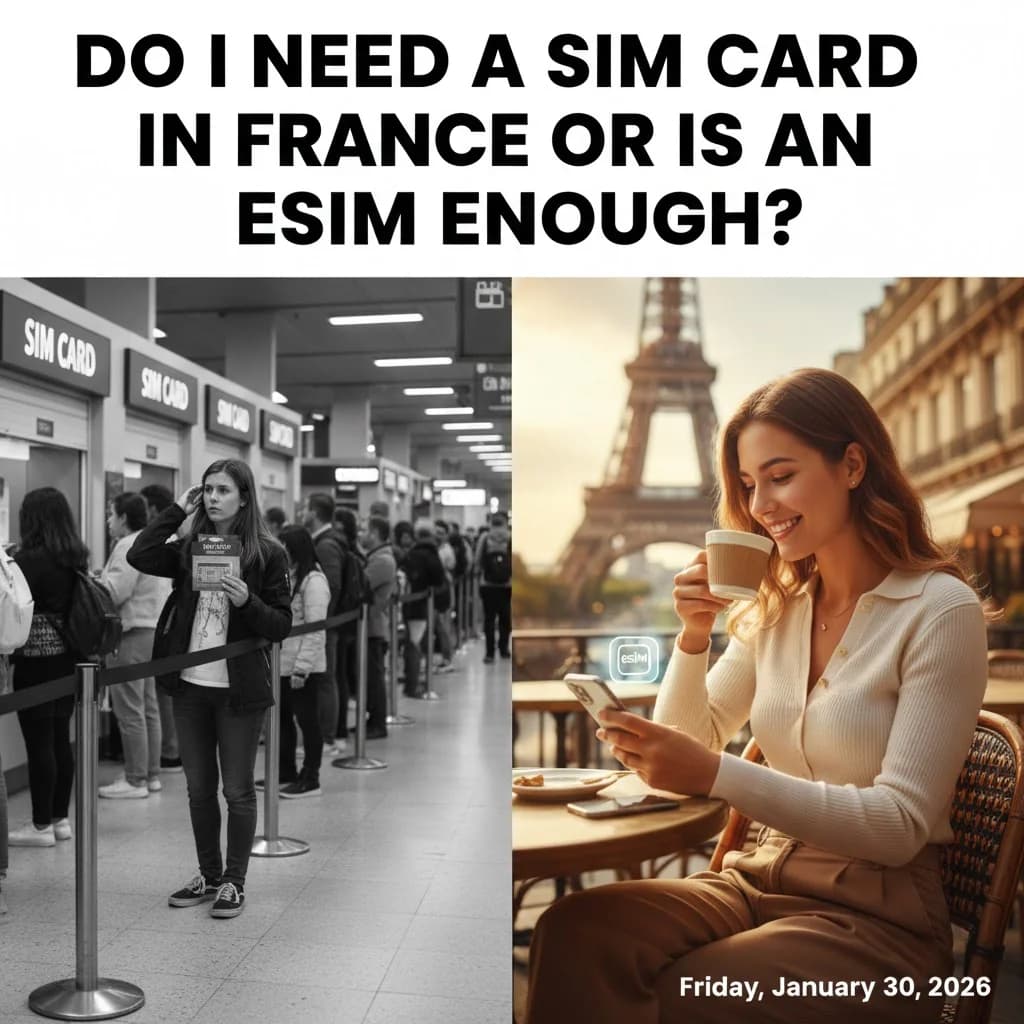
The allure of France, its historic cities, picturesque countryside, and world-class cuisine, is undeniable. Yet, the romance can quickly give way to frustration if you find yourself lost on a Parisian street with no internet connection. For generations, securing a local SIM card was a standard post-arrival ritual, involving airport kiosks, language barriers, and passport registrations. Today, a critical question for modern travelers arises: Is the traditional approach of buying a physical SIM card still necessary, or can a digital eSIM sufficiently meet your connectivity needs?
For most visitors to France, the answer is clear. An eSIM not only provides sufficient connectivity but often offers a superior experience. However, it is not a universal solution. This guide breaks down the real-world scenarios to help you determine which option is best for your French journey.
- Understanding Connectivity in France: eSIM vs. Local SIM
- Benefits of Choosing an eSIM for Your French Trip
- When a Local French SIM Card Might Still Be Your Best Option
- Choosing Your Cellesim France eSIM Plan
- eSIM vs. Physical SIM: A Direct Comparison for France
- Essential Tips for Maximizing Connectivity in France
- Activating Your Cellesim eSIM for France: A Quick Guide
- Conclusion: Is an eSIM Truly Enough for France?
- Frequently Asked Questions
Connect Instantly in France with Cellesim
Skip the airport SIM queues and language barriers. Get online the moment you land. Join 50,000+ travelers in 200+ countries.
Get Your France eSIMUnderstanding Connectivity in France: eSIM vs. Local SIM
Navigating mobile connectivity in a foreign country can be complex. In France, travelers typically face two primary options: a traditional physical SIM card or a modern eSIM. Each presents distinct advantages and disadvantages depending on your travel style and duration.
The Traditional Path: Local SIM Cards
Opting for a physical SIM card in France means purchasing from major carriers such as Orange, SFR, Bouygues Telecom, or Free Mobile. These are typically available at:
- Airport Kiosks: Convenient locations, often found in Relay shops at major airports like Charles de Gaulle, but usually at a premium price.
- Carrier Stores: Found in most city centers, these "boutiques" offer direct assistance, though queues and potential language barriers can be expected.
- Tabacs and Supermarkets: Some tobacco shops (Tabacs) and larger supermarkets like Carrefour or Auchan sell prepaid SIM card starter packs, often requiring self-activation.
A crucial factor when choosing a physical SIM in France is mandatory registration. French law requires you to present your passport for identity verification to activate a SIM card. This security measure adds an extra step to your arrival process, a step many travelers prefer to avoid after a long flight. Before considering this route, it is wise to check if your phone is eSIM-ready.
The Modern Solution: eSIM for France
An eSIM, or embedded SIM, is a digital SIM profile integrated directly into your smartphone. Instead of handling a physical card, you install a data plan by scanning a QR code or following a few simple steps in your device settings. This method offers immediate and significant benefits:
- Purchase and Installation Flexibility: Acquire and set up your eSIM from anywhere in the world, even before you depart for France.
- Instant Connection on Arrival: Your data service activates the moment your plane touches down in France and connects to a local network. This eliminates the need to search for Wi-Fi or a SIM vendor immediately upon arrival.
- Preserve Your Home Number: Your physical SIM card remains in your phone, allowing you to continue receiving calls and important SMS messages (like two-factor authentication codes) on your primary number. The eSIM manages your data connection.
- No Passport Registration Hassle: The purchasing and activation process for most travel eSIMs is entirely digital, circumventing in-person registration requirements.
Benefits of Choosing an eSIM for Your French Trip
An eSIM is more than a technological convenience; it is a practical solution addressing common travel challenges. It provides a reliable and efficient way to stay connected, making it the ideal choice for several categories of travelers seeking internet in France.
Ideal for Short-Term Tourists (1-3 weeks)
For a week-long exploration of Paris, including a weekend excursion to the enchanting Loire Valley, your connectivity needs are focused on navigation, communication, and information access. This includes using mapping apps to find a quaint bistro, Citymapper to navigate the Paris Metro, WhatsApp for sharing experiences, and booking museum tickets on the go. An eSIM is perfectly suited for this. You can select a data package tailored to your trip duration, avoiding the commitment and complexities of a physical SIM. This approach is significantly more economical than relying on expensive international roaming from your home provider. For a comprehensive comparison, consider reading about airport SIM card prices vs. eSIM.
Seamless for Multi-Country European Adventures
If your French journey is part of a broader European itinerary, perhaps a train ride from Paris to Brussels, followed by a flight to Rome, eSIMs truly excel. Rather than acquiring a new SIM card in each country, a regional eSIM plan offers continuous data coverage across numerous countries. A single Cellesim Europe eSIM plan can connect you across 42 countries, making it an excellent choice for multi-country trips. This strategy saves considerable time and money, allowing you to focus on your travels without connectivity interruptions.
Essential for Business Travelers and Digital Nomads
For professionals on the go, uninterrupted connectivity is non-negotiable. An eSIM ensures immediate and reliable access to emails, video conferences, and cloud documents upon arrival. The dual-SIM functionality is particularly valuable: you can maintain your primary business line for crucial calls while leveraging the eSIM for secure, high-speed data, thereby minimizing the risks associated with public Wi-Fi networks in cafes and hotels. It is the preferred choice for maintaining productivity while abroad. Further insights can be found in our guide for modern business travelers.
When a Local French SIM Card Might Still Be Your Best Option
While eSIMs offer extensive advantages, it is important to acknowledge situations where a traditional physical SIM card might be more appropriate. These are niche scenarios, but understanding them ensures you make an informed decision for your specific travel needs.
If You Require a Local French Phone Number
Most travel eSIMs are designed primarily for data, enabling calls and texts through apps like WhatsApp, FaceTime, or Telegram. However, if your trip necessitates making frequent traditional calls to French landlines or businesses that do not use these apps, a prepaid physical SIM from a local French carrier (e.g., Orange, SFR) will typically include a local French phone number (+33) and calling credits. This provides direct access to the local telecom infrastructure for voice communication.
For Extended Stays Beyond Three Months
For individuals relocating to France for study, work, or long-term residency exceeding three months, a short-term travel eSIM becomes less cost-effective over time. In such cases, securing a monthly contract plan (a 'forfait') from a local provider is advisable. These plans typically offer significantly larger data allowances and calling packages at a lower monthly rate, though they often require a French address, a local bank account, and a longer commitment.
If Your Device Lacks eSIM Compatibility
This is the most straightforward limitation. While many modern smartphones released in recent years feature eSIM capability, older models or certain budget devices may not support the technology. If your phone does not have eSIM functionality, a physical SIM card remains your only option. To verify your device's compatibility, you can use an online eSIM checker before your journey.
Choosing Your Cellesim France eSIM Plan
Selecting the right eSIM plan is crucial for a smooth and connected experience in France. Cellesim offers various options designed to meet different travel durations and data requirements. Understanding these choices will help you optimize your connectivity without overspending.
Data Needs for Your French Adventure
Consider your typical data consumption. Will you primarily use maps and messaging apps, or do you plan on streaming content and making frequent video calls? Navigating with maps and basic browsing consumes minimal data, typically a few hundred MBs per day. Streaming high-definition video or engaging in extended video calls, however, can quickly deplete several GBs. Use a tool like our smart data calculator to estimate your usage and select a plan that aligns with your needs, preventing unexpected data depletion or overpayment. For general usage, a 5-10GB plan is often sufficient for a 1-2 week trip, while heavier users might consider 20GB or more.
Plan Duration and Coverage
Cellesim offers flexible plan durations, from short 7-day options ideal for quick city breaks to 30-day plans for more extensive travel. When you choose a Cellesim eSIM for France, you benefit from strong network coverage. Cellesim partners with premium local networks, ensuring reliable 4G/LTE service across urban centers like Paris, Lyon, and Marseille, as well as in many rural areas. For detailed coverage information across the country, referring to the official French telecom regulator's maps (Arcep) can provide additional context. You can find general information on network infrastructure at the Arcep website.
Find Your Ideal France eSIM Plan
eSIM vs. Physical SIM: A Direct Comparison for France
To provide a clear perspective, here is a direct comparison between using a Cellesim eSIM, a local physical SIM, and international roaming from your home provider for a typical trip to France.
| Option | Setup Difficulty | Cost (per GB) | Local Number | Flexibility |
|---|---|---|---|---|
| Cellesim eSIM | Easy (Online) | Low (from $4.50/GB) | No (Data only) | High (Digital, Multi-country) |
| Local Physical SIM | Moderate (In-person) | Medium (Variable) | Yes | Medium (Country-specific) |
| Home Carrier Roaming | Very Easy (Automatic) | Very High ($10-15+/day) | Yes | Low (Very expensive) |
Essential Tips for Maximizing Connectivity in France
Beyond selecting your connectivity method, a few practical steps can ensure your phone is a consistently useful travel companion, rather than a source of frustration.
- Download Offline Maps: Prior to leaving your hotel's Wi-Fi, download offline maps of your planned destinations in apps like Google Maps or Apple Maps. This is invaluable in areas with weak signal, such as metro tunnels or remote parts of Provence, allowing for continuous navigation.
- Understand Network Coverage: France boasts a robust mobile infrastructure, particularly in urban areas. Cellesim collaborates with leading local networks like Orange and SFR, guaranteeing optimal coverage and speed whether you are near the Eiffel Tower or relaxing on the Côte d'Azur.
- Manage Dual SIM Settings: If using an eSIM alongside your physical SIM, take a moment to label them in your phone's settings (e.g., 'Home' and 'Travel eSIM'). Configure your travel eSIM as the primary source for all mobile data. This simple action prevents accidental usage of your home plan and avoids incurring substantial roaming fees. For a complete guide, refer to our eSIM setup guide.
- Secure Public Wi-Fi: While public Wi-Fi is available in many French cities, cafes, and hotels, it is often less secure. For sensitive tasks like banking or accessing personal information, rely on your secure eSIM data connection or use a Virtual Private Network (VPN).
"Staying connected in France with an eSIM meant I could effortlessly navigate the labyrinthine streets of Montmartre and instantly share my experiences, all without the worry of unexpected charges or searching for a local SIM shop."
Activating Your Cellesim eSIM for France: A Quick Guide
Activating your Cellesim eSIM is a straightforward process, designed to get you online quickly and efficiently. Here's a brief step-by-step overview:
- Purchase Your Plan: Visit cellesim.com/en/esim-france and select a data package that suits your travel duration and data needs. Complete the purchase online.
- Receive Your eSIM Details: After purchase, you will receive an email containing a QR code and manual installation details.
- Install the eSIM:
- Scan QR Code: On most smartphones (iPhone, Android), go to Settings > Cellular/Mobile Data > Add eSIM or Add Data Plan, and scan the provided QR code.
- Manual Input: If you cannot scan, choose "Enter Details Manually" and input the SM-DP+ Address and Activation Code provided in your email.
- Label and Set for Data: Once installed, label your new eSIM (e.g., "France Travel") and ensure it is selected for cellular data when you arrive in France. Keep your primary SIM enabled for calls/SMS if desired.
- Arrive in France: Upon landing, your Cellesim eSIM will automatically connect to a local network, providing instant data access.
Conclusion: Is an eSIM Truly Enough for France?
Revisiting our initial question: Do you need to concern yourself with a physical SIM card for your travels in France? For the vast majority of tourists, multi-country adventurers, and business professionals, the answer is a definitive no. A Cellesim eSIM for France is not merely sufficient; it represents a more intelligent, streamlined, and often more cost-effective method of maintaining connectivity.
It transforms the arrival experience in a new country from a potentially stressful scramble for internet access into a smooth, seamless transition. You bypass the queues, language barriers, and bureaucratic paperwork. With Cellesim, you are empowered with instant data access, allowing you to focus on the authentic French experience, avoring every croissant, exploring every museum, and cherishing every moment of your adventure. Before finalizing your travel preparations, take a moment to explore your eSIM options. This small preparatory step can significantly enhance your trip, ensuring you remain connected and free to enjoy France to its fullest.
Ready for Seamless Connectivity in France?
Experience instant, reliable internet across France and beyond. No physical SIMs, no roaming fees, just effortless connection.
Start Your Connected JourneyTrusted by 50,000+ travelers worldwide. 24/7 Support.
Frequently Asked Questions
Is my phone compatible with an eSIM for France?
Most modern smartphones released in the last few years, including recent iPhone models, Samsung Galaxy phones, Google Pixels, and others, are eSIM compatible. You can easily check your device's compatibility using our eSIM checker tool on the Cellesim website.
How much data do I need for a week in France?
For a typical week-long trip, using maps, social media, messaging, and light browsing, a plan with 5-10 GB of data is usually sufficient. If you plan to stream videos or participate in frequent video calls, consider a 20 GB plan or more. Our Smart Data Calculator can help you estimate your specific needs.
Can I keep my original phone number while using a Cellesim eSIM in France?
Yes, absolutely. When you use a Cellesim eSIM for data, your primary physical SIM remains active in your phone. This means you can continue to receive calls and text messages on your home number, while using the eSIM for all your mobile data needs in France.
What if I run out of data on my Cellesim eSIM?
Cellesim makes it easy to manage your data. If you find yourself needing more data during your trip, you can easily top up your existing plan or purchase a new one directly from the Cellesim website or app. This can be done quickly and seamlessly, ensuring you stay connected without interruption.
Is Cellesim reliable in all parts of France?
Cellesim partners with leading mobile networks in France, such as Orange and SFR, to provide extensive 4G/LTE coverage. This ensures reliable connectivity in major cities, popular tourist destinations, and most populated areas across the country. Coverage may vary in very remote or mountainous regions, as with any mobile network.
How does a Cellesim eSIM compare to international roaming from my home provider?
Cellesim eSIMs are significantly more cost-effective than international roaming. While roaming charges from your home provider can quickly accumulate to $10-15 or more per day, Cellesim offers affordable, transparent data plans without hidden fees. With Cellesim, you purchase a specific data allowance for a set period, giving you control over your spending and much better value.