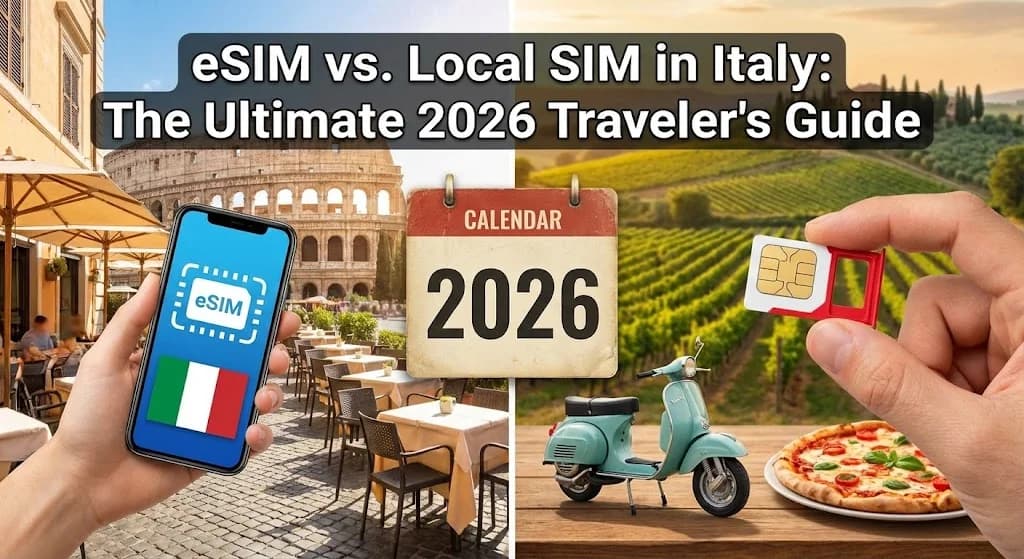
You have just landed at Rome Fiumicino (FCO), the scent of espresso faintly in the air. Your next move? Figure out how to get to your hotel. You pull out your phone to check the train schedule or call an Uber, but then it hits you: no signal. This is the moment every modern traveler faces, the critical first decision that shapes the rest of your trip. The debate over eSIM vs. local SIM in Italy is about more than just data; it is about starting your Italian adventure with seamless ease or frustrating delays. As you plan your 2026 journey, understanding your connectivity options is essential. A reliable travel eSIM for Italy can get you online the second you touch down, letting you navigate like a local from minute one. Many travelers searching for "eSIM Italy review" or "eSIM Italy Reddit" will quickly discover the benefits of this modern approach.
- eSIM vs. Local SIM: Your Arrival Experience in Italy in 2026
- Understanding eSIM Connectivity for Your 2026 Italian Journey
- Navigating Local SIM Cards in Italy: 2026 Considerations
- Cost Comparison: eSIM vs. Local SIM vs. Roaming in Italy 2026
- Network Performance Across Italy: eSIM vs. Physical SIM
- Choosing Your Best Data Plan for Italy: A 2026 Traveler's Guide
- eSIM Activation Steps for a Seamless Italian Trip
- Frequently Asked Questions
Choosing between a digital eSIM and a traditional plastic SIM card can feel complicated, but it does not have to be. One offers instant connectivity purchased from your couch, while the other involves finding a store, navigating a foreign language, and dealing with passport registration. We are here to break down exactly what you can expect in 2026, comparing everything from upfront cost and data speeds on networks like TIM and Vodafone to the sheer convenience of activation. This guide is built on real travel experience to help you make the smart choice for your trip, whether you are heading to the Milan Cortina Winter Olympics or a quiet Tuscan village.
For those who want the highlights, here is a direct comparison of the key factors that matter most to travelers planning their 2026 Italian getaway.
| Feature | eSIM for Italy | Local Italian SIM Card |
|---|---|---|
| Activation | Instant, via QR code before you travel | In-person at airport/store, requires passport |
| Convenience | Very High: Buy and install from home | Low: Requires finding a store, waiting in line |
| Cost | Competitive, transparent pricing upfront | Can be cheap, but watch for airport markups |
| Network Coverage | Excellent: Often connects to multiple top networks (TIM, Vodafone, WindTre) | Good: Locked to one provider's network |
| Phone Number | Usually data-only (use WhatsApp/FaceTime for calls) | Includes a local Italian (+39) number |
| Best For | Most tourists, business travelers, multi-country trips | Long-term stays (3+ months), those needing a local number |
Italy eSIM Plans from $4.50
Connect instantly in Italy without swapping SIMs. Join 50,000+ happy customers in 200+ countries.
Get Your Italy eSIM 🇮🇹eSIM vs. Local SIM: Your Arrival Experience in Italy in 2026
Your arrival in Italy in 2026, whether at a bustling hub like Rome Fiumicino (FCO), Milan Malpensa (MXP), or a smaller regional airport, sets the tone for your trip. With an eSIM, you can step off the plane, turn off airplane mode, and immediately connect. Imagine confirming your taxi, checking your hotel booking, or letting family know you have arrived while still taxiing on the runway. This seamless transition is a huge advantage, especially after a long flight, saving you precious travel time and avoiding stress at crowded arrival halls. The same applies to major train stations like Roma Termini or Milano Centrale, where immediate access to maps and translation apps can be invaluable for navigating onward journeys.
Conversely, opting for a local SIM card means your first task involves navigating airport kiosks or finding a specific carrier store. In 2026, these locations might still present queues, potential language barriers, and the need for passport registration , a process that can take 20 minutes to an hour, diverting time from your actual holiday. Given the increasing number of travelers, especially around major events like the upcoming Milan Cortina Winter Olympics, minimizing time spent on administrative tasks at airports is more crucial than ever. For an "eSIM Italy iPhone" user, the setup is typically straightforward through device settings, eliminating the need for any physical interaction.
Understanding eSIM Connectivity for Your 2026 Italian Journey
An eSIM (embedded SIM) is a digital SIM card that is already built into your smartphone. Instead of physically swapping tiny plastic cards, you activate a data plan by scanning a QR code. This technology has fundamentally changed the game for international travel connectivity, making it the preferred option for many planning a 2026 Italian adventure.
How an Italian eSIM Works for 2026 Travellers
The process is refreshingly simple. You purchase a data plan online from a provider like Cellesim before your trip. You will receive a QR code via email. In your phone's settings, you add a new cellular plan and scan the code. That is it. The plan is installed and ready to go. The moment your plane lands in Italy and connects to a local network, your eSIM activates, and you have instant access to high-speed mobile data. This allows you to immediately use apps for navigation, transport, or communication. Before you purchase, it is always a good idea to check your device compatibility with eSIM technology, though most phones manufactured since 2019 are, including popular "eSIM Italy iPhone" models. Cellesim offers global eSIM plans for over 200 countries, serving over 50,000 customers globally, backed by 24/7 support, ensuring you are covered for your 2026 trip.
Pros of Using an eSIM in Italy in 2026
- Unbeatable Convenience: This is the number one advantage for your 2026 trip. You can be online within seconds of landing, ordering a taxi, or messaging family while you are still on the tarmac. There are no queues at airport kiosks or trips to a Tabacchi shop.
- Keep Your Home Number: Because the eSIM handles your data, your primary physical SIM can remain active for calls and texts from home (just be sure to turn off data roaming on that line to avoid charges). This is perfect for receiving two-factor authentication codes from your bank, which is increasingly important for secure online transactions in 2026. Learn more about keeping your number with an eSIM.
- Superior Network Flexibility: Many travel eSIMs are not locked to a single provider. They can intelligently switch between Italy’s top network, like TIM, Vodafone, and WindTre, to give you the strongest possible signal, whether you are exploring the Colosseum in Rome or hiking in the Dolomites, or even attending events during the Milan Cortina 2026 Olympics.
- Enhanced Security: Your eSIM profile is digital and cannot be physically lost or stolen, unlike a traditional SIM card. This adds a layer of security, especially when traveling through busy areas in 2026.
- Eco-Friendly Choice: With growing awareness around sustainable travel, eSIMs reduce plastic waste associated with physical SIM cards, aligning with greener travel practices in 2026.
Cons of Using an eSIM in 2026
- Device Compatibility: While most modern flagship phones support eSIM, older or budget models might not. It is crucial to check your phone's compatibility before purchasing your Italy eSIM.
- Mostly Data-Only: The vast majority of tourist eSIMs are data-only. This is not a problem for most people who use apps like WhatsApp, FaceTime Audio, or Skype for calls, but if you absolutely need a traditional local phone number to make calls to Italian landlines, this is a consideration.
Navigating Local SIM Cards in Italy: 2026 Considerations
The traditional method involves buying a physical, prepaid SIM card from an Italian mobile provider upon arrival. This has been the go-to for years, but for those traveling in 2026, the process has its own set of challenges and benefits that are worth considering.
How to Get a Local SIM Card in Italy in 2026
You can typically buy a prepaid SIM card for tourists at major airports (like Rome FCO or Milan MXP), dedicated carrier stores (TIM, Vodafone, WindTre) in city centers, or even some larger electronics stores. The process requires you to present your passport for registration, which is a legal requirement in Italy, and remains so in 2026. The store clerk will register your details and activate the SIM for you. This can take anywhere from 20 minutes to over an hour, depending on queues and language barriers, especially during peak tourist seasons or major events like the Milan Cortina Winter Olympics. For a detailed comparison of airport SIMs, refer to our guide on airport SIM vs. eSIM.
Pros of a Local SIM Card for 2026
- Includes a Local Phone Number: The main advantage is that you get an Italian phone number (+39). This is useful if you need to make frequent calls to local Italian landlines or businesses, or if you prefer a traditional number for local contacts.
- Potentially Lower Cost for Long Stays: For extended trips (e.g., three months or more), local prepaid SIM plans can sometimes offer more data for a lower monthly cost than a short-term eSIM, though this varies by provider and promotion.
- Direct Customer Support: If you encounter issues, you can visit a physical store for face-to-face support. This can be reassuring for some travelers, though it also means navigating potentially long waits.
Cons of a Local SIM Card for 2026
- Time-Consuming Activation: The biggest drawback is the time and effort required to purchase and activate. This often involves waiting in line, completing paperwork, and potentially dealing with language barriers immediately after a long journey.
- Passport Registration Required: Italian law mandates passport registration for all SIM card purchases. This adds an extra step and can be cumbersome.
- Physical Swapping: You must physically remove your home SIM card, risking loss or damage. This means you will not receive calls or texts to your primary number while the Italian SIM is in use.
- Locked to One Network: Unlike some eSIMs, a local SIM from TIM, Vodafone, or WindTre will only use that specific network, potentially limiting your coverage in certain areas compared to a multi-network eSIM.
Cost Comparison: eSIM vs. Local SIM vs. Roaming in Italy 2026
Understanding the financial implications of your connectivity choice is vital for your 2026 Italian trip. Prices can fluctuate, but the general cost structures remain consistent for eSIMs, local SIMs, and international roaming.
International Roaming: The Most Expensive Option for Italy
Using your home provider's international roaming plan is almost always the most expensive option. While convenient because it requires no setup, daily roaming charges can quickly accumulate. Many travelers face "bill shock" upon returning home. In 2026, roaming costs can range from $10 to $15 per day, often with limited data allowances or throttled speeds after a small cap. This can easily add hundreds of dollars to your trip expenses. For a more detailed look at roaming costs, check our Roaming Savings Calculator.
Local SIM Cards: Varies by Provider and Promotional Offers
Local prepaid SIM cards from Italian carriers like TIM, Vodafone, and WindTre can offer competitive rates, especially for data. A typical tourist package in 2026 might cost between €20-€35 for 30 days, including 50-100GB of data and some local calls/SMS. However, be aware of activation fees (sometimes €5-€10), which are often not advertised upfront. Airport kiosks may also charge a premium for convenience. These prices can be attractive for longer stays, but the initial hassle and potential for hidden fees must be factored in.
eSIM for Italy: Transparent, Upfront Pricing
eSIM plans for Italy are generally priced transparently upfront, with no hidden activation fees. Prices vary based on data allowance and validity period. For example, a Cellesim eSIM for Italy might cost from $4.50 for a small data package, up to $30-40 for larger bundles suitable for a 15-30 day trip. This allows you to budget precisely and avoid unexpected costs. The convenience of instant activation and avoiding airport queues often justifies the competitive pricing.
| Option | Typical Cost (10 Days, 10GB) | Pros | Cons |
|---|---|---|---|
| Cellesim eSIM | $15 - $25 | Instant activation, Keep home SIM, Flexible plans | Data-only (no local calls) |
| Local SIM (e.g., TIM) | €20 - €35 (with activation) | Local number, High data for longer stays | In-person registration, Time-consuming, Physical SIM |
| International Roaming | $100 - $150+ | No setup | Very expensive, Limited data, Bill shock risk |
Network Performance Across Italy: eSIM vs. Physical SIM
Italy boasts a robust mobile network infrastructure, with the primary carriers being TIM, Vodafone, and WindTre. All three offer widespread 4G LTE coverage across the country, with 5G expanding rapidly in major cities and tourist hubs for 2026. Understanding how eSIMs and local SIMs interact with these networks is crucial for reliable connectivity.
Coverage and Speed with a Local Italian SIM
When you purchase a local SIM card from TIM, Vodafone, or WindTre, you are exclusively tied to that provider's network. Generally, all three offer excellent coverage in urban areas and along major transportation routes. Vodafone and TIM are often cited for having slightly better coverage in more rural or mountainous regions, including parts of the Dolomites or specific areas of Tuscany. Speeds are typically fast, supporting streaming, video calls, and large downloads where 4G/5G is available.
eSIM Performance and Network Flexibility in Italy
Many international eSIM providers, including Cellesim, partner with multiple local networks in Italy. This means your eSIM is not locked to a single carrier. Instead, it can dynamically connect to the strongest available signal from any of the partner networks (e.g., TIM, Vodafone, or WindTre) at your location. This feature can be a significant advantage, particularly when traveling between different regions or in less populated areas where one carrier might have a stronger presence than another. This intelligent switching helps maintain consistent high-speed data access throughout your journey. Your eSIM will typically deliver the same 4G or 5G speeds as a local SIM, leveraging the best available infrastructure.
"During my trip across Italy, from Milan to Sicily, my eSIM automatically switched between networks, ensuring I always had a signal, even in some remote villages. This made navigation and staying in touch effortless." - A recent Cellesim traveler
Choosing Your Best Data Plan for Italy: A 2026 Traveler's Guide
The amount of data you need depends entirely on your travel style and how you use your phone. For your 2026 Italian adventure, consider the following usage estimates:
- Light User (1-3 GB for 7 days): Primarily for navigation, checking emails, messaging via WhatsApp, and occasional social media. Ideal for travelers mostly relying on Wi-Fi at hotels and cafes.
- Moderate User (5-10 GB for 7-15 days): Includes light usage plus regular social media updates, occasional video streaming, and frequent use of translation apps. Good for exploring cities and staying connected on the go.
- Heavy User (15-30 GB for 15-30 days): For those who stream videos frequently, make numerous video calls, upload photos and videos daily, or use their phone as a hotspot. Essential for remote workers or long-term travelers.
Cellesim offers a range of Italy eSIM plans to suit different needs, from short trips to extended stays. Consider your itinerary and planned activities. Will you be relying heavily on Google Maps for driving directions, or mostly walking around cities with downloaded maps? Will you need to stream live sports from home, or simply check social media? Use our Smart Data Calculator to estimate your data needs more precisely.
eSIM Activation Steps for a Seamless Italian Trip
Activating your Cellesim eSIM for Italy is a straightforward process, designed to get you connected quickly and efficiently. Here is a simplified guide for your 2026 trip:
- Purchase Your eSIM: Visit cellesim.com/en/esim-italy and select the data plan that best fits your travel duration and data needs.
- Receive QR Code: After purchase, you will immediately receive an email containing a QR code and detailed installation instructions.
- Install eSIM (Pre-Departure Recommended):
- iPhone: Go to Settings > Cellular > Add Cellular Plan, then scan the QR code. Follow the prompts. Label your new eSIM "Italy" for easy identification.
- Android: Go to Settings > Network & Internet > SIMs > Add more, then scan the QR code. Follow the prompts.
- Arrival in Italy: Upon landing, ensure your new "Italy" eSIM line is turned on and selected for cellular data. Disable data roaming on your primary (home) SIM to avoid unexpected charges. Your phone will automatically connect to the strongest available local network.
- Start Exploring: You are now connected. You can immediately use navigation apps, communicate with family, or book your next train ticket.
For more detailed instructions, refer to our Complete eSIM Setup Guide or our Interactive Setup Guide.
Ready for Seamless Connectivity in Italy?
Choose Cellesim for instant data, transparent pricing, and robust coverage across Italy in 2026. No airport queues, no SIM swapping.
Start Your Connected Italian JourneyTrusted by 50,000+ travelers worldwide. 24/7 Support: [email protected]
Frequently Asked Questions
Can I use my WhatsApp number with an Italy eSIM?
Yes, absolutely. When you use an eSIM for data, your phone's operating system manages your primary phone number independently. As long as your original SIM card (from your home country) remains in your phone, your WhatsApp account will continue to function normally with your existing number, even if you are using the eSIM for all data. This means you do not need to notify contacts of a new number while abroad. For more details, see our guide on keeping your number with a travel eSIM.
Is my phone compatible with an eSIM in Italy?
Most modern smartphones manufactured since 2019 are eSIM compatible, including recent iPhone models (iPhone XS and newer), Samsung Galaxy S series (S20 and newer), Google Pixel phones (Pixel 3 and newer), and many more. It is crucial to check your specific device's compatibility before purchasing an eSIM. You can use our eSIM compatibility checker on the Cellesim website for quick verification.
Can I make calls with an Italy eSIM?
Most tourist-focused eSIMs for Italy are data-only. This means they provide high-speed internet access but do not come with a local Italian phone number for traditional calls or SMS. However, you can easily make calls using data-driven apps like WhatsApp, FaceTime Audio, Skype, or Google Meet, which effectively replace traditional phone calls for most travelers. Your home SIM, if kept active and with roaming data off, can still receive calls and texts to your primary number.
What is the best network in Italy for tourists in 2026?
Italy's primary network, TIM, Vodafone, and WindTre, all offer extensive 4G LTE coverage across the country, with increasing 5G availability in urban areas for 2026. While Vodafone and TIM often have slightly better coverage in more rural or mountainous regions, Cellesim eSIMs often provide the benefit of connecting to multiple partner networks, automatically choosing the strongest signal available. This offers superior flexibility compared to being locked into a single local provider.
When should I activate my Italy eSIM?
It is generally recommended to purchase and install your eSIM before you travel, ideally a day or two before your departure. This allows you to set it up while you have a stable Wi-Fi connection at home. You can then activate the data plan upon arrival in Italy by simply turning on the eSIM line in your phone's settings. This ensures immediate connectivity as soon as you land, saving you time and stress at the airport.
Are there any restrictions on buying a local SIM in Italy as a tourist?
Yes, Italian law requires all SIM card purchasers, including tourists, to register their personal details and present a valid passport at the point of sale. This process is mandatory and applies to all local network providers like TIM, Vodafone, and WindTre. There are no such registration requirements for purchasing and activating an international eSIM.