
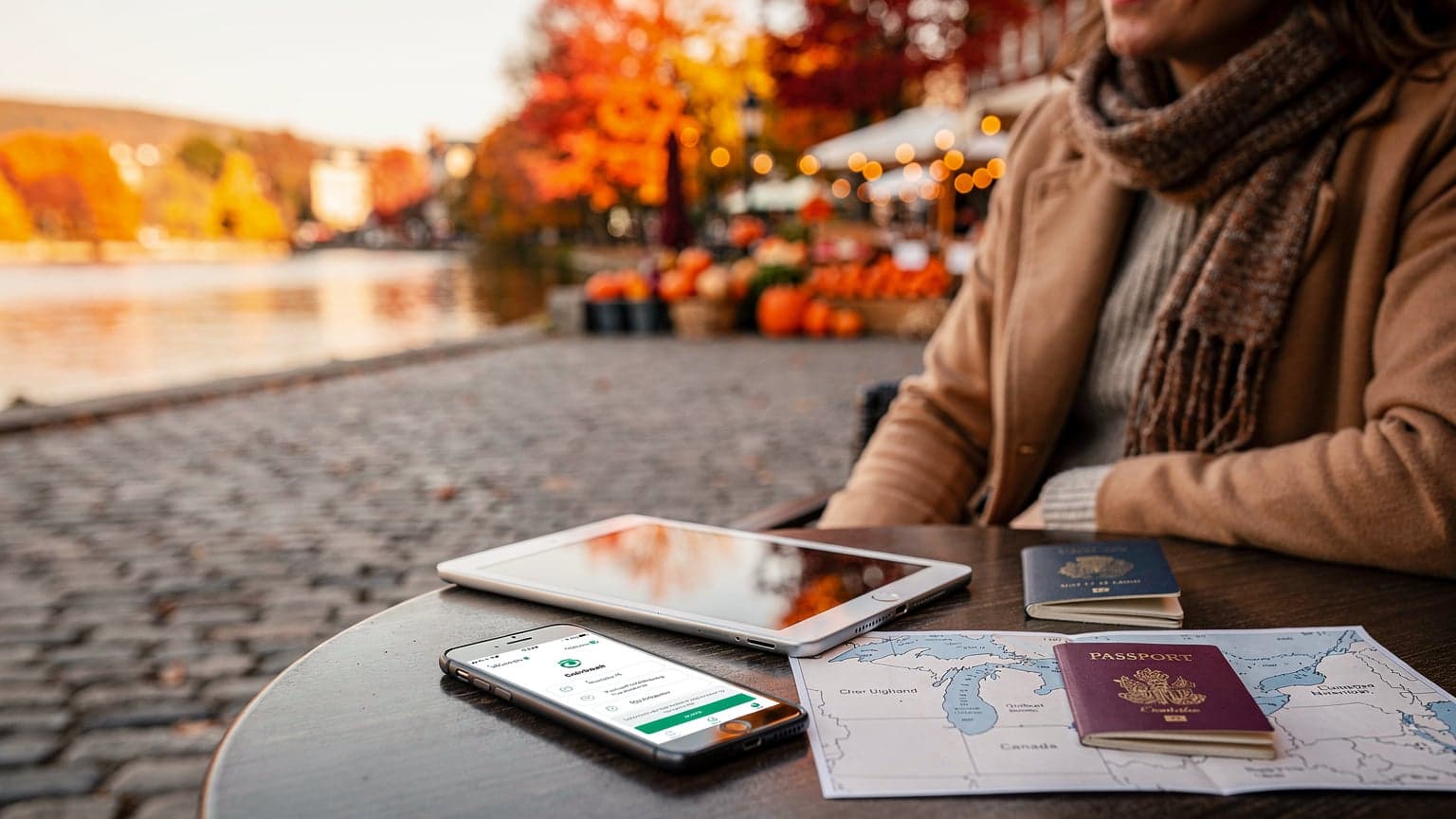
Why Autumn Travel Demands a Smart Connectivity Strategy
The post-summer lull, that sweet spot between the peak tourist season and the winter holidays, is when autumn travel truly shines. You're not fighting massive crowds, the weather's often crisp and pleasant, and the scenery, particularly in places known for fall foliage or harvest festivals, is spectacular. But here's the kicker: while the crowds thin, your need for reliable data doesn't. If anything, it intensifies. You're likely navigating less-beaten paths, checking festival schedules in real-time, or even trying to squeeze in some remote work from a cosy cafe in a small town. This isn't the time for a connectivity gamble.
Traditional roaming plans from UK carriers, particularly after Brexit, remain a wallet drain. I've heard countless stories in my nomad WhatsApp groups about folks getting hit with £10-£15 daily charges for barely touching their data, making a two-week trip easily add another £140-£210 to the bill just for the privilege of checking emails and Google Maps. That's a significant chunk out of your travel budget, money better spent on a good meal or an extra night's stay. The smarter move, proven over my four years on the road, is to get an eSIM for USA travel or a regional plan for Europe.
The Unseen Connectivity Challenges of Shoulder Season
Shoulder season travel has its quirks beyond just fewer people. Some smaller businesses, anticipating the winter slowdown, might have reduced hours or even close for a short break. This means relying more heavily on online information, whether it's checking opening times for a local farm stand or confirming a reservation for a popular vineyard tour. Even finding an open laundromat in a small Vermont town can become an internet-dependent quest. You also find yourself in more remote areas, chasing those perfect leaf-peeping spots, where signal strength can be a real concern. Having an eSIM that leverages the best available local network becomes critical.
Why a Physical SIM Isn't Always the Answer
While a local physical SIM card might seem like the obvious alternative to roaming, it comes with its own set of hassles. Hunting down a SIM card vendor upon arrival, dealing with potential language barriers, and the hassle of swapping out your primary SIM (and then inevitably misplacing it) are all things you can do without when you're fresh off a flight. Plus, some countries, like Brazil, have stringent local SIM registration requirements that often require a local tax ID, making it nearly impossible for short-term visitors. eSIMs, on the other hand, can be purchased and installed before you even leave home, activating the moment you land. It's about frictionless travel, something any seasoned nomad values.
New England Foliage Chasing: Which eSIMs Deliver?
New England in the autumn is iconic. Vermont, New Hampshire, Maine, Massachusetts, and upstate New York transform into a painter's palette of reds, oranges, and golds. But those rolling hills and dense forests, while beautiful, can be notoriously tricky for mobile signal. I've driven through parts of the Kancamagus Highway where even my trusty T-Mobile US physical SIM struggled, let alone relying on a flaky roaming connection. For seamless navigation and uploading those envy-inducing photos, you need an eSIM that taps into the strongest networks available.
Top eSIM Providers for USA Coverage in Rural Areas
When you're deep in the White Mountains or cruising through the Berkshires, coverage is king. In the USA eSIM Guide 2024: Navigating Data Plans and Coverage with Cellesim, we highlighted that carriers like AT&T and Verizon generally offer the most robust coverage in rural American regions. An eSIM that partners with these networks is your best bet. Cellesim's USA plans often leverage these primary networks, which means you're getting the same backbone service without the retail carrier's premium price tag.
| eSIM Provider | Primary Network Partners (USA) | Typical Data Allotments | Best For |
|---|---|---|---|
| Cellesim USA | AT&T, Verizon | 5GB, 10GB, 20GB (30 days) | Reliable coverage, flexible plans for short to medium stays |
| Airalo (USA) | AT&T, T-Mobile | 1GB, 3GB, 5GB (7-30 days) | Budget-conscious, short trips, lighter data users |
| Holafly (USA) | AT&T | Unlimited data (5-90 days) | Heavy data users, long trips, less concerned with cost |
I've personally found Cellesim's coverage in rural Massachusetts and Vermont to be excellent, even when my travel companions on their native T-Mobile plans were spotty. This is often because Cellesim aggregates access to multiple major networks, giving you better chances of a signal. Remember, some apps like certain regional banking apps in the US might require a local US phone number for verification, but for general internet use, an eSIM is perfectly fine.
Data Needs for a New England Autumn Adventure
If you're planning a two-week road trip through New England, navigating with Google Maps, uploading a few dozen high-res photos to Instagram daily, and doing some light browsing, you're looking at around 10-15GB of data. Add in a few video calls to family or an hour or two of Netflix on a rainy evening, and you're pushing 20GB. Don't underestimate the data drain of constant navigation and photo sharing. Always err on the side of more data, especially when you can't easily top up in a remote area. I once ran out of data near Stowe, Vermont, and the nearest place to get WiFi was a Starbucks 30 minutes away, which felt like an eternity when I was trying to find my B&B.
Canadian Autumn: eSIM Options From Maritime to Rockies
Canada's autumn is equally breathtaking, whether you're exploring the colourful landscapes of Quebec and Ontario or heading west to the Rockies. The vastness of Canada means network coverage can vary significantly, especially once you leave major cities. I spent a month in Montreal recently, and while the city itself has excellent connectivity, even a short drive into the Eastern Townships could see signal drop-offs. For those exploring the Maritime provinces or venturing near national parks, a reliable eSIM is non-negotiable.
Best eSIMs for Canadian Connectivity
Canada's mobile network landscape is dominated by three major players: Bell, Rogers, and Telus. Any robust eSIM for Canada will partner with one or more of these. Cellesim typically works with Bell and Rogers, providing a strong backbone for most populated areas and major tourist routes. Their plans are often more flexible than what you'd get directly from a Canadian carrier for a short stay.
| eSIM Provider | Network Partner (Canada) | Data Plans (Typical) | Notes |
|---|---|---|---|
| Cellesim Canada | Bell, Rogers | 5GB, 10GB, 20GB (15-30 days) | Good for nationwide coverage, competitive pricing |
| Airalo (Canada) | Bell | 1GB, 3GB, 5GB (7-30 days) | Solid for urban centres, can be topped up |
| Bytesim (Canada) | Rogers | Unlimited (5-15 days) | Good for short, intensive data use, sometimes speed capped after X GB |
When I was in Montreal, I relied on the WiFi at my co-working space, La Gare, in the Mile End neighbourhood, which had fibre-optic speeds. But for exploring Mont Royal or getting out to Jean-Talon Market, my Cellesim eSIM was invaluable. I also found that some local apps, like those for public transit or certain loyalty programs, didn't strictly require a Canadian number, but having one for food delivery was handy. Rent for a decent 1-bedroom in Mile End was around CAD $1500-1800/month, and my total cost of living, excluding rent, was about CAD $800-1000/month, a significant chunk of which could have gone to roaming fees if I wasn't careful.
Staying Connected in Quebec City and the Maritimes
Quebec City is a European-esque gem, and the Maritimes offer rugged coastal beauty. Both can have pockets of weaker signal, particularly in older stone buildings or remote coastal stretches. For these areas, ensuring your eSIM provider uses a network with strong regional penetration is key. Bell and Telus generally perform better in these more sparsely populated eastern regions compared to Rogers, so an eSIM with Bell access would be my top pick.
European Harvest Festivals: Reliable eSIM for Cultural Immersions
Europe in autumn is a tapestry of harvest festivals, wine celebrations, and Oktoberfest revelries. From the grape harvests in France's Bordeaux region to pumpkin festivals in Germany, there's always something happening. Staying connected is crucial for navigating public transport, translating local menus, and sharing those authentic experiences. Since Brexit, roaming in Europe has become a headache for many UK travellers, making eSIM for European adventures not just convenient, but financially sensible.
Best eSIMs for European Travel 2026
For Europe, I always lean towards regional eSIMs that cover multiple countries, simplifying things immensely. Cellesim's Europe-wide plans are usually a solid bet, partnering with major local carriers across the EU. This means seamless transitions as you cross borders, without the need to switch plans or worry about dead zones. I've used their regional eSIMs extensively, from the bustling markets of Berlin to the quieter vineyards of Tuscany, and found them consistently reliable.
| eSIM Provider | Coverage | Data Plans (Typical) | Key Benefit |
|---|---|---|---|
| Cellesim Europe | 30+ European countries | 10GB, 20GB, 30GB (15-30 days) | Wide coverage, excellent value for multi-country trips |
| Orange Holiday (eSIM) | 30+ European countries | 20GB + unlimited calls/SMS (14 days) | Includes calls/SMS, good for longer stays in France-centric regions |
| Vodafone (Global) | Regional EU plans | 5GB, 10GB (7-14 days) | Reliable network, good for shorter trips focused on one or two countries |
Connectivity for Oktoberfest and German Autumn Events
If you're heading to Oktoberfest in Munich, or any of Germany's numerous autumn wine festivals, connectivity is crucial. Munich's public transport, the MVV, is easy to navigate with their app, but you need data. Last time I was there, I stayed in a flat near Marienplatz for €1200/month, and my Cellesim eSIM on the O2 Germany network was solid even amidst the festival crowds. However, keep in mind that popular festival grounds can sometimes strain network capacity, so having a provider that partners with multiple local carriers (like Cellesim often does) can make a difference. For long-term stays, some German banking apps might require a local SIM for verification, but for tourist purposes, an eSIM is generally fine.
Navigating Italian Grape Harvests With Ease
Italy in autumn, particularly Tuscany or Piedmont, is stunning. The grape harvest is a major event, and you'll likely be driving through picturesque, but sometimes remote, countryside. Google Maps will be your best friend, and for that, you need reliable data. I usually base myself in Florence for a month, paying around €900 for a decent Airbnb in Oltrarno, and take day trips. The WiFi at Ditta Artigianale (via dello Sprone) is consistently excellent, but for exploring, my Cellesim eSIM, leveraging Vodafone IT's robust network, never let me down. It's important to remember that some smaller, artisanal vineyards might not have strong WiFi, so your eSIM will be your lifeline.
The eSIM vs. Local SIM Card Dilemma, Still a Thing in 2026?
For years, the debate raged: local physical SIM or pricey roaming? Now, eSIMs have largely settled that argument for most short to medium-term travellers. But there are still nuances, particularly for those of us who spend months in a single location. The convenience of an eSIM is undeniable, but sometimes a local physical SIM still offers certain advantages, albeit with more friction.
When an eSIM is Your Unquestionable Winner
For most autumn trips, especially those lasting less than a month and involving multiple destinations, an eSIM is the hands-down winner. Here's why:
- Instant Activation: Purchase online, scan a QR code, and you're good to go. No hunting for shops.
- Multi-Country Coverage: Regional eSIMs (like Cellesim's Europe plan) let you cross borders without a hitch.
- Keep Your Primary Number: Your home SIM remains active for calls/SMS, while data comes from the eSIM.
- Cost-Effective: Significantly cheaper than traditional roaming from UK carriers, particularly for EU travel, as detailed in Summer 2026: Ditch Roaming Fees, Embrace eSIM for European Adventures.
- No Physical Swapping: Reduces the risk of losing your home SIM.
Edge Cases: When a Local SIM Might Still Be Preferred
While I'm a huge eSIM advocate, I concede there are a few scenarios where a local physical SIM might still edge it out:
- Very Long Stays (3+ Months): If you're settling in for an extended period, a local SIM might offer better long-term package deals, though Cellesim is starting to bridge this gap.
- Local Phone Number Requirements: Some countries, like India with its Aadhaar system or certain Brazilian banks, absolutely require a local phone number registered in your name for various essential apps or services. If you plan to open a bank account or use specific government apps, a physical SIM is often unavoidable due to KYC (Know Your Customer) regulations.
- Unlimited Data Needs (Truly Unlimited): While eSIMs offer generous data, some local physical SIMs might provide truly unlimited data without any soft caps or speed throttling, which can be useful if you're tethering extensively or downloading huge files.
Navigating Carrier Roaming Charges: A Post-Brexit Reality Check
For UK travellers, the post-Brexit return of roaming charges from major networks like EE, Vodafone, and O2 has been a rude awakening. What used to be seamless travel across Europe now comes with a hefty daily fee. This isn't just an inconvenience, it's a significant additional cost that most holidaymakers and business travellers don't factor in until it's too late. As a UK Business Travel & Roaming Analyst for Cellesim, I've seen firsthand how these charges quickly accumulate.
The True Cost of UK Carrier Roaming in 2026
Let's be blunt: roaming with your UK network in Europe is expensive. Most major UK carriers now charge between £2-£10 per day for roaming in the EU. For US travel, it can be even worse, often £10-£15 a day for limited data. Consider a two-week trip to Italy for a harvest festival. At £5/day, you're looking at an extra £70. At £10/day, that's £140. This isn't enterprise-grade connectivity, it's simply paying for the convenience of using your home number, a convenience that an eSIM can replicate for data at a fraction of the cost. The data allowances are usually meagre too, often just a few gigabytes before you're charged extra. For a deeper dive into how Cellesim stacks up against traditional carriers, check out Verizon eSIM vs. Cellesim: The Smart Traveler's Escape from $10/Day Roaming in 2026.
"I got hit with a £90 bill after a week in Spain, just from forgetting to turn off data roaming on my EE contract. Never again. eSIM is non-negotiable now." - Sarah, fellow nomad in my Lisbon WhatsApp group.
Why eSIMs are the Smart Alternative for UK Travelers
eSIMs offer a clear escape route from these punitive charges. By purchasing a dedicated data plan for your destination or region, you pay a fixed, upfront cost for a generous data allowance. There are no hidden fees, no daily charges that suddenly appear on your bill, and you get to keep your main UK SIM active for any essential calls or texts (though receiving these is usually free). This hybrid approach gives you the best of both worlds: local data rates and your familiar number. It's the practical, no-bullshit solution I recommend to everyone in my network, particularly those concerned about post-Brexit roaming costs.
Setup Guide: Installing Your eSIM for Stress-Free Autumn Travel
One of the biggest advantages of an eSIM is how straightforward it is to install, even for those who aren't tech-savvy. You can set it up before you even leave home, ensuring you land with instant connectivity. This is a crucial step for preventing those initial moments of panic when you're trying to find your way from the airport to your Airbnb without data.
Step-by-Step eSIM Installation on iOS
For iPhone users, the process is incredibly streamlined:
- Purchase Your eSIM Plan: Go to the Cellesim website (or your chosen provider), select your destination/region (e.g., USA eSIM), choose your data package, and complete the purchase. You'll receive a confirmation email with a QR code or manual installation details.
- Access eSIM Settings: On your iPhone, go to Settings > Cellular (or Mobile Data) > Add eSIM.
- Scan QR Code: Tap "Use QR Code" and scan the QR code provided in your Cellesim email. If you're installing from the same phone you're viewing the QR code on, you'll need to use the "Enter Details Manually" option and copy-paste the SM-DP+ Address and Activation Code.
- Label Your eSIM: Once scanned, your phone will prompt you to label your new eSIM (e.g., "Travel USA", "Europe Data"). This helps differentiate it from your primary SIM.
- Set Default Line for Data: You'll then be asked to choose which line to use for Cellular Data. Select your newly installed eSIM. Make sure your Primary line is set to "Off" for Cellular Data while roaming, or simply set it for "Voice & SMS Only" if you want to receive calls.
- Activate When You Land: Your eSIM is now installed. You can keep it off until you land in your destination country. Once you arrive, simply go back to Settings > Cellular > select your eSIM, and toggle it to "On". Ensure Data Roaming is enabled for the eSIM (it usually is by default).
Android eSIM Installation Walkthrough
Android devices also offer a straightforward eSIM installation, though menu names might slightly vary by manufacturer (Samsung, Google Pixel, etc.):
- Purchase Your eSIM Plan: As with iOS, buy your plan from Cellesim and receive your QR code/manual details.
- Navigate to Network Settings: Go to Settings > Network & internet > SIMs (or Mobile network).
- Add New SIM: Look for an option like "Add eSIM" or "Download a SIM".
- Scan or Enter Details: Choose to scan the QR code from your email. If prompted for manual entry, input the SM-DP+ Address and Activation Code.
- Configure eSIM: Once the eSIM profile is downloaded, label it clearly (e.g., "Canada Trip").
- Set Data Preference: In the SIMs/Mobile network settings, select your new eSIM for "Mobile data" or "Preferred SIM for data". Ensure your home SIM's data roaming is off.
- Enable Upon Arrival: Keep the eSIM disabled until you're in your destination. Then, toggle it on in your SIM settings.
Optimising Your eSIM Data Usage on the Road
You've got your eSIM, you're connected, but data isn't infinite. Even generous plans can get chewed through quickly if you're not mindful, especially when you're relying on it for everything from navigation to entertainment. I've been caught out before, thinking 10GB would be plenty for a month, only to burn through it in two weeks because I forgot about background app refreshes. Here's how to make your data last.
Essential Data-Saving Tips for Travelers
These are the habits I've cultivated over years of trying to make my data stretch:
- Download Offline Maps: Before you head out, download the relevant regions in Google Maps or Maps.me. This saves huge amounts of data on navigation.
- Limit Streaming: Netflix, YouTube, Spotify, and similar services are data hogs. Download content onto your device via WiFi before you leave your accommodation or a cafe with good WiFi (like The Daily Grind in downtown Burlington, Vermont, where I often worked).
- Disable Background App Refresh: Go into your phone settings and turn off background refresh for most apps. Only leave it on for essential communication apps.
- Turn Off Auto-Downloads: Disable automatic downloads for app updates, photos to cloud services, and email attachments when on mobile data.
- Use WiFi Whenever Possible: Always connect to secure WiFi networks in your accommodation, co-working spaces (like Betahaus in Berlin, where I've had zero issues with their dedicated member WiFi), or cafes.
- Monitor Data Usage: Regularly check your phone's data usage settings to see which apps are consuming the most data. This helps you identify and curb data-hungry habits.
The Best Apps to Download for Offline Use
Beyond maps, several apps offer robust offline capabilities that are a lifesaver for data conservation:
- Translate Apps (Google Translate, DeepL): Download language packs for offline translation.
- Travel Guides (Lonely Planet, Rick Steves): Many offer offline access to guides and maps.
- E-readers/Audiobooks: Download your books and podcasts before you leave.
- Cloud Storage (Google Drive, Dropbox): Make important documents available offline.
What to Do When Your eSIM Flips Out: Troubleshooting Tips
Even with the best eSIMs, things can occasionally go sideways. It's rare, but it happens. Maybe you're not getting a signal, or your data seems to have vanished. Don't panic. Most issues are easily resolved with a few simple steps. I've had my share of connectivity woes in various corners of the world, and these are my go-to fixes.
Common eSIM Problems and Quick Fixes
When your eSIM isn't playing nice, try these first:
- Check Data Roaming Settings: Double-check that data roaming is enabled for your eSIM profile in your phone's cellular settings. This is the most common oversight.
- Restart Your Phone: The age-old IT solution. A quick reboot can often resolve temporary network glitches.
- Toggle Airplane Mode: Turn on Airplane Mode for 30 seconds, then turn it off. This forces your phone to re-scan for networks.
- Verify APN Settings: Sometimes, the Access Point Name (APN) needs to be set manually. Your eSIM provider (like Cellesim) will usually provide these details in their FAQ or support documentation. Go to your eSIM's cellular settings, find APN, and enter the correct information. (Often, it's simply 'internet'.)
- Manually Select Network: If your eSIM isn't automatically connecting to a network, try manually selecting one. In your cellular settings, look for 'Network Selection' and choose one of the available partner networks for your eSIM provider.
- Check Data Balance: Log into your Cellesim account (or your provider's app) to confirm you haven't run out of data.
When to Contact Customer Support
If the above steps don't work, it's time to reach out to your eSIM provider's customer support. Have your order number, phone model, and a detailed description of the issue ready. Cellesim offers 24/7 support, which is crucial when you're in a different timezone and relying on connectivity. Don't waste hours trying to fix something that might be a backend issue on their end. Knowing when to ask for help saves you a lot of frustration and wasted time. You can also check the Cellesim FAQ for common issues.
Final Thoughts on Your Autumn 2026 Connectivity Plan
Autumn travel, with its unique blend of scenic beauty and cultural events, deserves a connectivity plan that's as reliable and effortless as the season itself. Ditching the anxiety of exorbitant roaming charges from your home carrier and embracing the flexibility of an eSIM is, frankly, a no-brainer for any savvy traveller. Whether you're chasing the vibrant hues of New England, exploring the vast Canadian wilderness, or immersing yourself in European harvest festivals, an eSIM ensures you stay connected, navigate with ease, and share your experiences without a second thought.
My four years on the road have taught me that reliable data isn't a luxury, it's a fundamental tool for smooth travel. From confirming restaurant bookings to translating a local dialect, or even just finding the nearest open co-working space (like The Hub in Portland, Maine, which has surprisingly good coffee and fast WiFi), an eSIM is your digital lifeline. So, as you plan your post-summer escape for autumn 2026, make sure a Cellesim eSIM is at the top of your packing list. It's the practical, no-fuss solution that keeps you connected to what truly matters.
Frequently Asked Questions
What is the best eSIM for travel in New England for autumn 2026?
For New England's fall foliage, Cellesim USA plans are highly recommended as they typically partner with major networks like AT&T and Verizon, which offer robust coverage in rural areas. This ensures reliable data for navigation and photo sharing, even in less populated regions like the White Mountains.
Can I use an eSIM for Canadian autumn travel, especially in remote areas?
Yes, eSIMs are excellent for Canadian autumn travel. Providers like Cellesim Canada partner with primary networks such as Bell and Rogers, offering strong coverage across major cities and popular tourist routes, including parts of Quebec and the Maritimes. Always check your specific plan's network partners for the best regional coverage.
How do eSIMs compare to traditional roaming for European harvest festivals?
eSIMs are significantly more cost-effective than traditional roaming from UK carriers for European travel post-Brexit. For example, a Cellesim Europe plan offers a fixed, upfront cost for generous data across multiple countries, avoiding the daily roaming fees (often £5-£10/day) charged by networks like EE or Vodafone.
Do I need a local physical SIM card for any specific apps or services in Europe or North America?
For most tourist activities, an eSIM provides all the necessary data connectivity. However, some specific local apps, particularly certain banking or government services (like India's Aadhaar or some Brazilian banks), may require a local physical SIM card registered to a local phone number for verification purposes. For general travel, an eSIM is usually sufficient.
What's the typical data usage for a two-week autumn trip in the USA or Europe?
For a two-week trip involving navigation, photo uploads, social media, and some light streaming, you should budget for at least 10-15GB of data. If you plan on frequent video calls, heavy streaming, or extensive tethering, consider a 20GB+ plan. Always download offline maps and media to conserve data.
What should I do if my eSIM isn't connecting or providing data?
First, ensure data roaming is enabled for your eSIM profile and restart your phone. If that doesn't work, toggle airplane mode, check your APN settings against your provider's instructions, or try manually selecting a network operator. If the issue persists, contact your eSIM provider's 24/7 customer support with your details.