Heading to Canada in 2026? Get ready for an amazing trip, whether you're hitting up big cities like Toronto and Vancouver or diving into the wild beauty of the Rockies. To truly soak it all in, you'll need to stay connected. Think about it: finding your way around new places, sharing those "wish you were here" moments, or just looking up a good local poutine spot, it all needs reliable mobile data. This guide will show you why an eSIM for Canada is your must-have travel buddy, keeping you online from the moment your plane lands.
No more hunting for local SIM cards or dreading those crazy roaming charges. With Cellesim, grabbing your Canada eSIM is quick and easy. That means you can spend less time stressing about your phone and more time planning your adventures, from exploring Quebec City's history to hiking in Banff National Park. We'll cover everything you need to know about getting online in Canada, with practical tips and a look at why Cellesim gives you the best bang for your buck and solid coverage for your 2026 trip.
- Canada Travel Overview 2026: Why Visit Now?
- Connectivity & Network Coverage Across Canada
- How to Get Your Cellesim eSIM for Canada
- Top Canadian Cities & Regions: Connectivity Tips
- Airport Arrival: Get Connected Instantly in Canada
- Day Trips & Nearby Destinations with eSIM Coverage
- Local SIM vs. eSIM vs. Roaming: An Honest Canada Comparison
- Your Canada Connectivity Budget: What Tourists Spend on Data
- Practical Travel Tips for Canada (2026 Edition)
- Beyond Canada: Related Destinations & Multi-Country eSIM Options
- Frequently Asked Questions

Canada Travel Overview 2026: Why Visit Now?
Canada in 2026 is a fantastic mix of stunning nature, buzzing cities, and top-tier experiences. From British Columbia's Pacific coast to the Atlantic shores, you'll find all sorts of landscapes and activities. When to visit really depends on what you want to do. Summer (June to September) is perfect for outdoor fun like hiking in the Canadian Rockies, exploring national parks, and city festivals. If you're into winter sports, December to March is prime time for skiing and snowboarding in places like Whistler Blackcomb or Banff, or just enjoying a cozy winter vibe in cities like Montreal or Quebec City.
Spring (April-May) and Fall (October-November) bring milder weather, fewer crowds, and gorgeous seasonal changes, making them great for city trips and scenic drives. No matter the season, Canada is huge, so good planning is essential. The country spans six time zones and has vast distances between its main attractions. A smart travel plan will include efficient transport and reliable communication. Canada is known for being safe and welcoming, and with a good exchange rate for many international currencies, it's a tempting place to visit in 2026. Grabbing an eSIM for Canada will seriously boost your ability to navigate, chat, and make the most of your adventure across this incredible country.
Connectivity & Network Coverage Across Canada
Canada's mobile networks are pretty advanced, especially in and around its main cities. Bell, Rogers, and Telus are the big players, all offering solid 4G LTE and rapidly growing 5G coverage. In cities like Toronto, Vancouver, Montreal, Calgary, and Ottawa, you can expect excellent high-speed internet, often hitting 25-70 Mbps, with 5G pushing those speeds even higher. That means smooth streaming, quick downloads, and clear video calls.
However, Canada is massive, and its northern regions are pretty empty. So, network coverage can get spotty or disappear completely in remote wilderness areas, especially far from major roads or towns. While over 90% of urban residents have good service, venturing into places like the Yukon, Northwest Territories, or deep into national parks like Banff or Jasper might mean weaker signals or only 3G. Cellesim works with the best local networks to give you the widest possible coverage in Canada. If you're planning a lot of rural travel, it's always a good idea to check your specific route or destination. But for most tourist itineraries, major routes and attractions are well-covered. Even public transport, like Toronto's TTC subway, is getting more cellular coverage, making commutes easier for those with a Canada eSIM.
How to Get Your Cellesim eSIM for Canada
Getting a Cellesim eSIM for your 2026 Canada trip is super easy and gets you online instantly. Forget about hunting for a local shop or waiting in airport lines. Here's how you can get set up in just a few minutes:
- Head to Cellesim.com: Go straight to our Canada eSIM page.
- Pick Your Plan: Choose the data plan that fits your trip length and how much data you expect to use. Cellesim has options for everyone, from short city breaks to longer Canadian adventures.
- Buy It Securely: Complete your purchase safely using major payment methods like credit/debit cards, PayPal, and Alipay. Prices are often shown in your local currency, which is handy.
- Get Your eSIM: Within minutes of buying, a QR code and clear installation steps will land in your email inbox.
- Activate Your eSIM: Scan the QR code with your eSIM-compatible phone (check our supported devices page if you're not sure). Installation usually takes less than two minutes. Just remember to activate your eSIM when you're ready to use data, ideally as you arrive in Canada, or right before your flight if you want to be online immediately.
- Enjoy Instant Connection: Once installed, turn on your Cellesim eSIM, and you'll connect to Canada's reliable local networks right away. Now you can use your phone for maps, social media, staying in touch, and more, all without worrying about roaming fees or finding Wi-Fi.
Top Canadian Cities & Regions: Connectivity Tips
Canada's big cities usually have excellent eSIM connectivity, thanks to the strong networks of Rogers, Bell, and Telus. But knowing a few regional specifics can make your trip even smoother:
- Toronto (YYZ): As Canada's biggest city, Toronto offers comprehensive 4G LTE and 5G coverage. You'll have perfect signal downtown, all across the Greater Toronto Area, and even on the growing TTC subway lines. It's great for using Google Maps to explore spots like Kensington Market or calling an Uber.
- Vancouver (YVR): On the West Coast, Vancouver has equally fantastic urban coverage. Enjoy fast speeds for uploading photos from Stanley Park or finding your way through busy Gastown. The signal can even be strong on ferries heading to Vancouver Island, though it might dip in very remote inlets.
- Montreal (YUL) & Quebec City: In Canada's French-speaking heartland, connectivity is strong. Montreal's Metro system is well-covered, and Quebec City's historic district will have no issues. Expect reliable service for translating menus, finding charming cafes, or staying in touch while you explore Old Montreal or the Plains of Abraham.
- Banff & Canadian Rockies (YYC nearby): While towns like Banff and Canmore have good coverage, and major highways through the national parks are generally covered, deep hiking trails or remote backcountry areas will likely have no signal. Always download offline maps and critical info before heading into the wilderness. For emergencies, 911 should still work if any signal is available.
- Niagara Falls: You'll get strong connectivity here. Sometimes, you might even pick up US network signals near the border. You'll have no problem sharing your Niagara Falls photos instantly or checking attraction times.
A Cellesim Canada eSIM taps into these top networks, giving you consistent internet where you need it most as a tourist.
Airport Arrival: Get Connected Instantly in Canada
Landing in Canada, especially at big airports like Toronto Pearson (YYZ), Vancouver International (YVR), or Montreal-Trudeau (YUL), is usually when travelers first realize how important immediate internet access is. Sure, these airports offer free Wi-Fi, but it can be slow, unreliable, or a pain to log into, adding extra stress after a long flight. This is exactly where your Cellesim eSIM for Canada really shines.
Imagine this: you land, walk off the plane, and instead of fumbling for change for an airport SIM or wrestling with a public Wi-Fi portal, your phone just connects to a fast local network. With your eSIM pre-activated and ready, you can immediately:
- Book a ride: Use apps like Uber or Lyft without any delays.
- Find your hotel: Open Google Maps for directions to your accommodation.
- Tell folks you're safe: Send a quick message on WhatsApp or iMessage to let family know you've arrived.
- Access travel documents: Pull up hotel bookings, rental car details, or tour tickets stored on your phone.
Counting solely on airport Wi-Fi is a gamble. It's often shared by thousands of travelers, leading to slow speeds and frustration. Plus, public Wi-Fi networks can sometimes be a security risk. A personal eSIM connection is not just faster and easier, but also more secure for your private data. Cellesim makes sure you hit the ground running, connected and in control, the second you land at any Canadian airport.
Explore Canada with Seamless Connectivity in 2026
Don't let connectivity worries hold you back. Get your Cellesim eSIM for Canada and enjoy instant data across cities and stunning landscapes. Join 50,000+ travelers worldwide.
Buy Your Canada eSIM Now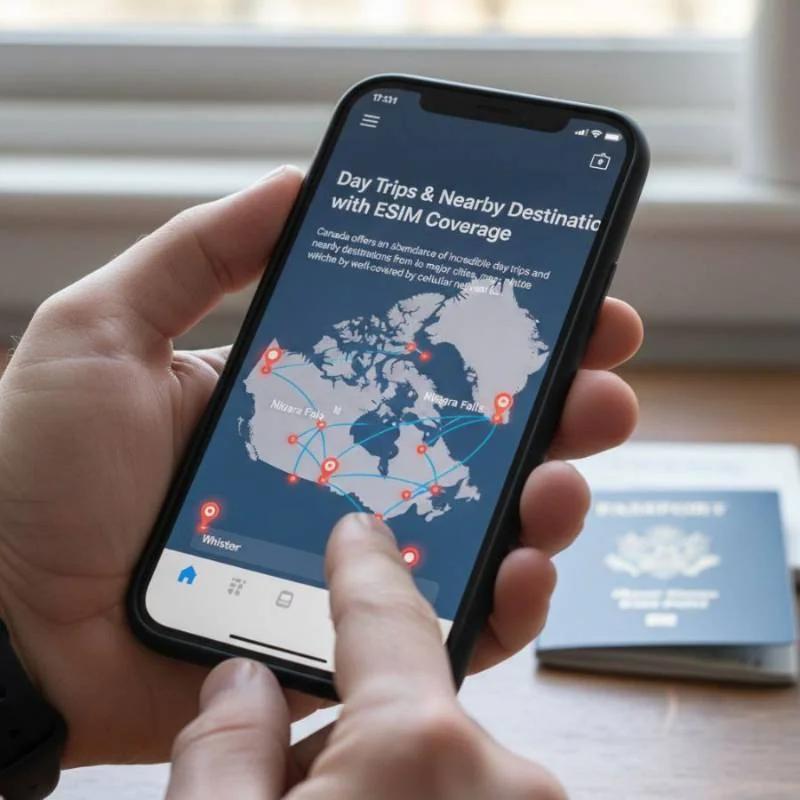
Day Trips & Nearby Destinations with eSIM Coverage
Canada is packed with amazing day trips and close-by destinations from its major cities, and many of these spots have good cell service. Your Cellesim eSIM Canada will keep you connected even when you leave the city limits:
- From Toronto:
- Niagara Falls: Just a 90-minute drive, and connectivity is solid. You can easily share stunning photos of the Horseshoe Falls and navigate the beautiful Niagara-on-the-Lake wine region.
- Muskoka: This "Cottage Country" offers incredible lake views. Main towns like Bracebridge or Huntsville have good coverage, but expect service to drop off as you get deeper into the woods or across large lakes.
- From Vancouver:
- Whistler Blackcomb: A world-class spot for skiing and mountain biking. The village and mountain slopes have excellent coverage, but some remote trails might be patchy.
- Victoria (Vancouver Island): You can get here by ferry, and British Columbia's capital has strong network coverage for exploring gardens and historic sites. Ferries usually have decent signal for most of the trip.
- From Montreal & Quebec City:
- Mont-Tremblant: This popular ski resort and village offers good connectivity for snapping slopeside selfies and keeping track of your group.
- Eastern Townships: Known for its vineyards and charming villages. Main roads and towns are well-covered, perfect for winery tours with GPS.
While city areas are consistently strong, remember that Canada's huge wilderness can still be a challenge for connectivity. For longer trips into national parks or very remote areas, always download offline maps and maybe let someone know your itinerary. If your multi-country trip takes you south, check out eSIM for the United States options to stay connected across the border.
Local SIM vs. eSIM vs. Roaming: An Honest Canada Comparison
When you're planning how to stay connected for your 2026 Canada trip, you basically have three choices: buying a local physical SIM card, using international roaming from your home provider, or grabbing a Cellesim eSIM for Canada. Here's a straightforward comparison:
Local SIM Card: Canada's mobile plans are famously pricey, among the highest globally. A prepaid tourist SIM often costs CAD 40-60 or more just for a modest data package. Plus, you have to find a store and maybe even show ID. While you do get full local speeds, the cost and setup hassle are big turn-offs.
International Roaming: This might seem easy, but roaming is usually the most expensive choice. Many carriers charge USD/GBP 10-15 per day for a "travel pass," which often comes with a small data cap (like 500MB) before your speeds get throttled. Over a longer trip, these costs can quickly explode, leading to that dreaded "bill shock" when you get home. Also, be aware of common issues like the ghost roaming trap.
Cellesim eSIM: A Cellesim Canada eSIM strikes the perfect balance of affordability, ease, and performance. You buy your plan online before you even travel, activate it digitally, and connect to Canada's best networks at local speeds. Prices are much lower than roaming or local tourist SIMs, and you keep your main physical SIM active for calls and texts from your home number. Other providers like Airalo ($5 for 1GB/7d), Holafly ($22 for Unlimited/5d), and Ubigi ($7 for 1GB/30d) also offer eSIMs, but Cellesim consistently aims for competitive prices and great customer support in 24 languages.
Your Canada Connectivity Budget: What Tourists Spend on Data
Figuring out your data usage is key to budgeting for your Canada trip. While Cellesim offers great prices for Canada eSIM plans, knowing how much data you actually need helps you avoid overspending or running out. Here's a general idea of how much data different activities use:
- Light User (1-3 GB for 7 days): Perfect for checking maps occasionally, light social media browsing (iMessage, WhatsApp), and checking emails. This is enough if you plan to use hotel Wi-Fi whenever it's available.
- Moderate User (5-10 GB for 7-14 days): Good for frequent navigation, regular social media updates, occasional video calls (like FaceTime or WhatsApp video), and light music streaming. This suits most active tourists who want to stay connected all day while exploring.
- Heavy User (10+ GB for 14+ days): If you're going to stream a lot of video, make many video calls, use your phone as a personal hotspot for other devices (eSIM personal hotspot), or work remotely, a bigger data package is a good idea.
To give you a clearer picture: 1 GB of data generally covers:
- About 10-12 hours of Google Maps navigation.
- Around 50 hours of browsing websites.
- Roughly 3-4 hours of standard definition video streaming.
- About 20 hours of scrolling through social media (Facebook, Instagram).
- Around 3 hours of video calls on apps like WhatsApp or FaceTime.
Considering that local Canadian SIM cards are very expensive (CAD 40-60 for even a little data), Cellesim's eSIMs offer significant savings. For instance, a 10GB Cellesim plan for Canada might cost around USD 20-30 for 30 days, which is much better value than a tiny local SIM or daily roaming fees. Use our Smart Data Calculator on Cellesim.com to help figure out what you'll need.
Practical Travel Tips for Canada (2026 Edition)
To make sure your 2026 trip to Canada is smooth and fun, here are some essential tips, with a special focus on staying connected:
- Visa & Entry: Many international visitors need an Electronic Travel Authorization (eTA) to fly to or pass through Canada. Make sure to apply well in advance through the official Canadian government website Canada.ca.
- Currency & Payment: The Canadian Dollar (CAD) is the official currency. Credit and debit cards (Visa, MasterCard, American Express) are widely accepted. Contactless payments (Apple Pay, Google Pay, Interac) are very common, especially in cities. It's always a good idea to carry some cash for smaller vendors or emergencies.
- Tipping Culture: Tipping is customary and expected in Canada, just like in the US. A standard tip for good service in restaurants, bars, and for taxis is 15-20%. Remember to factor this into your budget.
- Power Plugs: Canada uses Type A and B sockets (two flat parallel pins, or two flat parallel pins with a grounding pin). The standard voltage is 120 V and the frequency is 60 Hz. Bring the right adapters for your gadgets.
- Emergency Numbers: For any emergency (police, fire, ambulance), dial 911 from any phone, including your mobile with an active Canada eSIM.
- Transportation: Big cities like Toronto, Vancouver, and Montreal have efficient public transit. For traveling between cities, consider VIA Rail Canada trains or long-distance buses. Renting a car gives you flexibility for rural areas, but be ready for long drives and changing road conditions depending on the season. Your eSIM will be a lifesaver for GPS navigation.
- Safety: Canada is generally a safe country. Still, take normal precautions, especially in busy tourist spots. Be aware of your surroundings, keep your valuables safe, and avoid walking alone in dimly lit areas at night.
- Staying Connected: Always check that your eSIM for Canada is active and has enough data. Public Wi-Fi is available but can be insecure; think about using a VPN when on public networks. For critical info, always download offline versions of maps and documents.

Beyond Canada: Related Destinations & Multi-Country eSIM Options
Canada's huge North American presence makes it a common starting point or a piece of a bigger multi-country adventure. Many travelers combine a trip to Canada with a visit to its southern neighbor, the United States, or explore other North American regions. For staying connected across several destinations, Cellesim offers convenient regional eSIM plans.
If your adventure includes a visit to the United States, you can easily find eSIM for the United States plans on Cellesim.com. This keeps your data going as you cross the border, without needing to switch providers or buy a new SIM. For even wider coverage, consider a North America 3 Countries eSIM from Cellesim, which usually covers Canada, the United States, and Mexico. This is a perfect solution for big road trips or visits spanning multiple countries in the region, ensuring you're always connected, whether you're finding your way around New York, exploring the Rockies, or relaxing on Cancun's beaches.
Cellesim makes multi-country travel simpler by providing flexible plans that fit your itinerary. You can manage all your data needs from one easy-to-use eSIM. Check our website for all the country and regional eSIM options available for your 2026 travels.
Stay Connected Across the Globe with Cellesim eSIM
Explore 200+ countries with reliable, high-speed data. Instant setup, 24/7 support, and no roaming fees. Your perfect travel companion.
Explore All eSIM PlansJoin 50,000+ satisfied customers worldwide.
Frequently Asked Questions
What eSIM is best for Canada in 2026?
The best eSIM for Canada in 2026 really depends on how much data you need and how long you're staying. Cellesim offers a variety of plans that use Canada's top networks (Bell, Rogers, Telus) for dependable 4G LTE and 5G service. Our plans are well-priced and super easy to activate, making them a top choice for most travelers.
Can you get an eSIM for Canada?
Yes, absolutely! eSIM technology is fully supported in Canada, and Cellesim offers smooth eSIM plans for travelers. You can buy and activate your Canada eSIM online in minutes, getting a QR code via email for quick setup on your compatible device.
Will my American eSIM work in Canada?
An eSIM bought for the United States typically won't work in Canada unless it's a specific North America regional plan that clearly includes Canada. If you have a US-only eSIM, you'll need to buy a separate Canada eSIM or a North America multi-country eSIM to have service north of the border. Cellesim offers both single-country Canada eSIMs and regional North America plans.
What are the disadvantages of eSIMs when traveling?
While eSIMs have tons of perks, there are a couple of small things to keep in mind: your phone needs to be eSIM-compatible and unlocked (most newer smartphones are). Also, if you lose or damage your device, you might need to reinstall your eSIM on a new phone. But generally, these downsides are pretty minor compared to the convenience, cost savings, and dual SIM benefits.
How much data do I need for a week in Canada?
For a typical 7-day trip to Canada in 2026, a moderate user will probably need 5-10 GB of data. This allows for frequent use of maps, social media, occasional video calls, and light streaming. If you plan on a lot of video streaming or using your phone as a hotspot, consider a 10GB+ plan. Light users who rely on hotel Wi-Fi might be fine with 3-5 GB. Use Cellesim's Smart Data Calculator to help figure out your exact needs.
Is it better to get a local SIM or eSIM for Canada?
For most travelers in 2026, an eSIM is generally a better choice than a local physical SIM in Canada, mainly because of the cost and convenience. Canadian local SIM plans are notoriously expensive for tourists (often CAD 40-60+ for limited data). An eSIM, like those from Cellesim, can be bought online for less, activated instantly, and lets you keep your home number active, saving you from physical SIM swaps and airport queues.
See also: how to activate an eSIM
See also: Mexico eSIM
See also: Toronto eSIM
See also: Vancouver eSIM