Planning a North America road trip in 2026? You're in for an incredible adventure, whether you're cruising through the USA, exploring Canada's vastness, or soaking up Mexico's culture. But before you hit the road, there's one big question: how will you stay connected? We're talking about everything from navigating unfamiliar routes and sharing updates with friends to booking your next motel. Good internet access isn't a luxury anymore; it's a must-have.
This guide will help you decide between an eSIM or a traditional physical SIM card. Both get you online, but they offer very different experiences, especially when you're crossing borders. For a truly easy experience with great coverage, take a look at Cellesim's North America eSIM plans. They're built to keep you online from one coast to the other.
- Understanding Connectivity Options for Your 2026 North America Journey
- The Advantages of Using an eSIM for Your North America Road Trip in 2026
- Local SIM Cards: Pros and Cons for USA, Canada, and Mexico Travel in 2026
- Cost Comparison: eSIM vs. Local SIMs for North America Road Trippers 2026
- Coverage and Speed Across North America in 2026: What to Expect
- Ease of Setup and Activation: eSIM vs. Physical SIM Cards for Travelers
- Maintaining Your Home Number: Dual SIM Functionality and Messaging
- Specific Considerations for Each North American Country (USA, Canada, Mexico)
- Recommendations for Your 2026 North America Road Trip Connectivity
- Frequently Asked Questions
Understanding Connectivity Options for Your 2026 North America Journey
A smooth North America road trip in 2026 really comes down to having dependable mobile internet. Picture this: you're trying to find a gas station in a remote part of Montana, looking for the best tacos in Mexico City, or checking border wait times for Canada, all without an internet connection. Nobody wants that headache on vacation.
Luckily, you have two main ways to stay online: the physical SIM card we've all used for ages, and the newer, more flexible eSIM. Both give you data, but how you get them, manage them, and what they mean for your travel experience are quite different, especially when you're jumping between the USA, Canada, and Mexico. Knowing these differences is key to planning your communication strategy before you even start your engine.
The Advantages of Using an eSIM for Your North America Road Trip in 2026
For a trip like a North America road trip, which spans multiple countries, eSIMs are a game-changer for staying connected. First off, they're incredibly convenient. Instead of hunting down local SIM card shops when you arrive in the USA, Canada, or Mexico, you can buy and activate an eSIM digitally, often before you even leave home. This means your data is ready to go the moment you land, so you can immediately use maps, call a ride, or tell people you've arrived.
For example, Cellesim sends your eSIM QR code right to your email in just minutes. Second, eSIMs are perfect for multi-country travel. Instead of buying a separate physical SIM for each country, one regional eSIM plan can cover all three: the USA, Canada, and Mexico. It's a single, simple package. No more swapping cards, dealing with different phone companies, or juggling various local plans. With Cellesim, you get consistent coverage in over 200 countries, including specific USA eSIM, Canada eSIM, and Mexico eSIM options. Plus, with dual SIM capability, you can keep your regular physical SIM active for calls and texts, and use the eSIM just for data, keeping your main phone number always on hand.
Local SIM Cards: Pros and Cons for USA, Canada, and Mexico Travel in 2026
Traditional local SIM cards still have their uses, but they bring some distinct headaches for road trippers crossing borders in North America. In the USA, big carriers like AT&T, T-Mobile, and Verizon offer prepaid SIMs with solid data plans. Canada has providers like Rogers, Bell, and Telus, and in Mexico, Telcel, AT&T Mexico, and Movistar are the main players. The best part of a local SIM is often getting more data for your money in that specific country, plus a local phone number, which can be handy for local contacts or services.
However, for a multi-country road trip, the downsides really pile up. First, you have to physically buy these SIM cards, which usually means finding a store, waiting in line, showing ID, filling out forms, and then actually swapping your SIM. This eats up valuable travel time, especially after a long flight, or if you're in a remote area without a phone store nearby. Second, local SIMs only work in their own country. A US SIM won't work in Canada or Mexico without racking up expensive roaming fees. This forces you to repeat the whole buying and activation process in each new country, adding cost and a lot of logistical stress. This is a stark contrast to the simple, unified connection you get with a regional eSIM.
Stay Connected Across USA, Canada, and Mexico in 2026
Get seamless data for your entire North America road trip with a single Cellesim eSIM. Join 50,000+ travelers worldwide.
Get Your North America eSIM Now 🌍Cost Comparison: eSIM vs. Local SIMs for North America Road Trippers 2026
When you're planning your 2026 North America road trip budget, knowing the real cost of staying connected is crucial. Regular international roaming from your home carrier can be shockingly expensive, with many charging $10-$15 or more per day for limited data and calls. For a two or three-week trip, these daily passes can quickly add up to hundreds of dollars, creating a huge, unexpected bill. This is where eSIMs really shine financially.
Cellesim's regional North America eSIM plans are designed to give you affordable data across multiple countries without any hidden roaming fees. Instead of buying one local SIM for the USA, another for Canada, and a third for Mexico, you can get one eSIM package with a set amount of data that works for your whole trip across all three nations. While prices change, eSIM providers consistently offer better value for cross-border travel compared to buying multiple local SIMs or paying outrageous roaming fees. This way, you avoid bill shock and can budget your mobile data more accurately. To see just how much you can save, read our guide on eSIM vs International Roaming.
Coverage and Speed Across North America in 2026: What to Expect
On a North America road trip in 2026, your phone's connection will depend on where you are. Generally, cities and suburbs in the USA, Canada, and Mexico have strong 4G LTE and increasingly widespread 5G. Major carriers in these countries have put a lot of money into their networks. For instance, in the USA, T-Mobile and AT&T have vast 5G coverage in cities, and their 4G networks work well in many rural spots. Canada's big providers, Rogers, Bell, and Telus, offer excellent speeds along major highways and in populated areas, though you'll lose service in truly remote wilderness.
In Mexico, Telcel is known for its broad coverage, especially in tourist areas and along main roads, with 5G growing in bigger cities. The good news for eSIM users is that providers like Cellesim team up with these top local networks. This means you get the best signal and speeds available, without trading performance for convenience. Whether you pick an eSIM or a local physical SIM, your actual coverage and speed will depend on the local network where you are. But an eSIM lets you tap into these strong local networks without the hassle of buying a physical SIM from each carrier. For more on our network partners, see How Our Network Works.
Ease of Setup and Activation: eSIM vs. Physical SIM Cards for Travelers
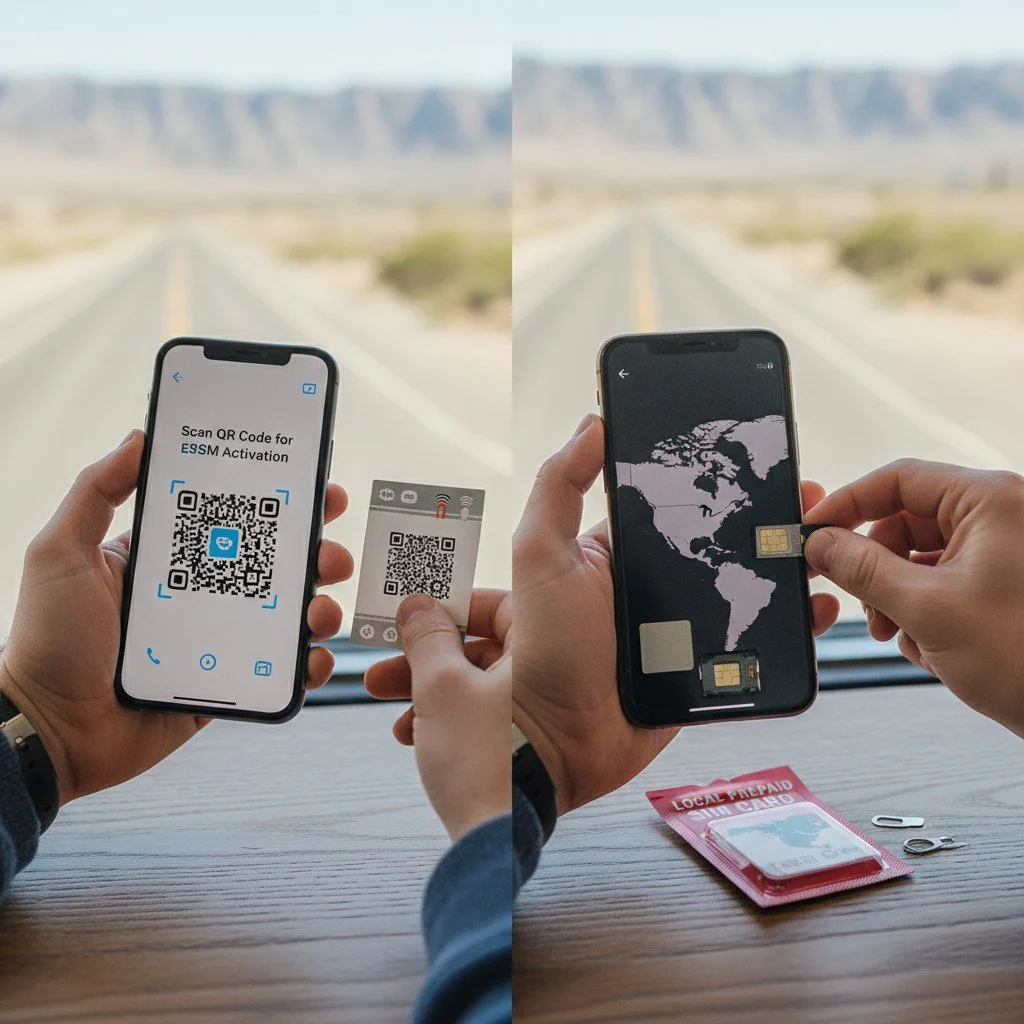
Getting your phone connected while traveling is a huge difference between eSIMs and physical SIM cards, especially on a multi-country road trip. With a traditional local SIM, you start by hunting for a mobile store, waiting in line, showing ID, filling out forms, and then physically swapping your home SIM for a new local one. This can be really annoying when you've just arrived in a new country and just want to get going, or if you're crossing a border somewhere remote without a phone store nearby. Activation delays, tech glitches, or unexpected registration rules can make things even worse.
eSIM activation, on the other hand, is designed to be simple and fast. After you buy an eSIM plan online from a provider like Cellesim, you get a QR code in your email within minutes. To set it up, you usually just scan this QR code with your phone's camera and follow a few steps on the screen. The whole thing takes just a couple of minutes, meaning you can have data active before you even leave the airport or cross into the next country. This instant, digital delivery and activation means no physical lines or paperwork, which is incredibly convenient for the dynamic nature of a North America road trip. Our Interactive Setup Guide has step-by-step instructions.
Maintaining Your Home Number: Dual SIM Functionality and Messaging
One of the biggest perks of an eSIM, especially for travelers, is how well it works with dual SIM functionality. Most newer smartphones with eSIM technology let you use both a physical SIM card and an eSIM at the same time. This means you can keep your main home number, linked to your physical SIM, active for important calls or texts, while using your travel eSIM purely for high-speed data. This setup is incredibly valuable for keeping in touch with family, getting bank alerts, or accessing two-factor authentication codes without missing crucial communications.
On the flip side, choosing a local physical SIM means taking out your home SIM, which temporarily turns off your primary number. While apps like WhatsApp might still work over the new data connection, you won't get traditional calls or texts to your home number. This can be a real hassle for both personal and work connections. The eSIM option ensures you keep full access to your home number for calls and texts, using it only when necessary, while relying on the eSIM for all your data needs, like navigation, social media, and streaming. Learn more about this feature in our guide on how to use Dual SIM on iPhone for travel.
Specific Considerations for Each North American Country (USA, Canada, Mexico)
While a regional eSIM makes staying connected easier, understanding each North American country's quirks can improve your 2026 road trip. The United States has a massive mobile network, with widespread 5G in cities and dependable 4G on most interstates. However, some remote national parks or desert areas might still have patchy signal. If you're thinking about local SIMs, remember that sales tax on phone services varies by state, which affects the final price. In Canada, mobile data has historically been more expensive than in the USA, so competitive eSIM plans are even more appealing. Coverage is excellent in cities and along major roads like the Trans-Canada Highway, but it drops off significantly in vast wilderness and northern regions.
Mexico has its own things to consider. Telcel, the biggest carrier, offers impressive coverage across much of the country, especially in popular tourist spots and central areas. However, buying a local SIM in Mexico might involve a slightly more involved registration process for foreigners compared to its northern neighbors. While urban areas have strong 4G and growing 5G, rural and mountainous regions can have spotty service. A regional North America eSIM plan effectively links these different national networks, giving you a smooth data experience that handles varying carrier landscapes without a hitch. This means border crossings won't interrupt your mobile data.
Recommendations for Your 2026 North America Road Trip Connectivity
For anyone planning a North America road trip in 2026, an eSIM is the clear winner for easy, affordable, and convenient connectivity. Its digital nature means no more fumbling with physical SIM cards, making border crossings between the USA, Canada, and Mexico smooth and uninterrupted. The ability to keep your home number active while still getting affordable data plans is a huge plus, ensuring you're connected for both personal chats and vital travel needs. While local SIMs might offer a bit more data for less within a single country, the combined cost and headache of buying and managing three separate physical SIMs far outweigh any small savings for a multi-country trip.
Cellesim offers an excellent solution with its dedicated North America eSIM plans, covering all three nations. With 24/7 email support in 24 languages and instant digital delivery, Cellesim makes sure you're ready for your adventure. Whether you're just sightseeing or you're a business traveler, an eSIM simplifies your digital life on the road. This frees you up to focus on North America's stunning scenery and rich experiences. Pick an eSIM for a truly modern and stress-free way to stay connected.
Comparison Table: eSIM vs. Local SIMs for a North America Road Trip (2026)
Explore Cellesim eSIM Plans for Any Destination
Stay connected in 200+ countries with Cellesim's flexible and affordable eSIM plans. Instant setup, global coverage, 24/7 support.
Explore All eSIM Plans ✈️Trusted by 50,000+ travelers worldwide for seamless global connectivity.
Frequently Asked Questions
Are eSIMs better than physical SIMs for travel in 2026?
For most international travelers, especially those doing multi-country trips like a North America road trip, eSIMs are generally better than physical SIMs in 2026. They offer incredible convenience with instant digital delivery, mean you don't have to swap cards, and let you keep your home phone number. eSIMs also tend to be cheaper for regional travel compared to buying many local SIMs or paying expensive roaming fees.
Is it better to get a local or regional eSIM for a North America road trip?
For a North America road trip that includes the USA, Canada, and Mexico, it's definitely better to get a regional eSIM. A single regional eSIM plan, like those from Cellesim, gives you continuous data across all three countries, making your trip much smoother. If you got separate local eSIMs for each country, you'd have to manage multiple plans and possibly different expiration dates, which can be a pain when you're frequently crossing borders.
What are the downsides of using a US eSIM for an entire North America trip?
The main drawback of using just one US eSIM for a whole North America trip (meaning Canada and Mexico too) is that you'd likely get hit with international roaming charges from the US carrier when you cross into Canada or Mexico. A US-specific eSIM is made to work only within the United States. For continuous and affordable connection across all three countries, a dedicated North America regional eSIM is the way to go.
Is it worth getting an eSIM when traveling in 2026?
Absolutely. Getting an eSIM for travel in 2026 is totally worth it. You get instant internet as soon as you arrive, avoid the hassle of finding and putting in physical SIM cards, steer clear of outrageous roaming fees, and can keep your primary phone number active. For a multi-country adventure like a North America road trip, an eSIM is a smart, modern way to stay connected without any fuss.
How do I activate a Cellesim eSIM for my road trip?
Activating your Cellesim eSIM is super easy. After you buy your plan online, you'll get a QR code by email in just a few minutes. Just open your phone's settings, go to "Cellular" or "Mobile Data" (it might be named slightly differently depending on your phone), and pick "Add eSIM" or "Add Data Plan." Scan the QR code, follow the on-screen steps to name your plan, and turn it on for data. You can even do this before you leave for your trip. For a full step-by-step guide, check out how to buy an eSIM online.
Can I use my Cellesim eSIM for hotspot tethering?
Yes, Cellesim eSIMs generally let you use personal hotspot tethering. This means you can share your data connection with other devices like laptops, tablets, or other smartphones. This feature is super handy for working remotely, keeping travel buddies connected, or giving internet access to devices without their own data plan during your North America road trip. Just make sure your device supports hotspot functionality. For more info, check our guide on how to use your eSIM personal hotspot.