

 eSIM Destination
United Arab Emirates eSIM
Burj Khalifa observation deck, desert safari livestream, your eSIM towers above roaming.
Operators in United Arab Emirates
1 carrier supported
- Du5G
Highest generation per operator is displayed; some plans may use a fallback band based on local conditions.
Free VPN with your eSIM
Every active Cellesim eSIM comes with a free VPN. Browse securely on public Wi-Fi and reach the apps you rely on from anywhere, at no extra cost and with no separate signup.
Best eSIM for United Arab Emirates in 2026
Looking for the best eSIM for United Arab Emirates? Cellesim is a top pick for travelers thanks to transparent pricing, fast 4G/5G coverage, and instant activation. Plans start from $4.50 for United Arab Emirates eSIM data. Rated 4.4/5 across 420 verified customer reviews. Compare features below and see why Cellesim consistently ranks among the best value eSIM options for international travelers.
- Transparent prices — no account needed
- Enterprise-grade network backbone
- 24/7 multilingual support
Frequently Asked Questions
Yes, WhatsApp calls, FaceTime video/audio, Messenger calls, Instagram calls, and Telegram calls are blocked in Dubai (UAE) due to government regulations. The UAE government's regulations specifically block all video and voice calls over IP (VoIP), meaning services like WhatsApp calls, FaceTime video/audio, Messenger calls, Instagram calls, and Telegram calls will not connect. Even iMessage calls are affected by these restrictions.
However, your high-speed data plan will work perfectly for almost everything else you need to do online. You'll be able to stay connected and navigate your trip with ease:
- Text Messaging (WhatsApp, iMessage, Telegram) works perfectly.
- Sending Voice Notes works perfectly.
- Google Maps, Uber, Careem, and all navigation apps work.
- Instagram, Facebook, TikTok, and all social media browsing/posting work.
If you absolutely must make a voice or video call, you will need to use a VPN. It's highly recommended to install your VPN application and set it up before you arrive in the UAE.
Planning the trip? See our Dubai eSIM plans, install in one tap before you fly, and land online. Free VPN included.
Yes, 100% easier. Buying a physical "Tourist SIM" at Dubai (DXB) or Abu Dhabi (AUH) airport requires you to find the Du/Etisalat kiosk, wait in very long queues, and go through a mandatory passport and biometric (fingerprint/face scan) registration process. Our eSIM is 100% digital, requires no ID registration or biometrics, and can be installed before you fly. You will be connected the moment you land, ready to order an Uber.
No, absolutely not. The UAE is NOT part of the EU, UK, or US domestic plans. Most home carriers (like AT&T, Verizon, T-Mobile, or UK's Vodafone/O2) will charge you their highest "Rest of World" international "Day Pass" rates (e.g., $10-$15 per day). A Cellesim eSIM is a one-time prepaid fee that is significantly cheaper.
This specific plan is valid only within the UAE. This is a critical point. If you are on a multi-country Gulf trip and drive to Oman or fly to Saudi Arabia/Qatar, your connection will stop at the border. For this, we highly recommend our Middle East Regional eSIM to stay connected seamlessly in all countries.
Yes, in key areas. Our eSIM connects to the premium networks (Du/Etisalat), which have excellent 4G/5G coverage that extends far from the cities. You will have a strong signal at all major desert safari camps (for uploading your sunset photos) and along the main highways. You may only lose signal temporarily if you drive into the deepest remote dunes, far from any roads.
Yes. Careem and Uber are the primary ways to get around Dubai and Abu Dhabi, and reliable data is essential to book rides safely without cash.
Yes. Coverage is surprisingly good even at the "At the Top" observation decks of the Burj Khalifa, allowing you to livestream the view from the world's highest building.
Yes. The United Arab Emirates has one of the fastest mobile networks in the world, and our eSIM connects to high-speed 5G in downtown Dubai and Marina.
Yes. You will have excellent coverage throughout Abu Dhabi, including inside Ferrari World on Yas Island and at the Sheikh Zayed Grand Mosque.
Most flagship smartphones released since 2018-2019 support eSIM, including iPhone XS and newer, Google Pixel 3 and newer, and Samsung Galaxy S20 series and newer. Tablets, smartwatches and an increasing number of laptops also support eSIM. The fastest way to verify your specific device is to check Settings , if you see "Add eSIM" or "Add cellular plan" as an option, you're compatible.
eSIM compatibility is now standard across the high-end smartphone market and rapidly spreading into mid-range devices. Cellesim works with any unlocked, eSIM-capable device , no special configuration needed beyond scanning the QR code we send you.
iPhones with eSIM support
- iPhone XS, XS Max, XR (2018) , first iPhones with eSIM (one physical SIM + one eSIM).
- iPhone 11, 11 Pro, 11 Pro Max (2019).
- iPhone 12, 12 mini, 12 Pro, 12 Pro Max (2020).
- iPhone 13, 13 mini, 13 Pro, 13 Pro Max (2021) , supports two active eSIMs simultaneously.
- iPhone 14, 14 Plus, 14 Pro, 14 Pro Max (2022) , US versions are eSIM-only (no physical SIM tray).
- iPhone 15, 15 Plus, 15 Pro, 15 Pro Max, iPhone SE 3 and later , full eSIM support.
Google Pixel with eSIM support
- Pixel 3 / 3 XL and all later models (Pixel 4, 4a, 5, 5a, 6, 6 Pro, 6a, 7, 7 Pro, 7a, 8, 8 Pro, Pixel Fold).
Samsung Galaxy with eSIM support
- Galaxy S20, S20+, S20 Ultra, S20 FE (2020) , first Galaxy with eSIM.
- Galaxy S21 / S22 / S23 / S24 series (all variants except some regional versions).
- Galaxy Z Fold 2, 3, 4, 5 and Z Flip 1, 2, 3, 4, 5.
- Galaxy Note 20, 20 Ultra.
- Note: Some regional Samsung variants (e.g., specific Hong Kong dual-SIM physical models) may not support eSIM. Check Settings → Connections → SIM Card Manager.
Other Android devices with eSIM
- Huawei: P40, P40 Pro, Mate 40 Pro and newer flagships.
- Motorola: Razr (2019+), Edge 30 series, ThinkPhone.
- Xiaomi: Mi 11 series and newer (international versions).
- OnePlus: OnePlus 11, 12 (verify region).
- Sony: Xperia 1 IV, 5 IV, 10 IV and newer.
- Nokia / HMD: G60, X30 5G.
How to verify eSIM support on your device
- iPhone: Settings → Cellular → look for "Add eSIM" or "Add Cellular Plan". You can also dial *#06# , if you see an "EID" (32-digit number), your phone has eSIM hardware.
- Android: Settings → Connections (or Network & Internet) → SIM Cards → look for "Download a SIM instead" or "Add eSIM".
- EID check: most eSIM-capable Android phones show EID in Settings → About Phone → Status.
Tip: Even if your phone supports eSIM hardware, it must be unlocked (not carrier-locked) to use third-party eSIMs like Cellesim. Most phones bought outright are unlocked; phones from carrier instalment plans may require unlocking after the contract is paid off.
About United Arab Emirates eSIM
🇦🇪 United Arab Emirates eSIM — quick facts (2026)
A Cellesim United Arab Emirates travel eSIM connects to the main local networks — Du — the same towers locals use, not a weak roaming partner. 5G is widely available. For a typical trip, plan about 1 GB of data per day (light use ~0.4 GB/day, heavy use ~2.5 GB/day). Plans start from $1.05, activate instantly by QR code, and work on any unlocked eSIM-compatible phone — no roaming charges, no physical SIM swap.
- Networks: Etisalat
- 5G: Widely available
- Recommended data: ~1 GB/day
- Price from: $1.05
- Activation: Instant QR code, before you travel
eSIM United Arab Emirates: High-Speed Data for Dubai, Abu Dhabi & Sharjah
Welcome to the United Arab Emirates! From the towering Burj Khalifa in Dubai to the majestic Sheikh Zayed Grand Mosque in Abu Dhabi, stay connected effortlessly. Cellesim UAE eSIM plans offer instant 5G/4G connectivity starting at just $4.50, covering all seven emirates including Sharjah and Ras Al Khaimah.
🏙️ Dubai
🌍 Visiting more than one country? eSIM Middle East
Avoid Expensive Roaming in Dubai & UAE
Roaming in the UAE can be incredibly pricey with your home carrier. Instead of paying daily fees, switch to a local eSIM. It’s the digital, hassle-free way to use Google Maps, order an Uber, and share your desert safari moments without the bill shock.
Why Cellesim is the Best Choice for UAE Travel
- Instant Activation: Land at Dubai International (DXB) or Abu Dhabi (AUH) and get online instantly. No queuing at kiosks.
- Reliable Network: Our eSIMs connect to the best local networks, including Du, ensuring you always have strong coverage.
- Regional Travel: Planning a wider trip? We have seamless options. Check our Middle East eSIM for multi-country trips, or specific plans for Saudi Arabia and Oman.
- Keep Your Number: Use Cellesim for data while keeping your primary number active for bank SMS and 2FA.
- VoIP Note: While WhatsApp calls are often restricted in UAE, our data allows you to use social media, messaging, and VPNs seamlessly.
Connect Across Top UAE Cities
- Dubai: Navigate the massive Dubai Mall and find your way to the Palm Jumeirah with ease.
- Abu Dhabi: Share live videos from Ferrari World or the Louvre Abu Dhabi using fast 5G.
- Sharjah & Ras Al Khaimah: Stay connected on your beach resorts or Jebel Jais mountain adventures.
United Arab Emirates eSIM reviews from real travelers
420 verified reviews from people who used a Cellesim eSIM in United Arab Emirates.
- user199·Jul 8, 2026·Cellesim Customer
Used in AE, perfect experience. Perfect
- Traveler543·Jul 5, 2026·Cellesim Customer
Awesome! Would buy again
Setup was solid
John T.·Jul 3, 2026·Cellesim CustomerSetup was solid. Used in AE, nice experience. I tried it without any issues. Good! Would buy again. The esim was excellent.
used in ae
Anonymous·Jun 27, 2026·Cellesim Customerused in ae, fine experience. i used it without any issues. would buy again.
I used it
Anonymous·Jun 24, 2026·Cellesim CustomerI used it without any issues. The internet was super
- sarah·Jun 19, 2026·Cellesim Customer
Flawless speed 😊
Odporúčam QR code
Zuzana·Jul 9, 2026·Cellesim Customer·skOdporúčam QR code. Veľmi dobré
- Sophie258·Jul 8, 2026·Cellesim Customer·fr
Je recommande. Parfait
Veldig bra WiFi
Kari D.·Jul 7, 2026·Cellesim Customer·noVeldig bra WiFi. Anbefales
- Luca X.·Jul 1, 2026·Cellesim Customer·it
Lento. Male. Pessimo.
For langsomt
Bruger·Jun 29, 2026·Cellesim Customer·daFor langsomt. Virker ikke
- Marie445·Jun 28, 2026·Cellesim Customer·fr
Je recommande. Ça marche. Rapide. Parfait.
United Arab Emirates eSIM guides:what travellers ask before they go
Coverage, install steps, real connection speeds, and the small stuff that ruins a trip if you skip it. Curated for United Arab Emirates.
 Savings & Comparisons
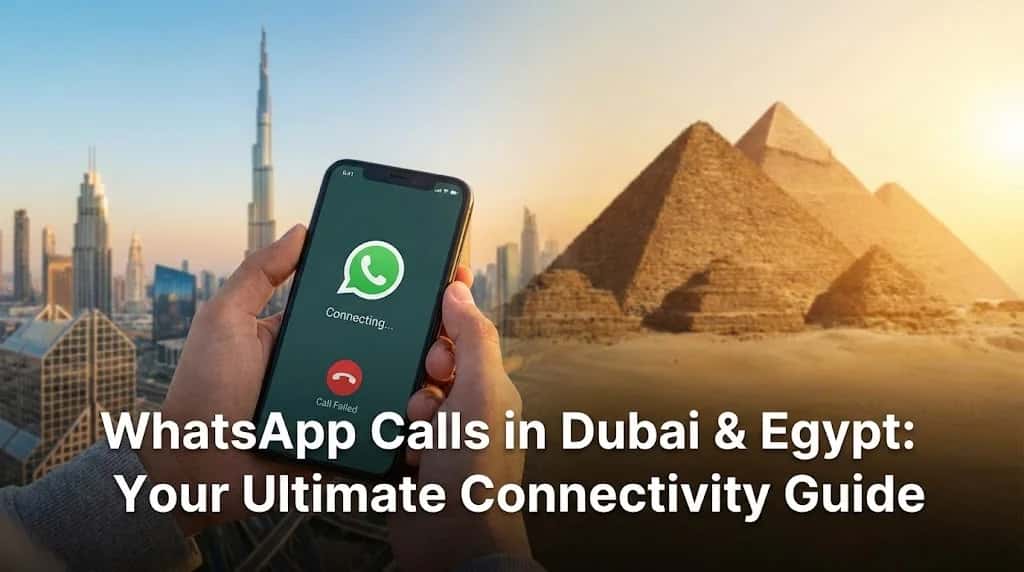
WhatsApp Calls in Dubai & Egypt: Your Ultimate Connectivity Guide
Struggling with WhatsApp calls in Dubai or Egypt? This guide breaks down your best options, comparing the risks of VPNs, the high cost of roaming, and the smart savings of a travel eSIM.
Read the guide Destination Guides
MWC Mobile World Congress Barcelona 2026: Your Ultimate Connectivity Guide
Master internet at MWC Mobile World Congress Barcelona 2026. Discover seamless eSIM connectivity, avoid roaming fees, and stay connected with Cellesim.
Read the guide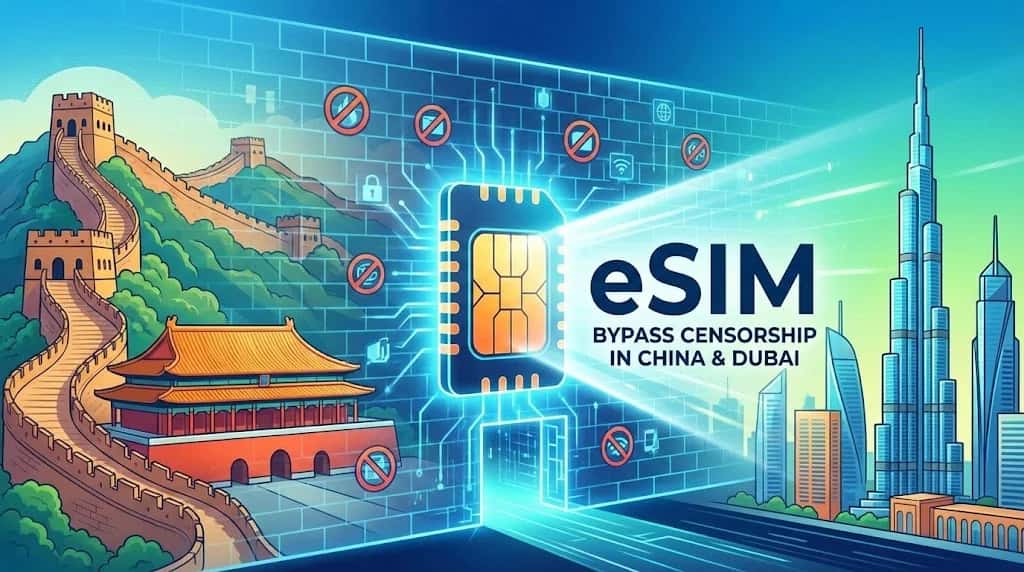 How-to & Guides
How to Bypass Internet Censorship in China & Dubai with an eSIM
Traveling to China or Dubai? Discover how an international eSIM acts as a built-in VPN, bypassing the Great Firewall and other restrictions for seamless access to Google, WhatsApp, and more.
Read the guide
Popular cities in United Arab Emirates
City-specific connectivity guides


Nearby Countries
Travelers to United Arab Emirates also buy eSIMs for these countries


