The Real Cost of Data: Indonesia Edition
Let's talk money, because that's always a big deal when you're trying to stretch your travel budget. On my last 10-day trip through Java and Bali, I ended up spending just €25 on data. That got me about 20 GB, which was more than enough for maps, Instagram, WhatsApp calls, and even some Netflix during those long bus rides between Yogyakarta and Mount Bromo. You really don't need to break the bank to stay connected, but you do need to be smart about how you get your data.
For years, everyone said to just grab a local Telkomsel SIM card at the airport. It used to be cheap and reliable, and topping it up was easy. But things have changed. With eSIMs becoming more common and new government regulations, the game is different now. You essentially have two main options: the traditional Telkomsel, which offers both physical SIMs and tourist eSIMs, and the super-easy Cellesim Indonesia eSIM. Both have their good points and bad points, especially for budget travelers who care about both their cash and their time.
The Cheapest Fallback: Physical SIM Cards
Before we go deep into eSIMs, I should mention the absolute cheapest way to get data, if you're up for a bit of extra effort. If your phone still takes a physical SIM and you don't mind some hassle, you can find local SIM cards from providers like Smartfren or IM3 Ooredoo at small kiosks outside the airport. These can sometimes give you slightly better per-GB rates than Telkomsel's tourist plans, especially for smaller packages. The downside? You'll still have to deal with the KTP/passport registration process, which can be annoying, and their coverage might not be as good as Telkomsel's in more remote spots. For example, getting Smartfren to work reliably outside major cities in Sumatra can be a headache, even if it saves you a few thousand rupiah per GB.
Telkomsel Tourist eSIM: The Local Option with Strings
Telkomsel is Indonesia's biggest mobile network, no question. Their coverage is generally fantastic, even reaching some of the more distant islands. For tourists, they offer specific data packages, and yes, you can now get these as an eSIM if your phone supports it. Sounds perfect, right? Well, there are a few catches.
The Registration Ordeal at the Airport
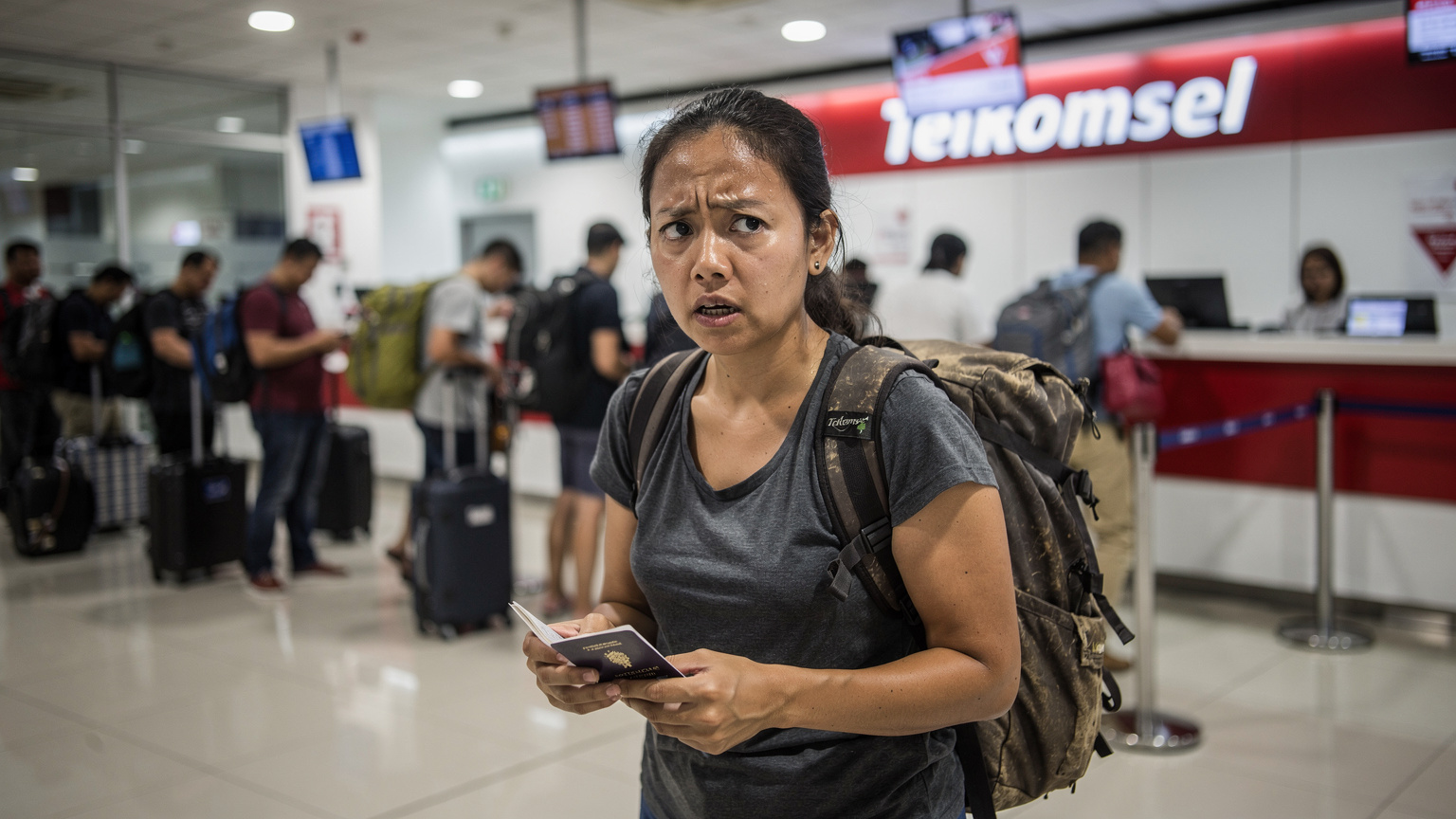
The biggest hurdle with Telkomsel, whether you get a physical SIM or an eSIM, is the mandatory registration. Indonesian law requires all SIM cards to be registered with a valid ID, which means your passport. At Denpasar Airport (DPS) or Jakarta's Soekarno-Hatta (CGK), this means finding the Telkomsel counter, usually after you've picked up your bags but before you exit. You'll probably run into:
- Long queues: Especially during busy seasons or when a big flight has just landed. I've personally waited over an hour at DPS just to register a SIM, watching my hostel shuttle leave without me.
- Passport checks: They'll scan your passport and type your details into their system. This can be slow, especially with a language barrier.
- Device IMEI registration: For some tourist SIMs, they might even register your phone's IMEI number. This is less common for short-term tourist eSIMs but can be an extra bureaucratic step if you plan to stay a long time.
- Limited plan options: The tourist plans at airport kiosks are often more expensive per GB than what locals get, and the data sizes might not perfectly fit what you need.
Sure, you're paying in Indonesian Rupiah (IDR), which often feels cheaper on paper, but the time you lose is a real cost. That's an hour of your vacation day you're not spending exploring Seminyak or finding your hostel in Canggu.
Telkomsel Plan Sizes and Prices
Prices can change, but a typical Telkomsel tourist eSIM package in 2026 might look something like this:
| Data Package | Validity | Approx. Price (IDR) | Approx. Price (EUR) | Price per GB (EUR) |
|---|---|---|---|---|
| 15 GB | 30 Days | IDR 150,000 | €9 | €0.60 |
| 25 GB | 30 Days | IDR 220,000 | €13 | €0.52 |
| 50 GB | 30 Days | IDR 350,000 | €20 | €0.40 |
These prices are pretty good, especially for the larger plans. But again, you have to deal with the hoops to get them. And if you only need 10GB for a two-week trip, you might end up overpaying for a 15GB package you won't fully use.
Cellesim eSIM for Indonesia: The Instant Solution
This is where eSIMs from companies like Cellesim really shine. The whole process is digital, super fast, and the best part? You can do it all from your couch before you even leave home. No airport queues, no passport scans, no language issues.
Buy, Activate, and Go
The beauty of a Cellesim Indonesia eSIM is how simple it is. You buy it online, get a QR code, scan it, and you're ready. It's made for travelers who want to land and be connected instantly. No messing with tiny SIM trays, no wondering if your phone is unlocked, and no dealing with local rules that can be confusing for tourists.
Cellesim Plan Sizes and Prices
Cellesim offers various packages to fit different trip lengths and data needs. Here's an idea of what you might see for Indonesia (prices are examples and can change):
| Data Package | Validity | Approx. Price (EUR) | Price per GB (EUR) |
|---|---|---|---|
| 5 GB | 7 Days | €10 | €2.00 |
| 10 GB | 15 Days | €18 | €1.80 |
| 20 GB | 30 Days | €30 | €1.50 |
Looking at the price per GB, Cellesim might seem a little pricier than Telkomsel's largest plans. But think about the smallest package. A 5GB, 7-day Cellesim plan for €10 is perfect for a quick Bali trip, while Telkomsel might push you into a bigger, more expensive 15GB, 30-day plan that's way more than you need. This is where Cellesim often saves you money by giving you data that actually matches what you'll use.
Head-to-Head: Telkomsel vs. Cellesim eSIM Comparison
Let's break it down. When you're trying to pick an eSIM for Indonesia, it comes down to a few key things: cost, how easy it is to use, coverage, and speed. Any budget traveler knows that convenience sometimes costs a little more, but it can be totally worth it if it saves you precious travel time.
| Feature | Telkomsel Tourist eSIM | Cellesim Indonesia eSIM |
|---|---|---|
| Purchase Method | Airport kiosks, Telkomsel stores in Indonesia | Online before travel |
| Activation Process | Kiosk registration, passport scan, potentially IMEI registration | Instant QR code scan |
| Required Documents | Passport for registration | None (beyond purchase details) |
| Convenience | Low, involves queues and local interaction | High, land and connect immediately |
| Cost per GB (approx.) | €0.40 - €0.60 (for larger plans) | €1.50 - €2.00 (depends on plan size) |
| Flexibility | Limited tourist plans, need to top up locally | Various data/validity options, easy online top-up |
| Coverage | Excellent, widest in Indonesia | Uses local partner network (often Telkomsel or XL Axiata), typically very good |
For a two-week trip, if you use a lot of data (say, 2GB a day for social media, video calls, and maps), you'd need about 28GB. With Telkomsel, you might grab the 50GB plan for €20. With Cellesim, you might go for the 20GB plan for €30 and then top up if you need more, or find a larger plan. Telkomsel clearly saves you money upfront, but that's assuming you care more about the cash saved than the time you'll spend waiting in line at Ngurah Rai International Airport.
Coverage and Speed: Who Wins Where?
Network performance is super important, especially if you're relying on data for directions or staying in touch with folks back home. In Indonesia, Telkomsel generally has the best and most widespread coverage, especially outside the main tourist areas. That's just a fact, and it's why they can charge a bit more.
Telkomsel: The Undisputed Coverage King
Telkomsel's 4G/LTE network covers most inhabited islands, from the busy streets of Jakarta to the remote villages of Flores. If you're planning a road trip through Sumatra or trekking in Kalimantan, Telkomsel is your safest bet for staying connected. Their infrastructure is simply more spread out.
Cellesim: Piggybacking on Local Giants
Cellesim, like most international eSIM providers, doesn't actually own its own cell towers in Indonesia. Instead, it works with local networks. In Indonesia, this usually means they connect you to either Telkomsel or XL Axiata. That's a good thing, because you're getting access to established networks. For instance, a Cellesim eSIM for Indonesia would almost certainly use Telkomsel's network in popular spots like Bali, Lombok, and the big cities on Java.
However, there's a small difference: while Cellesim uses these networks, local users who have a direct Telkomsel SIM might sometimes get priority or slightly faster speeds during really busy times, especially in super crowded areas like Kuta or central Jakarta. But for most travelers, the difference in everyday use won't be noticeable. I've used both and found Cellesim's performance in major tourist zones, including the digital nomad hotspots of Canggu and Ubud, to be perfectly fine for everything from video calls to uploading photos.
The Kiosk Queue Conundrum: Why Time is Money
Anyone who travels a lot knows that time is precious, especially after a long flight. Every minute you spend in an airport line is a minute you could be doing something else. For me, that usually means grabbing a cheap Gojek ride to my hostel, dropping my bag, and heading straight for some amazing street food.
The Telkomsel Airport Experience
Picture this: You land at DPS. You're tired, maybe a little confused. All you want to do is get to your hostel. You spot the Telkomsel counter, often bustling with other tourists. You get in line. The process goes something like this:
- Waiting in line: Could be 15 minutes, could be an hour, especially if several big flights have just landed.
- Passport verification: You hand over your passport, and the agent carefully types in your details.
- Choosing a plan: Often, the agents will try to sell you the bigger, more expensive plans. You might need to haggle or be firm about what you want.
- Payment: Usually in local currency, often cash, though cards are becoming more accepted.
- Activation: The agent activates the SIM/eSIM, which can sometimes take a few minutes to connect to the network.
This whole thing, from getting off the plane to having working data, can easily add an hour or more to your arrival. That's an hour of daylight gone, an hour of potential exploring lost. For a budget traveler on a tight schedule, this is a significant cost, even if the data rate is a little lower.
The Cellesim Seamless Arrival
With Cellesim, the situation is completely different. You bought your Indonesia eSIM online a few days before your flight. You scanned the QR code at home or even on the plane. You land, turn on your phone, and boom: you're connected. You can immediately call your Gojek driver, find your hostel on a map, and let your family know you arrived safely. This is the real advantage of Cellesim: no friction when you arrive. It's the kind of smooth experience that saves you mental energy and lets you start your trip right away, which is priceless when you're traveling.
Border Crossing and eSIM Activation: A Tactical Guide
This is where eSIMs truly get a leg up, especially for those of us who cross borders often. Think about it: if you're flying into Bali but then planning to take a ferry to Lombok, or even a bus from Singapore into Malaysia, an eSIM makes life so much easier.
The Border-Crossing Edge Case: Physical SIM Cards
With a physical SIM, you're usually stuck with one country or a specific regional plan. If you're doing a multi-country Southeast Asia trip, you'd be swapping SIMs at every border. Not only is this annoying, but you risk losing your tiny physical SIM, and then you're back to the airport kiosk dance every single time. I once had to buy a new SIM in Kuala Lumpur after realizing I'd left my Thai SIM in my previous hostel. Rookie mistake, and it cost me an hour and some ringgit.
eSIMs for Regional Travel
Cellesim offers not just eSIMs for single countries, but also regional ones, like a Southeast Asia eSIM. This is a game-changer. Imagine landing in Singapore, activating your regional eSIM, then traveling to Indonesia, Thailand, and Vietnam without ever needing to change your data plan. You stay connected consistently, and your main phone number stays active for calls and texts from home.
For those flying into Bali but planning to immediately head to, say, the Gili Islands or even a quick trip to Nusa Penida, an activated eSIM means you're connected the second your plane touches down. You're ready to book your fast boat or find your pre-arranged transfer. No need to wait until you're in a Telkomsel service center in Mataram, Lombok.
"I once saw a traveler trying to register a Telkomsel SIM at a small ferry terminal in Padang Bai, after missing the airport window. The frustration was palpable. An eSIM would have saved them hours of headache and a potentially missed boat."
Estimating Your Data Needs: Don't Overpay
One of the biggest mistakes travelers make is paying too much for data they don't use. Or, even worse, not buying enough and running out mid-trip, forcing an expensive top-up. Let's do some quick math to figure out what you actually need.
Data Consumption Benchmarks
- Light user (email, maps, WhatsApp text): 0.5 GB to 1 GB per day
- Medium user (social media, photos, light video streaming): 1 GB to 2 GB per day
- Heavy user (video calls, Netflix, large uploads): 2 GB to 5 GB per day
Let's say you're a medium user on a 15-day trip. You're looking at roughly 1.5 GB/day x 15 days = 22.5 GB. In this case, Telkomsel's 25 GB plan for around €13 looks good on paper. But what if you're only there for 8 days? You'd need 1.5 GB/day x 8 days = 12 GB. Telkomsel's smallest 15 GB plan (around €9) still means you're paying for 3 GB you won't use. Cellesim might offer a 10 GB plan for 15 days at €18, which you could top up with a smaller plan, or a 20 GB plan for 30 days at €30. The key is to match your usage to the plan's validity and size.
The Hidden Costs of Under- or Over-Buying
Under-buying: Running out of data means you're scrambling to find Wi-Fi or paying crazy roaming charges. Or, if you're on a local SIM, you're trying to figure out Indonesian top-up menus, which can be really confusing. I once ran out of data trying to find my hostel in a new city and ended up paying €5 for 100MB of emergency data, a total rip-off.
Over-buying: You're just throwing money away. While a few euros might not seem like much, every bit counts when you're trying to keep your daily expenses under €40.
With Cellesim, the flexibility to buy smaller, shorter-duration plans means you're less likely to overspend. You can always top up online if you realize you need more data. Plus, you can manage multiple eSIMs on your iPhone 17 eSIM for Norway's Fjords: Seamless Trekking Data 2026, easily switching between your home SIM and your travel eSIM, making sure you only use data when you mean to. This kind of control is incredibly valuable for budget travelers.
Final Verdict: Which eSIM Makes Sense for You?
So, Telkomsel versus Cellesim for Indonesia in 2026? It really comes down to what's important to you and how you like to travel. As a budget backpacker, I'm always looking for value, but that's not just about the lowest price tag. It's about the total cost, the time saved, and making travel less stressful.
Choose Telkomsel If:
- You're staying for a long time (1 month+): The bigger packages give you better value per GB, and the initial setup hassle is spread out over a longer stay.
- You're going to very remote areas: Telkomsel's network often has the best reach in truly off-the-beaten-path places.
- You don't mind airport queues and local registration: You're a patient traveler who enjoys the local experience, even the bureaucratic parts.
Choose Cellesim If:
- You want convenience and instant connection: Land, connect, and go. No queues, no paperwork. This is invaluable, especially after a long flight.
- You're on a shorter trip (under 3 weeks): Cellesim's smaller, more flexible plans can actually save you money because you're not paying for data you won't use.
- You value your time: An hour saved at the airport is an hour you can spend exploring, relaxing, or getting to your hostel. This is a big deal when you're traveling on a budget.
- You want a smooth experience across several countries: If Indonesia is just one stop on a bigger Southeast Asian adventure, a regional eSIM from Cellesim is much more practical.
- You use a modern phone that supports eSIMs: This is the future of connectivity, and phones like the iPhone 18 & Galaxy Z Fold/Flip 6: Optimizing Your New Device's eSIM for International Travel 2026 are built for this flexibility.
For me, the choice is clear. While Telkomsel's per-GB price on big plans can be tempting, the hassle of registration and airport queues for a Telkomsel Tourist eSIM vs Instant Setup: Best Bali & Indonesia Data 2026 isn't worth it. My time is worth more than the few euros saved. I'd rather pay a little extra for the peace of mind and instant connection that a Cellesim eSIM provides. It lets me focus on the actual travel, not just getting online. If you want to avoid tourist traps for data, especially in places like Ubud, Canggu, or Seminyak, then an eSIM is the smarter move.
Frequently Asked Questions
Is Telkomsel eSIM available for tourists in Indonesia?
Yes, Telkomsel does offer eSIMs for tourists. However, you typically still need to go through a registration process at an official Telkomsel store or airport kiosk, requiring your passport, similar to a physical SIM card.
Can I buy an Indonesia eSIM before I travel?
Absolutely. Providers like Cellesim allow you to purchase and activate your Indonesia eSIM online before you even depart, receiving a QR code for instant setup. This means you land with immediate connectivity.
Is Cellesim's coverage in Indonesia as good as Telkomsel's?
Cellesim partners with local Indonesian networks, often including Telkomsel or XL Axiata. This means its coverage is generally very good in major tourist areas and cities, rivaling Telkomsel in most places a typical tourist would visit.
How much data do I need for a 10-day trip to Bali?
For a 10-day trip as a medium data user (maps, social media, light streaming), you'd typically need around 15-20 GB. If you're a heavy user, consider 25-30 GB. Light users might get by with 5-10 GB.
What is the cheapest way to get data in Indonesia?
The absolute cheapest per-gigabyte rates might be found with local physical SIM cards from smaller providers like Smartfren or IM3 Ooredoo, purchased away from the airport. However, this involves more hassle, potentially less coverage, and still requires local registration.
Do I need to register my phone's IMEI with a Telkomsel tourist eSIM?
For short-term tourist eSIMs, IMEI registration for your device is generally not required. However, if you plan an extended stay (over 90 days), or buy a local SIM that isn't specifically a 'tourist' package, you might need to register your device's IMEI to avoid it being blocked.