Separate port connectivity from connectivity at sea
A land-based travel eSIM package should not be assumed to include a ship's maritime or satellite service. Check the exact package coverage and your home carrier's maritime charging conditions before boarding. Plan separately for time ashore and time at sea. Save the itinerary and essential travel information offline before losing a land connection. Buying a regional package does not by itself prove that its network is available throughout the cruise route. Compare the countries visited in port against the package details.
Data plans and prices: Bahamas eSIM
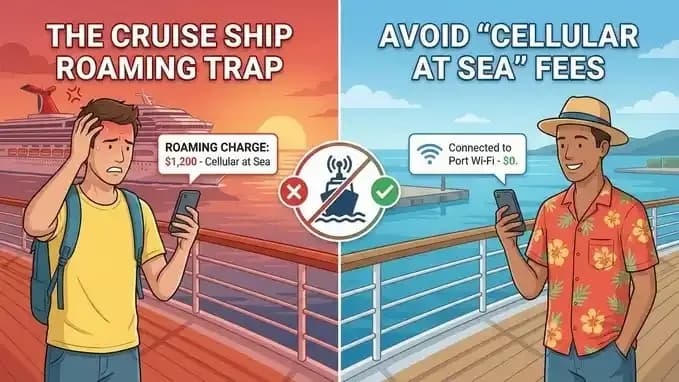
Embarking on a cruise promises relaxation, adventure, and often, a journey across international waters. Many travelers meticulously plan their wardrobe and excursions, but often overlook the complexities of staying connected at sea. You might assume your existing international roaming plan or a special add-on from your carrier will keep you online. However, once your ship sails beyond coastal limits, a unique and often expensive system called "Cellular at Sea" takes over, rendering standard plans ineffective.
- What "Cellular at Sea" Is and How It Works
- Decoding the Hidden Costs of Maritime Roaming
- The Limitations of Your Standard International Roaming Plan
- Navigating Ports of Call: Seamless Connectivity with an eSIM
- Choosing the Right eSIM for Your Cruise Journey
- Activating Your eSIM: A Step-by-Step Guide for Cruise Travel
- Comparing Your Options: eSIM vs. Ship Wi-Fi vs. Traditional Roaming
- Frequently Asked Questions
Global eSIM Plans from Cellesim
Stay connected across 200+ countries, even when docking at various ports. Join 50,000+ happy customers who trust Cellesim for their travel connectivity.
View Global eSIM PlansThis maritime network uses satellite links to provide cellular service where land-based networks are unavailable. What you pay for using it is set by your own mobile carrier, not by the network, so the cost depends entirely on your plan. Travelers who check their plan before sailing avoid surprises; those who don't can see a large bill. Knowing how this works is the first step to staying connected affordably throughout your cruise.
What "Cellular at Sea" Is and How It Works
When your cruise ship leaves port and enters international waters, it moves beyond the range of land-based cellular towers. To maintain connectivity, cruise lines utilize satellite communication systems. Your phone automatically connects to a maritime mobile network provider, often branded as "Cellular at Sea," "MCP (Maritime Communications Partner)," or similar names. These networks are operated by third-party companies, but they do not bill travelers directly: your home carrier bills you under your plan's roaming terms, the same way it would in a foreign country.
Unlike terrestrial roaming agreements, where carriers have established partnerships and often negotiated rates, maritime satellite networks operate in a different regulatory and economic landscape. Data, calls, and texts are routed through satellites, a significantly more expensive infrastructure. This setup allows you to send a message or make a call in the middle of the ocean, but the convenience comes at a premium. For a deeper understanding of how these networks function, you can explore resources from organizations like the GSMA on satellite networks.
Understanding the Costs of Maritime Roaming
How much you pay at sea depends on your carrier. Many carriers offer a cruise day pass or cruise package: a flat daily rate (commonly around $20 per day) that covers your usage on the ship's cellular network. If your plan has no cruise package or day pass, usage is billed at your carrier's pay-per-use maritime roaming rates, typically per minute, per message and per megabyte, and that is where bills can grow quickly.
Data adds up fastest without a package, because phones use data in the background even when idle (app updates, photo backup, email sync). Your carrier publishes its maritime roaming rates in its roaming terms, so check them, or ask whether a cruise day pass is available, before you sail.
Travelers who skip this check sometimes only discover pay-per-use charges when the bill arrives. Many carriers send a welcome text with maritime rates when you connect at sea; read it rather than dismissing it.
The Limitations of Your Standard International Roaming Plan
Your domestic mobile carrier's international roaming plans are designed for use on land-based cellular networks. They rely on agreements with foreign carriers in specific countries. When your cruise ship is in open water, it is not connected to any of these terrestrial networks. Instead, it utilizes the ship's independent satellite system.
This distinction is critical. An "International Day Pass" or a similar add-on only activates when your phone registers on a partner network in a specific country. Once offshore, your phone connects to the ship's satellite network, which is treated as a completely separate entity. Your carrier considers this as usage on an "unaffiliated" or "premium" network, thus bypassing your included roaming benefits. This means you will be charged the highest possible rates for any data, call, or text activity, even if your phone merely checks for updates in the background. For general advice on staying connected while cruising, you can refer to insights from travel platforms like Cruise Critic.
Navigating Ports of Call: Seamless Connectivity with an eSIM
While an eSIM won't provide data in the middle of the ocean when connected solely to "Cellular at Sea," it offers an invaluable solution for staying connected affordably and conveniently when your cruise ship docks at various ports. Instead of relying on expensive ship Wi-Fi or hunting for local physical SIM cards at each stop, an eSIM allows you to activate a local data plan instantly.
Imagine visiting multiple Caribbean islands, or European coastal cities. With a Cellesim regional or multi-country eSIM, you can pre-purchase a data plan that covers all your destinations. As your ship pulls into port, your phone automatically switches from "Cellular at Sea" (or Wi-Fi) to the local cellular network. Your eSIM plan then becomes active, providing you with high-speed internet, allowing you to use navigation apps, communicate with fellow travelers, share updates, and access information without interruption.
This eliminates the hassle of switching SIM cards, dealing with foreign languages, or worrying about unpredictable charges. With Cellesim, you can ensure you have reliable internet from the moment you step off the ship until you re-board.
Choosing the Right eSIM for Your Cruise Journey
Selecting the optimal eSIM plan for your cruise depends on your itinerary and data needs. Cellesim offers a variety of plans designed to cater to different travel patterns:
- Single Country eSIMs: If your cruise has an extended stop in a particular country, or if you plan to return there frequently, a dedicated Italy eSIM or Indonesia eSIM can be cost-effective. These offer deep coverage and often competitive pricing for specific destinations.
- Regional eSIMs: For cruises covering multiple countries within a single region (e.g., a Caribbean cruise hitting several islands, or a Mediterranean tour), a regional eSIM is ideal. Cellesim provides regional plans that cover dozens of countries under one package, ensuring seamless transitions between ports. Check our Global eSIM Plan 127 Countries which also covers many regional options.
- Global eSIMs: For transcontinental cruises or journeys with diverse port stops, a global eSIM provides the broadest coverage across 127+ countries. This offers maximum flexibility, ensuring you are covered almost anywhere your ship docks.
Consider your typical data usage. Will you primarily be checking emails and maps, or do you plan to stream videos and make frequent video calls? Cellesim provides various data allowances to match your consumption habits. You can also easily monitor and top up your data directly from the Cellesim app or website.
When selecting your plan, verify the countries included in the eSIM package align with your cruise itinerary's port stops. This proactive step ensures you have coverage exactly where you need it.
Activating Your eSIM: A Step-by-Step Guide for Cruise Travel
Activating a Cellesim eSIM for your cruise is a straightforward process, best handled before you embark. Here’s a simplified guide:
- Check Compatibility: Ensure your smartphone is eSIM compatible and unlocked. Most newer models support eSIM technology. You can use our eSIM Checker to confirm.
- Purchase Your eSIM: Visit cellesim.com, select your desired destination(s) and data plan based on your cruise itinerary. Complete your purchase.
- Installation: You will receive a QR code via email. Scan this code (or follow manual instructions) to add the eSIM profile to your device. Do this while you still have a stable internet connection at home or before leaving port. For detailed instructions, refer to our complete eSIM setup guide or the interactive guide.
- Activation Timing: Keep your primary SIM active while at sea if you need to receive calls, but turn off mobile data for your primary SIM to avoid "Cellular at Sea" charges. Enable your Cellesim eSIM's data plan only when your ship is approaching or docked at a port covered by your eSIM.
- Data Management: In your phone's settings, you can toggle between your primary line and your eSIM for data. Ensure your eSIM is selected for data usage while in port.
By preparing your eSIM in advance, you can step off the ship in each port ready to connect instantly, avoiding the rush and potential issues of finding local connectivity on the spot. For more insights on general roaming avoidance, see our article on how to avoid roaming charges and stay connected abroad.
Comparing Your Options: eSIM vs. Ship Wi-Fi vs. Traditional Roaming
When planning connectivity for your cruise, you generally have three main options for staying online. Understanding their pros and cons, especially concerning costs and convenience, is crucial for avoiding the "Cellular at Sea" trap.
| Option | Connectivity (At Sea) | Connectivity (In Port) | Price | Convenience |
|---|---|---|---|---|
| Cellesim eSIM | No (Use Ship Wi-Fi) | High Speed 4G/5G | Low (Pre-paid) | High (Instant activation) |
| Ship Wi-Fi | Slow-Moderate (Satellite) | Slow-Moderate (Satellite) | High (Per device/day) | Moderate (Shared, often unreliable) |
| Carrier Roaming (Standard Plan) | No (Expensive "Cellular at Sea") | Varies by plan & country | Very High (Bill shock risk) | Low (Uncertain coverage, high cost) |
Cruise ship Wi-Fi packages, while offering some connectivity at sea, are often expensive, slow, and designed for basic browsing or messaging. They are also per-device, meaning you'd pay for each phone, tablet, or laptop. Cellesim eSIMs, on the other hand, provide dedicated data plans for when you are docked, offering much faster speeds and better value for money.
The choice is clear for savvy travelers: leverage ship Wi-Fi for essential communication while at sea, and switch to a Cellesim eSIM the moment you reach a port to enjoy reliable, affordable, and high-speed local data.
Ready to Save on Data at Every Port?
Join 50,000+ travelers in 200+ countries. Set up your Cellesim eSIM in minutes and enjoy stress-free connectivity in port.
Start Your Connected JourneyTrusted by travelers worldwide. 24/7 Support.
Frequently Asked Questions
Will my regular international roaming plan work on a cruise ship?
It depends on your carrier. At sea your phone connects to the ship's maritime network, and your carrier bills that usage under its maritime roaming terms, which are often separate from its regular international plan. Many carriers offer a cruise day pass or cruise package for a flat daily rate; check with your carrier before you sail.
What is "Cellular at Sea" and how is it billed?
"Cellular at Sea" is the cellular network used on many cruise ships in open waters. It does not bill travelers itself: your home carrier charges you under your plan's maritime roaming terms. With a carrier cruise day pass the cost is a flat daily rate; without a package you pay your carrier's pay-per-use rates, which can add up quickly.
Can an eSIM provide data while my cruise ship is in the middle of the ocean?
An eSIM, like a physical SIM, relies on terrestrial cellular networks. It will not provide data when your ship is solely connected to a "Cellular at Sea" satellite network in the open ocean. However, it is ideal for connecting instantly and affordably when your ship docks in any port covered by your eSIM plan.
How can Cellesim eSIMs help me save money on a cruise?
Cellesim eSIMs prevent you from incurring expensive "Cellular at Sea" charges by providing affordable data plans that activate when your ship docks in a covered port. Instead of relying on costly ship Wi-Fi or local physical SIMs, you get seamless, high-speed connectivity exactly when you need it.
When should I activate my Cellesim eSIM for my cruise?
You should purchase and install your Cellesim eSIM while you have a stable internet connection before your cruise departs. For data usage, activate your eSIM's data plan only when your ship is approaching or docked at a port covered by your plan, and keep your primary SIM's mobile data turned off while at sea.
Are there any alternatives to "Cellular at Sea" for staying connected on a cruise?
Yes, primary alternatives include purchasing the cruise ship's Wi-Fi package (which can be expensive and slow), or using a Cellesim eSIM when docked at various ports. The eSIM provides cost-effective, high-speed internet by connecting to local networks when land-based service is available.