Updated: 2026-02-16
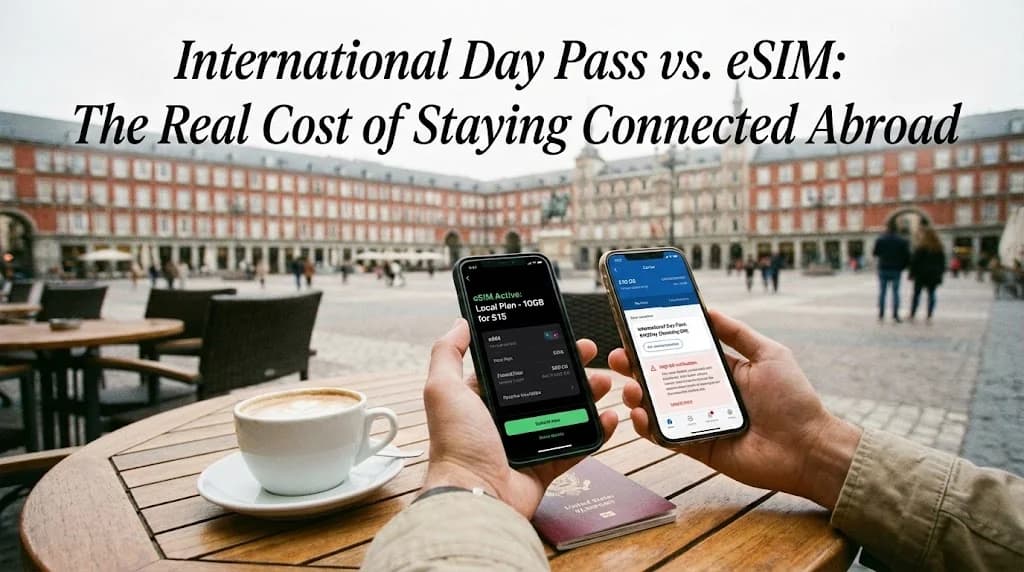
You have just landed in a new country. The cabin doors open, and one of your first instincts is to switch your phone off airplane mode. You need to pull up your hotel address, message family you have arrived safely, and perhaps book a ride. Then, the inevitable text message from your home carrier arrives: "Welcome to [Country]! Use your domestic plan for just £10/day." It sounds straightforward, a convenient way to stay connected, but for many seasoned travellers, a quiet dread sets in. Is this truly the most economical or convenient option? This question lies at the heart of the international day pass versus eSIM debate, a crucial choice that significantly impacts your travel budget and overall experience. Many travellers simply accept the daily fee, unaware that understanding how to avoid roaming charges can save them hundreds over a trip. In this comprehensive guide, we will break down the real-world differences between your mobile carrier’s international day pass and the modern flexibility of an eSIM, helping you make an informed decision for your next journey.
- The Roaming Dilemma: Understanding International Day Passes
- eSIM Technology: A Modern Approach to Global Connectivity
- Direct Comparison: International Day Pass vs. eSIM Pricing
- Beyond Cost: Performance, Convenience, and Flexibility
- Data Usage Realities: How Much Do You Actually Need?
- When to Choose Which: Scenarios for Day Passes and eSIMs
- Activating Your eSIM: A Simple Guide for Travellers
- Pro Tips for Smart International Connectivity
- Frequently Asked Questions
Unlock Seamless Global Connectivity
Ditch expensive roaming. Connect instantly in 200+ countries with Cellesim. Join 50,000+ happy customers today.
Shop All eSIM PlansThe Roaming Dilemma: Understanding International Day Passes
International day passes, offered by most traditional mobile carriers, promise a hassle-free way to use your phone abroad. The premise is simple: for a fixed daily fee, you can use your existing plan’s talk, text, and data allowances, often up to a certain limit. For instance, a common offer is to use your plan for £10 a day. While this sounds convenient, the "real cost" often extends beyond this headline figure. Many travellers find themselves accumulating unexpected charges or experiencing throttled data speeds.
The primary issue with day passes is their cumulative cost. A short weekend trip might seem affordable at £20-£30, but a week-long vacation quickly escalates to £70 or more, and a two-week journey can easily exceed £140. This daily fee often applies even if you use very little data or only make one quick call. Moreover, many day passes have a data cap before speeds are significantly reduced or additional charges apply. For example, you might get 500MB or 1GB of high-speed data, after which your connection slows to 2G speeds, making navigation, streaming, or video calls frustrating.
Understanding the specific terms and conditions of your carrier's international day pass is crucial. Some passes activate automatically the moment your phone connects to a foreign network, even if you just check an email. Others might reset at midnight in your home time zone, rather than local time, leading to two daily charges on a travel day. This lack of transparency and flexibility often leads to bill shock upon returning home, negating any perceived convenience. This dynamic is a core part of the international day pass vs eSIM debate.
"The convenience of an international day pass is often outweighed by its hidden costs and restrictive terms, particularly for longer trips where daily fees quickly compound, leading to unexpected expense."
eSIM Technology: A Modern Approach to Global Connectivity
In contrast to the traditional physical SIM card and its associated roaming issues, eSIM technology offers a digital, embedded SIM that revolutionises international connectivity. An eSIM eliminates the need for physical SIM cards, allowing you to switch carriers or plans digitally. This means no more searching for local SIM card vendors, dealing with language barriers, or fumbling with tiny trays and pins at the airport, a common frustration explored in the airport SIM vs eSIM comparison.
With an eSIM, you can purchase a data plan for your destination country or region online, often before you even depart. Once purchased, the eSIM profile is downloaded directly to your compatible device, typically via a QR code or manual activation details. This process takes just minutes, providing instant connectivity upon arrival, or even while still in transit. Cellesim offers eSIMs for over 200 countries, making global travel simpler and more affordable. You can check if your device is eSIM compatible on our website.
eSIM technology is increasingly becoming the standard for modern smartphones, backed by organisations like the GSMA. Key advantages of eSIMs include:
- Cost-Effectiveness: eSIM plans are generally significantly cheaper than international day passes, especially for multi-day or multi-week trips. You pay for a fixed amount of data over a specific duration, without recurring daily fees.
- Flexibility: You can often choose plans based on your exact data needs and trip duration. Need 10GB for 15 days in Italy? There is an eSIM for that. Travelling across Europe? A regional eSIM for Europe covers multiple countries without extra charges.
- Instant Activation: Purchase and activate your plan online within minutes, anytime, anywhere.
- Keep Your Home Number: Your physical SIM (and thus your home number) remains active for calls and texts, while the eSIM handles data. This allows you to receive important calls or messages without incurring roaming data charges, which is a key benefit often highlighted in our guide to keeping your WhatsApp number.
- Transparency: What you pay for is what you get. There are no hidden daily charges or unexpected activation fees.
Direct Comparison: International Day Pass vs. eSIM Pricing
To truly understand the "real cost" of international connectivity, let us compare typical scenarios. Prices for international day passes vary by carrier and country, but a common rate in the UK is around £10 per day. eSIM plans, conversely, are typically purchased as a package of data for a set duration, offering greater cost predictability.
Consider the following comparison for a one-week trip to a popular European destination:
| Option | Typical Cost (7 days) | Data Allowance | Setup Difficulty |
|---|---|---|---|
| Cellesim eSIM | From £7 | 5GB (or more) | Instant Online |
| Carrier Day Pass | £70 (at £10/day) | 1-2GB (throttled after) | Automatic/On-demand |
| Local Physical SIM | £15-£30 | 5GB - 15GB | In-store purchase/activation |
As this table illustrates, the cost difference is substantial. For a single trip, an eSIM can save you over 80% compared to a carrier day pass. For frequent travellers, these savings accumulate rapidly, making the eSIM the clear economic winner. Our roaming savings calculator can help you quantify these benefits for your specific travel plans.
Furthermore, the data allowance on a day pass is often lower and subject to throttling after a small amount of usage. With Cellesim, you purchase a data package, and you know exactly how much high-speed data you have. You can also easily top up if you run out, which is often not an option with day passes, and can lead to frustration and a poor connectivity experience.
Beyond Cost: Performance, Convenience, and Flexibility
While direct cost is a significant factor, the "real cost" of staying connected abroad also includes aspects like network performance, ease of use, and adaptability to your travel style. Here, eSIMs often provide a superior experience that enhances your overall journey.
- Network Speed and Reliability: eSIM providers like Cellesim partner with local premium networks, often providing full 4G and 5G speeds where available. Day passes, while using your home carrier's roaming agreements, can sometimes result in deprioritised traffic or slower speeds, especially during peak times, impacting your ability to navigate or communicate effectively.
- Setup and Activation: Activating an international day pass is typically automatic, which can be convenient, but it means you are locked into their terms. Activating an eSIM involves a quick scan of a QR code and a few taps in your phone settings, a process that usually takes less than five minutes. This can be done from the comfort of your home before you even depart, or while waiting at the airport. You can review the step-by-step guide on how to install an eSIM for more details, or try our interactive setup guide.
- Flexibility for Multi-Country Travel: If your itinerary includes multiple countries, an international day pass can become very complex and expensive. You might trigger a new daily charge for each country. With Cellesim, you can purchase a regional or global eSIM plan that covers dozens of countries under a single package, offering seamless transitions without managing multiple local SIMs or incurring new daily fees.
- Keeping Your Home Number: An eSIM allows you to maintain your primary SIM card active for calls and texts from your home number. This is invaluable for two-factor authentication, receiving messages from banks, or urgent contact from family. The eSIM then handles all your data needs, preventing unexpected data roaming charges on your home plan, a benefit often highlighted in our Cellesim vs. Roaming comparisons.
The flexibility of an eSIM empowers you to control your connectivity, tailoring it precisely to your travel needs, rather than being dictated by your home carrier's often rigid and costly terms. This control adds immense value beyond mere monetary savings.
Find Your Ideal eSIM Plan
Data Usage Realities: How Much Do You Actually Need?
One of the trickiest aspects of managing connectivity abroad is accurately estimating data usage. Day passes often provide limited high-speed data before throttling, which can be insufficient for many travellers, leading to a frustrating experience. Understanding your typical usage can help you choose the right eSIM plan and avoid unnecessary costs.
Consider these average data consumption figures:
- Basic Browsing & Messaging: Checking emails, WhatsApp, light social media posts , 50-100MB per hour.
- Navigation: Using Google Maps or Apple Maps , 5-10MB per hour.
- Social Media (heavy): Scrolling Instagram, TikTok, watching short videos , 200-500MB per hour.
- Video Streaming: YouTube, Netflix (standard definition) , 700MB-1GB per hour.
- Video Calls: WhatsApp, FaceTime, Zoom , 500MB-1GB per hour.
For a typical traveller relying on data for navigation, messaging, occasional browsing, and social media, a minimum of 1GB per day is a good starting point. For those who stream video, make frequent video calls, or rely heavily on social media, 3-5GB per week might be more appropriate. Cellesim’s Smart Data Calculator can help you estimate your specific data needs based on your planned activities, ensuring you purchase the optimal plan.
With an eSIM, you can purchase a plan that matches your estimated usage, and if you find yourself needing more, topping up is usually a straightforward process. This contrasts with day passes, where exceeding a small daily limit often leads to a severely degraded experience without the option for more high-speed data, forcing you to pay for another full day to regain speed.
When to Choose Which: Scenarios for Day Passes and eSIMs
While eSIMs offer clear advantages in cost and flexibility for most international travel, there are specific, niche scenarios where one option might be marginally preferred.
Choose an International Day Pass if:
- Very Short, Infrequent Trips: If you travel internationally only once a year for 1-2 days and anticipate minimal data use, the convenience of automatic activation might outweigh the higher daily cost. However, even for such brief trips, a small eSIM plan can often still be more cost-effective.
- Emergency Only: If you primarily intend to use Wi-Fi and only need data for absolute emergencies, and your carrier's pass is activated strictly on demand, it could serve as a fallback. Yet, a small, pay-as-you-go eSIM plan often provides more predictable costs even for emergencies.
Choose an eSIM if:
- Any Trip Longer Than 2-3 Days: The cumulative cost savings quickly make an eSIM the superior choice for trips of this length or more.
- Multi-Country Travel: Regional or global eSIM plans simplify connectivity across borders, eliminating the need to manage multiple services or incur repeat daily charges.
- Frequent International Traveller: The ease of switching plans, purchasing online, and managing connectivity through an app makes eSIMs ideal for business travellers or digital nomads. Cellesim offers excellent options tailored for business travellers.
- Budget-Conscious Traveller: For anyone seeking maximum value and transparency without the risk of bill shock.
- High Data User: If you rely on your phone for navigation, social media, streaming, or video calls, an eSIM provides more generous and affordable data allowances.
- Want to Keep Your Home Number Active: Ideal for receiving texts, OTPs, or important calls without incurring data roaming charges. This allows for seamless communication on your primary number while using the eSIM for all data needs.
For the vast majority of international travellers seeking reliable, affordable, and flexible connectivity, an eSIM provides a demonstrably better solution than an international day pass. Explore Cellesim's range of plans for Italy, Indonesia, Switzerland, and Taiwan, among over 200 other countries covered by our network.
Activating Your eSIM: A Simple Guide for Travellers
Setting up your Cellesim eSIM is a straightforward process, designed to get you connected quickly and efficiently. You can complete most of the setup before you even leave home, ensuring instant connectivity upon arrival.
- Check Compatibility: First, ensure your device supports eSIM technology. Most newer smartphones from Apple, Samsung, Google, and others are compatible. Use our eSIM checker to confirm your device is ready.
- Purchase Your eSIM Plan: Visit cellesim.com and select the country or region you are travelling to. Choose a data plan that suits your duration and data needs, with options ranging from short trips to extended stays.
- Receive QR Code: After purchase, you will receive an email containing a QR code and manual installation details. This code is your digital key to connectivity.
- Install eSIM:
- iPhone: Go to Settings > Cellular (or Mobile Data) > Add eSIM. Choose "Use QR Code" and scan the code. Follow the on-screen prompts to label your eSIM.
- Android: Go to Settings > Network & Internet > SIMs > Add eSIM (or Download a SIM). Scan the QR code.
For more detailed, step-by-step instructions with visual aids, refer to our interactive setup guide.
- Activate Upon Arrival: Once you land at your destination, simply enable the Cellesim eSIM in your phone's settings and ensure data roaming is turned OFF for your primary SIM to avoid charges. Your Cellesim eSIM will then connect to a local network, providing immediate internet access.
It is advisable to install your eSIM profile before you travel, but only enable data roaming for it when you arrive at your destination. This prevents premature activation of its validity period and ensures you are ready to connect instantly upon landing.
Pro Tips for Smart International Connectivity
Maximising your connectivity experience and avoiding unexpected costs goes beyond just choosing between a day pass and an eSIM. Here are some additional tips to ensure seamless, affordable, and stress-free connectivity throughout your international travels:
- Understand Your Home Carrier's Roaming Settings: Even if you use an eSIM for data, understand your home carrier's voice and text roaming rates. Crucially, keep data roaming off for your primary SIM to prevent accidental charges, a common trap detailed in our guide to avoiding bill shock.
- Use Wi-Fi Strategically: Leverage free and secure Wi-Fi networks in hotels, cafes, and airports for large downloads or updates. Remember, public Wi-Fi can be unsecured, so use caution and consider a VPN for sensitive transactions. For official government advice on staying safe online while travelling, consult sources like the UK FCDO Travel Safety and Security guidelines.
- Download Offline Maps and Content: Before you leave, download offline maps for your destination (Google Maps allows this) and any movies, music, or podcasts you want to consume. This significantly reduces data usage and provides backup navigation even without a connection.
- Monitor Data Usage: Regularly check your data consumption through your phone's settings or the Cellesim app if available. This helps you stay within your plan, manage your budget, and top up proactively if needed.
- Consider a Regional Plan: If you are visiting multiple countries within a region (e.g., Europe or Asia), a regional eSIM plan is often more cost-effective and convenient than purchasing individual country plans. For example, Cellesim offers an Europe eSIM for 42 countries, making border crossings seamless.
- Turn Off Background App Refresh: This can consume significant data without your active use. Disable it for non-essential apps in your phone settings to conserve data and battery life.
By combining the power of eSIM technology with these smart habits, you can enjoy seamless, affordable, and stress-free connectivity throughout your international travels, truly getting the best value for your money.
Ready for Truly Connected Travel?
Break free from expensive roaming. Connect with Cellesim and experience global freedom.
Start Your Connected JourneyTrusted by 50,000+ travellers in 200+ countries. 24/7 Support available via [email protected].
Frequently Asked Questions
What is the main difference between an international day pass and an eSIM?
An international day pass is an add-on from your home carrier that allows you to use your existing plan abroad for a daily fee, often with data limitations and potential hidden charges. An eSIM is a digital SIM card you purchase from a provider like Cellesim, offering dedicated data plans for specific countries or regions at generally lower, fixed costs without daily fees.
Are international day passes always more expensive than eSIMs?
For most trips longer than 2-3 days, international day passes tend to be significantly more expensive due to their cumulative daily charges. eSIMs offer more transparent and often lower costs for comparable data allowances, especially for multi-week or multi-country travel, providing better value.
Can I keep my original phone number with an eSIM?
Yes, absolutely. When using an eSIM for data, your primary physical SIM remains active for calls and texts on your original number. This allows you to receive important communications like two-factor authentication codes without incurring high data roaming charges on your home plan, as the eSIM handles all your internet connectivity.
How do I know if my phone is compatible with an eSIM?
Most modern smartphones, including recent iPhone models (XR/XS and newer), Samsung Galaxy S20 series and later, and Google Pixel 3 devices and later, support eSIMs. You can check your device's compatibility in your phone settings or use Cellesim's eSIM checker tool on our website for an instant verification.
What happens if I run out of data on my Cellesim eSIM plan?
If you deplete your data allowance on a Cellesim eSIM, you can easily top up your plan directly through the Cellesim website or app. This allows you to continue enjoying high-speed connectivity without interruption, unlike some day passes that simply throttle your speed without a clear top-up option, forcing you to wait for the next day's activation.
Is it better to activate my eSIM before I travel or after I land?
It is generally recommended to install your eSIM profile (scan the QR code) before you travel, ideally while you still have a stable internet connection. However, you should only enable the eSIM for data usage once you have arrived at your destination to avoid prematurely activating its validity period and wasting valuable days.
Heading there? Compare data plans on our Philippines eSIM page and install before you fly.