You have just landed, the cabin doors open, and the first thing you do is switch your phone off airplane mode. That small moment of anticipation is universal for travelers: will my connection pop up instantly, or will I be stuck watching a spinning wheel while trying to book an Uber? The speed and reliability of your mobile data can genuinely make or break the first few hours in a new country. That is why we conducted a comprehensive eSIM speed test across 20 global cities to demystify what you can actually expect abroad.
Forget theoretical maximums; we are talking about real-world performance for everything from navigation to video calls. Understanding your options is the first step in learning how to avoid roaming charges and stay connected abroad, ensuring your trip starts smoothly.
- Understanding the Numbers: Speed, Latency, and Jitter for Travelers
- Our Methodology: How Cellesim Conducted the Global eSIM Speed Test
- Global eSIM Performance Snapshot: 5G vs. 4G Real-World Differences
- City-Specific Insights: eSIM Speed Variances Across the Globe
- Beyond Speed: Practical Impact on Your Travel Experience
- Optimising Your eSIM Connectivity: Tips for Maximum Performance
- Choosing the Right eSIM Plan: Data Needs vs. Speed Expectations
- Frequently Asked Questions
Connect Instantly in 200+ Countries
Experience reliable 4G/5G speeds across the globe. Join 50,000+ happy customers with Cellesim.
Shop All eSIM PlansUnderstanding the Numbers: Speed, Latency, and Jitter for Travelers
Before diving into the city-by-city results, let's quickly break down the key metrics. When you run a speed test, you will typically see three main numbers: download speed, upload speed, and latency. Each one impacts your travel experience differently.
- Download Speed (Mbps): This is the rate at which your device receives data. Higher numbers mean faster loading for websites, quicker streaming of videos, and smoother app downloads. For travelers, robust download speeds are crucial for navigation apps, watching travel vlogs, or simply browsing local attractions.
- Upload Speed (Mbps): This measures how quickly your device sends data to the internet. Good upload speeds are essential for sharing photos and videos on social media, making video calls, or uploading documents. If you are a digital nomad or frequently share your travel experiences, this metric is particularly important.
- Latency (ms): Also known as ping, latency is the reaction time of your connection, how quickly your device gets a response after sending a request. Lower latency (fewer milliseconds) means less delay. For real-time applications like video calls, online gaming, or quickly refreshing live maps, low latency is critical. High latency can lead to noticeable lag and frustration.
- Jitter (ms): This refers to the variation in latency. While a low latency is good, consistent low latency (low jitter) is even better. High jitter can make video calls choppy and unreliable, even if the average latency is acceptable.
Understanding these metrics helps translate raw numbers into practical expectations for your eSIM experience in Italy or any other destination.
Our Methodology: How Cellesim Conducted the Global eSIM Speed Test
To provide travelers with genuinely useful insights, Cellesim undertook a rigorous eSIM speed testing program. Our team visited 20 major global cities, conducting extensive tests across various times of day and in different urban environments, from city centers to popular tourist sites.
Our goal was not just to measure raw network capabilities, but to evaluate the actual user experience provided by eSIM technology. Here is how we approached it:
- Standardised Devices: We used a consistent set of modern, eSIM-compatible smartphones to eliminate device-specific performance variations. All devices were eSIM compatible and running the latest operating systems.
- Multiple Networks: In each city, we tested eSIMs from different local network providers available through the Cellesim platform, ensuring a representative sample of connectivity options.
- Varied Locations: Tests were performed in central business districts, major transportation hubs (like Paris CDG Airport or Dubai International Airport), and popular tourist zones to simulate real-world usage scenarios.
- Consistent Tools: We used industry-standard speed testing applications to ensure accurate and comparable data collection for download, upload, and latency.
- 5G vs. 4G Analysis: A primary focus was to differentiate between 5G and 4G performance. Where 5G networks were available, we actively sought to test them, comparing their speeds directly against 4G alternatives in the same locations.
Global eSIM Performance Snapshot: 5G vs. 4G Real-World Differences
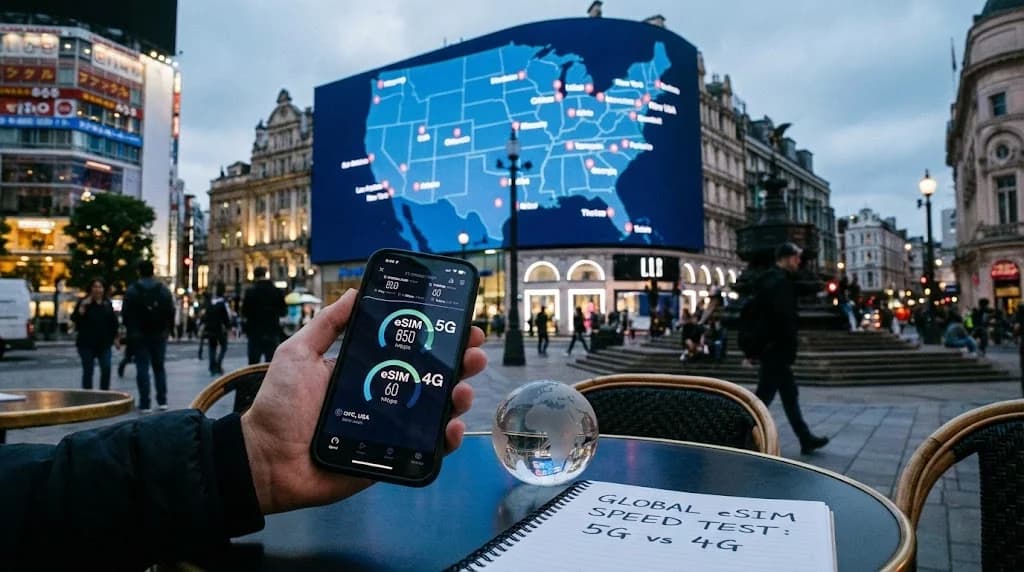
Our global eSIM speed tests revealed a clear hierarchy in network performance, with 5G consistently outperforming 4G in cities where it was widely deployed. However, the magnitude of this difference, and the overall reliability, varied significantly by location.
Globally, 5G average download speeds were often 3-5 times faster than 4G, with latency reduced by up to 50%. This translated into noticeable improvements for data-intensive activities.
Here is a simplified overview of our general findings:
| Network Type | Avg. Download | Avg. Upload | Avg. Latency |
|---|---|---|---|
| 5G (Cellesim) | 100-300+ Mbps | 20-60+ Mbps | 15-30 ms |
| 4G (Cellesim) | 20-80 Mbps | 5-20 Mbps | 40-80 ms |
| Traditional Roaming | 10-50 Mbps | 2-10 Mbps | 80-150 ms |
While 5G offers superior speed and responsiveness, 4G networks remain highly capable for most everyday travel needs. For travelers focused on efficient communication, basic browsing, and standard definition streaming, a strong 4G connection provided by a Cellesim global eSIM plan is often more than sufficient.
City-Specific Insights: eSIM Speed Variances Across the Globe
While global averages provide a baseline, the true picture emerged from specific city analyses. Our tests in 20 global cities highlighted distinct regional and infrastructural differences:
- North America (e.g., New York, Toronto): We observed robust 5G rollouts in major urban centers, with peak download speeds often exceeding 300 Mbps. However, coverage could be less consistent in older buildings or underground transit systems, where 4G still provided reliable fallback. The competition among local carriers typically ensured good performance.
- Europe (e.g., Paris, Berlin, Rome): European cities showed a varied landscape. Cities like Berlin and Paris often delivered excellent 5G speeds, especially in newly developed areas. In contrast, older city centers in places like Rome or Venice sometimes had more widespread 4G, which was still perfectly adequate for navigation and communication, but with less pronounced 5G penetration. An eSIM for Europe generally offers good consistency.
- Asia (e.g., Seoul, Tokyo, Singapore): These cities consistently delivered some of the highest average speeds, particularly for 5G. Seoul, for instance, frequently demonstrated download speeds over 500 Mbps, reflecting advanced infrastructure. Even 4G in these regions was often faster than 5G in some Western cities. This makes countries like Taiwan and Indonesia excellent for data-heavy users.
- Middle East (e.g., Dubai): Dubai demonstrated excellent 5G coverage and speeds, mirroring its commitment to modern infrastructure. Connections were generally stable and very fast, suitable for all types of data usage.
- South America (e.g., Rio de Janeiro): While 5G is expanding, our tests showed more reliance on 4G in many areas. Performance was good for general use, but users should manage expectations for ultra-fast speeds in all locations.
These variations underscore the importance of choosing an eSIM provider like Cellesim, which partners with multiple local networks to ensure you get the best available signal, whether it is 5G or 4G.
Beyond Speed: Practical Impact on Your Travel Experience
While impressive numbers are interesting, how do these speeds actually translate into a better travel experience? Our tests revealed that the difference between a good 4G and a strong 5G connection is most evident in specific use cases:
- Navigation and Maps: Even a solid 4G connection is sufficient for real-time GPS navigation. The primary benefit of 5G here is faster initial map loading and quicker rerouting, especially in dense urban environments.
- Streaming and Entertainment: For casual streaming of music or standard-definition video, 4G holds up well. However, if you plan to stream high-definition movies or play online games, 5G significantly reduces buffering and improves responsiveness.
- Video Calls: This is where lower latency and higher upload speeds of 5G truly shine. Video calls on a 5G network were consistently clearer, with less freezing and more natural conversation flow compared to 4G, which could sometimes introduce slight delays or pixelation.
- Large File Transfers: Uploading batches of high-resolution photos or downloading large travel guides is dramatically faster on 5G. This is particularly beneficial for business travelers or content creators.
- Instant Information Access: The low latency of 5G means almost instantaneous loading of web pages and apps, eliminating those frustrating micro-delays that accumulate throughout the day.
Ultimately, a fast and reliable eSIM connection ensures you spend less time waiting and more time enjoying your trip, whether you are trying to find the nearest metro station or sharing a live video of your adventures.
Find Your Ideal eSIM Plan
Optimising Your eSIM Connectivity: Tips for Maximum Performance
While Cellesim eSIMs are designed for optimal performance, there are steps you can take to ensure you are getting the best possible speeds and reliability:
- Check Device Compatibility: Ensure your phone supports eSIM technology and the specific 5G bands used in your destination. Use the Cellesim eSIM Checker to verify compatibility before you travel.
- Verify Network Settings: After activating your eSIM, double-check your phone's cellular settings. Ensure "Data Roaming" is enabled for your eSIM (this refers to using partner networks, not traditional roaming charges) and that your preferred network type (5G/4G/LTE) is selected, if applicable. Refer to our complete eSIM setup guide for detailed instructions.
- Restart Your Device: Sometimes a simple restart can help your device connect to the strongest available network tower.
- Move to an Open Area: Physical obstructions like thick walls, basements, or dense urban canyons can degrade signal quality. Moving to a more open area can often improve speeds.
- Monitor Data Usage: While not directly related to speed, understanding your usage helps you avoid running out of data, which effectively becomes a "speed limit." Use the Cellesim app or your phone's built-in data monitor.
- Disable Background App Refresh: Apps running in the background can consume data and bandwidth, potentially slowing down your active tasks.
"Reliable connectivity transformed my trip. With Cellesim, I never worried about getting lost or missing an important video call, even in bustling Tokyo." , A Cellesim Traveler
Choosing the Right eSIM Plan: Data Needs vs. Speed Expectations
Selecting the right eSIM plan involves balancing your data needs with your speed expectations. Cellesim offers a range of plans, from small data packages for light users to larger bundles for heavy streamers and business travelers.
- Assess Your Usage: Before choosing, consider how you typically use your phone when traveling. Are you just checking emails and maps, or will you be streaming movies and making frequent video calls? Our Smart Data Calculator can help estimate your data requirements.
- Consider Plan Duration: Cellesim plans vary in duration, from a few days to several weeks. Match the plan duration to your trip length to avoid overpaying or running out of data prematurely.
- Evaluate Network Coverage: While our speed tests indicate general performance, always check the specific network coverage for your precise destinations on the Cellesim website to ensure 5G or strong 4G is available where you need it most.
- Cost-Effectiveness: Compare the cost of a Cellesim eSIM with traditional roaming charges or local physical SIM cards. In most cases, eSIMs offer significant savings and greater convenience.
By making an informed choice, you can ensure your eSIM provides the seamless, high-speed connectivity you need for an unforgettable journey.
Ready for Seamless Connectivity on Your Next Trip?
Experience the Cellesim difference with reliable 4G/5G speeds in over 200 countries.
Start Your Connected JourneyTrusted by 50,000+ travelers worldwide. 24/7 Support.
Frequently Asked Questions
Does Cellesim offer 5G connectivity?
Yes, Cellesim provides 5G connectivity in many countries and cities where local network partners support it. Our eSIMs automatically connect to the best available network, whether it is 5G or high-speed 4G, ensuring optimal performance for your travel needs.
How do I know if my phone supports 5G with an eSIM?
Most modern smartphones (iPhone 12 and newer, recent Samsung Galaxy models, Google Pixel phones) support both eSIM and 5G. You can use our eSIM checker tool on the Cellesim website to quickly verify your device's compatibility.
Is 4G fast enough for most travel activities?
Absolutely. For the majority of travel activities such as navigation, social media browsing, email, and standard-definition video streaming, a stable 4G connection is more than sufficient. 5G offers benefits for very data-intensive tasks or areas with high network congestion.
Will my eSIM speed be consistent across a country?
Network speeds can vary within a country, depending on factors like urban vs. rural areas, network infrastructure, and local congestion. Cellesim partners with leading local providers to offer the most reliable coverage possible, but some fluctuation is normal.
How can I check my eSIM speed while traveling?
You can use popular speed testing apps available on your phone's app store (e.g., Speedtest by Ookla, Fast.com). Simply download the app, ensure your Cellesim eSIM is active for data, and run the test to see your current download, upload, and latency figures.
Why is my eSIM slower than expected?
Several factors can affect speed: network congestion, your device's 5G/4G settings, signal strength, or background app usage. Ensure you have good signal, check your phone settings, and consider restarting your device. For persistent issues, contact Cellesim [email protected].