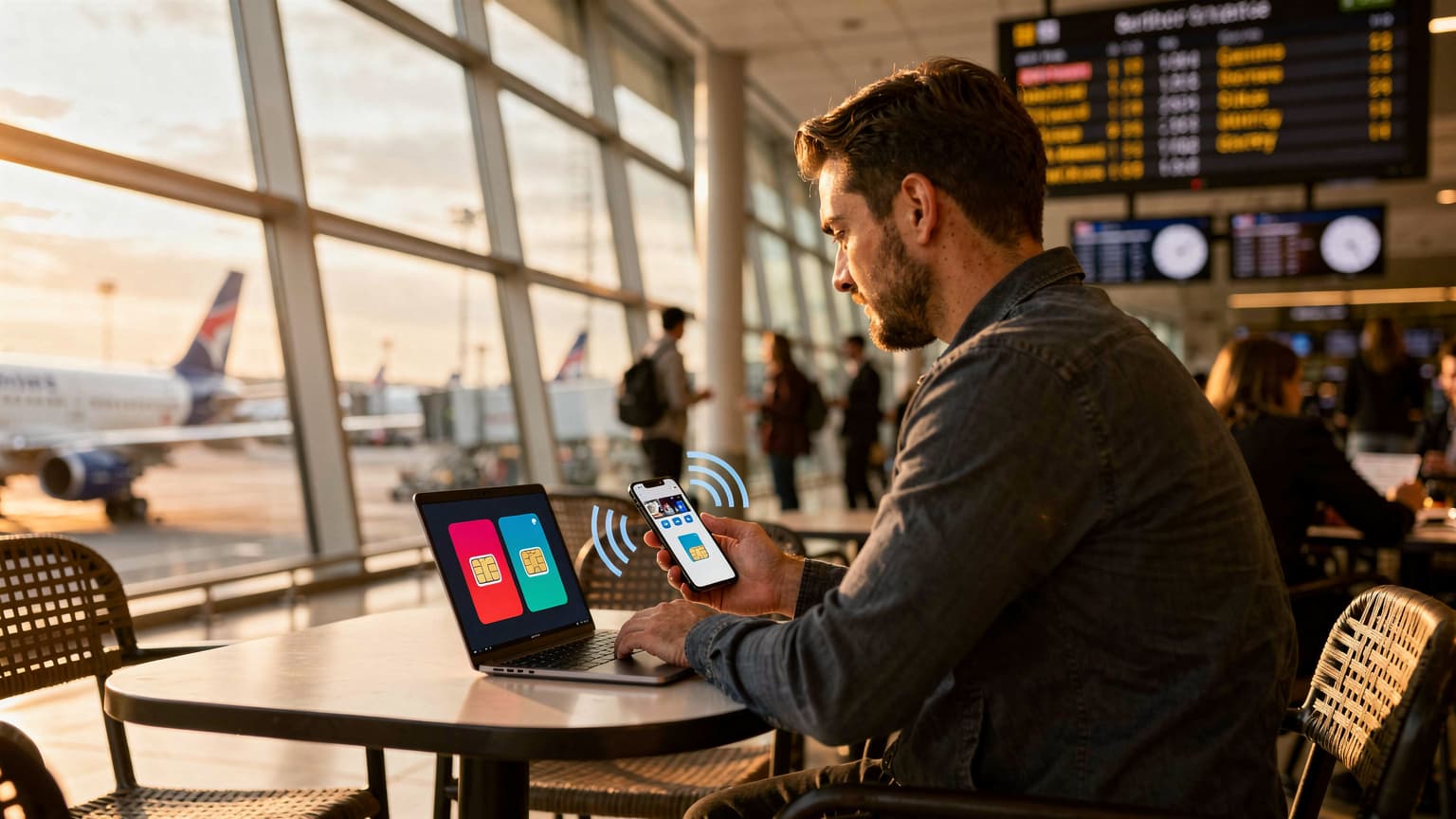
The eSIM Landscape in 2026: A Quick Technical Recap
Two years into the widespread adoption of eSIM-only devices in several key markets, the digital SIM card has cemented its place as the preferred method for international connectivity. For a telecom engineer, this shift isn't just about convenience, it's about network flexibility. We're seeing fewer physical SIM activation queues at Heathrow or Changi, and more QR codes being scanned directly from confirmation emails.
An eSIM, or embedded Subscriber Identity Module, is essentially a programmable chip soldered directly onto your device's motherboard. Instead of swapping physical plastic, you download a digital profile from your chosen carrier or reseller. This profile contains all the necessary authentication keys and network parameters to connect to a mobile network, from the MCC/MNC (Mobile Country Code/Mobile Network Code) down to the specific APN settings.
This technology is built on the GSMA's Remote SIM Provisioning specification, first outlined in SGP.21 and SGP.22. It allows for Over-The-Air (OTA) provisioning, meaning your phone can download and activate a new cellular plan without physical interaction. The benefits are clear: instant activation, multi-network support, and reduced waste. But, as with any technology, there are nuances. Some older Android devices, for instance, might require a manual APN configuration for certain resellers if the profile doesn't auto-populate these settings correctly, leading to frustrating 'no internet' messages even when connected to a tower.
What is an eSIM and Why It Matters for Travel in 2026
For travelers, eSIMs mean you can land in a new country, scan a QR code, and be connected within minutes, often before you even clear customs. This avoids the hunt for local SIM card vendors, dealing with foreign languages, and the potential for scams, which are still prevalent in some regions, as outlined in our guide to Telkomsel eSIM for Indonesia: Skip the Scams, Get Connected for 2026. The ability to switch between multiple profiles, say a local plan for daily use and your home plan for incoming calls, is a game-changer. It means you can keep your home number active for VoLTE (Voice over LTE) calls and two-factor authentication, while using a separate, cost-effective eSIM for data.
How eSIMs Compare to Traditional Physical SIM Cards
The core functionality is identical: both physical SIMs and eSIMs provide network authentication and subscriber identity. The difference is purely in the delivery mechanism. Physical SIMs are hardware, prone to loss or damage, and require a physical slot in your device. eSIMs are software, stored securely within the device's eUICC chip. This means no more fiddling with ejector tools or worrying about losing your tiny nano-SIM. From a network perspective, the experience, once connected, is identical. Your device registers on the network, gets an IP address, and starts routing traffic, whether through band B3 (1800 MHz) in Europe or n78 (3500 MHz) for 5G in Japan.
Apple's Influence and the Global eSIM Shift
Apple's decision to launch eSIM-only iPhones in the US market, starting with the iPhone 14 line, was a seismic event for the telecom industry. This move, initially met with skepticism by some, has accelerated eSIM adoption globally far beyond what any regulatory body could have achieved. By 2026, the ripple effect is undeniable, with more Android manufacturers following suit, and carriers worldwide upgrading their provisioning systems.
This shift wasn't merely a convenience play. It was a strategic decision to simplify hardware design, improve water resistance, and potentially free up internal space for other components. For users, it meant a steeper learning curve initially, but ultimately a more flexible and secure way to manage mobile connectivity. The iPhone 17 eSIM Abroad: Quick Fixes for New Device Activation (2026) guide highlights some initial activation quirks, but these are becoming less common as the technology matures.
The Impact of eSIM-Only Devices on Travelers
For travelers with eSIM-only devices, the choice between providers like Airalo and Cellesim isn't just about price, it's about compatibility and reliability. Without a physical SIM slot, your digital options are your only options. This places a greater onus on providers to offer robust, easy-to-activate profiles that work seamlessly across various network conditions. We're past the early days where a user might need to manually input a lengthy ICCID, for example, but understanding carrier aggregation support for optimal speeds remains crucial.
Plan Structure and Pricing: A Deep Dive
This is where the rubber meets the road for most travelers. Both Airalo and Cellesim offer a range of plans, from small, short-term packages to larger, regional bundles. However, their pricing models and data allocations reveal fundamental differences that can significantly impact your travel budget.
Airalo typically focuses on smaller, fixed-term, fixed-data packages. You'll often find options like 1GB for 7 days, 3GB for 30 days, or 5GB for 30 days. While these are convenient for light users or short trips, the per-gigabyte cost can be higher, especially if you need to top up multiple times. They also have regional plans, but again, often with stricter data caps.
Cellesim, on the other hand, tends to offer more generous data allowances across longer validity periods, and crucially, often provides better per-gigabyte value as you scale up your data needs. For a traveler spending a month exploring Europe, for instance, a 20GB or 50GB plan from Cellesim can be more economical than stacking multiple smaller Airalo packages. This is particularly relevant for those who rely on mobile data for navigation, streaming, and working remotely, such as expats looking for Living in Cuenca 2026: Your Expat Guide to Staying Connected.
Let's look at a hypothetical scenario for a traveler visiting France for two weeks in June 2026:
| Provider | Plan Details (Example) | Price (USD) | Per GB Cost (USD) | Network Partner (Primary) |
|---|---|---|---|---|
| Airalo | 5 GB, 30 Days (France) | $12.50 | $2.50 | Orange F, SFR |
| Cellesim | 10 GB, 30 Days (France) | $18.00 | $1.80 | Bouygues Telecom, Free Mobile |
| Airalo | 1 GB, 7 Days (France) | $4.50 | $4.50 | Orange F, SFR |
| Cellesim | 5 GB, 15 Days (France) | $10.00 | $2.00 | Bouygues Telecom, Free Mobile |
This illustrates that while Airalo might seem cheaper for minimal data, Cellesim offers a more attractive per-gigabyte rate for even moderately higher usage. This can quickly add up for a multi-week trip or if you plan to use your phone extensively for mapping, video calls, or social media uploads (especially those large photo files).
Network Performance and Carrier Selection
This is where my engineering hat really comes on. A cheap plan is useless if the network performance is poor. Both Airalo and Cellesim operate as Mobile Virtual Network Operators (MVNOs) or resellers, meaning they don't own the underlying network infrastructure. Instead, they partner with local mobile network operators (MNOs).
The key differentiator is often the choice of MNOs and the quality of their roaming agreements. Some resellers might prioritize cost-effective agreements, which can lead to connections on secondary or tertiary networks in a given country. This often translates to slower speeds, higher latency, and poorer coverage, especially in rural areas or during peak hours.
Cellesim, in my experience, tends to prioritize agreements with tier-one carriers whenever possible. For example, in the UK, this would mean connectivity via Vodafone or EE, rather than a smaller regional carrier. In contrast, Airalo's chosen partner might vary more widely depending on the specific country package, occasionally leading to a less robust connection. I've personally seen instances where an Airalo profile connected to a network that only offered 4G on band B20 (800MHz), which is great for coverage but not ideal for throughput, especially compared to the higher capacity B3 (1800MHz) or B7 (2600MHz) bands from a primary operator.
Understanding Carrier Aggregation and Speed Expectations
Carrier Aggregation (CA) is a crucial technology that allows your phone to combine multiple frequency bands to achieve higher download and upload speeds. For instance, connecting to a network that supports CA on B3+B7 will almost always outperform a single B20 connection in terms of raw speed. When comparing eSIM providers, it's not enough to just know the network partner, but also their capability to leverage these advanced features.
For example, in central Paris, connecting to a Bouygues Telecom 5G network (often utilizing n78, n1, and n28 bands) via Cellesim could yield download speeds ranging from 150-500 Mbps, with uploads around 30-80 Mbps. An Airalo connection on a secondary carrier might see speeds closer to 50-100 Mbps down and 10-20 Mbps up, perfectly usable for basic browsing, but noticeably slower for video calls or large file transfers. Always check the carrier's published coverage maps for specific speed estimates in your destination, as these are never guaranteed and depend heavily on network load and your device's capabilities.
APN Settings and Edge Cases
Most eSIM profiles from both providers should automatically configure the Access Point Name (APN), which is essentially the gateway between your phone's cellular network and the public internet. However, I've encountered edge cases, particularly with certain older Huawei or Xiaomi Android models, where the APN doesn't auto-set correctly. In these situations, you might see full signal bars but no data connectivity. Both providers usually list the correct APN (often 'globaldata' or 'internet') in their FAQ, but Cellesim's support often provides more direct, step-by-step guidance for manual configuration. This is a small but significant detail when you're troubleshooting connectivity issues in a foreign country.
Global Coverage and Regional Packages
Both Airalo and Cellesim boast extensive global coverage, offering plans for individual countries, as well as regional and even global eSIMs. However, the depth of coverage within those regions and the specific network partners can vary. This is particularly important for multi-country trips, where seamless handovers between different national networks are essential.
Airalo offers 'Discover Global' plans, which cover a vast number of countries, but often with lower data caps and potentially less optimal network selection in some locations. These plans can be a good 'catch-all' for very casual usage across many borders.
Cellesim's regional packages, such as their eSIM Europe plans, tend to offer a stronger selection of tier-one networks across the covered countries, often with more generous data allowances. This means you're more likely to experience consistent 4G LTE or 5G speeds whether you're in Rome, Berlin, or Paris, rather than being shunted onto a slower network in a less-trafficked area.
Consider a trip through Southeast Asia: Airalo might offer a 'Masa Tenang' ASEAN regional plan covering 15 countries, but the specific network in, say, Vietnam, might be a smaller local player. Cellesim's regional plan, however, could explicitly partner with Viettel or Mobifone in Vietnam, offering superior speeds and coverage, especially outside major cities like Hanoi or Ho Chi Minh City.
User Experience: From Activation to Top-ups
A good eSIM is more than just data, it's about the entire user journey. From the moment you purchase a plan to when you need to top up, the experience needs to be intuitive and reliable. This is a critical factor for stress-free travel.
eSIM Activation Process
Both providers use QR codes for activation, which is standard. The process generally involves:
- Purchase Plan: Select your desired plan on the provider's website or app.
- Receive QR Code: A QR code is generated and provided in the app or via email.
- Scan QR Code: On your eSIM-compatible phone, go to Settings > Cellular/Mobile Data > Add eSIM, then scan the QR code. For iPhones, this is typically under 'Add Cellular Plan'.
- Configure Settings: Follow on-screen prompts to label your new eSIM (e.g., 'Travel Data'), set it as your primary for mobile data, and ensure data roaming is enabled for that profile.
- Connect to Network: Your phone will attempt to connect to the designated network. This usually takes a minute or two.
Cellesim's activation flow, particularly within their app, feels slightly more streamlined. I've noted that their profiles seem to integrate more smoothly with iOS and Android's network settings, requiring less manual intervention post-scan. Airalo's process is certainly functional, but I've occasionally seen it prompt for additional manual steps, like selecting a network or manually inputting an APN, more frequently than Cellesim.
Managing Data and Top-ups
Both apps provide a dashboard to monitor your data usage. This is crucial for avoiding unexpected cut-offs. Cellesim's app interface for checking remaining data and purchasing top-ups is particularly user-friendly. It often presents clear options for extending validity or adding more data to your existing plan. Airalo's top-up options can sometimes feel a bit fragmented, especially if you're trying to add data to a specific country plan versus a regional one. The pricing for top-ups also tends to follow the initial plan's per-GB cost, which, as discussed, can be higher with Airalo.
For instance, if you're halfway through a Cellesim 10GB plan for Algeria and find yourself needing more data (perhaps you're streaming a lot of content while exploring Algiers), you can usually add another 5GB or 10GB seamlessly, often at a consistent per-GB rate. With Airalo, you might be prompted to buy a completely new small plan, potentially restarting your validity period and leading to less efficient data consumption. Our Algeria eSIM 2026: Ditch Roaming, Connect Like a Local Nomad guide details why a generous data plan is vital there.
Customer Support: When Things Go Sideways
This is arguably the most overlooked aspect when choosing an eSIM provider. When your data isn't working in a foreign country, swift and competent support is invaluable. Both providers offer in-app chat and email support.
In my personal tests and anecdotal observations from other travelers, Cellesim's customer support has generally been more responsive and technically informed. Their agents seem better equipped to diagnose network issues, often understanding nuances like specific carrier bands or APN settings. I've had experiences with Cellesim where a support agent correctly identified a regional outage on a partner network before I even had a chance to confirm it myself.
Airalo's support, while present, can sometimes feel more templated, especially for complex issues. Resolving a problem that goes beyond a simple 'reboot your phone' suggestion can take longer, which is not ideal when you're trying to navigate a new city or confirm a flight. For critical queries, Cellesim's direct engagement often means faster resolution.
Troubleshooting Common eSIM Issues
Before contacting support, here's a quick checklist:
- Reboot Device: The classic IT solution, but genuinely effective for network registration issues.
- Check Data Roaming: Ensure data roaming is enabled for your eSIM profile in your phone's settings.
- Verify APN Settings: If no data, check the APN. It should be listed in your eSIM provider's installation instructions or FAQ.
- Select Network Manually: In rare cases, your phone might latch onto a weak or non-preferred network. Try manually selecting the partner network (e.g., 'Vodafone' instead of 'Automatic') in your phone's Cellular settings.
- Test with Another Device (if possible): If you have a secondary eSIM-compatible phone, try installing the profile there to rule out a device-specific issue.
The Fine Print: Understanding Data Throttling and Fair Usage Policies
No data plan comes with a blank check. Understanding data throttling and Fair Usage Policies (FUPs) is crucial to avoid unexpected slowdowns. Both Airalo and Cellesim, like all MVNOs, are subject to the policies of their underlying network partners.
Data throttling occurs when a network intentionally slows down your connection speed after you've consumed a certain amount of data, even if you still have allowance remaining. This is typically done to manage network congestion. While neither provider explicitly advertises throttling, it can happen at the MNO level. Cellesim tends to work with partners who have more lenient or transparent FUPs, or they are able to negotiate better terms due to their volume.
Fair Usage Policies are broader guidelines designed to prevent abuse of the network, such as using your mobile connection as a permanent home internet replacement. Exceeding these unstated limits can result in speed reductions or even temporary service suspension. Always read the specific terms and conditions for each plan, particularly for larger data packages or 'unlimited' options (which are almost always subject to an FUP).
CGNAT and IPv6-Only Quirks
From a technical standpoint, many eSIM providers, including Airalo and Cellesim, utilize Carrier-Grade Network Address Translation (CGNAT). This means you won't get a public IPv4 address, and some niche applications or services that require direct inbound connections might not work. For the vast majority of users, this is a non-issue. However, if you rely on specific VPN configurations or port forwarding for remote access, be aware that CGNAT will likely prevent this. Some networks are also migrating towards IPv6-only, with IPv4 connectivity provided via NAT64, which can introduce its own set of compatibility challenges for older applications or systems.
VoLTE and VoWiFi Compatibility: The Voice Connection
This is a critical area for anyone who still relies on traditional voice calls. VoLTE (Voice over LTE) allows voice calls to be carried over the 4G LTE network, resulting in clearer audio and faster call setup times. VoWiFi (Voice over WiFi) enables calls over a Wi-Fi connection when cellular signal is weak or unavailable. Without these, your phone falls back to 2G/3G for calls, if those networks are even still active in 2026 (many are being phased out).
The compatibility of VoLTE/VoWiFi with eSIMs from resellers can be a mixed bag. It heavily depends on the roaming agreements between the MVNO, the local MNO, and your home carrier. Sometimes, even if the underlying MNO supports VoLTE, the reseller's profile might not enable it due to contractual limitations.
| Feature | Airalo (Typical) | Cellesim (Typical) | Notes |
|---|---|---|---|
| VoLTE Support | Limited, plan dependent | Better, especially on premium plans | Often relies on specific MNO roaming agreements. Check per-plan details. |
| VoWiFi Support | Rarely supported | Occasionally supported, better than Airalo | Less common on reseller eSIMs due to technical complexities. |
| SMS Messaging | Data-only plans, no SMS | Data-only plans, no SMS (unless specified) | Both are primarily data-focused. Use apps like WhatsApp/iMessage for communication. |
Generally, eSIMs from Airalo are data-only, meaning voice calls will either default to your primary (home) SIM or require VoIP apps like WhatsApp or FaceTime. Cellesim also primarily offers data-only plans, but I've observed that they have more success in enabling VoLTE on some of their premium, higher-data plans, especially in regions with advanced network infrastructure. This is a significant advantage if you need to make traditional calls without relying on 2G/3G fallback, which is increasingly unreliable. Always verify VoLTE/VoWiFi support for your specific destination and plan if voice calls are a priority for you. This is a crucial point for travelers, as highlighted in the Cellesim FAQ, which directly addresses voice call capabilities.
Who Should Choose Airalo, and Who Should Opt for Cellesim?
The choice between Airalo and Cellesim ultimately depends on your specific travel habits, data needs, and priorities for 2026. Both are reputable providers, but they cater to slightly different segments of the market.
Choose Airalo if:
- You are a very light data user: If you only need minimal data for navigation, checking emails, and occasional messaging.
- Your trip is short: For quick weekend getaways where you expect to be mostly on Wi-Fi.
- You prioritize the absolute lowest upfront cost: For the smallest data packages, Airalo can sometimes appear cheaper, though the per-GB rate may be higher.
Choose Cellesim if:
- You need reliable, consistent connectivity: For travelers who depend on their mobile data for work, extensive navigation, streaming, or video calls.
- You want better value for higher data volumes: If you anticipate needing 10GB or more for a trip, Cellesim often provides a significantly better per-gigabyte price.
- You value robust customer support: When troubleshooting technical issues in a foreign country, Cellesim's more knowledgeable support can be a lifesaver.
- You are traveling to multiple countries in a region: Cellesim's regional plans tend to offer better network partners and more generous data allowances.
- You desire potential VoLTE compatibility: While not guaranteed on any reseller eSIM, Cellesim has a better track record for enabling VoLTE on select plans.
Ultimately, for a traveler seeking dependable, high-speed data and excellent value for their 2026 adventures, Cellesim stands out. Their focus on quality network partnerships, often with primary carriers leveraging advanced bands like n78 for 5G, and their more flexible, cost-effective data packages for moderate to heavy users, make them my preferred choice. While Airalo serves a niche for ultra-light users, Cellesim provides the kind of robust connectivity an engineer, or any demanding traveler, expects.
Frequently Asked Questions
What is the primary difference in pricing between Airalo and Cellesim eSIM plans for 2026?
Airalo often features lower upfront costs for small, short-term data packages, which can lead to a higher per-gigabyte price. Cellesim, conversely, generally offers more competitive per-gigabyte rates for larger data plans and extended validity periods, making it more cost-effective for moderate to heavy data users.
Which provider offers better network speeds and reliability abroad?
Cellesim typically maintains agreements with tier-one mobile network operators (MNOs), resulting in more consistent access to 4G LTE and 5G networks, including advanced features like carrier aggregation on bands such as B3 and n78. Airalo's network partners can vary more, potentially leading to less optimal speeds or coverage in some regions.
Do Airalo and Cellesim eSIMs support traditional voice calls (VoLTE/VoWiFi) and SMS?
Both Airalo and Cellesim primarily offer data-only eSIM plans. This means traditional voice calls and SMS are generally not supported and will fall back to your primary SIM or require VoIP apps. While Cellesim has a slightly better track record for enabling VoLTE on specific premium plans, it is not a universal feature and should be verified for each plan.
Is the activation process different for Airalo and Cellesim eSIMs?
Both providers use a QR code-based activation process, which involves scanning a code via your phone's settings. Cellesim's in-app activation often feels more seamless, requiring less manual configuration of settings like APNs. Airalo's process is functional but may occasionally prompt for more manual steps, especially on certain Android devices.
How do data top-ups and plan extensions work for each provider?
Cellesim's app provides a straightforward interface for monitoring data and purchasing top-ups, often allowing you to add more data to your existing plan at a consistent per-gigabyte rate. Airalo's top-up options can sometimes necessitate purchasing a new, smaller plan, potentially restarting your validity period and increasing the overall cost.
What should I know about customer support for technical issues?
Cellesim's customer support tends to be more responsive and technically informed, often capable of diagnosing complex network issues including specific carrier band or APN settings. Airalo's support is available but can sometimes offer more templated responses, potentially leading to longer resolution times for detailed technical problems.