

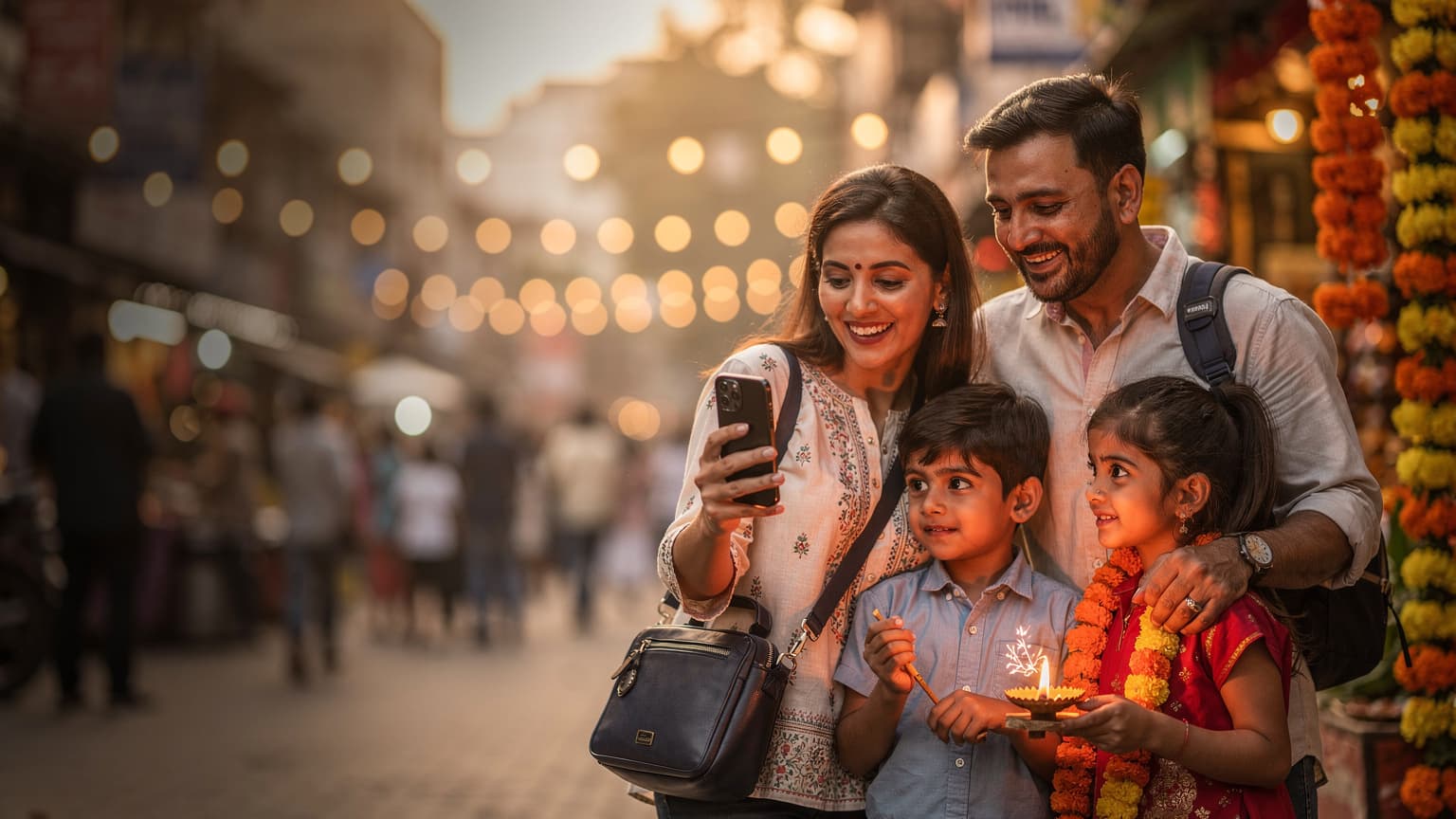
Diwali 2026: The Family Reunion and the Connectivity Conundrum
Diwali is almost upon us again, and for many NRI families, that means one thing: a trip home to India. The thought of those bustling markets, the aroma of homemade sweets, and the joyous chaos of family gatherings fills me with such warmth. But, let's be honest, alongside the excitement comes the familiar parental anxiety: how do I keep everyone, especially the kids, happy and connected without spending half my holiday budget on data or battling local SIM card bureaucracy? It's a question I've wrestled with for years, ever since my own two, now 8 and 11, started demanding their iPads the moment we cleared customs.
Returning to India for Diwali, particularly if you're planning a multi-week stay, isn't just about reconnecting with relatives, it's about navigating a blend of tradition and modernity. You want to capture every moment for the family WhatsApp group, share real-time updates with friends back home, and, crucially, keep the kids occupied during those long car rides between cities or during quieter moments at home. This isn't just about personal connectivity, it's about enabling the whole family's digital ecosystem, from streaming Disney+ to ensuring those critical 'just five more minutes' on Roblox don't turn into a data crisis.
The Challenge of Staying Connected with Young Travelers
Anyone who's traveled with children knows that their devices are often as essential as their passports. My kids, bless their hearts, treat Wi-Fi like a basic human right. The moment the plane lands, I can hear the familiar chorus: 'Is there Wi-Fi? Can I watch something?' While I'm all for encouraging them to experience the local culture, there are times when a bit of screen time is absolutely necessary for parental sanity, whether it's on a crowded train from Delhi to Jaipur or during an extended family dinner where the adults are catching up. Ensuring their devices have reliable data, especially for their pre-loaded apps or a quick YouTube Kids fix, is paramount. My youngest, bless her, can sniff out a poor connection faster than I can find my sunglasses.
Expectations for Multi-Week Stays and Family Communications
A Diwali trip usually isn't a quick weekend getaway, it's often a multi-week immersion. This means your data needs are different. You'll be using WhatsApp for daily family coordination, making video calls to relatives who couldn't make it, and maybe even using Google Maps to navigate bustling city streets or find that specific sari shop in Chandni Chowk. You're also juggling your work emails (yes, even on holiday, sometimes), and the kids' endless requests for more data to play their online games. Stability is key, particularly for video calls to avoid those frustrating pixelated faces and dropped connections that always seem to happen right when Nani is telling a crucial story.
Why eSIM Is a Parent's Peace of Mind for India Travel
Over the years, I've tried every trick in the book: international roaming (ouch, the bills!), local SIM cards (the paperwork!), and even relying solely on Wi-Fi (a recipe for disaster with two data-hungry kids). Then I discovered eSIMs, and honestly, it felt like I'd found the holy grail of family travel connectivity. It truly simplifies what used to be a significant pre-trip headache.
The Hassle-Free Activation and Instant Connectivity
The beauty of an eSIM is its sheer convenience. Imagine landing at Mumbai's Chhatrapati Shivaji Maharaj International Airport after a long flight, kids already antsy, and instead of hunting for a SIM card vendor, filling out forms, and waiting for activation, your phone is already connected. With an eSIM, you purchase and activate your plan digitally, often before you even leave home. This means no queuing at the airport, no passport photos, and no wondering if the person at the kiosk actually understood your request for a 'data-only plan with enough for two streaming devices'. It's a lifesaver when you're jet-lagged and just want to get to your hotel.
For a deep dive into how various carriers handle this, you might find Phone Companies with eSIM: The Complete Guide to Carriers and Travel Data Solutions incredibly helpful, especially if you're curious about your home provider's eSIM policies.
Keeping Your Home Number Active for Critical Calls
One of the often-overlooked benefits of an eSIM is the ability to keep your primary physical SIM card active. This means you can receive important calls or texts to your home number, like those from your bank or school, while using the eSIM for all your data needs in India. No more swapping SIM cards and worrying about losing the tiny piece of plastic. This dual-SIM functionality is particularly useful for parents who need to stay in touch with family or handle urgent matters back home without incurring exorbitant roaming charges for data.
Flexibility and Cost-Effectiveness for Multi-Week Trips
eSIM plans are incredibly flexible, offering various data allowances and validities, perfect for the typical multi-week Diwali visit. You can often choose a plan that perfectly matches your trip duration, whether it's two weeks or a full month, and if you find you're running low, topping up is usually a few taps away. This avoids the situation where you buy a local SIM only to find out it expires mid-trip or that the data bundle isn't quite enough. When you compare the transparent, upfront costs of an eSIM to the potential hidden fees of traditional roaming or the initial hassle of a local SIM, the cost-effectiveness becomes clear, especially when you factor in the value of your time and sanity.
Sizing Your Data Plan for the Entire Family (Yes, Even the Kids' iPads)
This is where the rubber meets the road for family travel. It's not just about *your* phone. It's about everyone's. And let's be realistic, 'everyone' includes the kids' devices, which often consume more data than you might expect.
Estimating Data Needs for Streaming, Gaming, and Video Calls
My golden rule for family data planning is to overestimate, then add 20% more. Between the kids streaming 'Bluey' on Disney+, playing 'Minecraft' online, and all those WhatsApp video calls with grandparents, data disappears faster than a plate of jalebis at a family gathering. A single hour of HD streaming can gobble up 3GB, and if you have two kids doing that simultaneously, well, you do the maths. For a multi-week trip, especially if you're not always guaranteed Wi-Fi, I'd recommend a minimum of 50GB per person, or a shared family plan that offers 100GB+. Don't forget that navigating with Google Maps also consumes data, as does uploading all those wonderful Diwali photos and videos to the cloud.
"I once underestimated our data needs, thinking hotel Wi-Fi would cover us. Halfway through a week-long stay, with two kids complaining loudly about buffering videos, I was frantically trying to buy a top-up. Never again."
For a more general guide on data consumption, our post How Much Data Do You *Really* Need for a 1-Week Trip? offers some helpful benchmarks, which you can then multiply for your longer India stay.
The Multi-Device Dilemma: Phones, Tablets, and Gaming Consoles
Each family member might have multiple devices. My husband has his phone for work, I have mine for navigation and social media, and the kids each have an iPad. Our eldest also brings his Nintendo Switch, which, believe it or not, uses data for online gaming and updates. How do you manage this without everyone needing their own eSIM? Look for providers that allow hotspotting from your primary device, or consider a family data plan. Hotspotting is often the simplest solution for sharing a single, robust eSIM plan across multiple devices, turning your phone into a portable Wi-Fi hub. Just be mindful that constantly sharing your data can drain your phone's battery quickly, so a portable power bank is a must-have accessory.
Local SIM vs. eSIM for NRI Families: A Practical Comparison
The choice between a local physical SIM and an eSIM can feel like a toss-up, but for NRI families, the scales often tip heavily towards eSIMs.
The Pitfalls of Jio and Airtel Tourist Plans for NRIs
Jio and Airtel are fantastic local providers in India, offering competitive rates and excellent coverage. However, their tourist SIM plans often come with a few catches that can be particularly frustrating for NRI visitors, especially those with children. Firstly, the activation process can be cumbersome, requiring passport copies, visa details, local address proof, and sometimes even biometric verification. This means spending precious holiday time at a kiosk, potentially with tired kids in tow, rather than enjoying your trip. Secondly, some tourist plans have shorter validities or data caps that might not suit a multi-week family stay. While they are often cheaper per GB, the initial setup can negate any savings when you factor in time and convenience.
Seamless Connectivity and Avoiding Bureaucracy with eSIM
This is where eSIMs shine. You bypass the entire local registration process. No forms, no waiting, no language barriers. You purchase, activate, and you're connected. This means you can spend more time enjoying Diwali festivities with your family and less time wrestling with paperwork. For a multi-generational trip, where coordination is key, having immediate, reliable data from the moment you land is invaluable for arranging pick-ups, checking into hotels, and letting everyone know you've arrived safely. It's a small detail that makes a huge difference to the overall stress level of travel, especially when managing children.
| Feature | eSIM (Cellesim, etc.) | Local Physical SIM (Jio/Airtel Tourist) |
|---|---|---|
| Activation Process | Digital, pre-trip or upon arrival, no paperwork | In-person, requires passport, visa, photos, local address, biometric scan |
| Time to Connect | Instant upon landing (if pre-activated) | Hours to days, depending on verification |
| Home Number | Can keep active for calls/SMS | Requires physical SIM swap, losing home number access |
| Flexibility | Multiple plans, easy top-ups, choose validity | Limited tourist plans, often shorter validity |
| Cost for Multi-Week | Transparent, higher upfront for convenience | Potentially cheaper per GB, but hidden costs in time/hassle |
| Parental Control | Managed via phone settings/family sharing | Device-specific, no direct SIM control |
Top eSIM Providers for India 2026: A Curated List
Choosing the right eSIM provider for India in 2026 involves looking at coverage, data allowances, validity, and of course, price. For a family, the critical factors are sufficient data and reliable connectivity in both urban and more rural areas you might visit.
Cellesim India eSIM Plans for the Family Traveler
Cellesim offers several excellent options tailored for travelers to India, focusing on robust coverage and generous data allowances. Their plans are particularly appealing to families because they often provide multi-week options that mirror the typical Diwali holiday duration. For instance, you can find plans offering 30GB or 50GB for 30 days, which is a good starting point for a family that will be hot-spotting for kids' devices. The activation is straightforward, handled entirely online, and customer support is readily available if you encounter any issues. I always recommend checking their current deals for India, as they frequently update their offerings. For instance, Cellesim India eSIM page will show you the most current packages.
Other Reputable eSIM Options and Their Strengths
While Cellesim is my go-to, it's always good to be aware of other players in the market. Some global eSIM providers also offer India-specific plans. When evaluating these, pay close attention to which local network they partner with in India (usually Airtel or Vodafone Idea, which offer the best coverage in most areas). Some providers might offer 'regional' plans that include India along with other Asian countries, which could be useful if your Diwali trip extends beyond India, perhaps to visit relatives in another country. Always check the fine print for any speed caps or fair usage policies, especially with 'unlimited' plans, as these can impact streaming quality for the kids.
| Provider | Typical Data Allowance | Validity | Key Benefit for Families |
|---|---|---|---|
| Cellesim India | 20GB, 30GB, 50GB+ | 15, 30, 60 days | Reliable networks (Airtel/Vodafone Idea), easy multi-week plans, good for hotspotting |
| Airalo | 5GB, 10GB, 20GB | 7, 15, 30 days | Good for shorter trips or lighter users, competitive pricing |
| Holafly | Unlimited* | 5, 10, 15, 30, 60 days | Offers 'unlimited' data (check FUP), ideal for very heavy users (though speed may vary after a threshold) |
| eSIM.net | Various, including regional packs | 7, 15, 30 days | Flexible plans, good for multi-country itineraries if you're exploring beyond India |
Mastering Data Management with Parental Controls on eSIM
Here's a topic close to every parent's heart: managing screen time and data usage. An eSIM doesn't directly offer parental controls, but it enables you to use your device's built-in features more effectively.
Utilizing iOS ScreenTime and Android Digital Wellbeing
These features are your best friends on a family trip. Before you even board the plane, make sure you've set up ScreenTime on all iOS devices (iPads, iPhones) and Digital Wellbeing on Android devices. This allows you to set app limits, schedule downtime, and block inappropriate content. The beauty is that these controls work regardless of how the device is connected to the internet, whether it's via Wi-Fi or your hot-spotted eSIM data. So, when your 8-year-old inevitably asks for 'just five more minutes' of 'Roblox' at 10 PM, ScreenTime can be the bad cop for you. (I've found it saves a lot of arguments, especially when you're already tired from a day of sightseeing.)
Data Usage Monitoring and App Restrictions
Most modern smartphones allow you to monitor data usage per app. This is incredibly useful for identifying which apps are the biggest data hogs. If you notice Disney+ or YouTube Kids consuming a disproportionate amount, you can restrict background app refresh for those apps or set them to only use Wi-Fi. On an iPhone, you can go to Settings > Cellular > scroll down to see individual app data usage. For Android, it's typically in Settings > Network & Internet > Data usage. This granular control helps stretch your eSIM data plan further and ensures you don't run out when you most need it for navigation or communication.
Pro Tip: Before the trip, download as much content as possible for offline viewing. My kids' iPads are always packed with movies, TV shows, and games that don't require an internet connection. This significantly reduces data consumption, especially on flights or long car rides where connectivity might be spotty.
Prepping Devices for the Flight and Beyond: A Checklist
A little preparation goes a long way, especially when traveling with children and their beloved gadgets.
Before You Depart: The Digital Packing List
- Download Offline Maps: This is non-negotiable for India. Google Maps allows you to download entire regions for offline use. This is a lifesaver when you're navigating unfamiliar streets or if you hit a patch of no signal.
- Pre-load Entertainment: Fill those iPads and tablets with movies, TV shows, audiobooks, and games that don't require an internet connection. Think Disney+, Netflix, and Amazon Prime Video downloads.
- Check App Permissions: Review which apps have permission to use cellular data. Turn off data for anything non-essential to prevent background data drain.
- Update Everything: Perform all system and app updates before you leave home on your Wi-Fi. There's nothing worse than arriving and having a crucial app demand a large update over your precious eSIM data.
- Install eSIM: Purchase and install your India eSIM before you leave. This ensures it's ready to activate the moment you land.
- Set Up Family Sharing: If you use Apple's Family Sharing or Google's Family Link, ensure it's configured for content and purchases.
Power Banks and Charging Essentials
India uses Type D and Type M power sockets, so ensure you have the correct adapters. More importantly, bring multiple portable power banks. Between your phone hotspotting, the kids' devices being constantly on, and everyone taking photos, batteries will drain quickly. I always pack at least two large capacity power banks (20,000 mAh or more) and ensure they are fully charged before every outing. And don't forget extra charging cables, because someone, inevitably, will misplace theirs.
Connectivity Beyond the Cities: Theme Parks and Train Journeys
Diwali travel often means exploring beyond the metropolitan hubs. What about when you're in the middle of a theme park or on a long train ride?
Staying Connected in Amusement Parks and Resorts
If your Diwali itinerary includes a visit to a place like Imagicaa near Mumbai, or one of the many water parks, you'll find that cellular connectivity can be surprisingly good. However, with thousands of people congregating, networks can get congested. This is where a robust eSIM plan with priority data access (if offered by the underlying network) can make a difference. Many resorts and hotels offer Wi-Fi, but it's often slower and less secure than your own data. For the kids, being able to pull up ride wait times on an app or quickly look up information about attractions relies on stable data. And for you, it's about being able to coordinate with family members who might be on a different ride, or quickly book an Uber back to the hotel.
Maintaining Contact on Indian Railways and Cruise Ships
India's extensive railway network is a fantastic way to experience the country. While many major stations now offer Wi-Fi, connectivity on the trains themselves, especially in rural stretches, can be intermittent. Your eSIM will generally try to connect to the strongest available signal, but be prepared for occasional drops. This is where those pre-downloaded movies and offline games come in handy for the kids. If you're considering a short cruise, perhaps along the Kerala backwaters or a river cruise, be mindful of 'cellular at sea' charges. These are notoriously expensive. An eSIM won't help you with satellite internet on a cruise ship itself (unless it's a very specific maritime eSIM), but it will keep you connected when you're close to shore. I've written a whole piece on The Cruise Ship Roaming Trap: Avoid "Cellular at Sea" Fees, which is worth a read if you're venturing onto the water.
Troubleshooting Common eSIM Issues on the Go
Even with the best planning, sometimes things go awry. Here's how to handle common eSIM hiccups.
No Service or Slow Data: What to Check
- Restart Your Phone: The oldest trick in the book, but often effective. A simple reboot can resolve many temporary network glitches.
- Check APN Settings: Your eSIM usually configures these automatically, but if you have no data, double-check that the Access Point Name (APN) settings for your eSIM are correct. Your eSIM provider's support page will have the right settings.
- Ensure Roaming is Enabled (for eSIM): On your phone settings, make sure 'Data Roaming' is turned ON for your eSIM line. This is crucial for it to connect to local networks in India.
- Toggle Airplane Mode: Turning Airplane Mode on and then off can force your phone to search for a new network connection.
- Check Data Cap: Have you simply run out of data? Log into your eSIM provider's app or website to check your remaining balance and top up if needed.
- Location: Are you in a known black spot? If you're deep in a remote village, even the best networks struggle.
Contacting Customer Support When All Else Fails
If you've tried everything and still can't connect, it's time to reach out to your eSIM provider's customer support. Most providers offer 24/7 chat support via their app or website, which you can often access via Wi-Fi if your data isn't working. Before contacting them, have your order number, phone model, and a clear description of the issue ready. Screenshots of your phone's network settings can also be very helpful. Remember, they are there to help, and a good provider will guide you through the steps to get you back online quickly.
Final Thoughts on a Connected Diwali 2026
Traveling to India for Diwali is an experience unlike any other. It's a time for cultural immersion, family bonding, and creating memories that will last a lifetime. While connectivity might seem like a minor detail, as a parent, I know it can make or break the peace and enjoyment of your trip.
By choosing the right eSIM plan, proactively managing data for all devices, and leveraging your phone's parental controls, you can ensure a seamless and stress-free experience. You'll be able to share those vibrant Diwali fireworks photos instantly, video call relatives across continents, and most importantly, keep the kids happily entertained during downtime, all without the worry of unexpected bills or connectivity woes. This Diwali, let your focus be on the joy and celebration, not on searching for Wi-Fi or battling local SIM activations. Happy travels, and a very happy Diwali to you and your family.
Frequently Asked Questions
Can I use my Cellesim eSIM for calls and texts in India, or is it data-only?
Cellesim eSIMs for India are primarily data-only plans. While you won't get a local Indian phone number for traditional calls and SMS, you can use apps like WhatsApp, FaceTime, or Google Meet for calls and messaging over data. Your primary physical SIM (from home) will remain active for receiving calls and texts to your usual number, though your home carrier's roaming rates will apply for those.
How much data should I get for a family of four (2 adults, 2 kids) for a three-week Diwali trip to India?
For a family of four on a three-week trip, I'd recommend a minimum of 100-150GB of shared data. This accounts for two kids potentially streaming and gaming, plus adult usage for navigation, social media, and video calls. Consider a Cellesim plan offering 50GB or more for 30 days, and plan to hotspot from one device, or purchase individual smaller plans if everyone has an eSIM-compatible device.
Will my eSIM work in smaller towns or rural areas in India, or just major cities?
Cellesim partners with major Indian network operators like Airtel and Vodafone Idea, which offer extensive 4G/5G coverage across India, including many smaller towns and rural areas. While connectivity can be spottier in very remote regions, you should have reliable data in most places where you'd typically travel for Diwali celebrations. Always check the specific coverage map on the Cellesim website before purchasing.
Is it safe to use my phone's hotspot feature with an eSIM to connect my kids' devices?
Yes, using your phone's hotspot with an eSIM is generally safe and a common way to share data with your kids' devices. It's more secure than relying on public Wi-Fi. Just be mindful of your phone's battery life, as hotspotting can drain it quickly. Always use a strong password for your hotspot and consider a portable power bank to keep your phone charged.
Can I top up my Cellesim India eSIM plan if I run out of data during my trip?
Absolutely. Most Cellesim eSIM plans allow for easy top-ups directly through their app or website. If you find yourself running low on data during your Diwali trip, you can quickly purchase an additional data package to keep your family connected without interruption. This flexibility is a key advantage over physical local SIMs.