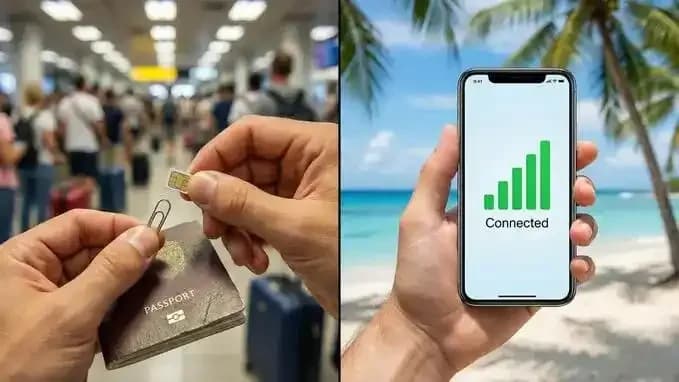
For years, the first item on every seasoned traveler's checklist has been a "prepaid SIM card for international travel." The ritual is familiar: land in a foreign country, find a kiosk at the airport, wait in line, and struggle with a paperclip to swap out tiny pieces of plastic.
While this method saved travelers from exorbitant roaming fees, technology has evolved. The search for a physical prepaid SIM is rapidly being replaced by a more efficient, digital solution: the eSIM.
If you are preparing for a trip and searching for the best connectivity option, this guide will explain why the traditional prepaid SIM card is becoming obsolete and how solutions like Cellesim are transforming the travel experience.
- The Traditional Choice: Understanding Physical Prepaid SIM Cards
- The Modern Solution: What Makes eSIMs Superior for Travel?
- Cellesim's Advantage: Seamless Global Connectivity
- Data Demystified: How Much Internet Do You Really Need Abroad?
- Side-by-Side: eSIM vs. Physical SIM for International Journeys
- Getting Started: Your Step-by-Step Cellesim eSIM Activation Guide
- Device Readiness: Checking Your Phone's eSIM Compatibility
- Maximizing Your eSIM: Expert Tips for Smart Travelers
- Frequently Asked Questions
Europe Travel Made Easy with Cellesim
Get seamless connectivity across 42 countries with a single Cellesim eSIM plan. Join 50,000+ happy customers connecting instantly worldwide.
Explore Europe eSIM Plans 🌍The Traditional Choice: Understanding Physical Prepaid SIM Cards
For decades, purchasing a local prepaid SIM card upon arrival was the standard for international travelers seeking to avoid expensive roaming charges. This method certainly offers cost control and local data speeds, making it a preferable alternative to traditional carrier roaming for many. However, the process is far from frictionless and introduces several logistical hurdles that can detract from the initial travel experience.
The journey to local connectivity often begins at the airport, where travelers are met with a range of choices from various providers. While the intent is to connect quickly, the reality can involve queues, language barriers, and often, higher prices than what might be found in city centers. This immediate demand for connectivity can lead to decisions made under pressure, without the opportunity to compare plans or understand terms fully.
"The hassle of finding a local SIM, navigating language barriers, and dealing with physical card swaps can easily consume valuable time during a trip. Digital solutions have simplified this considerably."
The Hidden Inconveniences of Physical SIMs:
-
Time Consumption: Locating a vendor, waiting in line, and completing the purchase can take significant time, particularly after a long flight. This time could be spent exploring your destination.
-
Language Barriers: Communicating your data needs and understanding plan details in a foreign language can be challenging, leading to misunderstandings or purchasing an unsuitable plan.
-
Physical Swapping: The need to remove your home SIM card means keeping it safe, handling tiny components, and potentially losing it. This also temporarily disconnects you from your primary number.
-
Device Compatibility: Some phones are locked to specific carriers, preventing the use of local SIMs. Additionally, older phones might not support certain network bands.
-
Limited Flexibility: If your trip spans multiple countries, you would need to repeat the process in each new destination, acquiring multiple local SIMs, each with its own activation and management.
While a local SIM at the airport might seem like the simplest solution at first glance, these cumulative inconveniences often make travelers reconsider their options, especially when a seamless digital alternative is available.
The Modern Solution: What Makes eSIMs Superior for Travel?
An eSIM, or embedded Subscriber Identity Module, represents a fundamental shift in how we connect while traveling. Unlike its physical predecessor, an eSIM is a small chip already built into your smartphone or device. Instead of swapping physical cards, you simply download and activate a data plan digitally. This eliminates nearly all the drawbacks associated with traditional prepaid SIM cards, offering unparalleled convenience and flexibility for the modern traveler. For more on eSIM technology, consult resources like GSMA's eSIM information.
Key Advantages of Choosing an eSIM:
-
Instant Activation: Purchase an eSIM plan online before you even leave home. Upon arrival, a quick toggle in your phone settings activates your data, instantly connecting you to a local network. No queues, no physical interaction required.
-
Seamless Multi-Country Travel: With an eSIM, you can store multiple data plans on a single device. This means you can easily switch between plans for different countries or regions without changing physical cards. Cellesim offers extensive regional and global plans, covering Europe, Asia, and over 127 countries worldwide.
-
Cost-Effectiveness: eSIM plans are often competitively priced, especially when compared to traditional roaming charges. They also help you avoid inflated airport SIM card prices and the need to purchase multiple physical SIMs for multi-country trips.
-
Dual SIM Functionality: Most eSIM-compatible devices support Dual SIM. This allows you to keep your primary home SIM active for calls and texts, while using the eSIM for all your data needs abroad. This way, you stay reachable on your original number without incurring roaming data costs.
-
Enhanced Security: An eSIM cannot be physically lost or stolen from your device. If your phone is misplaced, your connectivity plan remains secure digitally.
-
Environmental Benefit: Choosing eSIMs reduces the production of plastic SIM cards and their associated packaging, contributing to a more sustainable travel ecosystem.
Cellesim's Advantage: Seamless Global Connectivity
As you consider the shift to digital connectivity, selecting a reliable eSIM provider becomes crucial. Cellesim stands out as a leading choice for international travelers, offering a robust network and a user-centric approach that simplifies staying connected abroad. Our mission is to eliminate connectivity worries, allowing you to focus on your travel experience.
Why Travelers Trust Cellesim:
-
Extensive Global Coverage: Cellesim provides connectivity in over 200+ countries and regions. Whether you are exploring the historical sites of Italy, conducting business in the UAE, or on an adventure across Africa, we have you covered.
-
Instant Digital Delivery: All Cellesim eSIMs are delivered digitally via email within minutes of purchase. This means you can buy your plan from anywhere, anytime, and be ready to connect before you even pack your bags.
-
Flexible Data Plans: We offer a variety of data plans tailored to different travel durations and usage needs, from short trips to extended stays. You can choose from single-country, regional, or global plans.
-
24/7 Multilingual Support: Our dedicated customer support team is available 24/7 via email at [email protected] to assist you in 24 languages. We are here to help with activation, troubleshooting, or any questions you may have.
-
Proven Reliability: With 50,000+ happy customers and counting, Cellesim has established a reputation for reliable service and excellent connectivity, earning the trust of travelers worldwide.
Data Demystified: How Much Internet Do You Really Need Abroad?
One of the most common questions for international travelers is how much mobile data to purchase. Overestimating leads to unnecessary expense, while underestimating can result in unexpected top-ups or being without crucial connectivity. Understanding your usage patterns helps in selecting the most cost-effective Cellesim eSIM plan.
Estimating Your Daily Data Usage:
Your data needs depend heavily on your travel style and reliance on digital services:
-
Light User (1-3 GB for 7 days): Ideal for checking emails, light social media browsing, occasional map navigation, and messaging apps like WhatsApp. You primarily use Wi-Fi when available.
-
Moderate User (5-10 GB for 7 days): Suitable for frequent map usage, regular social media updates, occasional video streaming (short clips), video calls, and relying less on Wi-Fi.
-
Heavy User (15+ GB for 7 days): For those who stream high-definition video regularly, engage in prolonged video calls, frequently upload large files, or use their phone as a hotspot. You are almost always on mobile data.
Consider the length of your trip and your planned activities. Are you planning extensive research on the go, or mostly using your phone for essential navigation and communication? Cellesim offers various data packages, from 1 GB to 20 GB or more, ensuring there's a plan for every type of traveler.
To help you estimate your exact data needs, try our Smart Data Calculator. It provides a personalized recommendation based on your typical usage.
Find Your Ideal eSIM Plan
Side-by-Side: eSIM vs. Physical SIM for International Journeys
To provide a clearer perspective, let's directly compare the key aspects of using a physical prepaid SIM card versus a Cellesim eSIM for your international travel needs. This table highlights the practical differences and why an eSIM often emerges as the superior choice for convenience, cost, and flexibility.
| Feature | Physical Prepaid SIM | Cellesim eSIM |
|---|---|---|
| Purchase & Setup | In-person at airport/store, physical swap, manual activation | Online purchase, digital delivery (QR code), instant activation |
| Convenience | Time-consuming, potential language barriers, risk of losing SIM | Hassle-free, remote setup, no physical card management |
| Cost Effectiveness | Can be cheaper locally, but airport markups & multi-SIM costs add up | Competitive pricing, no roaming fees, avoid airport price gouging, transparent costs |
| Multi-Country Travel | Requires new SIM in each country, managing multiple cards | Seamless switching between multiple stored plans, regional/global plans available |
| Keeping Home Number | Must remove home SIM, making you unreachable on primary number | Dual SIM allows keeping home number active for calls/SMS |
| Security | Physical SIM can be lost or stolen | Digitally embedded, cannot be lost or removed |
| Top-Up Process | Often requires finding physical store or specific voucher | Easy online top-ups via Cellesim website |
The comparison clearly indicates that for the smart, modern traveler, an eSIM offers a streamlined, secure, and generally more cost-effective solution for staying connected across borders. The initial perceived savings of a physical SIM often dissipate when considering the time, effort, and potential hidden costs involved.
Getting Started: Your Step-by-Step Cellesim eSIM Activation Guide
Transitioning to an eSIM is designed to be straightforward, ensuring you can connect quickly and effortlessly. Here’s a simple guide to purchasing, installing, and activating your Cellesim eSIM, along with advice on when to set it up for optimal use during your international trip.
When to Purchase Your Cellesim eSIM:
We recommend purchasing your Cellesim eSIM plan days or even weeks before your departure. This gives you ample time to receive your QR code via email, install the profile, and familiarize yourself with the process without the stress of last-minute preparations.
When to Activate Your Cellesim eSIM Data Plan:
The installation of the eSIM profile (scanning the QR code) can be done anytime before you travel. However, the critical step is activating the data plan by turning on data roaming for your eSIM line. This should typically be done:
-
Upon Arrival: Activate your eSIM data plan once you land at your destination. This ensures that the validity period of your plan begins when you actually need it, maximizing your data usage during your trip.
-
Just Before Departure (if needed): If you require immediate connectivity upon landing (e.g., for booking a ride or urgent communication), you can activate it just before your flight, but be mindful that the plan's validity period will start immediately.
Simple Steps to Install and Activate Your Cellesim eSIM:
-
Purchase Your Plan: Visit cellesim.com and select the desired country or regional eSIM plan.
-
Receive QR Code: After purchase, you will receive an email containing a QR code and detailed instructions.
-
Install eSIM Profile: On your eSIM-compatible device, go to Settings > Cellular/Mobile Data > Add eSIM or Add Data Plan. Scan the QR code provided. Follow the on-screen prompts to label your eSIM line (e.g., "Travel eSIM").
-
Configure Settings: Before travel, ensure your home SIM is set as default for calls and messages, and your new eSIM is set for mobile data. Turn off data roaming for your home SIM to avoid charges.
-
Activate on Arrival: Once you arrive at your destination, turn on data roaming specifically for your Cellesim eSIM line. Your device should connect to a local network instantly.
For a more detailed, interactive walkthrough, refer to our Complete eSIM Setup Guide or the Interactive Setup Guide.
Device Readiness: Checking Your Phone's eSIM Compatibility
Before committing to an eSIM for your international travels, it is essential to confirm that your smartphone or tablet supports eSIM technology. While most newer devices from major manufacturers are eSIM-compatible, it's not a universal feature across all models or regions.
How to Verify eSIM Compatibility:
The easiest way to check if your device is eSIM-ready is to use the Cellesim eSIM Checker. Simply enter your device model, and it will confirm compatibility instantly. Alternatively, you can check manually:
-
For iPhones: Generally, iPhone XS, XS Max, XR, and newer models (released after late 2018) support eSIM. In some regions, older models might have physical dual SIM slots instead of eSIM. Navigate to Settings > Cellular or Mobile Data. If you see an option like "Add eSIM" or "Add Data Plan," your device is compatible.
-
For Samsung Galaxy: Samsung Galaxy S20 series, Note 20 series, Fold series, and newer flagship models typically support eSIM. Check Settings > Connections > SIM card manager. Look for an "Add eSIM" option.
-
For Google Pixel: Google Pixel 3 and newer models are eSIM compatible. Find this in Settings > Network & internet > Mobile network > Advanced > Carrier > Add carrier.
-
Other Android Devices: Many newer flagship devices from Huawei, Oppo, and other manufacturers also support eSIM. The steps may vary slightly depending on the brand and Android version. Look for "eSIM" or "Add mobile plan" in your network settings.
It's also important to ensure your device is unlocked. Carrier-locked phones may restrict you from using eSIMs from other providers. If you are unsure, contact your home carrier.
You can find a comprehensive list of eSIM compatible devices on our website.
Maximizing Your eSIM: Expert Tips for Smart Travelers
Beyond basic activation, there are several strategies smart travelers employ to get the most out of their Cellesim eSIM, ensuring uninterrupted connectivity and cost savings throughout their journey.
Leveraging Dual SIM Functionality:
One of the greatest advantages of eSIMs is the ability to use Dual SIM functionality. This allows you to retain your primary phone number for calls and SMS while dedicating your Cellesim eSIM for all data usage abroad. This means:
-
Stay Connected to Home: Receive calls and texts on your personal number without incurring high roaming data charges.
-
WhatsApp Continuity: You can continue using WhatsApp and other messaging apps seamlessly with your original number, as they are typically tied to your phone number, not the data line. Just ensure your home SIM is still active to receive the initial verification if needed.
Data Saving Strategies:
-
Wi-Fi Prioritization: Always connect to secure Wi-Fi networks when available (e.g., at hotels, cafes) to conserve your eSIM data allowance. Many