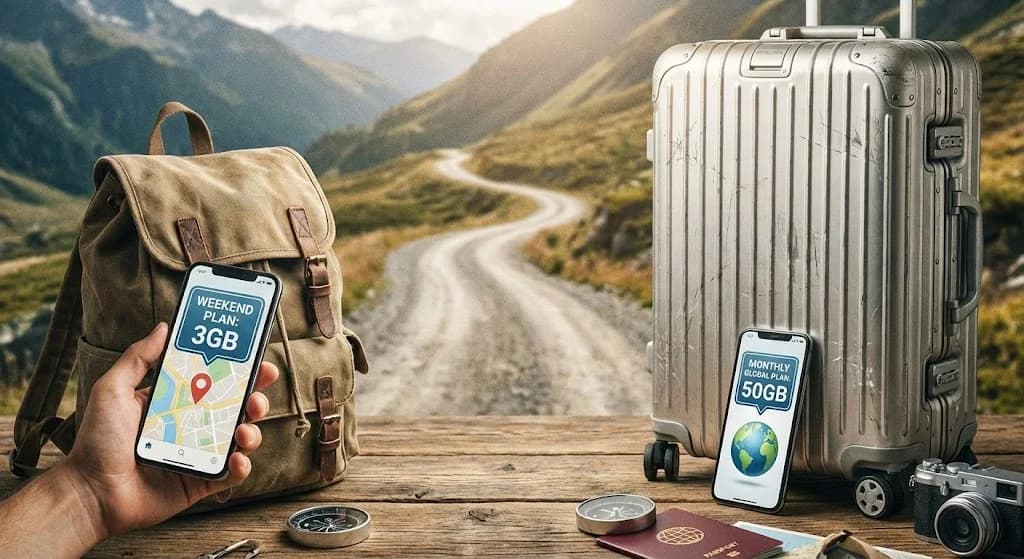
You have booked the flights. One trip is a spontaneous 72-hour city break in Lisbon. The other is a six-week backpacking adventure through Southeast Asia. Your packing list for each is wildly different, so why would your mobile data plan be the same? This is the central question travelers face when choosing connectivity. Picking the wrong plan is not just a minor inconvenience; it means either overpaying for data you will never use or facing the dreaded “you are out of data” notification mid-trip. Getting the right eSIM for short trips versus a long-term journey is the key to staying connected without the stress. We are here to break down exactly how to match your plan to your itinerary, saving you money and hassle. Understanding this difference is more critical than ever, especially when you compare the real cost of staying connected abroad against traditional roaming.
- The Weekend Warrior vs. The Long-Haul Explorer
- The Weekend Warrior: Mastering the eSIM for Short Trips
- How Much Data Do You Truly Need for Your Trip?
- The Extended Explorer: Scaling Your eSIM for Long-Term Travel
- Beyond Data and Duration: Key Features to Compare
- Understanding eSIM Activation: A Quick Guide
- eSIM vs. Traditional Options: A Cost & Convenience Comparison
- Network Coverage and Speed: What to Expect
- Real-World Scenarios: Putting It All Together
- Frequently Asked Questions

Seamless Connectivity for Your European Adventure
Explore 42 countries with one simple eSIM plan. Instant activation, reliable speeds.
Get Your Europe eSIM Plan 🌍The Weekend Warrior vs. The Long-Haul Explorer
The distinction between a short trip and an extended journey goes beyond just the number of days. It influences your daily routine, budget, and crucially, your connectivity demands. A quick city break often means relying on Wi-Fi for heavy data tasks, using mobile data primarily for navigation and communication. Longer expeditions, however, might see you working remotely, streaming content, or navigating remote areas where consistent data is paramount.
Understanding these differing needs allows you to approach mobile data solutions with a strategic mindset. Instead of opting for generic plans, tailoring your eSIM choice ensures efficiency, cost-effectiveness, and uninterrupted access to the digital tools you rely on, wherever your travels take you.
The Weekend Warrior: Mastering the eSIM for Short Trips
For trips lasting anywhere from a long weekend to a full week, your connectivity needs are specific and immediate. You land, you need to call your Uber, check your hotel reservation, and pull up Google Maps to navigate to that amazing restaurant you found online. There is no time to waste hunting for a local SIM card vendor. This is where a prepaid travel eSIM shines.
The beauty of an eSIM for short trips is its cost-efficiency. Instead of your home carrier’s expensive $10-per-day international pass (which can add up to $40 for a four-day trip), you can get a 7-day, 3GB eSIM for a fraction of that price. You are buying a finite amount of data for a set period, which is the most economical approach for brief travels. This model puts you in control and eliminates the risk of bill shock upon your return.
How Much Data Do You Truly Need for Your Trip?
It is easy to overestimate your data needs for a short getaway. You are likely to be using hotel or cafe Wi-Fi for heavy tasks like uploading photos or video calls. For the essentials while you are out exploring, a smaller data bucket is usually perfect. Consider your core activities:
- Navigation: Using apps like Google Maps or Waze typically consumes about 5-10 MB per hour of active navigation.
- Ride-Sharing: Booking an Uber or Bolt uses a negligible amount of data, primarily for loading maps and sending requests.
- Messaging: WhatsApp, iMessage, and similar platforms are highly efficient, using very little data for text communication and even light photo sharing.
- Light Browsing: Checking museum hours, reading restaurant reviews, or looking up public transport schedules.
- Social Media: Scrolling through social feeds uses more data, especially with videos. Moderate use might add 100-200 MB per day.
For a typical 3-5 day trip, a plan with 1GB to 3GB of data is often the sweet spot. This provides more than enough for navigation, essential communication, and light browsing without paying for data that will expire unused. For longer trips, consider daily averages:
- Light User (emails, maps, messaging): 100-200 MB per day.
- Moderate User (some social media, occasional streaming): 500 MB - 1 GB per day.
- Heavy User (video calls, constant streaming, tethering): 2 GB+ per day.
The best way to get a personalized recommendation based on your habits is to use a smart data calculator.
The Extended Explorer: Scaling Your eSIM for Long-Term Travel
When your trip extends beyond a week or two, your relationship with mobile data changes. You are no longer just a tourist; you might be working remotely, living like a local, or hopping between multiple countries. Your priorities shift from short-term convenience to long-term value, data volume, and plan flexibility.
Bulk Data for Big Adventures: Finding the Sweet Spot
For trips lasting a month or more, a 3GB plan will not suffice. Your usage patterns will be more akin to your data habits at home. You will be using data for video calls with family, streaming music on long bus rides, and potentially tethering your laptop for work. This is where larger international data plans become essential.
Look for plans offering 20GB, 50GB, or even unlimited data options with a validity of at least 30 days. The magic here is the cost-per-gigabyte. While a 3GB plan might cost $10 ($3.33/GB), a 30GB plan might be $40 ($1.33/GB). This economy of scale provides significant savings for heavy users and those on extended stays. It is particularly crucial for digital nomad connectivity, where a stable and ample data supply is a professional necessity, especially to cover data-heavy needs in the USA or other large countries.
The Power of Regional eSIMs for Continent Hoppers
Are you planning a multi-country Euro trip or a tour of Southeast Asia? The last thing you want is the hassle of buying a new SIM card every time you cross a border. This is where regional eSIMs are a game-changer. A single Europe-wide eSIM can keep you connected seamlessly from Paris to Prague, covering 42 countries in Europe. This not only saves time but also prevents you from accumulating a collection of plastic SIM cards and dealing with the complexities of avoiding new EU roaming charges. A regional plan is the ultimate tool for frictionless, long-term, multi-destination travel, simplifying connectivity across continents like Asia with Cellesim's Asia eSIM for 20 countries.

Beyond Data and Duration: Key Features to Compare
Choosing the right eSIM is not just about gigabytes and days. The underlying technology and provider policies can make a huge difference in your travel experience. As a trusted global eSIM provider, we know that the details matter.
Network Quality and Carrier Partnerships
Not all travel data roaming is created equal. Some budget eSIM providers partner with smaller, slower local networks to cut costs. A premium provider, however, establishes partnerships with the top-tier carriers in each country (like Vodafone, Orange, or AT&T). This means you get access to their superior infrastructure, resulting in faster 4G/5G speeds and more reliable coverage, whether you are in a capital city or a rural town. This superior infrastructure is critical for seamless connectivity, which you can read more about on GSMA's eSIM page. Before you purchase any plan, it is a good idea to check if your phone is eSIM-ready to ensure you can take full advantage of this technology.
Explore more reasons to choose Cellesim: Learn About Us
Top-Up and Extension Policies
Travel is unpredictable. A short trip might get extended, or you might use more data than anticipated. A key feature to look for is the ability to easily top up your data or extend your plan. The best providers offer a simple, in-app or online process to add more data without needing to purchase and install a whole new eSIM. This flexibility is a safety net that can save you from being disconnected at a critical moment. Cellesim provides intuitive options for checking data usage and topping up instantly, ensuring you always remain connected.
Understanding eSIM Activation: A Quick Guide
Your eSIM experience starts before you even leave. A smooth activation process is crucial for immediate connectivity upon arrival. Cellesim simplifies this with clear, user-friendly steps.
Look for providers that offer instant QR code delivery via email. The best practice is to install your eSIM profile while you are still at home and connected to your Wi-Fi. This process usually takes less than two minutes. Once you land, all you need to do is switch your phone's cellular data line to the eSIM, and you are online instantly. This eliminates the need to find local SIM card vendors or deal with unfamiliar processes after a long flight.
For anyone unsure about the process, an interactive setup guide can remove all the guesswork. Furthermore, checking your device's compatibility beforehand using an eSIM checker is a smart move to ensure a seamless experience.
eSIM vs. Traditional Options: A Cost & Convenience Comparison
When planning international travel, selecting a mobile data solution involves weighing costs, convenience, and coverage. Here is a comparison of eSIMs against traditional roaming and local physical SIM cards:
| Feature | Cellesim eSIM | Local Physical SIM | Traditional Roaming (Home Carrier) |
|---|---|---|---|
| Cost | Highly competitive; pay-as-you-go or bundled plans, often lowest cost per GB. | Low cost per GB, especially for long stays. | Very expensive; daily passes or high pay-per-use rates. |
| Convenience | Instant activation, digital delivery, no physical card swap, keep your main SIM. | Requires finding a store, installation, registration. | Automatic, but often requires activation of expensive add-ons. |
| Flexibility | Easy top-ups, regional plans for multiple countries, various data packages. | Tied to one country/region, can be difficult to top up from abroad. | Limited options, usually fixed daily rates or small data bundles. |
| Activation Time | Minutes (pre-flight or on arrival). | Hours (finding store, purchase, setup). | Instant (if roaming is enabled). |
| Coverage | Partners with top local networks; 4G/5G available in 200+ countries. | Good local coverage for that specific country. | Relies on home carrier's roaming agreements, can be inconsistent. |
| Phone Numbers | Data only (keep your primary number for calls/SMS). | Provides a local number. | Uses your existing number. |
As the table illustrates, Cellesim eSIMs offer a compelling balance of affordability, convenience, and global coverage, making them an ideal choice for most international travelers. For more detailed insights, you can review airport SIM card prices vs. eSIM comparisons.
Network Coverage and Speed: What to Expect
The quality of your mobile data experience abroad hinges significantly on the underlying network infrastructure and carrier partnerships. Cellesim prioritizes robust connectivity by collaborating with leading local network providers in each of the 200+ countries it covers.
This means that whether you are in a bustling city center or exploring a more remote area, you can expect access to reliable 4G and often 5G speeds where available. Our commitment to partnering with established carriers translates into a stable connection for navigation, streaming, and communication. Before traveling, it is always a good practice to check the general network coverage for your specific destination through independent resources like OpenSignal, which provides detailed insights into network performance globally.
For travelers relying on consistent data for work or critical communications, understanding these partnerships provides peace of mind. Cellesim's approach ensures you benefit from the best possible local network performance, making your connectivity as seamless as possible.
Real-World Scenarios: Putting It All Together
Let us apply this knowledge to a few common travel scenarios to see how it works in practice.
- The 4-Day Rome City Break: You will be navigating to the Colosseum, buying tickets online for the Vatican, and using WhatsApp to coordinate with your travel partner. Your Wi-Fi at the hotel will handle big uploads. The Verdict: A country-specific 3GB/7-day eSIM plan for Italy is perfect. It is cheap, simple, and provides more than enough data for your needs.
- The 6-Week Southeast Asia Backpacking Trip: You are crossing borders between Thailand, Vietnam, and Cambodia. You need constant access for booking hostels, checking bus schedules, and staying in touch with people back home. The Verdict: An Asia Regional eSIM with 30GB or 50GB of data and a 60- or 90-day validity is the clear winner. One plan, one activation, zero hassle.
- The 1-Month USA Road Trip: You are driving from coast to coast, relying heavily on GPS, streaming music playlists, and uploading photos from national parks where Wi-Fi is non-existent. The Verdict: A large data plan (50GB or unlimited) with a 30-day validity is essential. Prioritize a provider that partners with major US carriers to ensure coverage across vast, rural areas, such as Cellesim's North America eSIM.
- The 2-Week Business Trip to Multiple European Cities: You are moving between London, Paris, and Berlin, requiring consistent internet for video conferences, email, and presentation downloads. The Verdict: A regional Europe eSIM with a generous data allowance (e.g., 10-20GB for 30 days) ensures you remain productive without worrying about data limits or switching plans.
Frequently Asked Questions
What is the main difference between eSIM plans for short vs. long trips?
For short trips, you typically need smaller data packages (1-5GB) with shorter validity periods (7-15 days), prioritizing immediate convenience and cost-efficiency for essential tasks. For long trips, larger data allowances (20GB+ or unlimited) with longer validity (30-90 days) are crucial, focusing on value per gigabyte, flexibility, and regional coverage for multi-country travel.
Can I use a single Cellesim eSIM for multiple countries?
Yes, Cellesim offers regional eSIM plans that cover multiple countries within a continent, such as Europe (42 countries) or Asia (20 countries). These are ideal for long-term travelers or those visiting several destinations, as they provide seamless connectivity across borders with a single plan.
How do I know how much data I need for my trip?
Your data needs depend on your activities. Light users (maps, messaging) might need 1-3GB for a week. Moderate users (social media, light streaming) might need 5-10GB. Heavy users (video calls, tethering) could need 20GB or more per month. Use the Cellesim Smart Data Calculator for a personalized estimate.
Is it cheaper to use an eSIM than my home carrier's international roaming?
In most cases, yes. Cellesim eSIMs often provide significantly lower costs per gigabyte compared to expensive international roaming packages or daily passes from your home carrier. This can lead to substantial savings, especially for extended travel.
When should I activate my Cellesim eSIM?
For optimal convenience, it is recommended to install your eSIM profile via QR code while still connected to Wi-Fi at home, before your departure. Once you arrive at your destination, simply switch your phone's cellular data to the eSIM, and you will be connected instantly. This ensures you have immediate access upon landing.
What if I run out of data on my Cellesim eSIM during my trip?
Cellesim offers easy top-up options directly through our website or app. You can purchase additional data packages or extend your plan's validity instantly, ensuring you remain connected throughout your journey without any hassle or the need to acquire a new eSIM.

Your Perfect Travel Companion Awaits
Whether it is a quick escape or a grand tour, Cellesim has an eSIM plan designed for your adventure.
Explore All eSIM Plans ⚡Join 50,000+ happy customers staying connected globally.
The best international SIM card or eSIM is not a one-size-fits-all product. The key is to stop thinking about what the 'best' plan is in general, and start focusing on what the best plan is for *your specific trip*. For short trips, prioritize cost-effective, smaller data packages that offer immediate, hassle-free connectivity. For long trips, shift your focus to better value per gigabyte, longer validity periods, and the convenience of regional coverage.
By taking a moment to align your data plan with the length and style of your journey, you transform connectivity from a potential travel headache into a seamless and powerful tool. You will travel smarter, save money, and stay connected for the moments that matter. Ready to find the perfect fit for your next adventure? Explore Cellesim's range of local and regional plans today.