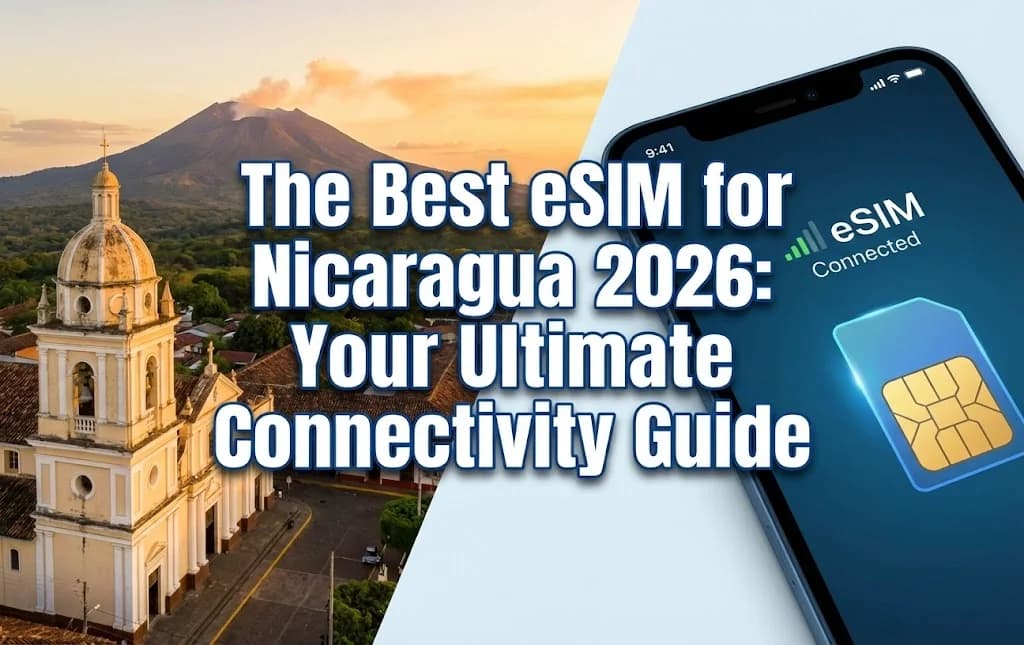
The Best eSIM for Nicaragua 2026: Your Ultimate Connectivity Guide
Traveling to Nicaragua in 2026? This guide demystifies eSIM technology, showing you how to get affordable, high-speed data from the moment you land. Stay connected with ease.
Imagine your plane touching down at Augusto C. Sandino International Airport (MGA) in Managua. The excitement for your Nicaraguan adventure—exploring the colonial streets of Granada, hiking the volcanoes of Ometepe Island, or surfing near San Juan del Sur—is palpable. But then, a familiar travel consideration arises: connectivity. How will you book a ride-share, check into your hotel, navigate unfamiliar streets, or let family know you have arrived safely? The old way involved hunting for a local SIM card kiosk, potentially dealing with language barriers, and fumbling with tiny plastic cards. In 2026, there is a far superior solution.
This guide is designed to show you why finding the best eSIM for Nicaragua in 2026 is the key to a seamless, stress-free travel experience. An eSIM, or embedded SIM, is a digital SIM card that allows you to activate a cellular plan without needing a physical nano-SIM. It provides instant, affordable data from the moment you land, transforming your smartphone into an indispensable travel tool. We will walk you through everything from understanding eSIM technology and how it works to a step-by-step setup process, ensuring you feel confident and in control of your connectivity throughout your journey across Nicaragua.
In This Article
Why an eSIM is Essential for Your 2026 Nicaragua Trip
Understanding eSIM Technology for Nicaragua Travel
eSIM vs. Physical SIM Card: The Best Choice for Nicaragua in 2026
Cost Comparison: eSIM, Local SIM, and Roaming in Nicaragua (2026)
Choosing Your Nicaragua eSIM Data Plan: How Much Data Do You Need?
Pre-Trip Setup: Activating Your Nicaragua eSIM Before You Fly
Connectivity Upon Arrival: Getting Your eSIM Working in Nicaragua
Pro Tips for Maximizing Your Connectivity in Nicaragua
Frequently Asked Questions
Connect Instantly in Nicaragua
Get high-speed data from the moment you land. Cellesim covers 200+ countries, trusted by 50,000+ customers.
Why an eSIM is Essential for Your 2026 Nicaragua Trip | Cellesim eSIMLanding in Nicaragua Connected and Confident | Cellesim eSIM
Why an eSIM is Essential for Your 2026 Nicaragua Trip
Traveling to Nicaragua in 2026 means embracing modern solutions for everyday challenges. An eSIM simplifies your trip by eliminating the hassle of traditional SIM cards. Instead of spending valuable vacation time searching for a local vendor or navigating foreign mobile plans, you can arrive fully connected. An eSIM allows you to purchase and activate a data plan digitally, often before you even depart your home country.
This digital convenience means instant access to maps for exploring Granada's colonial architecture, booking transportation to the Mombacho Volcano, or sharing your surfing adventures in San Juan del Sur with friends and family. With an eSIM from a reliable provider like Cellesim, you ensure consistent, high-speed internet access throughout your journey. This seamless connectivity enhances safety, convenience, and your overall travel experience, making it an indispensable tool for any modern traveler heading to Nicaragua.
Understanding eSIM Technology for Nicaragua Travel
An eSIM, or embedded Subscriber Identity Module, is a small chip permanently built into your smartphone or device. Unlike a physical SIM card, it is not removable. Instead, it allows you to download and activate cellular profiles remotely. This technology has become standard in most newer smartphones, tablets, and smartwatches, including models like the iPhone XS/XR and newer, Google Pixel 3 and newer, and Samsung Galaxy S20 series and newer.
For your trip to Nicaragua, an eSIM offers several advantages: no physical card to swap, the ability to switch between networks easily, and often more competitive data rates compared to international roaming. To ensure your device is compatible, you can consult Cellesim's eSIM compatible devices list or use our convenient eSIM checker tool. Verifying compatibility before you travel guarantees a smooth setup process and eliminates any surprises upon arrival.
Pro Tip: Before purchasing any eSIM plan, double-check that your smartphone supports eSIM technology. Most flagship devices released in the last few years are compatible.
eSIM vs. Physical SIM Card: The Best Choice for Nicaragua in 2026
When planning connectivity for Nicaragua, travelers typically consider three main options: using your home carrier's international roaming, purchasing a local physical SIM card upon arrival, or opting for a travel eSIM. While roaming can be convenient, it is often prohibitively expensive. Local SIM cards offer better value but require time and effort to acquire, especially after a long flight.
An eSIM combines the best of both worlds, providing excellent value and immediate connectivity without the physical hassle. Here is a comparison of these options for a typical 7-day trip to Nicaragua in 2026:
Choosing a Cellesim eSIM for your Nicaragua trip means you avoid high roaming fees and the time-consuming process of finding and installing a local SIM. With Cellesim, you are ready to connect the moment you land, giving you more time to experience Nicaragua.
Cost Comparison: eSIM, Local SIM, and Roaming in Nicaragua (2026)
Understanding the financial implications of each connectivity option is crucial for budget-conscious travelers. International roaming, while convenient, can lead to significant bill shock. Many carriers charge upwards of $10-$15 per day for basic data access, which quickly adds up over a week-long trip. For a longer stay, this becomes unsustainable.
Local physical SIM cards, available from providers like Tigo or Claro in Nicaragua, typically cost between $15 and $30 for a package including data, local calls, and texts. This is a more affordable option, but it necessitates a trip to a store, often at the airport or in a city, where you might face queues and language barriers. Furthermore, you will need to register the SIM with your passport, a process that can take time.
Key Info: Cellesim eSIM plans for Nicaragua start from as low as $4.50, offering competitive rates for high-speed data without hidden fees or the need for physical card swaps.
Cellesim eSIMs offer a clear financial advantage. With plans designed for various data needs and durations, you can select exactly what you require, paying only for the data you use. Activation is entirely digital, saving you time and stress, and allowing you to compare options and purchase your plan well in advance from the comfort of your home. This transparent pricing and ease of use make an eSIM the most cost-effective and convenient choice for most visitors to Nicaragua in 2026. You can explore options for Cellesim's Nicaragua eSIM plans directly on our website.
Choosing Your Nicaragua eSIM Data Plan: How Much Data Do You Need?
Determining the right data plan for your trip to Nicaragua depends heavily on your intended usage. A common mistake travelers make is underestimating their data needs, leading to unexpected top-ups or slow speeds. Conversely, overbuying data can result in unnecessary expense. Consider your activities:
Light User (1-3 GB for 7-10 days): Checking emails, occasional social media, light map usage, messaging apps like WhatsApp.
Moderate User (5-10 GB for 7-10 days): Frequent social media, streaming music, regular map navigation, video calls, some photo uploads.
Heavy User (10+ GB for 7-10 days): Extensive social media, high-quality video streaming, working remotely, frequent video calls, large file uploads/downloads.
Most travelers find a 5 GB plan sufficient for a one-week trip, covering navigation, communication, and sharing their experiences. For longer trips or if you anticipate significant media consumption, consider a larger plan. Cellesim offers various packages tailored to different needs, and you can easily estimate your data usage with our Smart Data Calculator to find the perfect fit.
Pre-Trip Setup: Activating Your Nicaragua eSIM Before You Fly
One of the greatest advantages of an eSIM is the ability to set it up before you even leave home. This ensures that you are connected the moment your plane touches down in Nicaragua, avoiding the initial scramble for Wi-Fi or local SIM cards.
The process with Cellesim is straightforward:
Purchase Your Plan: Visit cellesim.com/en/esim-nicaragua and select the data plan that best suits your trip duration and usage needs.
Receive QR Code: After purchase, you will receive an email containing a QR code and detailed instructions.
Install eSIM: Scan the QR code with your compatible smartphone (usually found in your phone's Cellular/Mobile Data settings). Follow the prompts to install the eSIM profile. Do this while connected to a stable Wi-Fi network.
Label Your eSIM: Give your new eSIM a clear label, such as "Nicaragua Travel" to easily distinguish it from your primary line.
While you can install the eSIM profile before your trip, it is often recommended to activate the data plan itself only once you arrive in Nicaragua, or just before you depart, to ensure maximum validity of your plan. For a visual walkthrough, consult our interactive setup guide.
"Setting up my Cellesim eSIM for Nicaragua was incredibly easy. I did it at home before my flight, and had data the second I landed. No stress, just seamless connection." - A Recent Cellesim Traveler
Connectivity Upon Arrival: Getting Your eSIM Working in Nicaragua
Once you land at Augusto C. Sandino International Airport (MGA) or cross a border into Nicaragua, activating your Cellesim eSIM is simple. The eSIM profile should already be installed on your device if you followed the pre-trip setup steps. All you need to do is enable it:
Turn On Data Roaming (for eSIM): In your phone's cellular settings, select your Cellesim eSIM profile and ensure 'Data Roaming' is enabled for this line. This allows your eSIM to connect to local networks without incurring roaming charges from your home provider.
Switch to eSIM for Mobile Data: In the same cellular settings, designate your Cellesim eSIM as the primary line for mobile data. Your home SIM can remain active for calls and texts if you wish (Dual SIM functionality).
Connect to Local Network: Your phone should automatically detect and connect to one of Cellesim's partner networks in Nicaragua, typically Tigo or Claro. These networks provide robust 4G/LTE coverage in major cities and popular tourist areas across the country.
If you encounter any issues, a quick restart of your device can often resolve connectivity problems. Should problems persist, Cellesim's dedicated support team is available via [email protected] to assist you.
Pro Tips for Maximizing Your Connectivity in Nicaragua
To make the most of your Cellesim eSIM in Nicaragua, consider these practical tips:
Manage Dual SIM Effectively: If you are using your home SIM for calls and texts, ensure your Cellesim eSIM is set as the default for mobile data. This allows you to keep your original number active while benefiting from affordable data.
Monitor Data Usage: Regularly check your data consumption through your phone's settings or the Cellesim portal. This helps you avoid running out of data unexpectedly. If you need more, Cellesim makes topping up your plan simple and immediate.
Utilize Wi-Fi When Available: While your eSIM provides reliable mobile data, connecting to hotel or cafe Wi-Fi networks for large downloads or streaming can conserve your data plan for when you truly need it on the go.
Download Offline Maps: Before venturing into less connected areas or for general navigation, download offline maps of Nicaragua using apps like Google Maps. This reduces data usage and provides a reliable backup.
Stay Informed: Keep an eye on local news or official travel advisories. For general travel information about Nicaragua, consult the official Visit Nicaragua tourism board website.
Pro Tip: For critical communication, such as ride-hailing or urgent messages, consider keeping a small amount of data on your home SIM (if roaming rates are reasonable for minimal use) as a backup, or rely solely on your Cellesim eSIM for all data needs, including VoIP calls.
Ready for Seamless Connectivity in Nicaragua?
Join 50,000+ travelers connecting instantly in 200+ countries. Set up your Cellesim eSIM in minutes.
Trusted by travelers worldwide. 24/7 Email Support.
Landing in Nicaragua Connected and Confident
The transition from airplane to ground transport in a foreign country often presents a challenge for travelers seeking immediate connectivity. Without a reliable internet connection, simple tasks like hailing a taxi via an app, confirming hotel reservations, or updating loved ones can become sources of stress. An eSIM solution effectively removes this hurdle, enabling you to step off the plane at Augusto C. Sandino International Airport (MGA) in Managua with full confidence in your digital access. You can instantly access maps to navigate to your accommodation, search for local attractions, or communicate with tour guides. This immediate connectivity is not just about convenience; it is about providing a sense of security and control from the very start of your Nicaraguan journey, allowing you to focus on the experience rather than logistical worries.
Understanding eSIM Technology: Your Digital Passport to Connectivity
For years, the physical SIM card has been the standard for mobile connectivity. But as technology evolves, so does the way we connect. An eSIM is essentially a small chip embedded directly into your phone's motherboard by the manufacturer. Think of it as a rewritable SIM card that you cannot lose. Instead of physically inserting a plastic card, you download a digital "eSIM profile" from a provider like Cellesim. This profile contains all the information needed to connect your device to a local mobile network in Nicaragua, such as Tigo or Claro. The process is remarkably simple and entirely digital. After purchasing a plan online, you receive a QR code via email. Scanning this code with your phone's camera is all it takes to install the data plan. This modern approach eliminates the logistical hassles of traditional SIM cards and unlocks powerful features, most notably Dual SIM capability. This means you can have your home country's SIM active for calls and texts while using the international eSIM for Nicaragua for all your data needs, giving you the best of both worlds. It is a fundamental shift in how travelers manage mobile data abroad, offering unparalleled convenience and control.
The Core Benefits of Using an eSIM in Nicaragua
The advantages of choosing an eSIM for your Nicaraguan travels extend far beyond simple convenience. First and foremost is the immediate access to the internet upon arrival. You can order your ride from the airport, look up directions to your hotel in León, or post your first vacation photo from the tarmac without ever connecting to unsecured airport Wi-Fi. Secondly, eSIMs are incredibly cost-effective. Traditional roaming charges from major carriers can be exorbitant, often costing $10 to $15 per day. In contrast, a prepaid eSIM data plan for tourists might offer 10GB of high-speed data for a two-week trip for around $25-$30, representing savings of up to 80%. This allows you to use your phone freely for maps, translation apps, and video calls without the fear of a massive bill when you return home. Finally, security is a significant, often overlooked benefit. With an eSIM, there is no physical card to lose or have stolen, which can be a major security risk as it is often tied to your personal and financial accounts. The entire transaction is digital, secure, and managed from the safety of your own device.
eSIM vs. Physical SIM Card in Nicaragua: A Head-to-Head Comparison
While local physical SIM cards are still an option, a detailed comparison reveals why the best eSIM for Nicaragua 2026 is the superior choice for most travelers. The primary difference lies in the procurement and activation process. To get a physical SIM, you must first find a vendor—either at the airport or in a city like Granada—present your passport for registration, and then physically swap out your home SIM. This process can take time and be inconvenient after a long flight. An eSIM, on the other hand, is purchased online in minutes from anywhere in the world and installed before you even leave home. This pre-trip setup means you are ready to connect the second you land. Flexibility is another key differentiator. If your travel plans change or you need more data, topping up an eSIM plan is usually a simple process done through an app or website. With a physical SIM, you might need to find another store to purchase a new plan or voucher. From my experience, managing data digitally provides a level of freedom that is invaluable while traveling.
Network Coverage and Performance
A common concern for travelers is whether an eSIM offers the same quality of service as a local SIM. The answer is a resounding yes. eSIM providers like Cellesim do not operate their own networks; instead, they partner with major local carriers. In Nicaragua, this means your eSIM will connect to the robust 4G/LTE networks of established operators like Tigo and Claro. You will receive the exact same coverage and speeds as a local customer would on those networks. Whether you are navigating the streets of Managua, sharing photos from the Corn Islands, or working remotely from a café in San Juan del Sur, you can expect reliable, high-speed data. The technology simply changes how you access the network, not the quality of the network itself. This ensures you have the connectivity you need for everything from Google Maps to streaming video, without compromise.
Nicaragua's mobile network infrastructure primarily relies on Tigo and Claro, which offer decent 4G/LTE coverage in urban centers and popular tourist destinations. Remote areas and some volcanic regions may experience more limited or slower service. Before your trip, you can check coverage maps on the official websites of Tigo or Claro to get a clearer picture of service in your specific destinations. An eSIM leverages these existing networks, providing you with consistent performance where service is available.
Dual SIM Functionality: The Decisive Advantage
Perhaps the most compelling feature of eSIM technology is its ability to enable Dual SIM functionality on compatible devices like the iPhone 15 or Samsung Galaxy S24. This allows you to use two mobile plans on one phone simultaneously. For travelers, this is a game-changer. You can keep your primary physical SIM or eSIM from home active for receiving important calls and SMS messages (like two-factor authentication codes from your bank) while designating your Nicaraguan eSIM as the sole source for mobile data. This setup provides a perfect balance: you remain reachable on your regular number while avoiding your home carrier's expensive data roaming fees. Our guide on Can I Keep My Number When Using a Travel eSIM? explores this powerful feature in greater detail, showing you how to configure your device for optimal use abroad.
How Much Data Do You Need for Your Trip to Nicaragua?
Estimating your data needs for a trip abroad is essential for choosing the right eSIM plan and avoiding unexpected top-ups or running out of connectivity. Your data usage in Nicaragua will largely depend on your travel style and reliance on your smartphone.
Light User (1-3 GB for 7-10 days): If you primarily need data for navigation (Google Maps), messaging (WhatsApp, iMessage), occasional social media checks, and quick email glances, a smaller plan will suffice.
Moderate User (5-10 GB for 7-14 days): This category includes travelers who frequently use navigation, regularly browse social media, upload photos, make video calls to family, and occasionally stream music or short videos.
Heavy User (15-20+ GB for 14-30 days): Digital nomads, business travelers, or those planning to stream extensively, engage in prolonged video calls, or work remotely will require larger data packages. Sharing your connection via a personal hotspot also consumes data rapidly.
Consider downloading offline maps (like Google Maps' offline feature) and any entertainment (movies, podcasts) before your trip to conserve data. Public Wi-Fi is available in many hotels and cafes, but its reliability and security can vary. For a personalized estimate, you can use a Smart Data Calculator to determine your ideal data package based on your expected activities.
Step-by-Step Guide: Setting Up Your Nicaragua eSIM Before You Fly
The beauty of the eSIM is that the entire setup process can be completed from the comfort of your home, ensuring you are prepared for your trip well in advance. Following these simple steps will guarantee a smooth and successful activation.
Step 1: Confirm Your Device is eSIM-Compatible and Unlocked
Before purchasing any plan, the first critical step is to verify that your smartphone supports eSIM technology and is carrier-unlocked. Most flagship phones released since 2018, including the iPhone XS and newer models, Google Pixel 3 and newer, and high-end Samsung Galaxy devices (S20 series onwards), are eSIM-ready. However, it is always best to be certain. You can easily check our comprehensive list of eSIM compatible devices to confirm your specific model. Additionally, your phone must be 'unlocked,' meaning it is not restricted to use with a single carrier. If you purchased your phone directly from a carrier on a contract, you might need to contact them to request it be unlocked for international travel. This step is non-negotiable and prevents any issues when you try to install the eSIM profile.
Step 2: Choose and Purchase the Right Data Plan for Your Trip
Once compatibility is confirmed, it is time to select a Nicaragua data plan for tourists that fits your needs. Consider the length of your stay and your expected data usage. Are you a light user who just needs maps and messaging, or will you be streaming videos and uploading high-resolution photos? Cellesim offers a variety of plans, such as 5GB of data valid for 15 days for approximately $15, or a larger 20GB plan valid for 30 days for around $40. It is almost always cheaper to buy a slightly larger plan than to run out and need a top-up. You can find plans for various destinations, similar to our popular eSIM plans for the United States, tailored to different traveler profiles. The purchase is completed online, and you will instantly receive an email with your QR code and instructions.
Step 3: Install Your eSIM Profile via QR Code
With your QR code in hand, it is time to install your eSIM. It is highly recommended to do this while you have a stable Wi-Fi connection, either at home or at the airport before you depart. The process is straightforward. On an iPhone, navigate to `Settings > Cellular > Add eSIM`. On an Android device, it is typically under `Settings > Network & Internet > SIMs > Add a SIM`. Your phone will prompt you to scan the QR code from your email. Once scanned, the phone will download and install the eSIM profile. You can label this new line something memorable, like 'Nicaragua Travel', to easily distinguish it from your primary line. Do not activate it for data yet—you will do that upon arrival to ensure the validity period starts correctly. For a visual walkthrough, our interactive setup guide provides clear, device-specific instructions. For a more comprehensive overview, consult The Complete eSIM Setup Guide.
Activating Your eSIM Upon Landing in Nicaragua
You have done the prep work, and now comes the rewarding part: activating your service the moment you arrive. This final phase is simple but requires a few key steps to ensure a flawless connection.
The Arrival Process: What to Do on the Plane
As your flight taxis to the gate in Managua, you can get your phone ready. The moment the crew announces it is safe to use electronic devices, turn off Airplane Mode. Your phone will begin searching for local networks. Your primary SIM will likely connect to a roaming partner and may trigger a welcome text from your home carrier with their (expensive) roaming rates. This is your cue to switch to your new eSIM for data.
Navigating Your Phone's Settings to Switch Data Lines
Go back into your phone's cellular or mobile data settings. Here you will see both your primary line and your newly installed 'Nicaragua Travel' eSIM. The crucial step is to select the eSIM as your designated line for 'Mobile Data'. This tells your phone to use the Cellesim plan for all internet-related activities, including apps, browsing, and iMessage/WhatsApp, while leaving your primary line active for voice and text if you wish. This simple switch prevents your home carrier from charging you for data usage, which can be a costly mistake. You can find more information on how these charges accumulate on our blog post, How to Avoid Roaming Charges and Stay Connected Abroad.
Confirm that Data Roaming is enabled for your Cellesim eSIM line in your phone's settings, as this is necessary for it to connect to the local network. Once activated, you should see the network name (e.g., Tigo or Claro) appear at the top of your screen, indicating that your high-speed data connection is active. Test it immediately by opening a web browser or a messaging app. Enjoy seamless connectivity from the moment you step off the plane.
Pro Tips for Seamless Connectivity in Nicaragua
To maximize your eSIM experience and ensure uninterrupted connectivity throughout your Nicaraguan adventure, consider these additional tips:
Monitor Data Usage: Regularly check your data consumption through your phone's settings or the Cellesim portal. This helps you stay within your plan limits and top up if necessary.
Download Offline Resources: Before venturing into areas with potentially limited coverage, download offline maps for cities like Granada or León, travel guides, and language translation packs. This ensures you can navigate and communicate even without an active data connection.
Secure Public Wi-Fi: While convenient, public Wi-Fi networks in airports, cafes, or hotels can be insecure. Always use a Virtual Private Network (VPN) when connecting to public Wi-Fi to protect your personal data.
Power Bank is Your Friend: Constant use of data and GPS can drain your phone's battery. Carry a portable power bank, especially during long excursions to volcanoes or remote beaches, to keep your device charged and your eSIM active.
Contact Support When Needed: If you encounter any issues with your Cellesim eSIM, our support team is available via email to assist you. Have your order details ready for a quicker resolution.
Check Official Travel Advisories: Always consult the latest travel advisories for Nicaragua from your home country's government before and during your trip. For example, the U.S. Department of State provides up-to-date information on safety and security.
Travel Smarter in Nicaragua with Cellesim | Cellesim eSIM
Travel Smarter in Nicaragua with Cellesim
Experience the freedom of immediate, affordable, and reliable internet access from the moment you land. Join 50,000+ happy customers who trust Cellesim for their global connectivity.
Most modern smartphones, including iPhone XS/XR and newer, Google Pixel 3 and newer, and Samsung Galaxy S20 series and newer, are eSIM compatible. You can verify your device model against our eSIM compatible devices list or use our eSIM checker tool to confirm compatibility.
Can I keep my original phone number while using a Cellesim eSIM in Nicaragua?
Yes, with Dual SIM functionality, you can keep your primary physical SIM or eSIM active for calls and texts from your home number while using the Cellesim eSIM for all your data needs. This allows you to stay connected on both fronts without incurring high roaming data charges, and is explained further in our guide on keeping your number with a travel eSIM.
How do I activate my Cellesim eSIM for Nicaragua?
After purchasing your plan online, you will receive a QR code via email. Scan this code in your phone's cellular settings to install the eSIM profile. Upon arrival in Nicaragua, simply switch your mobile data to the Cellesim eSIM line in your phone settings to activate it. Our interactive setup guide provides detailed steps.
What network does Cellesim use in Nicaragua?
Cellesim partners with major local carriers in Nicaragua, such as Tigo and Claro. This means your eSIM will connect to their established 4G/LTE networks, providing you with reliable coverage and speeds equivalent to a local customer.
What if I need more data during my trip to Nicaragua?
If you find yourself needing additional data, topping up your Cellesim eSIM plan is a straightforward process. You can usually do this directly through the Cellesim website or portal, allowing you to add more data quickly and seamlessly without needing a new physical SIM. Learn more about checking data usage and topping up.
Is an eSIM more secure than a physical SIM card?
An eSIM offers enhanced security because there is no physical card to lose or steal, reducing the risk of unauthorized access to your personal and financial accounts. All transactions are digital and managed securely through your device, minimizing the risk of SIM-swap fraud.
Based in New York City, Mike Donovan is the Budget Expert for Cellesim. Mike is dedicated to finding the absolute lowest cost per gigabyte for American travelers. He aggressively compares the hidden fees of US carriers and airport SIM kiosks ag...
Planning a trip to Nauru in 2026? Our complete guide explains how a Nauru eSIM provides instant and affordable mobile data. Learn about setup, compati...
Stay connected effortlessly on your Mauritanian adventure. This 2026 guide explains how to choose, set up, and use the best eSIM for Mauritania for re...
Planning a trip to Mongolia for Naadam 2026? This guide explains how to use an eSIM for instant, affordable mobile data, helping you avoid high roamin...
We use cookies to keep Cellesim reliable and secure, improve user experience, provide social media features, and analyze how our website is used. Learn more.
Guest Checkout
--•-
-
Enter your details to continue with guest checkout. No account needed!