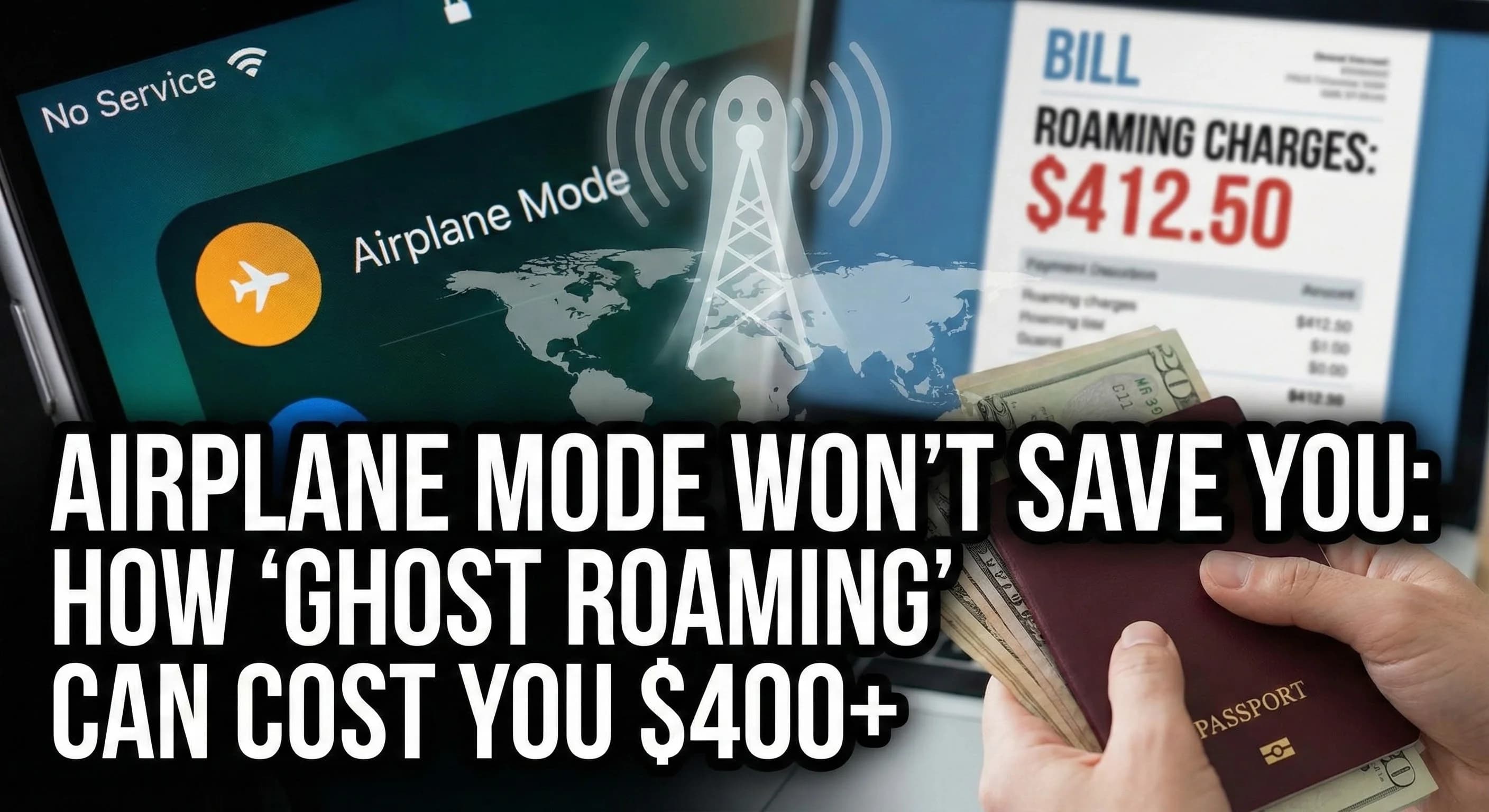
International travel promises discovery and new experiences, but it often comes with a hidden cost: unexpected mobile roaming charges. Many travelers believe that activating airplane mode or disabling mobile data will protect them from these fees. However, a phenomenon known as "ghost roaming" can silently activate daily charges, leaving you with a surprisingly large bill upon your return.
- The Hidden Threat: Understanding Ghost Roaming Charges
- Why Airplane Mode Isn't a Full Shield Against Roaming
- Unmasking Carrier Day Passes: Verizon and AT&T Traps
- Stealthy Triggers: Incoming Texts and Background Apps
- Guaranteed Protection: Strategies to Halt Roaming Fees
- The Cellesim eSIM Solution: Seamless Connectivity Without Surprises
- Making the Switch: eSIM vs. Traditional Roaming Costs
- Frequently Asked Questions
Connect Globally, Avoid Roaming Fees with Cellesim
Say goodbye to bill shock. Join 50,000+ happy customers in 200+ countries who trust Cellesim for reliable, affordable connectivity.
Get Your Global eSIMThe Hidden Threat: Understanding Ghost Roaming Charges
Ghost roaming refers to the often-overlooked network activity that occurs on your phone even when you believe you have disabled international roaming. Your device, when abroad, constantly searches for and attempts to connect with local cellular towers. These brief "network handshakes" are essential for maintaining basic cellular functionality, even if you are not actively browsing the internet or making calls.
Carriers like Verizon, AT&T, and T-Mobile often have policies where even a tiny, incidental data exchange, a failed connection attempt, or the receipt of an unsolicited text message can be enough to trigger a full daily roaming charge. This means that merely having your home SIM card active in a foreign country can lead to charges, sometimes adding up to $10-12 per day, accumulating rapidly over a week-long trip.
This subtle background activity is often invisible to the user, making it a significant source of bill shock. Travelers assume that because they haven't "used" data, they won't be charged. However, the carrier's billing system registers these minimal interactions as valid roaming events, activating their daily fee mechanisms.
Why Airplane Mode Isn't a Full Shield Against Roaming
Airplane mode is designed to disable all wireless transmissions, including cellular, Wi-Fi, and Bluetooth. It is effective in preventing active data usage and calls. However, many travelers often toggle airplane mode on and off for short periods to check Wi-Fi, or forget to re-enable it consistently. More critically, some phones might not fully disconnect from all cellular signals instantaneously or might re-establish a brief connection if airplane mode is deactivated even for a moment.
Furthermore, airplane mode completely isolates your phone. While it stops roaming, it also prevents any use of your phone’s cellular functions, including emergency calls. For many, this level of disconnection is impractical for modern travel, where navigation, communication, and information access are crucial. Relying solely on airplane mode means you are constantly searching for Wi-Fi, which can be unreliable or insecure, and leaves you vulnerable during transit or in areas without public Wi-Fi.
Many travelers also incorrectly assume that just turning off "Data Roaming" in their phone settings is sufficient. While this prevents intentional data usage, it does not stop the underlying cellular network connection from occurring or receiving incoming SMS, both of which can trigger carrier day pass fees.
Unmasking Carrier Day Passes: Verizon and AT&T Traps
Major carriers offer "international day passes" as a convenient option for travelers. Verizon's TravelPass and AT&T's International Day Pass, for example, typically charge around $10-12 per day for access to your domestic plan abroad. While seemingly straightforward, these passes come with critical caveats that often lead to the "$400 ghost roaming trap."
Verizon TravelPass: Activation Triggers
Verizon TravelPass activates automatically the moment you make or receive a call, use data, or send/receive a text message in a TravelPass country. The trap lies in the "receive a text message" clause. Even if you do not reply to an incoming SMS, the act of your phone downloading that message from the network is enough to trigger the $12 daily fee. Many background system texts or promotional messages can unknowingly activate your TravelPass, starting the 24-hour billing cycle.
For a family of four, even minimal, unintended activation across multiple devices can quickly add up. A single incoming text to each family member over a 7-day trip could potentially cost $12 x 4 people x 7 days = $336, without any active intentional use of data or calls.
AT&T International Day Pass: The Billing Cycle Reset
AT&T's International Day Pass generally has a 10-day cap per billing cycle (up to $100 per billing cycle per line). This cap is often misunderstood. It resets with your billing cycle, not with your trip duration. If your trip spans two different billing cycles, you could be charged for 10 days in each cycle, effectively paying $200 per line for a single trip.
"AT&T International Day Pass includes a daily fee for each 24-hour period you use your device abroad, up to 10 daily fees per billing cycle per line."
Consider a two-week trip for a family of four where the travel dates cross a billing cycle. Each family member could incur up to $100 in charges in the first billing cycle and another $100 in the second, leading to a total of $800 in international day pass fees for data, calls, or texts that may have been used minimally or accidentally. This illustrates how crucial it is to understand the fine print of these carrier plans.
You can verify your carrier's specific terms and conditions by visiting their official international roaming pages, such as Verizon's International Roaming or AT&T's International Day Pass.
Stealthy Triggers: Incoming Texts and Background Apps
Beyond the primary day pass activation, two common scenarios contribute to unexpected charges: incoming text messages and background app data usage. These are often overlooked by travelers focused on turning off data roaming.
The Cost of Incoming SMS
As mentioned, receiving an SMS from any source – whether a friend, a bank alert, or an unwanted promotional message – can trigger your carrier's daily roaming fee. Even if you only read the message and do not reply, the network interaction is billed. While iMessage over Wi-Fi is free, traditional SMS (green bubbles on iPhone) operates over the cellular network and counts as usage. This makes it challenging to truly disconnect without actively disabling your home SIM.
Background App Activity
Modern smartphones are constantly performing background tasks: syncing emails, refreshing social media feeds, updating apps, or backing up photos. If your Wi-Fi signal drops momentarily or becomes unstable, your phone is programmed to seamlessly switch to cellular data to maintain connectivity for these tasks. This brief switch can happen without your immediate knowledge and, crucially, can be enough to trigger a full daily roaming charge or incur expensive pay-per-use rates if you don't have an active day pass.
Even if you have "Data Roaming" turned off, some system services or critical app updates might bypass this setting, particularly on certain phone models or operating system versions. This makes passive data usage a persistent threat to your travel budget.
Guaranteed Protection: Strategies to Halt Roaming Fees
Avoiding ghost roaming and carrier traps requires a proactive approach. Beyond basic airplane mode, here are proven strategies, culminating in the most effective solution:
1. Manually Disable Your Home SIM (Physical SIM)
For phones with a physical SIM, the most foolproof method to prevent ghost roaming from your home carrier is to physically remove your SIM card while abroad. Alternatively, if your phone allows, you can go into your cellular settings and disable the specific SIM profile. This ensures no network handshakes or accidental data use can occur on that line.
2. The SIM PIN Lock Method (iOS/Android)
This clever trick keeps your physical SIM in place but electrically disconnects it from the network.
- Before you travel, enable a SIM PIN on your primary SIM card via your phone's cellular settings.
- When you land in your destination, restart your phone.
- When prompted for the SIM PIN, hit 'Cancel'. Do NOT enter the PIN.
This action prevents your home SIM from registering on any foreign network. Your phone will then operate as if no SIM is present for that line, preventing ghost roaming charges, while still allowing you to use Wi-Fi and even iMessage (if active with your Apple ID) or WhatsApp via Wi-Fi.
3. Leverage Wi-Fi Calling and Messaging
If your home carrier supports Wi-Fi Calling, you can often make and receive calls and texts at your domestic rates while connected to Wi-Fi abroad, without incurring roaming charges. Ensure this feature is enabled before you leave. However, remember this only works when on Wi-Fi and does not prevent ghost roaming if Wi-Fi calling is disabled or disconnected.
4. The Definitive Solution: Using a Travel eSIM
The most elegant and reliable way to avoid all forms of ghost roaming and carrier day pass traps is to use a travel eSIM. An eSIM allows you to install a separate, local data plan for your destination country or region, while keeping your home SIM card either completely off or in a 'data roaming off' state.
When you activate an eSIM, you essentially add a second line of connectivity to your phone. You can then configure your phone to use the eSIM for all data, preventing your primary SIM from engaging in any chargeable activity. This approach offers full control and transparency over your data usage and costs.
Many modern phones are eSIM compatible. Installing an eSIM is a quick, digital process that takes minutes, eliminating the need to visit local stores or swap physical SIMs. You can activate your eSIM before you even depart, ensuring you are connected the moment you land.
The Cellesim eSIM Solution: Seamless Connectivity Without Surprises
Cellesim offers a straightforward and cost-effective alternative to traditional roaming and carrier day passes. With Cellesim, you can purchase a data plan for your specific destination in advance, activating it when you arrive. This isolates your home carrier's SIM from incurring any roaming charges while providing you with reliable internet access.
- No Ghost Roaming: By setting your home SIM to "off" or "no data roaming" and using Cellesim for data, you completely bypass the risk of inadvertent charges from your primary carrier.
- Transparent Pricing: Cellesim plans are prepaid and clearly priced. You know exactly what you're paying for data, with no hidden daily fees or unexpected activations.
- Global Coverage: Cellesim provides connectivity in over 200 countries, ensuring you can travel widely without worrying about switching providers.
- Instant Activation: Purchase and install your Cellesim eSIM digitally in minutes. You can even set it up before you leave, so you have instant internet access upon arrival. Learn more with our interactive setup guide.
- Keep Your Number: With an eSIM, you can often keep your primary SIM active for calls and texts (on Wi-Fi, if available) while using the eSIM for all data, allowing you to keep your WhatsApp number and receive important calls without data roaming.
Embracing an eSIM provides peace of mind, allowing you to focus on your travel experiences rather than monitoring your phone for unexpected network activity.
Making the Switch: eSIM vs. Traditional Roaming Costs
When comparing connectivity options for international travel, the cost implications are stark. Let's look at how Cellesim eSIMs stack up against traditional carrier roaming and local physical SIMs, particularly in avoiding the "$400 ghost roaming trap."
| Option | Typical Cost (7 days, 1 line) | Risk of Ghost Roaming | Setup Difficulty | Flexibility |
|---|---|---|---|---|
| Cellesim eSIM | From $5 - $25 | None (with proper setup) | Instant, Digital | High (Multi-country options) |
| Carrier Day Pass (e.g., Verizon/AT&T) | $70 - $84 | High (Invisible triggers) | Automatic (but confusing) | Low (Tied to home plan) |
| Pay-per-use Roaming | $100s - $1000s | Extremely High | Automatic | Very Low (Expensive) |
| Local Physical SIM | $15 - $40 | None (if home SIM removed) | Medium (Store visit, swap) | Medium (Single country) |
As the table illustrates, Cellesim eSIMs offer a clear advantage in terms of both cost-effectiveness and freedom from ghost roaming concerns. For a 7-day trip, a Cellesim plan could cost as little as $5-10 for sufficient data, compared to $70-84 or more for a carrier day pass, not including the potential for "ghost roaming" charges on top of that.
The "ghost roaming" trap from carrier day passes can push costs well over $100 per person for a short trip, especially when considering the nuances of billing cycles and background activity. For families, these costs can easily escalate to several hundred dollars, precisely the $400 trap highlighted in the title.
Choosing Cellesim means you control your spending, activate your service on your terms, and completely eliminate the risk of these hidden fees. Explore our range of plans on cellesim.com to find the best option for your next journey.
Ready to Avoid the Roaming Trap?
Take control of your travel connectivity. Get a Cellesim eSIM and experience seamless, affordable internet access in 200+ countries.
Start Your Connected JourneyTrusted by 50,000+ travelers worldwide. 24/7 Support: [email protected]
Frequently Asked Questions
What is ghost roaming and how does it trigger roaming charges?
Ghost roaming occurs when your phone performs network handshakes with foreign cell towers even when data roaming is turned off. These tiny data exchanges register as connection events with carriers like Verizon and AT&T, automatically activating daily roaming fees of $10-12 per day without you actively using data.
Can incoming text messages trigger Verizon TravelPass charges?
Yes. Verizon TravelPass activates when you make or receive a call, use data, or send/receive a text message. Even if you do not reply to an incoming text, the moment your phone downloads that SMS over the cellular network abroad, it triggers the $12 daily fee.
How does the AT&T International Day Pass cap actually work?
AT&T's 10-day cap ($100 maximum) resets per billing cycle, not per trip. If your trip spans two billing cycles, you could pay for 10 days in each cycle. For a family of four, this can easily result in $400+ in charges for a single trip that crosses the billing date.
What is the SIM PIN lock method to prevent roaming charges?
Enable SIM PIN in your phone settings before traveling. After landing abroad, restart your phone and hit 'Cancel' when prompted to unlock the SIM. This keeps your home SIM physically present but electrically disconnected from all towers, preventing any network handshakes or roaming charges while maintaining iMessage via Wi-Fi.
How do background apps cause unexpected roaming charges?
When Wi-Fi signal drops momentarily, your phone may automatically switch to cellular data to complete background tasks like email syncing or app refreshes. Even a few seconds of cellular data usage can trigger full-day roaming charges or result in expensive pay-per-use rates if no day pass is active.
Is using an eSIM cheaper than international day passes?
Yes. An eSIM like Cellesim provides data in 200+ countries starting from just a few dollars for the entire trip, compared to $10-12 per day from carriers. For a 7-day trip, you could spend $84 on a day pass versus $10-20 for an eSIM with adequate data. Cellesim also activates instantly without triggering your home carrier's billing.