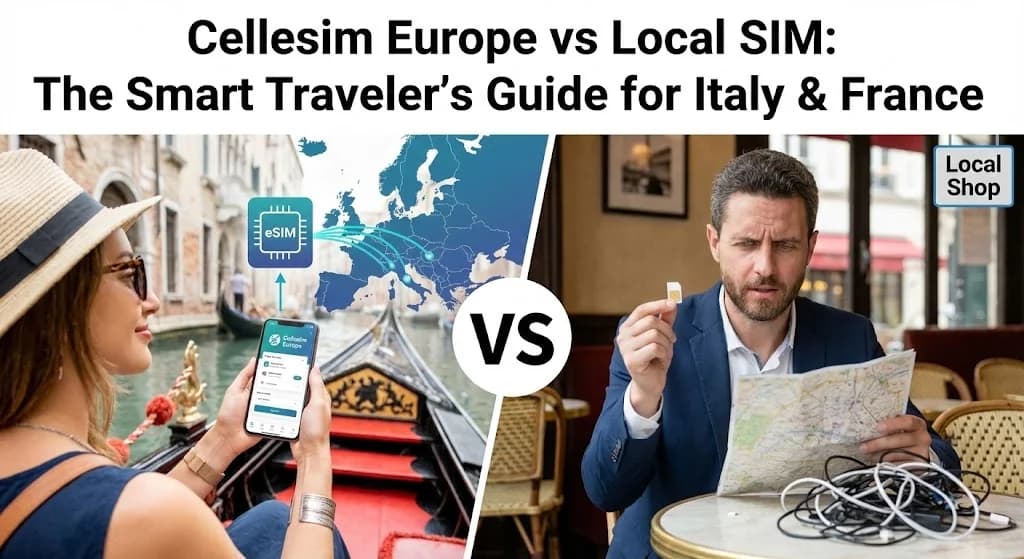
You have just landed at Rome's Fiumicino (FCO) airport after a long flight. Your hotel confirmation is buried in your email, you need to call an Uber, and Google Maps is a blank, useless grid. That familiar knot of travel anxiety tightens in your stomach. This is the modern traveler's first challenge: the connectivity crossroads. Do you choose the seamless convenience of a pre-purchased eSIM, or do you dive into the chaotic world of local SIM cards? When it comes to the classic Italy and France itinerary, the debate of Cellesim Europe vs local SIM is about more than just data, it is about your time, your money, and your sanity. We will break down the real costs, hidden hassles, and surprising benefits of each option, helping you choose the right mobile data solution. For many, having instant access with comprehensive data plans for Italy from the moment the plane's wheels touch down is a game-changer.
- Quick Comparison: Cellesim Europe Plan vs. Local SIMs at a Glance
- Deep Dive: The Cellesim Europe Plan Explained
- Deep Dive: The Local SIM Card Route in Italy and France
- Understanding Network Coverage in Italy and France
- How Much Data Do You Truly Need for Your European Trip?
- Activating Your Cellesim Europe eSIM: A Simple Guide
- A Detailed Cost Breakdown: eSIM vs. Local SIM vs. Roaming
- Essential Connectivity Tips for Travelers in Italy and France
- When to Purchase and Activate Your Travel eSIM
- Frequently Asked Questions
Stay Connected Across Europe
Our Europe 42 Countries eSIM plan offers seamless connectivity throughout your journey, covering all your needs from Rome to Paris.
- ⚡ Instant Activation
- 🌍 Data in 42 European Countries
- ✓ Trusted by 50,000+ Happy Customers
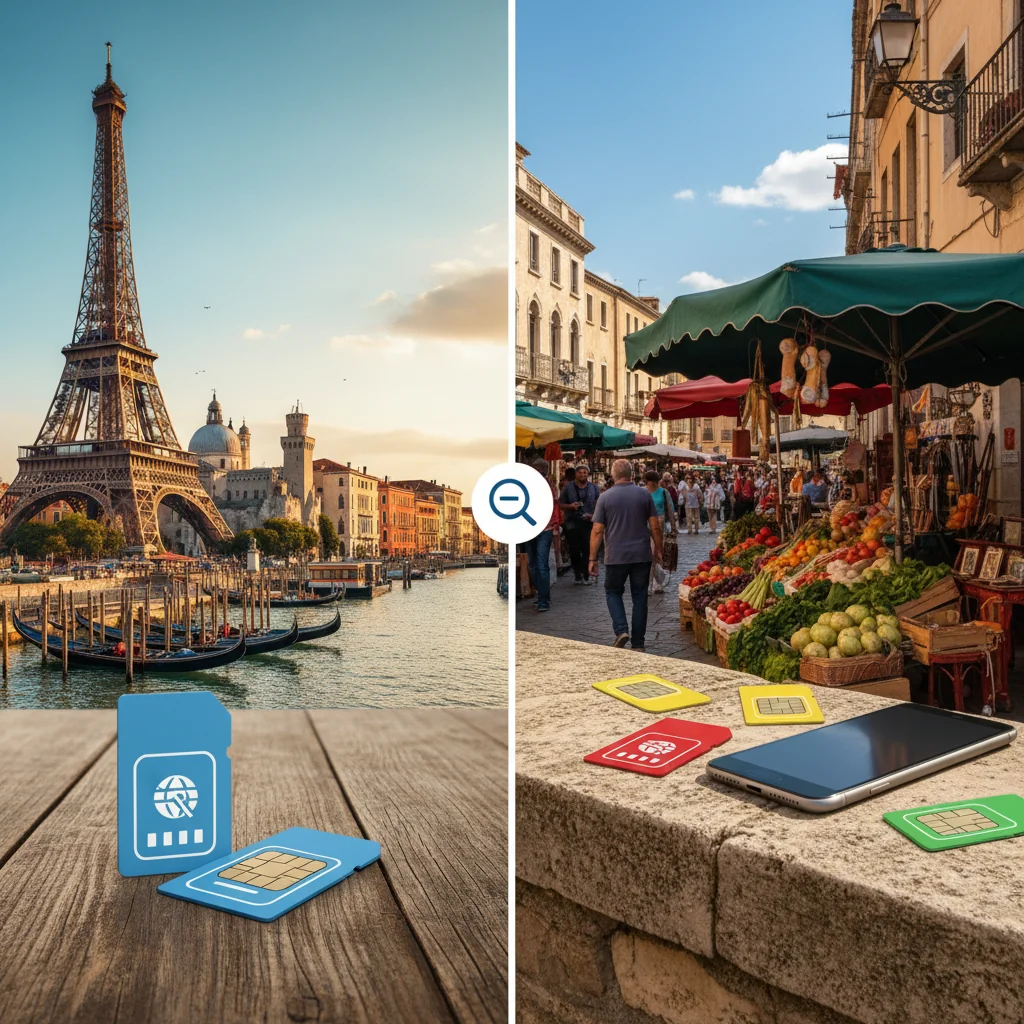
Quick Comparison: Cellesim Europe Plan vs. Local SIMs at a Glance
Before we dive deep, here is a high-level look at how these two approaches stack up against each other.
| Feature | Cellesim Europe Plan | Local SIMs (Italy/France) |
|---|---|---|
| Activation | Instant, before you travel | In-person, after you land |
| Multi-Country Use | Seamless across 42 countries | Requires buying a new SIM in each country |
| Time Investment | ~2 minutes online | 30-60+ minutes per country (finding store, queues, registration) |
| Requirements | eSIM-compatible phone | Unlocked phone, passport, time, patience |
| Cost Structure | Transparent, fixed price | Variable, potential airport markups, complex top-ups |
| Your Home Number | Stays active for calls/texts | Must physically swap out your home SIM |
| Privacy | No personal ID required | Passport registration mandatory |
| Support | 24/7 online support | Varies by local provider, language barrier possible |
Deep Dive: The Cellesim Europe Plan Explained
An eSIM (embedded SIM) is a digital SIM card that lives inside your phone. Instead of fumbling with tiny plastic chips, you simply scan a QR code to install a data plan. A regional plan, like the Cellesim Europe Plan, takes this a step further. You buy and install one plan, and it automatically provides high-speed data across dozens of European countries, including Italy and France.
How It Works: One Plan, Multiple Countries
The magic of a regional eSIM is its network-hopping capability. When you land in Rome, your phone, using the Cellesim eSIM, automatically connects to a premier local network like TIM or Vodafone. When you take the high-speed train to Paris, it seamlessly switches to a top French carrier like Orange or SFR without you having to do a thing. There is no service interruption, no settings to change, and no new SIM card to buy. It is the definition of set-it-and-forget-it travel connectivity. Before purchasing, it is always a good idea to check if your device is eSIM-ready, as most modern smartphones are.
The Pros of a Cellesim Europe eSIM
- Instant Connectivity on Arrival: This is the number one advantage. Your plan is active the second you turn off airplane mode. You can check train schedules, message your Airbnb host, or navigate to your hotel while everyone else is still searching for the airport's spotty free Wi-Fi or lining up at a crowded SIM kiosk.
- Seamless Border Crossing: For a multi-country trip, this is indispensable. Imagine driving from the Italian Riviera into the South of France. With a local SIM, your service would die at the border, leaving you without maps or communication until you could find a French phone store. With a Europe eSIM, your connection is uninterrupted. Our Europe 42 Countries eSIM ensures continuous data across borders.
- Upfront, Transparent Pricing: You pay once. The price you see is the price you pay for a set amount of data and validity period. There are no surprise roaming fees, no confusing top-up vouchers, and no hidden activation charges.
- Keeps Your Home SIM Active: Because the eSIM is digital, your physical SIM slot remains free for your home SIM card. This Dual SIM capability means you can keep your primary number for calls and texts (like 2FA codes from your bank) while using the eSIM for affordable, high-speed data.
- Enhanced Security and Privacy: Buying a local SIM in Italy or France almost always requires handing over your passport for registration and data collection. The Cellesim process is 100% digital and requires no personal identification, protecting your privacy.
- Customer Support: Cellesim offers dedicated 24/7 customer support via email at [email protected]. This provides peace of mind, especially when navigating a foreign country.
The Cons and Considerations
- Primarily Data-Only: Most travel eSIMs are focused on providing data, which is what 99% of travelers need for maps, messaging apps, and browsing. They typically do not come with a local European phone number for traditional voice calls or SMS. However, you can easily make calls using apps like WhatsApp, FaceTime Audio, or Skype over your data connection.
- Perceived Cost: If you look at a single data package for a 30-day stay in *only* Italy, a local SIM might offer more gigabytes for the same price on paper. However, this comparison is often misleading. The eSIM price includes the immense value of convenience, time saved, and multi-country functionality, which often outweighs a slight per-gigabyte difference.
Deep Dive: The Local SIM Card Route in Italy and France
The traditional method involves physically going to a store after you arrive and purchasing a prepaid SIM card. While it has been the default for years, it comes with a unique set of challenges and triumphs that are important to understand.
The Process: What to Expect at the Airport and in Town
In Italy, your main options will be TIM, Vodafone, and WindTre. You can find their official stores in city centers or sometimes authorized resellers in electronics shops or even within larger supermarkets. At Paris CDG Airport, you might find kiosks, but expect higher prices and limited options compared to city stores. Upon arrival, you will need to locate a store, navigate language barriers, present your passport for mandatory registration, choose a plan, and wait for activation. This process can take anywhere from 30 minutes to over an hour, potentially longer during peak tourist seasons or if the store is busy. In France, popular providers include Orange, SFR, Bouygues Telecom, and Free Mobile, with similar processes for purchasing a prepaid SIM. Always ensure your phone is unlocked before attempting to use a local SIM.
The Pros of a Local SIM Card
- Local Phone Number: If having a local Italian or French phone number for traditional calls and SMS is critical for your trip (e.g., for local job interviews, long-term stays, or specific local services), a local SIM provides this.
- Potentially More Data for Less (Single Country): For extended stays in a single country, some local prepaid plans might offer a higher data allowance at a lower per-gigabyte cost than a multi-country eSIM. However, this advantage diminishes rapidly if you plan to visit multiple countries.
- Top-Up Flexibility: You can often top up your data at various shops, supermarkets, or online portals, offering flexibility if your data needs change.
The Cons and Inconveniences
- Time-Consuming Activation: The biggest drawback is the time spent. After a long flight, navigating an airport or city to find a phone store, standing in line, and completing registration takes valuable time away from your travel experience.
- Passport Registration: Both Italy and France require passport registration for all SIM card purchases, meaning your personal data is collected by the local telecom provider. This can be a privacy concern for some travelers.
- Language Barriers: Unless you are fluent in Italian or French, explaining your needs and understanding plan details can be challenging, potentially leading to misunderstandings or purchasing an unsuitable plan.
- Single Country Focus: Local SIMs are inherently country-specific. If your itinerary includes both Italy and France, you will need to repeat the purchase and registration process in each country, incurring new costs and wasting more time. This is particularly inefficient for multi-country European tours.
- Losing Your Home Number: To use a local SIM, you must remove your home SIM card, meaning you will miss calls and texts to your primary number, including crucial two-factor authentication (2FA) codes.
Understanding Network Coverage in Italy and France
Whether you choose an eSIM or a local SIM, network coverage is paramount. Cellesim leverages the robust infrastructure of leading local carriers to ensure reliable connectivity. In both Italy and France, 4G LTE is widespread, and 5G networks are rapidly expanding in urban areas and major tourist destinations.
Italy's Major Carriers and Coverage
Italy's primary mobile network operators are TIM, Vodafone, and WindTre. These providers offer extensive 4G coverage across the peninsula, including popular cities like Rome, Florence, Venice, and Milan, as well as coastal regions and mountainous areas. 5G is available in major cities and is steadily rolling out to smaller towns. Cellesim partners with these top-tier networks, ensuring that your eSIM for Italy connects to the strongest available signal, providing consistent data speeds for navigation, communication, and content streaming.
France's Major Carriers and Coverage
In France, the main players are Orange, SFR, Bouygues Telecom, and Free Mobile. Orange is often cited as having the widest and most reliable network, particularly in rural areas, while all providers offer excellent 4G LTE coverage in cities like Paris, Nice, Marseille, and Bordeaux. 5G is widely available in urban centers. When you use a Cellesim eSIM for France, your device will automatically connect to one of these high-performance local networks, ensuring seamless internet access whether you are exploring the Louvre or driving through the French countryside. For general information on how eSIMs connect, you can refer to the GSMA's eSIM resource page.

How Much Data Do You Truly Need for Your European Trip?
Estimating your data needs can prevent both overspending and unexpected disconnections. Your usage will vary greatly depending on your travel style and reliance on digital tools.
Typical Data Usage Estimates
- Light User (1-3 GB for 7 days): Primarily uses maps, messaging apps (WhatsApp, iMessage), and light social media browsing. Downloads content (movies, podcasts) onto Wi-Fi before heading out.
- Moderate User (5-10 GB for 7 days): Regularly uses maps, messaging, social media, light video streaming, email, and occasional video calls. May upload photos and videos.
- Heavy User (10+ GB for 7 days): Frequent video streaming, extensive social media use, video calls, tethering other devices, and cloud backups. Relies heavily on data for work or entertainment on the go.
Consider downloading offline maps (Google Maps, Maps.me), pre-downloading entertainment, and utilizing hotel/cafe Wi-Fi when available to conserve data. For a personalized estimate, Cellesim offers a helpful Smart Data Calculator on our website.
Explore All Cellesim Plans
Activating Your Cellesim Europe eSIM: A Simple Guide
One of the significant advantages of Cellesim is the straightforward activation process, designed to get you connected quickly and effortlessly. There are typically three main methods, all user-friendly.
Step-by-Step Installation
- Purchase Your eSIM: Select your desired data plan for Europe on the Cellesim website (e.g., the Europe 42 Countries plan).
- Receive QR Code/Manual Details: After purchase, you will receive an email containing a QR code or manual installation details.
- Install the eSIM:
- QR Code Method: On your eSIM-compatible phone, go to Settings > Mobile Data/Cellular > Add Data Plan. Scan the QR code.
- Manual Method: If scanning is not possible, select "Enter Details Manually" and input the SM-DP+ Address and Activation Code provided in your email.
- Label Your eSIM: Give your new eSIM a recognizable name, such as "Cellesim Europe" or "Travel eSIM."
- Enable for Data: Ensure your eSIM is selected for mobile data usage, typically found in your phone's Mobile Data settings. Keep your home SIM active for calls/texts.
- Activate on Arrival: Once you land in your destination country (Italy or France), simply turn on your eSIM line and ensure data roaming is enabled for that line. Your Cellesim eSIM will connect to a local network automatically.
For more detailed instructions and troubleshooting tips, refer to our Complete eSIM Setup Guide or our Interactive Setup Guide.
A Detailed Cost Breakdown: eSIM vs. Local SIM vs. Roaming
Understanding the true cost of connectivity is essential for budget-conscious travelers. Let us compare the financial implications of Cellesim eSIMs, local SIM cards, and traditional roaming.
| Option | Upfront Cost (Approx.) | Per GB Cost (Approx.) | Hidden Fees/Hassles | Best For |
|---|---|---|---|---|
| Cellesim Europe eSIM | From ~$5 - $30 (for various data/duration) | From ~$1 - $3 per GB | None. Transparent pricing. | Multi-country travel, convenience, privacy. |
| Local SIM Card (Italy/France) | ~$10 - $25 (SIM + basic data bundle) | ~$0.50 - $2 per GB | Time spent, passport registration, language barrier, single country. | Long-term stay in a single country, needing a local number. |
| Traditional Roaming (Home Provider) | Daily fees (e.g., $10-$15/day) or high per-MB rates | ~$10 - $200+ per GB (highly variable) | Exorbitant costs, bill shock, throttled speeds. | Emergency use only, extreme short trips (less than a day). |
While a local SIM might appear cheaper per gigabyte for a very specific, single-country scenario, the cumulative costs of time, effort, and repeated purchases for multi-country travel quickly make it less economical. Traditional roaming is almost always the most expensive option, leading to unexpected charges that can quickly add up. Cellesim offers a predictable, cost-effective solution, especially for those exploring multiple European destinations. You can use our Roaming Savings Calculator to see how much you could save.
Essential Connectivity Tips for Travelers in Italy and France
Beyond choosing your data plan, a few practical tips can enhance your connectivity experience in Europe.
- Download Offline Maps: Before you leave your accommodation or a Wi-Fi zone, download maps of cities you will visit on Google Maps or Maps.me. This saves data and ensures you can navigate even without an active connection.
- Utilize Free Wi-Fi: Many hotels, cafes, and public spaces offer free Wi-Fi. Use these opportunities to download large files, update apps, or make video calls to conserve your eSIM data.
- Manage Background Data: Restrict apps from using data in the background. Check your phone settings to see which apps are consuming the most data and limit their access when not actively in use.
- Use Wi-Fi Calling: If your home carrier supports Wi-Fi Calling, you can use your eSIM's data connection to make and receive calls on your primary number, avoiding roaming charges.
- Stay Charged: Data usage drains battery faster. Carry a portable power bank, especially on long sightseeing days.
- Emergency Numbers: The universal European emergency number is 112. Ensure you know how to dial it if needed. While eSIMs provide data, they do not typically include local voice minutes for emergency calls unless using VoIP apps.
Smart data usage ensures your plan lasts throughout your adventure, letting you focus on the breathtaking sights of the Colosseum or the Eiffel Tower.
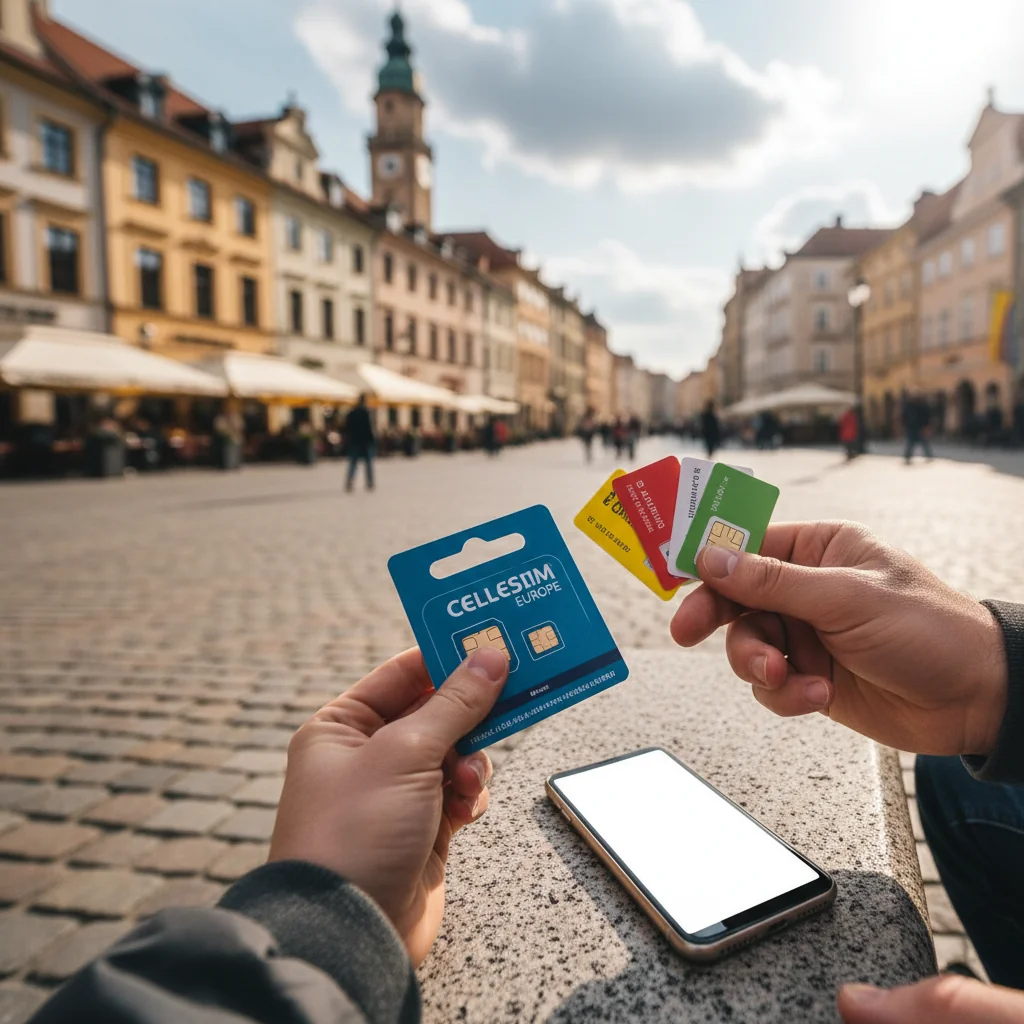
When to Purchase and Activate Your Travel eSIM
Timing your eSIM purchase and activation can significantly impact your travel experience. For optimal convenience, Cellesim recommends purchasing your eSIM before you travel.
Purchase Before You Fly
Buying your eSIM from cellesim.com before your departure means you can complete the entire process from the comfort of your home. You receive the QR code via email, install it on your device, and it is ready to activate the moment you land. This eliminates the stress of finding a SIM store upon arrival, dealing with potential language barriers, or relying on airport Wi-Fi. It is particularly beneficial for multi-country itineraries, as you will be connected from your very first stop.
Activate on Arrival
While you can install the eSIM profile at home, it is best to activate the data plan (by enabling the eSIM line and data roaming) only once you arrive at your destination. This ensures the validity period of your plan starts when you truly need it. For instance, if you purchase a 7-day plan, activating it when you step off the plane means you get the full 7 days of connectivity in Italy and France. This strategy is further detailed in our blog post: The Traveler's Dilemma: When to Buy Your eSIM.
Frequently Asked Questions
Is my phone compatible with an eSIM?
Most modern smartphones released in the last few years are eSIM compatible. This includes recent iPhone models (XS and newer), many Samsung Galaxy devices (S20 series and newer), Google Pixel phones (3a and newer), and others. You can use our eSIM Checker tool or refer to our eSIM Compatible Devices list for specific models.
Can I make calls and send texts with a Cellesim Europe eSIM?
Cellesim eSIMs are primarily data-only. This means you will use apps like WhatsApp, FaceTime Audio, Skype, or Google Meet for calls and messaging over your data connection. Your existing home number will remain active on your physical SIM for calls and texts (including 2FA codes) if you keep it in your phone.
What if I run out of data before my trip ends?
If your Cellesim eSIM data runs low, you can easily top up your plan directly from the Cellesim website. We offer various data packages to suit your needs, allowing you to extend your connectivity seamlessly without interruption.
Can I use multiple eSIMs on one device?
Yes, many eSIM-compatible devices allow you to store multiple eSIM profiles simultaneously. You can switch between them as needed, though only one eSIM can be active for data at any given time (alongside your physical SIM for Dual SIM functionality). This is convenient for travelers who frequently visit different regions.
Is it safe to use an eSIM for international travel?
Using an eSIM is generally very safe. It eliminates the risk of losing a tiny physical SIM card, and Cellesim's digital activation process protects your privacy as it does not require passport registration. Your data connection is secure and encrypted, just like with a traditional SIM card.
What if I encounter an issue with my Cellesim eSIM?
Cellesim provides 24/7 customer support via email at [email protected]. Our team is ready to assist you with any installation, activation, or connectivity issues you might encounter during your travels, ensuring a smooth experience.
Ready for Seamless European Connectivity?
Choose Cellesim for instant data across Italy, France, and 40+ other European countries. Experience travel without connectivity worries, just like 50,000+ happy customers already do.
Shop Europe eSIM Plans Now