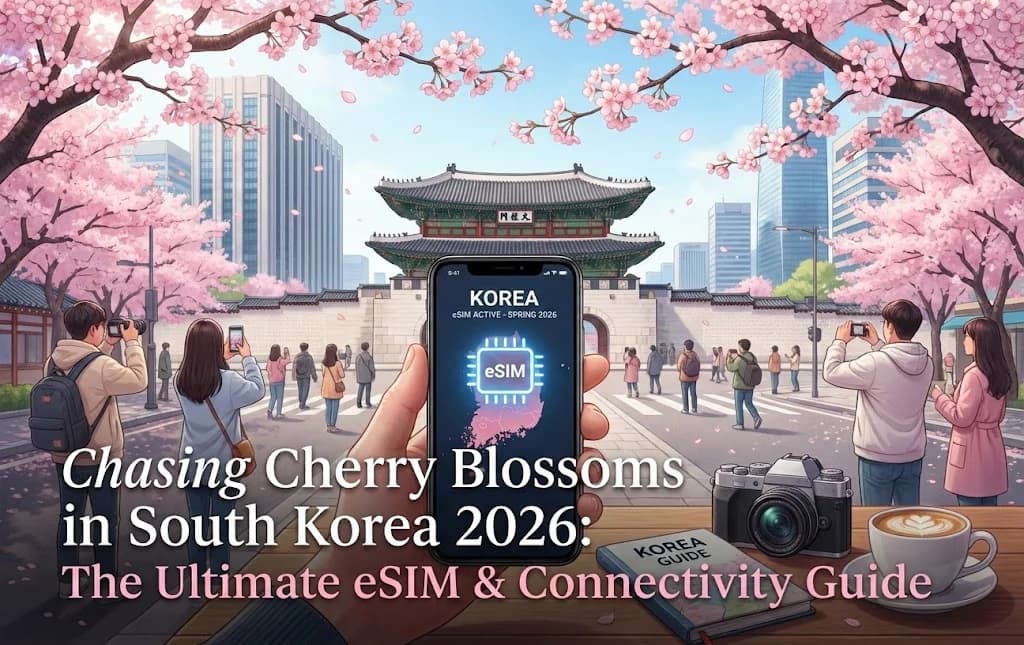
That moment you step off the plane at Incheon International Airport (ICN), the excitement is real. You're probably buzzing to dive into South Korea's vibrant culture, incredible food, and, of course, those stunning cherry blossoms. But before you can even think about catching the AREX train to Seoul, there's one big thing to sort out: getting connected. This is where a lot of travel plans hit their first snag.
Landing in a new country means you immediately face a choice that can impact your whole trip. Do you wait in long lines at crowded telecom kiosks, trying to figure out confusing plans? Do you desperately hunt for that often-unreliable airport Wi-Fi? Or do you risk huge roaming charges just to tell your family you landed safe? This is the modern traveler's dilemma, and for a trip as photo-heavy as chasing cherry blossoms, being without data just isn't an option. For your 2026 South Korea cherry blossom adventure, you need internet that works the second you land, especially when you're trying to find your way around new cities and snap those fleeting floral moments.
- Arriving Connected: Your Cherry Blossom Trip Begins at ICN
- Cherry Blossom Connectivity: eSIM vs. Local SIM vs. Roaming
- Why an eSIM is Essential for Your 2026 South Korea Spring Trip
- Best Cherry Blossom Spots & Cellesim Network Coverage in 2026
- Cellesim for South Korea: Plans Tailored for Spring Travelers
- Activating Your Cellesim eSIM for South Korea: A Step-by-Step Guide
- Pro Tips for Your 2026 South Korea Cherry Blossom Experience
- Frequently Asked Questions
Stay Connected in South Korea
Secure high-speed data for your cherry blossom adventure with a Cellesim eSIM. Join 50,000+ happy customers who connect instantly.
Get Your South Korea eSIM 🌸Arriving Connected: Your Cherry Blossom Trip Begins at ICN
Landing at Incheon International Airport (ICN) is an experience. It's one of the world's busiest and most advanced airports, but it can still feel overwhelming if you're not ready for connectivity. Sure, ICN has free Wi-Fi, but it's often slow and not secure for anything important. If you rely on it, you won't be able to call a taxi, use navigation apps to find your hotel, or even tell your family you've landed until you find a working public hotspot. For those of us excited for the 2026 cherry blossom season, immediate and reliable data is a must-have.
An eSIM completely bypasses that airport rush. Before you even get on your flight, you can buy and install your data plan for South Korea. This means the moment your plane touches down, you just switch on your Cellesim eSIM, and boom: you're connected to a local network. No lines, no language barriers, just instant internet. You can immediately check for real-time cherry blossom updates, find your way to Gyeongbokgung Palace, or book your KTX train ticket to Busan.
Cherry Blossom Connectivity: eSIM vs. Local SIM vs. Roaming
When you're planning your 2026 trip to see South Korea's beautiful spring, knowing your options for staying connected is crucial. Each choice has its good and bad points when it comes to how easy it is, how much it costs, and how well it works. Here's a quick comparison to help you decide:
| Option | Price (7 days) | Speed/Coverage | Setup | Keep Home Number |
|---|---|---|---|---|
| Cellesim eSIM | From $4.50 | Full 4G/5G (SKT/KT) | Instant (pre-arrival) | Yes |
| Local Physical SIM | $15-30 | Full 4G/5G (SKT/KT) | Airport kiosk (queues) | No (swap physical SIM) |
| International Roaming | $10-15/day | Variable (often throttled) | Automatic (expensive) | Yes |
"For a quick cherry blossom trip, an eSIM gives you the best mix of convenience, affordability, and constant connection. You arrive ready to explore, not stuck in a line."
Why an eSIM is Essential for Your 2026 South Korea Spring Trip
An eSIM offers more than just convenience; it gives you real benefits that will make your 2026 South Korean cherry blossom experience even better:
- Real-time Bloom Tracking: Cherry blossoms are tricky. Peak bloom can change by days or even a week because of the weather. With an eSIM, you can constantly check local forecasts, official bloom reports from the Korea Meteorological Administration (KMA), or even social media updates from other travelers to find the best spots at any moment.
- Easy Navigation: South Korea's public transport is fantastic, but you need apps like Naver Maps or Kakao Maps to use it, and those apps use a lot of data. From finding your way through Seoul's huge subway system to locating hidden, blossom-filled streets in Gyeongju, reliable GPS is a must.
- Instant Sharing: The beauty of cherry blossoms is something you'll want to share. Whether it's stunning photos from Yeouido Park or live video calls with family as you walk through Jinhae, an eSIM makes sure you have the bandwidth to capture and share every magical moment without delays or huge costs.
- Staying Informed & Safe: Constant internet access means you can easily look up opening times for attractions, translate menus, research local customs, or find emergency information if you need it. It's a vital tool for your safety and peace of mind.
- Saving Money: Compared to expensive international roaming charges, a Cellesim South Korea eSIM offers clear, pre-paid pricing. You know exactly what you're paying for, so no nasty bill surprises when you get home. You can even use our Roaming Savings Calculator to see how much you could save.
Best Cherry Blossom Spots & Cellesim Network Coverage in 2026
South Korea has tons of famous cherry blossom viewing spots, each with its own special charm. Cellesim, by using networks like SK Telecom and KT, offers wide coverage across the country. This means you'll stay connected whether you're in a busy city or a peaceful park.
- Seoul:
- Yeouido Park (Yeouiseo-ro Street): Known for its "Tunnel of Cherry Blossoms." Expect excellent 5G coverage, perfect for live streaming and sharing.
- Gyeongbokgung Palace & Surrounding Areas: Historic settings for blossoms. Strong 4G/5G ensures you can access digital guides and photo tips.
- Namsan Tower: Offers amazing city views covered in pink. High-speed data is available for uploading those breathtaking landscape photos.
- Busan:
- Samnak Ecological Park: Over 1,200 cherry trees line the Nakdonggang River. Reliable 4G/5G helps you find your way around the huge park and locate the best picnic spots.
- Dalmaji-gil Road: A beautiful drive or walk along Haeundae beach, famous for its moonlit blossoms. You'll have good connectivity even in this scenic coastal area.
- Gyeongju:
- Bomun Lake: A top cherry blossom destination with historical sites. Cellesim keeps you connected for booking boat rides or exploring the area.
- Donggung Palace and Wolji Pond: Stunning night views of blossoms. Data is essential for late-night navigation and capturing low-light photos.
- Jinhae:
- Jinhae Gunhangje Festival: Home to the country's biggest cherry blossom festival. Even though it's often crowded, SK Telecom and KT provide strong network coverage, handling lots of users during the festival.
- Gyeonghwa Station: Famous for its train passing through a tunnel of blossoms. Even in this popular, specific spot, Cellesim offers reliable data.
You can check specific coverage maps for SK Telecom and KT on their official websites if you want to verify signal strength in any more remote places you plan to visit.
Find Your Ideal South Korea eSIM Plan
Cellesim for South Korea: Plans Tailored for Spring Travelers
Cellesim offers a variety of eSIM data plans designed for different travel styles and trip lengths for your 2026 cherry blossom trip. Whether you're a light user who mostly navigates and messages, or a heavy user who captures and shares every moment, there's a plan for you.
When picking your plan, think about these things, especially for a cherry blossom trip:
- Navigation: Using Naver Maps or Kakao Maps for walking directions and public transport can use 50-100MB per hour, especially if you're frequently rerouting.
- Photo & Video Sharing: Uploading high-resolution photos and short videos to social media (Instagram, TikTok) uses a lot of data. A 1-minute video can be 50-150MB.
- Real-time Updates: Constantly checking bloom forecasts, local news, or festival schedules uses a moderate amount of data.
- Communication: WhatsApp, KakaoTalk, or other messaging apps use very little data, but video calls are data-heavy.
Cellesim plans for South Korea are generally data-only. This means your home phone number stays active on your primary physical SIM for calls and texts, while your eSIM handles all your internet use. This is perfect for getting important messages or bank codes from home while enjoying affordable local data rates. Learn more about keeping your number with an eSIM.
Activating Your Cellesim eSIM for South Korea: A Step-by-Step Guide
Activating your Cellesim eSIM for your South Korea trip is super easy, made with travelers in mind. You can even do it before you leave home.
- Check Compatibility: First, make sure your phone works with eSIMs. Most newer smartphones (iPhone XS and up, Samsung Galaxy S20 and up, Google Pixel 3 and up) support eSIM technology. You can quickly check this with our eSIM checker.
- Purchase Your Plan: Go to cellesim.com/en/esim-south-korea and pick the data plan that's best for your cherry blossom trip.
- Receive QR Code/Manual Details: After you buy your plan, you'll get an email with a QR code and instructions for manual installation.
- Install the eSIM:
- Using QR Code (Recommended): On an eSIM compatible device, go to Settings > Cellular/Mobile Data > Add eSIM. Scan the QR code from your email.
- Manual Installation: If you can't scan the QR code (for example, if you only have one phone), you can manually enter the provided SM-DP+ Address and Activation Code. Check our complete eSIM setup guide for detailed instructions.
- Activate Your Plan: Once it's installed, turn on your Cellesim eSIM line and make sure data roaming is enabled for this line (this uses your eSIM data, not your home provider's expensive roaming). Your data plan will activate when it connects to a supported network in South Korea.
- Set as Primary Data Line: In your phone's settings, choose your Cellesim eSIM as the main line for mobile data. You can keep your physical SIM active for calls and texts from your home number.
We suggest installing your eSIM a day or two before you leave. This way, you can fix any technical issues while you still have your home internet connection. Your data plan's validity usually starts when it first connects to a network in South Korea, not when you install it.
Pro Tips for Your 2026 South Korea Cherry Blossom Experience
To make your 2026 cherry blossom trip to South Korea truly amazing, here are some extra tips:
- Watch Bloom Forecasts Closely: As we mentioned, bloom times change. Follow trusted sources like the Korea Tourism Organization (english.visitkorea.or.kr) or local news for the latest updates. Your Cellesim eSIM will be super helpful for this.
- Book Accommodation & Transport Early: Cherry blossom season is incredibly popular, so hotels, KTX trains, and even domestic flights get booked up fast. Book well in advance to get your preferred options.
- Visit on Weekdays if You Can: Popular spots like Yeouido Park and Jinhae can get super crowded on weekends. Try to visit during the week for a more peaceful experience.
- Explore Beyond Seoul: While Seoul has beautiful spots, think about day trips or longer stays in Gyeongju, Busan, or Jinhae for different cherry blossom views.
- Download Offline Maps: Even with a reliable eSIM, downloading offline maps (Naver Maps, Kakao Maps, or Google Maps) is a good backup, especially if you go to areas with weaker signal. Learn how to save data with Google Maps.
- Pack Layers: Spring weather in South Korea can be unpredictable, with warm sunny days followed by cooler evenings. Layers are key.
- Learn Basic Korean Phrases: English is spoken in major tourist areas, but knowing a few basic phrases will really improve your interactions with locals and show respect for the culture.
- Carry a Portable Charger: Using navigation, camera, and social media apps a lot will drain your battery fast. A power bank is a lifesaver, especially during long days of cherry blossom viewing.
With an active Cellesim eSIM, you'll feel confident navigating, exploring, and sharing your amazing cherry blossom journey through South Korea, making sure you don't miss a single petal.
Ready for Seamless Connectivity in South Korea?
Don't let internet troubles ruin your cherry blossom experience. Get your Cellesim eSIM and connect instantly.
Start Your Connected JourneyTrusted by 50,000+ travelers worldwide. Available in 200+ countries. 24/7 Support: [email protected].
The Arrival Reality: Navigating Incheon Airport's Connectivity Maze
The first few hours in a new country really set the tone for your whole trip. At Incheon, which is known for being super efficient and modern, the first hurdle often comes down to getting good mobile service. How you handle this upon arrival can make your experience either smooth or really frustrating, all depending on how prepared you are. Travelers often forget how much they'll immediately need data, whether it's for simple navigation, contacting their hotel, or just sending that first "I've arrived" message.
The Local SIM Card Kiosk Experience
Your first thought might be to head straight for the KT, SK Telecom, or LG U+ counters in the arrivals hall. These kiosks are bright and easy to spot, but they often have long lines, especially during busy times like spring tourist season. Once you get to the front, you'll need your passport for mandatory registration, which is a legal requirement in South Korea. The staff are usually helpful, but you'll be faced with a confusing array of 'tourist SIM' packages, often priced from ₩30,000 to ₩70,000 (about $22-$50 USD) for short-term unlimited data plans. The process involves actually swapping out your home SIM card, which can be nerve-wracking if you're worried about losing that tiny, important piece of plastic. It's a workable solution, but it's not instant, and it means standing in a queue when all you want to do is start your adventure.
Relying on Airport Wi-Fi: A Temporary Fix
Many travelers figure they can just use airport Wi-Fi to get their bearings. While Incheon's Wi-Fi is better than most, it's still a public network. It can be slow because of too many people using it, sometimes needs a clunky sign-in process, and most importantly, it stops working the second you step outside to find your bus or taxi. This is a critical gap in your connection. You need data to put your hotel address into Kakao Maps, to use a translation app to talk to your driver, or to check the bus schedule. Relying on airport Wi-Fi is like having a map that only works inside the bookstore where you bought it. It's a temporary fix that often causes more stress than it solves, leaving you without a connection exactly when you need guidance the most. This is why many travelers now compare airport SIM card prices versus eSIM options before they even pack.
The Dreaded "No Service" Feeling
Perhaps the most stressful scenario is doing nothing and hoping everything works out. You walk out of the airport, your phone says "No Service," and you're completely cut off. You can't access your hotel confirmation email, you can't use a ride-hailing app like Kakao T, and you can't even look up basic phrases. This feeling of being digitally isolated is incredibly disorienting in a country as hyper-connected as South Korea. The alternative, turning on your home carrier's data roaming, can lead to a shocking bill. Many North American and European providers charge upwards of $10-$15 per day for international roaming, which can easily add over $100 to a week-long trip. This is an avoidable cost that can eat into your budget for exploring palaces and enjoying Korean BBQ. The peace of mind that comes from having data the second your plane's wheels touch the ground is priceless.
A Head-to-Head Comparison: eSIM vs. Tourist SIM vs. Roaming
Knowing your options is key to making a smart decision. Your choice for mobile data in South Korea really comes down to three main players: the modern eSIM, the old-school physical tourist SIM, and your home provider's roaming plan. Each has its good points and bad points, but when you look at them as a traveler here for the cherry blossoms, one clearly stands out for ease and value. Let's compare them in a real-world setting to help you figure out if you truly need a physical SIM card in South Korea or if a digital solution is a better fit for your 2026 trip.
| Feature | eSIM (Cellesim) | Local Tourist SIM | Home Carrier Roaming |
|---|---|---|---|
| Convenience & Activation | Purchase and install before arrival. Instant connectivity. No physical swap. | Purchase at airport kiosk. Requires queueing, passport, physical swap. | No setup needed. Automatically connects. |
| Cost for 10 Days (Approx.) | From $20 - $30 USD (High data) | $22 - $50 USD (Often less data or short validity) | $100 - $150 USD (High daily fees) |
| Keeping Home Number | Yes, use for calls/SMS while eSIM handles data. Dual SIM support. | No, your home SIM is removed. May require forwarding. | Yes, your home number remains primary. |
| Network Speed & Coverage | Full 4G/5G on top local networks (SK Telecom, KT). | Full 4G/5G on local networks. | Can be throttled or prioritized lower than local users. |
| Device Compatibility | Requires eSIM-compatible phone (most modern smartphones). Check Cellesim eSIM checker. | Works with any unlocked phone. | Works with any phone supported by your home carrier. |
| Flexibility & Top-ups | Easy online top-ups and plan extensions. Flexible durations. | Often limited to initial purchase options. Top-ups can be complex. | Typically fixed daily or monthly packages. |
Option 1: The South Korea eSIM (The "Land and Go" Choice)
An eSIM (embedded SIM) is a digital SIM card that's built right into most newer smartphones, like the iPhone 15 or Samsung Galaxy S24. Instead of a physical card, you get a QR code to install a data plan directly onto your phone. The main benefit is how fast it is. You can buy and install your eSIM for South Korea from home before you even leave. The plan only turns on when you connect to a network in South Korea, meaning you get high-speed data the second you turn off airplane mode. No lines, no passport hassles at a kiosk, and no fumbling with tiny SIM trays. Plus, it lets you keep your home number active for calls and important texts (like bank verification codes) while using the eSIM for affordable local data. This dual-SIM feature changes the game for international travel.
Option 2: The Local Tourist SIM Card (The Traditional Route)
As mentioned, buying a local SIM card is the traditional way. Its main benefit can sometimes be cost, especially for very long stays over a month where you might need a local phone number for specific administrative tasks. But for a typical 1-3 week trip, the convenience cost is high. You'll spend the first hour of your trip trying to get it. There's also the chance your phone is locked to your home carrier, meaning a foreign SIM won't work at all. You also have to keep your main SIM card safe while it's out of your phone. While it's an option, it's an older, more cumbersome way to get connected that's quickly being replaced by easier digital solutions.
Option 3: Your Home Carrier's Roaming Plan (The Expensive Convenience)
Using your home carrier's international roaming plan is definitely the easiest option in terms of setup, you do nothing. However, this convenience comes with a huge price tag. Plans like AT&T's International Day Pass or Vodafone's Roam-Further can cost a lot daily, quickly adding up to a big sum. For a 10-day cherry blossom tour, you could be looking at $100-$150 in roaming fees. In contrast, a similar eSIM data package from Cellesim might cost as little as $20-$30. While roaming saves you the trouble of finding a SIM, the cost is rarely worth it when much more affordable options give you the exact same, if not better, service by connecting you directly to local networks.
Why Mobile Data is Non-Negotiable for a South Korea Trip
In some countries, you can get by with downloading offline maps and using hotel Wi-Fi. South Korea isn't one of them. It's one of the most tech-savvy and digitally integrated societies in the world, and its infrastructure assumes everyone is connected. From navigating Seoul's huge subway system to finding the best hidden photo spots for cherry blossoms in Gyeongju, reliable mobile data isn't a luxury; it's an essential tool that lets you experience your trip to the fullest. Without it, you'll be trying to get around with one hand tied behind your back and missing out on the smooth experience the country offers.
Navigation Beyond Google Maps: Kakao & Naver
This is probably the most important point for anyone traveling to South Korea: Google Maps just doesn't work well here. Because of local rules and security laws, Google's map data is very limited. It can't give accurate walking, driving, or public transit directions. To get around effectively, you absolutely must use local apps like Naver Map or Kakao Maps. These apps are incredibly detailed and accurate, but they need a constant data connection to work. Trying to find a specific cherry blossom path in Yeouido Park or a recommended restaurant in Busan's Gamcheon Culture Village is nearly impossible without one of these apps, and they're useless without mobile data. For the latest travel information and local tips, check the official Korea Tourism Organization website.
Essential Apps: Translation, Ride-Hailing, and Payments
Beyond navigation, your smartphone is your lifeline. While many Koreans in tourist areas speak some English, you'll definitely run into situations where a translation app like Papago (which is better than Google Translate for Korean) will save the day. Calling a taxi is best done through the Kakao T app, which needs data to book a ride and talk to your driver. Also, many cafes and shops are moving towards QR code-based ordering and payment systems, all of which rely on an internet connection. Your data connection is key to smoothly interacting with modern Korean society, making your travel experience easy and more immersive.
Sharing Your Moments: From Jinhae to Jeju Island
Let's be real: a trip to see the cherry blossoms is an incredibly visual experience. You'll be taking hundreds of photos and videos, from the thick pink tunnels of the Jinhae Gunhangje Festival to the volcanic landscapes of Jeju Island. Having a reliable data connection lets you share these beautiful moments with friends and family back home in real-time. It also allows you to use social media to find trending photo spots or look up reviews for a nearby cafe on the fly. This isn't just about posting online; it's about using a powerful tool to enhance your discovery and enjoyment of the country's most beautiful season. For those traveling across the region, an Asia backpacking eSIM can provide smooth connectivity across several countries.
Explore all Cellesim plans
Deep Dive into eSIM for South Korea: What to Expect from Cellesim
Choosing an eSIM for your South Korean adventure isn't just about convenience; it's about using top-notch technology for a better travel experience. South Korea has some of the fastest mobile internet speeds on the planet, and using an eSIM from a provider like Cellesim ensures you directly tap into this world-class infrastructure. Understanding the details of network quality, data speeds, and how to pick the right plan will help you make a smart decision and travel confidently, knowing you have the best possible connection in your pocket.
Network Quality and Coverage (SK Telecom, KT, LG U+)
Cellesim works with South Korea's top mobile operators, mainly SK Telecom and KT. These are the two biggest networks in the country, known for their wide and strong coverage. Whether you're navigating the busy streets of Myeongdong in Seoul, exploring the historic sites of Gyeongju, or hiking in Seoraksan National Park, you can expect a strong and stable 4G/LTE or 5G signal. In our experience, coverage is incredibly reliable, even within the extensive subway systems of major cities. This means you won't lose your connection underground while planning your next stop, a common frustration in many other countries. For details on how we make sure you have robust network access, you can visit our How Our Network Works page.
Data Speeds: Leveraging Korea's 5G Prowess
South Korea is a global leader in 5G, offering unmatched mobile internet speeds. With a Cellesim eSIM, you get access to these high-speed networks. This means super-fast downloads, smooth streaming of high-definition video, video calls with loved ones without lag, and quick loading of maps and translation apps. While 4G/LTE is widely available and offers excellent speeds, 5G takes it to another level, especially in cities. For travelers who rely heavily on their devices for navigation, creating content, or staying connected for work, these speeds make a big difference in how productive and enjoyable their trip is.
Types of Cellesim Plans for South Korea
Cellesim offers a range of data plans designed for different travel needs and trip lengths. Our South Korea eSIM plans usually include generous data allowances, from 1GB for short, light-use trips to 20GB or more for longer stays and heavy usage. Plans are available with different validities, typically from 7 days to 30 days, giving you flexibility to match your trip length. All plans are data-only, letting you keep your primary SIM active for calls and texts, saving your home number for important communications. We focus on providing clear, transparent pricing with no hidden fees, so you know exactly what you're getting.
Choosing Your Ideal eSIM Data Plan for South Korea
Picking the right eSIM plan is crucial for a smooth trip. Your data needs in South Korea will really depend on how you travel and how you plan to use your phone. Overestimating your data needs can lead to spending more than you have to, while underestimating can leave you scrambling for a top-up at a bad time. Think about these factors when making your choice.
How Much Data Do You Really Need?
- Light User (1-3 GB for 7 days): Great for checking emails, light social media, occasional map use, and messaging apps like KakaoTalk. If you mainly use Wi-Fi at your hotel for most browsing, this might be enough.
- Moderate User (5-10 GB for 15 days): Good for regular navigation, frequent social media updates with photos and videos, a few video calls, and streaming music. This covers most typical tourist needs.
- Heavy User (15+ GB for 30 days): Best for lots of video streaming, frequent video calls, using your phone as a hotspot, gaming, or if you're working remotely. South Korea's high speeds might encourage you to use more data.
Remember that using local navigation apps like Kakao Maps and Naver Map, which are essential, can use more data than you might expect, especially if you're frequently moving around. Consider your daily habits and factor in a bit extra for unexpected use. Our Smart Data Calculator can help you estimate your needs.
Duration and Flexibility
Cellesim offers plans that last from 7 days to 30 days. Match your plan's duration to your travel itinerary. If your trip goes longer than your initial plan, topping up your eSIM with Cellesim is simple, often just a few clicks in your account, ensuring you stay connected without interruption. This flexibility is a big advantage over physical SIM cards, which often require another trip to a store for extensions.
Activating Your Cellesim eSIM: A Simple Guide
One of the best things about using a Cellesim eSIM is how easy it is to activate. You can set up your connection before you even leave, making sure you're ready to connect the moment you land. Here's a quick rundown of the process:
Step-by-Step Installation
- Purchase Your Plan: Choose your desired data plan for South Korea from the Cellesim website. You'll get an email with a QR code and detailed instructions.
- Scan the QR Code: On your eSIM-compatible smartphone, go to your cellular settings and select "Add eSIM" or "Add Cellular Plan." Scan the QR code from your email.
- Label Your eSIM: Once installed, label your new eSIM (e.g., "Cellesim Korea") so you can easily tell it apart from your primary SIM.
- Set Data Preference: Before you travel or when you arrive, set your Cellesim eSIM as your main line for cellular data. Make sure "Data Roaming" is enabled for your eSIM line if prompted (this means using the local network, not your home carrier's roaming).
- Activate Upon Arrival: Once your plane lands in South Korea, turn off airplane mode. Your Cellesim eSIM will automatically connect to the local network, giving you instant data access.
For more detailed instructions, including screenshots and troubleshooting tips, check out our comprehensive Complete eSIM Setup Guide or our Interactive Setup Guide.
When to Activate Your eSIM
It's generally a good idea to install your eSIM profile before you travel, ideally a day or two before you leave. The data plan itself will only become active when it connects to a supported network in South Korea. This means you can do the technical installation at home, then simply turn on your eSIM for data once you arrive at Incheon Airport. This avoids any last-minute stress of setting up your connection after a long flight, ensuring you're connected from the first moment.
Pro Tips for Experiencing South Korea's Cherry Blossom Season
A trip to South Korea during cherry blossom season is magical, but it needs some planning to get the most out of it. Connectivity is just one part of the puzzle. Here are a few extra tips to make your experience even better, ensuring you stay connected and make unforgettable memories.
Best Time and Locations for Cherry Blossoms
Cherry blossom season typically runs from late March to mid-April, moving from south to north. Key spots include:
- Jinhae: Hosts the biggest cherry blossom festival, Jinhae Gunhangje, usually in early April. Expect big crowds.
- Seoul: Yeouido Park, Seokchon Lake, and the royal palaces (Gyeongbokgung, Changdeokgung) offer stunning views, typically peaking mid-April.
- Gyeongju: The historic city is beautiful with blossoms around Bomun Lake and the various tumuli.
- Jeju Island: Often the first place to bloom in late March.
Always check local forecasts closer to your travel date, as bloom times can vary slightly each year. The Korea Times often provides seasonal updates on natural events like cherry blossoms.
Mastering Public Transportation
South Korea's public transportation system is world-class, especially in major cities. The Seoul subway is huge, efficient, and clean. You'll need a T-Money card (a reloadable transit card, available at convenience stores and subway stations) for easy travel. Your Cellesim eSIM will be invaluable for navigating with Kakao Map or Naver Map, which give real-time updates on bus and subway schedules. Don't underestimate how convenient it is to have live information at your fingertips, especially when connecting between different lines or types of transport.
Cultural Etiquette and Essential Phrases
While many Koreans in tourist areas speak English, learning a few basic phrases will really improve your experience. Simple greetings like "Annyeonghaseyo" (Hello) and "Kamsahamnida" (Thank you) are always appreciated. Be mindful of local customs, such as bowing slightly when greeting elders and taking off your shoes before entering homes or some traditional restaurants. Your translation app, powered by your eSIM data, will be a constant companion for deeper interactions.
Seamless Connectivity for Your South Korean Journey
Get instant, high-speed data across South Korea with a Cellesim eSIM. Stay connected the moment you land, navigate easily, and share every cherry blossom memory.
Get Your South Korea eSIMJoin 50,000+ happy travelers using Cellesim.
Frequently Asked Questions
What is an eSIM and how does it work in South Korea?
An eSIM is a digital SIM card built into your phone, so you don't need a physical one. In South Korea, a Cellesim eSIM lets you download a local data plan directly to your device, connecting you to top networks like SK Telecom or KT as soon as you arrive. This means instant high-speed internet without swapping SIM cards or dealing with airport kiosks.
Can I keep my home phone number while using a Cellesim eSIM in South Korea?
Yes, absolutely. One of the main advantages of using a Cellesim eSIM is its dual-SIM feature. You can keep your primary physical SIM active for calls and texts (perhaps with a minimal roaming plan for emergencies), while your Cellesim eSIM handles all your data needs at local rates. This way, you never miss important calls or messages.
Which phones are compatible with Cellesim eSIMs for South Korea?
Most newer smartphones from the last few years work with eSIMs, including many iPhones (XS and newer), Samsung Galaxy phones (S20 and newer), Google Pixel phones (3 and newer), and various other flagship devices. You can use our eSIM checker on the Cellesim website to quickly see if your specific phone supports eSIM technology.
How much data do I need for a typical cherry blossom trip to South Korea?
For a 7-10 day trip with moderate usage (navigation, social media, a little streaming), a 5-10GB plan is usually enough. Heavy users who stream a lot, make frequent video calls, or use their phone as a hotspot might want 15GB or more. Cellesim offers various plans, and you can easily top up if you need more data.
Is 5G available with Cellesim eSIMs in South Korea?
Yes, Cellesim partners with leading South Korean network providers, SK Telecom and KT, both of which offer widespread 5G coverage, especially in cities like Seoul, Busan, and Gyeongju. If your phone is 5G compatible and you're in a 5G service area, your Cellesim eSIM will give you access to these incredibly fast speeds.
What if I encounter issues with my Cellesim eSIM during my trip?
Cellesim offers dedicated customer support to help with any problems you might run into. You can reach our support team by email at [email protected]. We suggest checking your eSIM installation and APN settings first, as these often fix common connectivity issues. Our interactive setup guide also provides detailed troubleshooting steps.
See also: a cheaper alternative to T-Mobile's International Pass
See also: South Korea eSIM
See also: eSIM for Paris
See also: eSIM for Rome