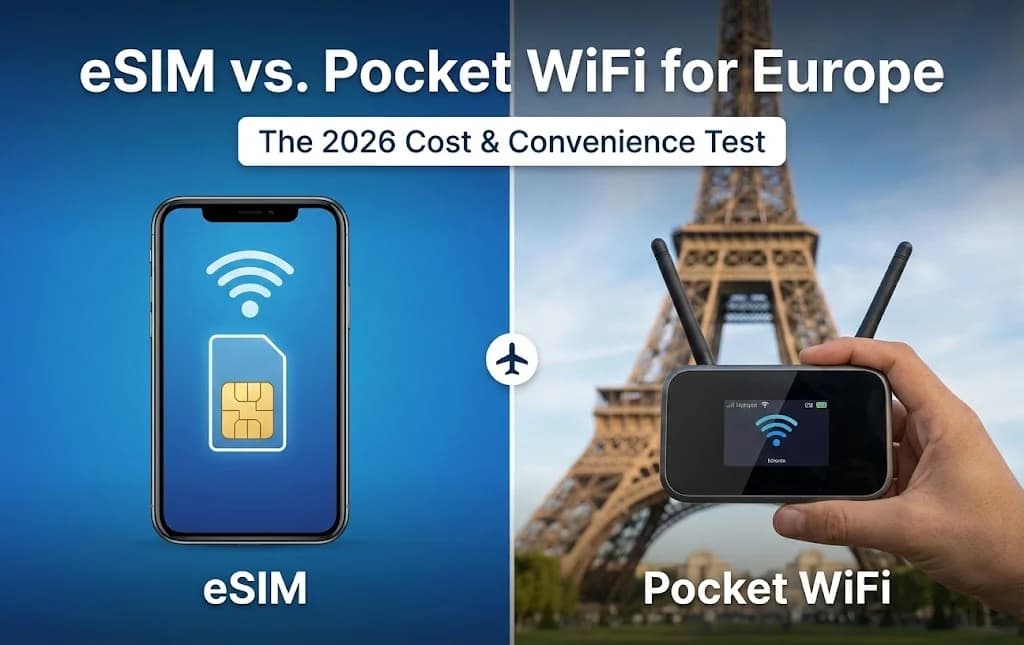
You’ve just landed at Paris Charles de Gaulle after a long flight. The excitement is real, but so is the immediate need for data. You need to pull up your hotel address, let family know you've arrived, and maybe check the RER train schedule. But first, you face a choice: join the lengthy queue for a physical SIM card, or try to find the kiosk where you pre-booked that portable WiFi hotspot. It’s a classic travel friction point. The decision you make right here will shape how you stay connected for your entire trip. This is the core of the eSIM vs pocket wifi Europe debate, and getting it right means saving money, time, and a whole lot of hassle. A Europe travel eSIM offers a modern solution, but how does it stack up against the traditional travel wifi Europe option? We’re about to break down the real-world costs, convenience factors, and performance to find the definitive answer for your 2026 European adventure.
- Quick Comparison: eSIM vs. Pocket WiFi at a Glance for Europe
- Deep Dive: The Modern Traveler's Choice - The Cellesim eSIM for Europe
- Deep Dive: The Traditional Option - Pocket WiFi for European Trips
- Network Coverage and Reliability Across European Destinations
- Estimating Your Data Needs for a European Adventure
- Seamless Connectivity: Activating Your Cellesim eSIM for Europe
- The 2026 Cost & Value Showdown: eSIM vs. Alternatives in Europe
- Maximising Your European Connectivity: Essential Pro Tips
- Frequently Asked Questions
Stay Connected Across Europe with Cellesim
Seamless data in 42 European countries. Get instant connectivity and forget about roaming fees. Join 50,000+ happy customers who trust Cellesim.
Explore Europe eSIM Plans 🇪🇺Quick Comparison: eSIM vs. Pocket WiFi at a Glance for Europe
Deciding between an eSIM and a Pocket WiFi device for your European travels in 2026 involves weighing several factors. Both offer alternatives to expensive traditional roaming, but they cater to different travel styles and priorities. Here's a brief overview to help clarify the fundamental differences:
| Feature | Cellesim eSIM | Pocket WiFi |
|---|---|---|
| Device Required | eSIM-compatible smartphone/tablet | Dedicated portable hotspot device |
| Convenience | Digital, instant activation, no extra device | Physical device to carry, charge, pick up/return |
| Cost (approx.) | From $4.50 (prepaid data plan) | $5-15/day rental + deposit + delivery/return fees |
| Activation | Scan QR code before you leave or on arrival | Charge device, connect via Wi-Fi password |
| Sharing | Tethering via smartphone (device-dependent) | Dedicated sharing for multiple devices |
| Coverage | Leverages local carrier networks (42+ countries in Europe) | Leverages local carrier networks, limited by device signal |
| Security | Uses your device's security protocols | Public Wi-Fi risks if unsecured; device-specific encryption |
Deep Dive: The Modern Traveler's Choice - The Cellesim eSIM for Europe
The eSIM (embedded SIM) represents a significant leap in mobile connectivity, especially for international travel. Instead of a physical chip, an eSIM is a digital profile downloaded directly to your phone. For Europe, this means you can purchase a Cellesim Europe eSIM plan before your departure, activate it upon arrival, and instantly connect to local networks in over 42 countries. This technology eliminates the need to swap physical SIM cards, queue at airport kiosks, or worry about losing a tiny piece of plastic.
The primary advantage of an eSIM is unparalleled convenience. You can manage your data plans from an app or website, switch between plans, and top up data without needing physical access to your phone's SIM tray. This is particularly beneficial for multi-country European tours, as a single regional eSIM plan can provide seamless coverage across borders. Your existing phone number remains active, allowing you to receive calls and texts on your primary line while using the eSIM for affordable data. This dual-SIM functionality is a game-changer for travelers needing to stay in touch with home while avoiding hefty roaming charges.
In terms of cost, eSIMs often present a more economical option. With Cellesim, you purchase a prepaid data package, giving you full control over your spending. There are no hidden fees, rental charges, or security deposits, which can quickly inflate the total cost of Pocket WiFi rentals. Data plans for Europe can start from as low as $4.50, offering flexibility for various trip durations and data needs.
Deep Dive: The Traditional Option - Pocket WiFi for European Trips
Pocket WiFi, also known as a mobile hotspot, is a small, portable device that creates a private Wi-Fi network wherever you are. It connects to local mobile networks and then broadcasts a Wi-Fi signal, allowing multiple devices (phones, laptops, tablets) to connect to the internet simultaneously. This has traditionally been a popular choice for families or business travelers who need to connect several gadgets.
The main draw of Pocket WiFi is its ability to share a single data connection among multiple users. If you are travelling as a group and plan to stay together consistently, a Pocket WiFi device can simplify connectivity, as everyone can connect to the same hotspot. However, this convenience comes with several trade-offs. You need to carry an additional device, ensure it's charged, and remember to pick it up and return it, often incurring delivery or airport collection fees. Battery life can also be a concern, requiring frequent recharging, especially with heavy usage or multiple connected devices.
From a cost perspective, Pocket WiFi devices typically involve daily rental fees, which can accumulate rapidly over longer trips. Many providers also require a security deposit, and there might be charges for exceeding data limits or for loss/damage to the device. While the per-person cost might seem lower for a large group sharing one device, the overall expenditure can often surpass that of individual eSIM plans, particularly if the group separates or if the device is not used constantly.
"For our family trip through Italy and France, we initially considered Pocket WiFi. But after calculating the rental fees, deposit, and the hassle of another device, individual Cellesim eSIMs were clearly the smarter choice. No charging, no returning, just seamless data."
Network Coverage and Reliability Across European Destinations
Reliable connectivity is paramount for a smooth European trip in 2026, whether you're navigating the streets of Rome, checking train schedules in Germany, or video-calling family from the French Riviera. Both eSIMs and Pocket WiFi devices rely on local mobile networks for their internet access. This means that the quality of your connection, peed, signal strength, and 4G/5G availability, will largely depend on the local network infrastructure in the specific country and region you are visiting.
Cellesim eSIMs partner with leading local network providers across Europe to ensure robust coverage. For instance, in France, Cellesim leverages networks like Orange and SFR; in Italy, it might be TIM or Vodafone. This allows eSIM users to access the same high-speed 4G and 5G networks that local residents enjoy. The advantage here is consistency: your phone, with its built-in antenna, is generally optimised for optimal signal reception. You can expect reliable service in urban areas and along major transportation routes, with performance comparable to what you would experience with a local physical SIM.
Pocket WiFi devices also connect to these local networks. However, their performance can sometimes be limited by the device's hardware, antenna quality, and signal processing capabilities. While many are designed to be efficient, they are still an additional layer between your phone and the network. Furthermore, carrying an extra device means another battery to manage, and if it loses charge, your entire group loses connectivity. Always check the specific Pocket WiFi provider's coverage map for your planned destinations, and be aware that rural or mountainous regions across Europe may have more limited coverage regardless of the technology used. For more information on Cellesim's network partners, visit our How Our Network Works page.
Estimating Your Data Needs for a European Adventure
One of the key elements of the "2026 Cost & Convenience Test" is understanding how much data you actually need. Overestimating leads to unnecessary spending, while underestimating leaves you scrambling for Wi-Fi. Your data usage in Europe will depend heavily on your travel style and activities.
- Light User (1-3 GB for 7 days): Primarily for navigation (Google Maps), occasional social media, checking emails, and messaging apps (WhatsApp). Ideal for travelers who rely on hotel/cafe Wi-Fi for heavy browsing.
- Moderate User (5-10 GB for 7 days): Includes all light user activities, plus streaming music, moderate video viewing (YouTube, TikTok), frequent social media updates, and some light work tasks. Good for active explorers who want reliable data throughout the day.
- Heavy User (15-30+ GB for 7 days): For those who stream high-definition video, make frequent video calls, upload large files, game online, or use their phone for tethering to a laptop. Essential for digital nomads or those who use their phone as their primary internet source.
Consider the types of applications you use daily. GPS navigation consumes less data than video streaming. For example, a single hour of Google Maps navigation might use around 5-10 MB, while an hour of Netflix can consume 1-3 GB. Messaging apps like WhatsApp use minimal data for text, but video calls can be data-intensive. Cellesim offers a Smart Data Calculator to help you estimate your exact needs.
Seamless Connectivity: Activating Your Cellesim eSIM for Europe
One of the major advantages of an eSIM is its straightforward activation process, significantly boosting the "convenience" factor for European travel in 2026. With Cellesim, you can set up your data plan in just a few minutes, often before you even leave home.
Here’s a simplified step-by-step guide to activating your Cellesim eSIM for Europe:
- Purchase Your Plan: Visit cellesim.com/en/esim-europe-42-countries and select a data plan that suits your European itinerary and data needs. Cellesim offers various packages ranging from a few gigabytes for short trips to larger allowances for extended stays.
- Receive QR Code: After purchase, you will immediately receive an email containing a QR code and detailed installation instructions.
- Scan and Install:
- On an iPhone: Go to Settings > Mobile Data > Add Data Plan. Scan the QR code. Follow the prompts to label your new eSIM (e.g., "Europe Travel").
- On an Android: Go to Settings > Network & Internet > SIMs > Add eSIM (or similar, depending on manufacturer). Scan the QR code and follow the setup wizard.
- Activate and Connect: Once in Europe, ensure your new eSIM is turned on and set as the preferred line for mobile data. You can keep your primary SIM active for calls and texts if your device supports dual-SIM. Your phone will automatically connect to a local partner network.
This process is entirely digital, meaning no physical handling of SIM cards and no hunting for local stores upon arrival. You can even activate your eSIM before you travel, giving you peace of mind that you'll have instant internet access as soon as your plane lands. This flexibility and ease of use are central to why eSIMs are becoming the preferred choice for savvy travelers.
The 2026 Cost & Value Showdown: eSIM vs. Alternatives in Europe
When planning your 2026 European trip, understanding the true cost of connectivity is vital. Beyond eSIM and Pocket WiFi, traditional roaming and local SIM cards remain options. Let's compare their financial implications and overall value.
Cost Comparison for a 10-Day European Trip (approximate 2026 figures, 10GB data)
| Option | Initial Cost | Daily Fee | Hidden Costs | Total for 10 Days | Convenience |
|---|---|---|---|---|---|
| Cellesim eSIM | From $20 (for 10GB) | None | None | ~$20-30 | Very High (Digital, instant) |
| Pocket WiFi Rental | $0-20 (delivery/pickup) | $5-15 | Deposit ($100+), late fees, damage fees | ~$70-170+ | Medium (Extra device, charge, return) |
| Carrier Roaming | None | $10-20 (daily pass) | Exorbitant per-MB rates if no pass | ~$100-200 | High (Automatic) but very expensive |
| Local Physical SIM | $10-20 (SIM + data) | None | Time to find store, activate, language barrier | ~$10-30 | Low (Requires local purchase, registration) |
As the table illustrates, traditional roaming remains the most expensive option, often incurring daily charges that quickly inflate your bill. While a local physical SIM can be affordable, the "convenience test" often reveals its drawbacks: time spent locating a store, potential language barriers, and the need to swap out your primary SIM. Pocket WiFi, while offering sharing capabilities, adds the burden of an extra device and layers of rental costs and potential penalties.
Cellesim eSIMs are prepaid, meaning you pay for your data upfront and there are no surprises. This transparency, combined with competitive data rates for a wide range of European countries, positions eSIMs as the frontrunner for value in the 2026 travel landscape. You can use our Roaming Savings Calculator to see how much you could save.
Maximising Your European Connectivity: Essential Pro Tips
Regardless of whether you choose an eSIM or Pocket WiFi, a few smart practices can enhance your connectivity experience in Europe:
- Download Offline Maps: Before venturing out, download maps of your destinations using apps like Google Maps or Maps.me. This saves data and ensures navigation even if you lose signal.
- Leverage Free Wi-Fi: Many European cafes, restaurants, hotels, and public spaces offer free Wi-Fi. Use these opportunities for heavy data usage (e.g., uploading photos, streaming video) to conserve your eSIM or Pocket WiFi data.
- Monitor Data Usage: Regularly check your data consumption. Cellesim makes this easy through your account dashboard. For Pocket WiFi, check the device's display or companion app.
- Secure Public Wi-Fi: If using public Wi-Fi, be cautious. Avoid accessing sensitive information like banking details. Consider using a Virtual Private Network (VPN) for added security. For more on staying safe, refer to this FTC guide on public Wi-Fi security.
- Power Banks are Your Friend: Both your phone (especially with tethering) and a Pocket WiFi device can drain batteries quickly. A portable power bank is an indispensable travel accessory.
- Understand Fair Usage Policies: Some "unlimited" plans may have fair usage policies that throttle speeds after a certain amount of data. Always read the fine print. You can learn more about unlimited data claims in our article The Truth About Unlimited eSIM Data.
Ready for Seamless Connectivity in Europe?
Choose Cellesim for instant data in over 42 European countries. No hidden fees, no extra devices, just easy and affordable connectivity for your 2026 adventure.
Start Your Connected JourneyTrusted by 50,000+ travelers worldwide. Available in 24 languages. 24/7 Support: [email protected]
Frequently Asked Questions
Is eSIM better than Pocket WiFi for Europe?
For most individual travelers, couples, or small groups who prefer minimal hassle, an eSIM is generally superior due to its cost-effectiveness, convenience (no extra device to carry), and instant digital activation. Pocket WiFi can be better for very large groups (4+) who consistently stay together and require a dedicated shared connection.
Can I use my regular phone number with an eSIM in Europe?
Yes, if your phone supports dual-SIM functionality (which most eSIM-compatible phones do), you can keep your home SIM active for calls and texts while using the Cellesim eSIM for all your data needs. This allows you to receive important communications without incurring expensive roaming data charges.
What happens if I run out of data on my Cellesim eSIM while in Europe?
If you deplete your data allowance, your connectivity will pause. You can easily top up your Cellesim eSIM plan directly through your account on cellesim.com or by purchasing another data package from the website, allowing you to get back online within minutes.
Are there any hidden costs with Cellesim eSIMs for Europe?
Cellesim offers transparent, prepaid plans for Europe. The price you see for your data package is the final price you pay. There are no daily rental fees, security deposits, insurance costs, or unexpected charges like those often associated with pocket WiFi rentals or traditional roaming.
Which European countries are covered by a Cellesim Europe eSIM?
Cellesim's regional Europe eSIM plans cover over 42 countries, including major destinations like France, Germany, Italy, Spain, the UK, and many more. Our plans are designed for seamless travel across the continent, allowing you to move between countries without losing connectivity. You can find the full list of supported countries on our Europe eSIM page.
Is a Pocket WiFi device more secure than an eSIM for European travel?
Both options can be secure. An eSIM uses your phone's inherent security features and connects directly to local carrier networks. Pocket WiFi creates a private Wi-Fi network which can be secured with a password. However, public Wi-Fi , often relied upon by Pocket WiFi users when outside their rental data , can pose security risks if not properly encrypted or if a VPN is not used. An eSIM on your personal device generally offers a more integrated and often more secure connection.