
Holafly vs Cellesim: The Raw Numbers for 2026
Let's get straight to it. My travel budget doesn't care about fancy marketing. When I'm planning a trip, the first thing I check is the price and exactly how much data I'm getting for my money. My last two-week trip through Portugal and Spain cost me a total of €28 on data with Cellesim. That covered about 14GB, which works out to roughly 1GB a day. That's more than enough for maps, booking hostels, and those essential WhatsApp calls back home. Holafly, for the same 14-day European trip, would have cost me closer to €47 for their "unlimited" plan.
Here's the real talk: Holafly often champions itself as having unlimited data, and for some heavy users, that might be accurate. But those prices reflect a premium. Cellesim, conversely, sells data packages with clear GB limits, usually at a lower per-GB cost. You really need to know your data usage. If you're like me, using around 0.8GB to 1.2GB a day for navigation, social media, and communication, paying for "unlimited" data you won't use is just wasting money. It's like that time I paid an extra €15 for an "unlimited" metro pass in Rome only to use it twice. Same idea here.
| Feature | Holafly (Europe) | Cellesim (Europe) |
|---|---|---|
| Data Packages | Often 'Unlimited' (with fair usage policy) | Fixed GB packages (e.g., 5GB, 10GB, 20GB) |
| Price (15 Days) | €47-€59 for 'Unlimited' | €22-€38 for 10GB-20GB |
| Calling/SMS | No calls/SMS, but includes +34 local number in some plans | Data-only, use VoIP apps (WhatsApp, Signal) |
| Top-ups | Not generally available for 'unlimited' plans, new eSIM needed | Easy in-app top-ups available |
| Connectivity | Partners with major local networks | Partners with major local networks |
The Per-GB Cost Breakdown: Where Your Money Really Goes
Let's do some more math. Imagine a 15-day trip to Germany. Holafly's "unlimited" plan for Europe could cost you €47. If you end up using, say, 15GB over those two weeks, your effective cost per GB is around €3.13. With Cellesim, a 15GB plan for 15 days in Europe might be €28. That brings your cost per GB down to about €1.87. That's a huge difference when you're trying to save every cent.
This isn't just theory. Last year in Japan, I tracked my data meticulously. For a 10-day trip, I used about 8GB, mostly for Google Maps, translation apps, and Instagram stories of street food. Holafly's unlimited option for Japan was €37. Cellesim offered 10GB for €20. The numbers speak for themselves: if you can estimate your data usage, Cellesim offers better value. I even wrote a whole post comparing Airalo eSIM for Japan vs Cellesim: Value, Coverage & Connectivity 2024, if you want more details on the Asian market.
Understanding the 'Unlimited' Data Trap
"Unlimited data." It sounds perfect for a digital nomad, doesn't it? No worries about running out, endless streaming, video calls home. But here's the catch: most "unlimited" plans, including Holafly's, come with a Fair Usage Policy (FUP). This isn't a secret clause, but it's often buried in the fine print. It means your speeds can be throttled after you hit a certain data cap. While it's usually a pretty high cap, often 50GB, it's not truly "unlimited" like your home internet might be.

I learned this the hard way trying to upload a huge video file from a tiny hostel in Bangkok. My "unlimited" data plan (not Holafly, but a similar local one) slowed to a crawl after about 30GB. I had to find a cafe with decent WiFi, which isn't always easy when you're on a tight schedule. Cellesim, by offering fixed data packages, is upfront about what you're getting. No surprises, no throttling until you've actually used up your allowance. You can always top up if you need more, which is a lifesaver.
Data Consumption: Show Me the Math
How much data do you actually need? That's the million-dollar question, or more accurately, the €20 question. Here's a rough guide I use:
- Light user (email, maps, WhatsApp text): 0.3-0.5 GB/day
- Medium user (add social media, some light browsing): 0.8-1.2 GB/day
- Heavy user (streaming, video calls, large uploads): 2+ GB/day
Let's say you're taking a 20-day trip to Southeast Asia. If you're a medium user, you're looking at roughly 1 GB/day x 20 days = 20 GB total. With Cellesim, you can buy a 20GB plan for around €35. Holafly's "unlimited" for the same region might be €70. You're paying double for data you won't even touch, and potentially getting throttled anyway. For me, it's an easy decision.
Coverage and Network Partners: Who Gets You Online, Where?
This is one area where Holafly and Cellesim are pretty much neck and neck, which is great news for us backpackers. Both providers use local networks, meaning they don't build their own infrastructure. They're essentially reselling access to the major carriers in each country. In Europe, you're typically connecting to networks like Vodafone, Orange, Telefónica, or Deutsche Telekom. In Japan, you'd likely be on SoftBank or NTT Docomo. This is important because it means you're getting the same signal quality as someone with a local SIM card.
However, it's always smart to check the specific carriers listed for your destination. Some eSIM providers might partner with a secondary network that has slightly less coverage in rural areas. Always check their website for detailed coverage maps before you buy. I once bought an eSIM for a trip to Bosnia and Herzegovina, and while it worked fine in Sarajevo and Mostar, as soon as I headed into the mountains for some hiking, I was offline. Turns out the eSIM only connected to M:tel, which had weaker rural coverage than BH Telecom.
| Provider | Network Partners (Example) | Coverage Strength | Multi-Country Support |
|---|---|---|---|
| Holafly | Vodafone, Orange, Telefónica, T-Mobile | Excellent in urban areas, good in rural | Yes (Regional plans) |
| Cellesim | Vodafone, Orange, Telefónica, Deutsche Telekom | Excellent in urban areas, good in rural | Yes (Regional and Global plans) |
Border-Crossing Edge Cases and Connectivity
Ah, border crossings. The pain point for many budget travelers. I've definitely had my share of data dropouts at customs checkpoints, especially when moving between a non-EU country and an EU one, or vice-versa. Think crossing from Serbia into Hungary, or from Morocco into Spain. This is where a good regional eSIM truly shines. Both Holafly and Cellesim offer regional plans (like "Europe" or "Asia"), which means your data should smoothly switch over as you cross borders. This is a huge advantage over buying separate local SIMs for each country.
I remember taking the night bus from Belgrade to Budapest. As we neared the Hungarian border, my Serbian SIM died. But my Cellesim EU plan automatically connected to the Hungarian network without any trouble. If you're doing a multi-country trip, this smooth transition is incredibly valuable. No fumbling with new SIMs at 2 AM in a dark bus station. For those who frequently travel across regions, checking out options like the T-Mobile Free eSIM Trial 2026: A Backpacker's Brutally Honest Review might give you another angle on multi-country roaming, though those often come with their own quirks.
Activation and Ease of Use: No Time for Tech Headaches on the Road
After a 12-hour flight, when all you want to do is find your hostel, the last thing you need is a complicated eSIM activation. Both Holafly and Cellesim make activation pretty straightforward, using QR codes or manual entry. Typically, you buy the eSIM online, get a QR code via email, scan it with your phone, and follow a few steps. It usually takes about 5 minutes, tops.
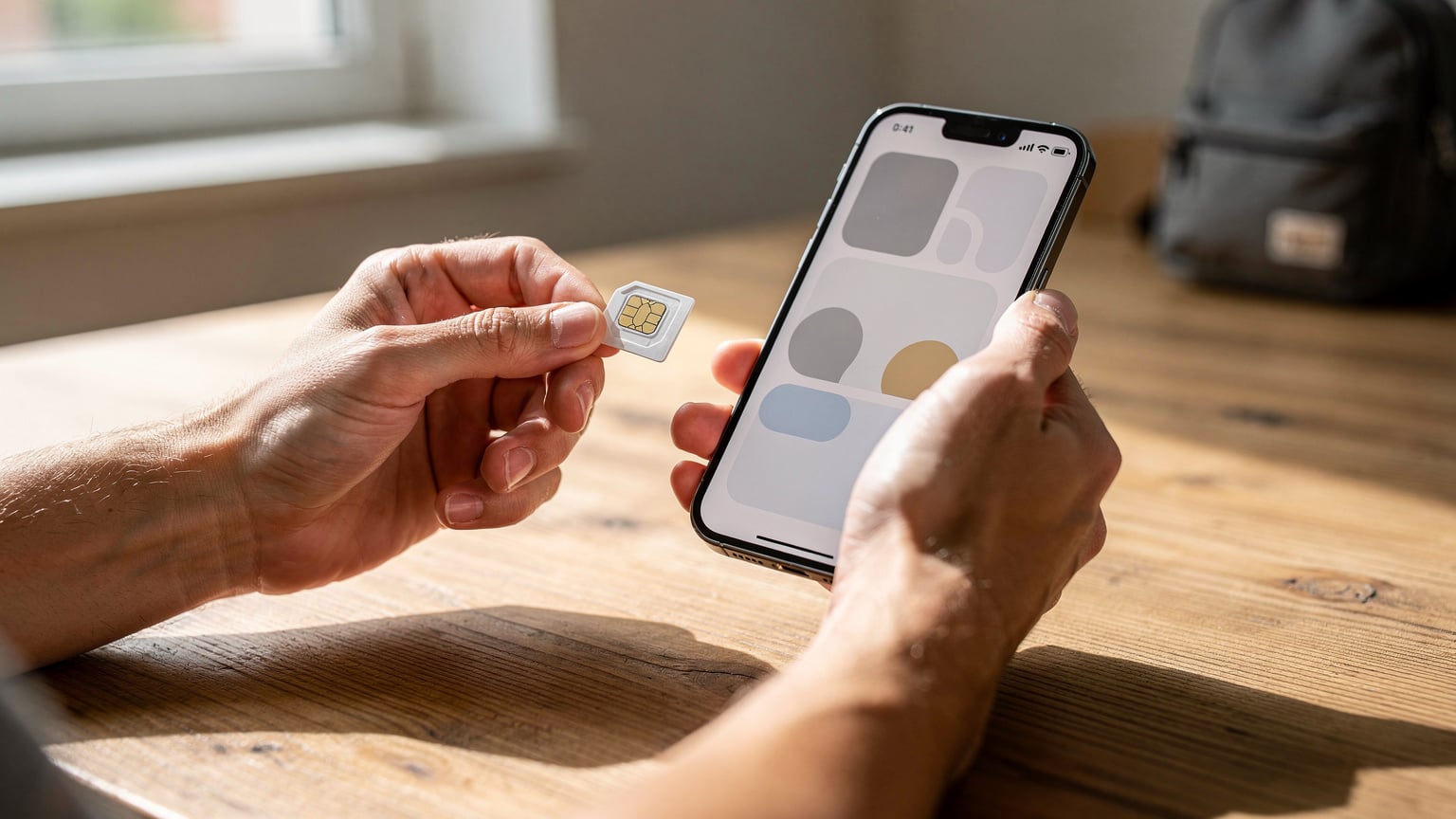
My advice? Always activate your eSIM before you leave your home country, or at least while you have a stable WiFi connection. Trying to fix connectivity problems on shaky airport WiFi in a foreign language is a recipe for disaster. I once watched a guy at Athens airport nearly throw his phone across the terminal trying to activate a local SIM he bought from a kiosk, only to discover his phone was locked. eSIMs avoid that physical hassle entirely.
The iPhone 15 Factor: All eSIM, All the Time
If you're using an iPhone 15 eSIM Activation: Your Family Travel Connectivity Playbook 2024, you already know your phone is eSIM-only. This simplifies your choice: no physical SIM tray means no local physical SIM cards. You're completely dependent on eSIMs for international data. Both Holafly and Cellesim are fully compatible with eSIM-only devices, so you won't have any issues there. The process is the same: scan the QR, set up the cellular plan, and you're good to go.
- Purchase Your eSIM: Go to the Cellesim website or app, pick your destination/region and data package. Finish the purchase.
- Receive QR Code: You'll get an email with a QR code and clear instructions. Keep this handy, maybe by taking a screenshot or printing it if you prefer.
- Scan QR Code: On your iPhone (or Android), go to Settings > Cellular/Mobile Data > Add eSIM or Add Data Plan. Scan the QR code.
- Configure Settings: Follow the on-screen prompts to name your new eSIM, make it your primary data line (if needed), and ensure data roaming is enabled for the eSIM.
- Activate & Connect: Once you land, turn off your primary SIM's data roaming (if you have one) and make sure the Cellesim eSIM is active. You should connect to the local network automatically.
Customer Support: When Things Go South at 3 AM
People often overlook this until they're in a tough spot. I can't count how many times I've needed help with a connection issue at an absurd hour, usually because of a time zone change or a red-eye flight. Good customer support isn't just a bonus, it's crucial. Holafly boasts 24/7 support, often through WhatsApp, which is a huge plus when you're abroad. Cellesim also offers solid customer support, typically via their app or email, with quick response times.
My experience? Holafly's WhatsApp support is genuinely fast. I once had a problem where my data wasn't connecting in Colombia, and they walked me through APN settings in minutes. Cellesim's support, while not always on WhatsApp, is also very responsive and helpful. The main thing is that both are available when you actually need them, not just during business hours in one time zone. This is a massive advantage over trying to call a local carrier's helpline in a language you don't speak.

The Local SIM Card Alternative: Don't Forget the Fallback
Okay, let's be fair. eSIMs are convenient, but they're not always the absolute cheapest choice, especially if you're staying in one country for a long time. For example, if you're spending a month in Thailand, you can walk into any 7-Eleven or airport kiosk and grab a local DTAC or AIS SIM card for incredibly cheap. A 30-day, 15GB plan might cost you 300 THB, which is about €8. No eSIM can beat that price. But then you have to find a store, deal with activation, show your passport, and potentially lose your home SIM if your phone only has one slot.
For short trips, multi-country travel, or if you simply value convenience and not having to swap physical cards, eSIMs like Holafly and Cellesim clearly win. But for a true budget backpacker, knowing about the local physical SIM option is vital. I've done it many times, especially for trips longer than a month in a single country. It's a trade-off: save a few euros, but spend an hour or two on logistics. For example, in Turkey, getting a local Turkcell SIM at the airport for a month can be cheaper per GB than any eSIM, but you'll spend valuable time at the airport counter. For a quick hop over to Istanbul, an eSIM for Turkey is definitely the way to go.
The Cost of Convenience: Weighing Your Options
This is where your travel style comes into play. If you're backpacking like I do, constantly moving, crossing borders every few days, then an eSIM is a no-brainer. The convenience of consistent connectivity across multiple countries far outweighs the slight potential savings of a local SIM in each country. I'd happily pay an extra €5-€10 for an eSIM if it means I don't have to search for a SIM card vendor in a new city every three days.
However, if your trip involves staying in one place for a month, say volunteering in Vietnam, then a local physical SIM is probably your best bet for raw cost efficiency. Always do the math for your specific trip. Don't just assume an eSIM is always cheaper, or always more expensive. It's about knowing your needs, your itinerary, and being smart about it.
My Personal Recommendation for Budget Backpackers
Alright, after years on the road, testing countless eSIMs and local SIMs, here's my honest opinion for my fellow budget backpackers: Cellesim is generally the better choice for value-conscious travelers in 2026.
Why Cellesim? It boils down to two things: straightforward pricing and flexible data plans. I don't need "unlimited" data if it means paying more and possibly getting throttled anyway. I need a clear data allowance at a competitive per-GB rate, with the option to easily top up if I suddenly go viral with a video of a street cat. Cellesim delivers on that. The ability to track your usage and top up without buying a whole new eSIM is also a huge benefit. Holafly is a solid choice if you genuinely use a lot of data, or if you simply want the comfort of "unlimited" without checking your usage. But for most of us, that comfort comes with a higher price tag for data we won't fully use.
Ultimately, both are good options. The "best" one is the one that fits your specific travel style and budget. But if you're watching every euro like I am, Cellesim often gives you a more strategic advantage.
FAQ: Your eSIM Questions Answered
A: Both Holafly and Cellesim are mainly data-only eSIMs. This means you'll use your usual messaging apps like WhatsApp or Signal for communication, running on the eSIM's data connection. Holafly does offer some plans with a local phone number for incoming calls and texts, especially in Europe, which is a nice extra if you absolutely need it. For more details, check our comprehensive eSIM FAQ.
A: In my experience, no, not noticeably. Modern phones are built to handle eSIMs efficiently. Any battery drain you might see is usually from heavy data usage (streaming, GPS navigation) or your phone trying to find a signal in remote areas, not the eSIM technology itself. Always keep a power bank handy.
A: eSIM compatibility depends on your phone's hardware. Most flagship phones released since 2018-2019 support eSIMs, including iPhone XS/XR and newer, Samsung Galaxy S20 and newer, and Google Pixel 3 and newer. Always check your specific phone model's specifications before buying an eSIM. If you're not sure, look up your phone manufacturer's website.
A: First, make sure data roaming is turned on for the eSIM profile in your phone's settings. Sometimes, simply restarting your phone can fix connection issues. If problems continue, check your APN settings against what your provider recommends, and contact customer support right away. Both Holafly and Cellesim have support teams ready to help troubleshoot.
A: Yes, absolutely! This is one of the biggest benefits of eSIMs. You can have both your home physical SIM and your travel eSIM active at the same time. You can choose which line to use for calls, texts, and data, letting you receive calls on your home number while using the eSIM for affordable data. Just be careful to turn off data roaming on your home SIM to avoid huge charges.
Frequently Asked Questions
Can I use my regular phone number for calls and texts with Holafly or Cellesim?
Both Holafly and Cellesim are primarily data-only eSIMs. This means you'll use your regular messaging apps like WhatsApp or Signal for communication, leveraging the eSIM's data connection. Holafly does offer some plans with a local phone number for incoming calls and texts, primarily in Europe, which is a nice add-on if you absolutely need it. For more details, check our comprehensive eSIM FAQ.
Will an eSIM drain my phone's battery faster than a physical SIM?
In my experience, no, not noticeably. Modern phones are designed to handle eSIMs efficiently. Any battery drain you might observe is usually due to heavy data usage (streaming, GPS navigation) or searching for signal in remote areas, not the eSIM technology itself. Keep a power bank handy, as always.
Can I use an eSIM on an older phone model?
eSIM compatibility depends on your phone's hardware. Most flagship phones released since 2018-2019 support eSIMs, including iPhone XS/XR and newer, Samsung Galaxy S20 and newer, and Google Pixel 3 and newer. Always check your specific phone model's specifications before purchasing an eSIM. If you're unsure, consult your phone manufacturer's website.
What if my eSIM doesn't activate or connect?
First, ensure data roaming is enabled for the eSIM profile in your phone's settings. Sometimes, a quick restart of your phone can resolve connection issues. If problems persist, check your APN settings against what your provider recommends, and contact customer support immediately. Both Holafly and Cellesim have support teams available to help troubleshoot.
Can I keep my home physical SIM card active while using an eSIM?
Yes, absolutely! This is one of the biggest advantages of eSIMs. You can have both your home physical SIM and your travel eSIM active simultaneously. You can choose which line to use for calls, texts, and data, allowing you to receive calls on your home number while using the eSIM for affordable data. Just be careful to disable data roaming on your home SIM to avoid exorbitant charges.