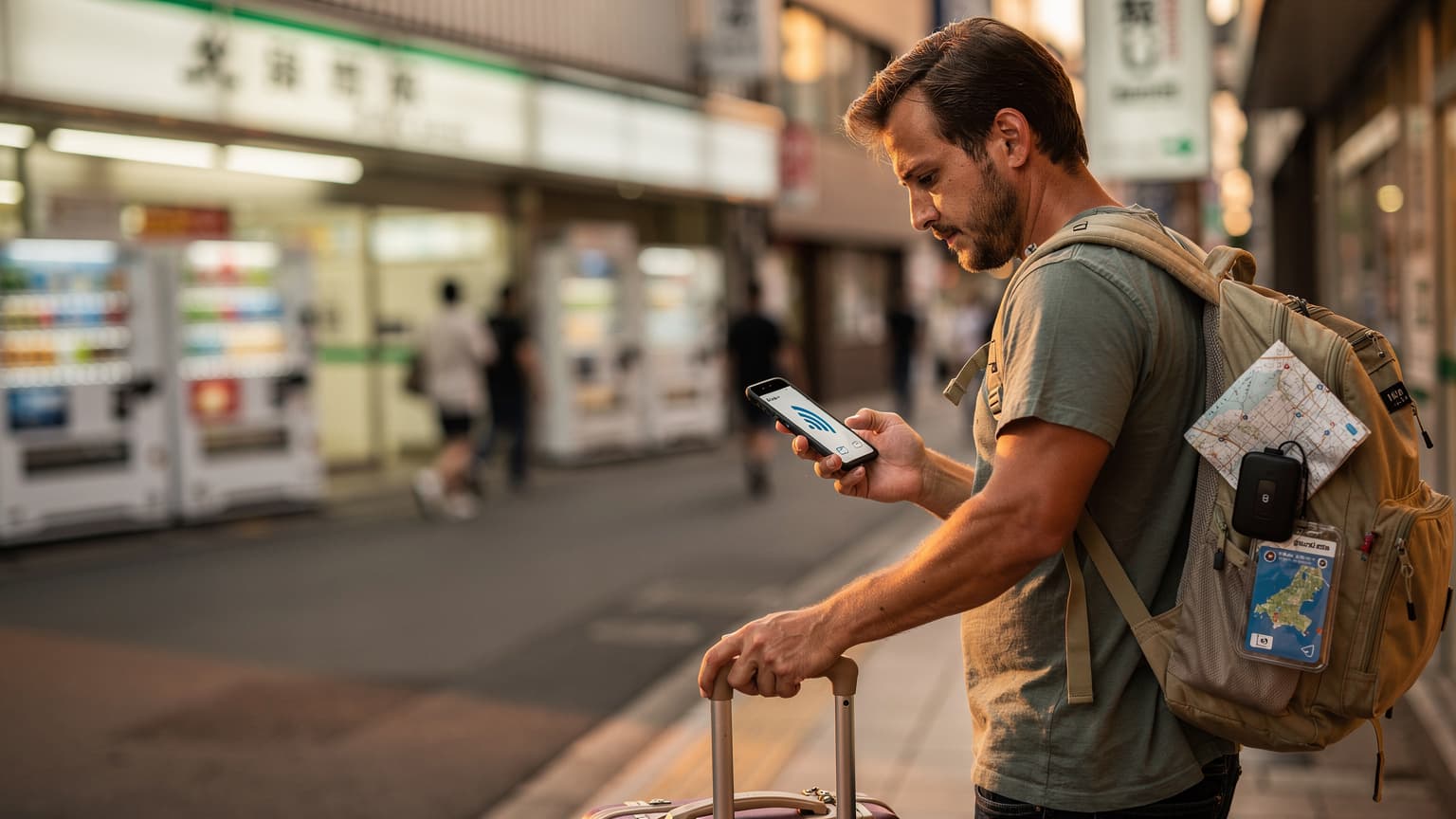
For a typical 8-day trip to Japan in 2026, a Cellesim JP eSIM is absolutely worth it for most tourists, offering a balance of cost, convenience, and reliable connectivity. Expect to spend around ¥3,900 for sufficient data, beating the hassle and often higher costs of physical SIMs or pocket Wi-Fi, especially if you're keen on seamless, instant connection upon arrival.
Japan Connectivity: The Budget Backpacker's Dilemma
Alright, fellow penny-pinchers, let's talk Japan. You've booked your hostel in Taito, scoped out the cheapest Shinkansen routes, and now you're staring down the barrel of data costs. Japan isn't a cheap destination, and every yen counts. For my last 8-day run through Tokyo and Kyoto, I tracked my data spending religiously, coming in at a grand total of ¥3,900 (about $26 USD) for connectivity. That's for about 20GB of data, give or take. The goal, as always, is to get reliable internet without blowing your ramen budget.
Forget traditional roaming, that's a sucker's game unless you enjoy paying €10/MB. We're talking about smart solutions here: eSIMs, local physical SIMs, or those clunky pocket Wi-Fi devices. Each has its pros and cons, but when you're trying to keep your daily spend under €40, efficiency is key.
The Pain Points of Being Unconnected in Japan
Imagine this: you've just landed at Narita, sleep-deprived, and you need to figure out the cheapest way to your hostel in Asakusa. Google Maps is your lifeline, but without data, you're fumbling with paper maps (remember those?) or desperately searching for scarce airport Wi-Fi. It's not just about navigation, it's about translating menus, checking train schedules on HyperDia, finding the best street food stalls, and keeping in touch with home. In Japan, where English isn't as universally spoken as in, say, Bangkok, reliable data is a necessity, not a luxury.
Comparing Your Options: eSIMs vs. the Rest
When it comes to staying connected in Japan, you've got three main players to consider. Each option has its own price tag, convenience factor, and quirks that can either save you money or drain your wallet.
| Option | Pros | Cons | Typical Cost (8 days, 20GB) |
|---|---|---|---|
| Cellesim JP eSIM | Instant activation, keep primary SIM, no physical swap, good rates, flexible plans | Requires eSIM-compatible phone, can't top up with local cash | ¥3,500 - ¥4,500 |
| Local Physical SIM (e.g., Mobal, B-mobile) | Potentially cheaper for long stays, local support, can top up in convenience stores | Hassle of finding/buying/activating, often requires Japanese address/ID, phone locked to carrier, lose primary SIM | ¥3,000 - ¥5,000 (often higher upfront) |
| Pocket Wi-Fi Rental | Shareable with multiple devices/people, reliable speeds | Another device to carry/charge, pick-up/drop-off hassle, easy to lose, daily rental fees add up | ¥5,000 - ¥8,000 |
| International Roaming | Convenient, instantly active | Extremely expensive, can quickly lead to bill shock | ¥10,000+ (easily) |
The Pocket Wi-Fi Trap
Many travelers, especially those in groups, consider pocket Wi-Fi. On the surface, it seems appealing: everyone shares one device, one bill. But here's the reality: it's another gadget to keep charged, another thing to worry about losing (especially after a few sake bombs in Shinjuku Golden Gai), and the daily rental fees really stack up. Plus, if you get separated from your group, you're suddenly without internet. For a solo budget traveler, or even a couple, it's almost always a more expensive and less convenient option than an eSIM or a local SIM.
Cellesim JP eSIM: The Nitty-Gritty on Cost and Value
Let's cut to the chase: how much does a Cellesim JP eSIM actually cost, and what do you get for your money? The pricing is usually tiered based on duration and data allowance. For Japan, you're typically looking at plans that range from 7 days to 30 days, with data packages from 5GB to unlimited.
For my 8-day trip, a 20GB Cellesim plan would have run me about ¥3,900. This is pretty competitive, especially when you factor in the convenience. No hunting for a SIM card at the airport, no language barriers, just scan a QR code and you're good to go. The value isn't just in the yen saved, but in the time and stress avoided.
Breaking Down a Typical Cellesim JP Plan
- Duration: Most Cellesim plans for Japan offer flexibility, from short trips (7-10 days) to longer stays (15-30 days). Choose wisely based on your itinerary, because unused days are wasted yen.
- Data Allowance: This is where you need to be honest with yourself. Are you a heavy streamer, or just need maps and WhatsApp? For the average tourist, 1-2GB per day is usually sufficient. A 10GB plan for 7 days might cost around ¥2,500, while a 20GB for 15 days could be ¥4,500.
- Cost per GB: Do the math! Divide the total plan cost by the GB. This helps you compare apples to apples. Cellesim usually comes in at around ¥200-¥300 per GB for popular plans, which is a solid rate.
- Activation: The beauty of an eSIM is instant activation. You usually get an email with a QR code, scan it, and you're online. No fiddling with paper clips or tiny plastic cards.
How Much Data Do You Really Need in Japan? Show the Math
This is crucial for any budget traveler. Overestimating your data needs means you're throwing money away. Underestimating means you're stuck without maps in the middle of a Kyoto alley. Based on my travels, here's a realistic breakdown for a typical tourist:
- Mapping & Navigation (Google Maps, Apple Maps): 100-200MB/day. You're constantly looking up directions, train lines (especially the Yamanote Line in Tokyo), and local spots.
- Messaging (WhatsApp, Line, iMessage): 50-100MB/day. Staying in touch with family, coordinating with travel buddies.
- Social Media (Instagram, Facebook, TikTok): 300-500MB/day. Let's be real, you're posting those epic ramen shots and Shibuya crossing boomerangs.
- Browsing & Research (TripAdvisor, blogs, translations): 200-300MB/day. Finding the best izakaya, translating kanji on menus.
- Occasional Streaming (YouTube, Netflix on trains): 500MB-1GB/day. If you're unwinding on a long train ride or in your hostel.
Total Daily Usage Estimate: 1.2GB - 2GB per day.
So, for an 8-day trip, you're looking at roughly 9.6GB to 16GB. A 15GB or 20GB plan for 8 days is a safe bet. My 20GB plan for ¥3,900 broke down to roughly 2.5GB/day, costing me about ¥195 per GB. That's a solid deal for uninterrupted connectivity.
Coverage and Speed: Where Does Cellesim Stand?
Cellesim typically partners with major local carriers, usually NTT Docomo or SoftBank in Japan. This is good news because these networks offer some of the best coverage and speeds globally. You'll get 4G LTE speeds almost everywhere, with 5G slowly rolling out in major urban centers. I've personally used these networks extensively, from the bustling streets of Osaka to the quieter temple grounds of Nara, and rarely experienced a drop in signal.
Real-World Performance in Japan
During my last trip, the data speeds were consistently excellent. I could easily stream videos on the Shinkansen, make crystal-clear Zoom calls from a Kyoto cafe, and upload high-res photos to my blog without a hitch. The only places you might experience a dip are deep underground subway tunnels (though many major stations have Wi-Fi) or extremely remote mountainous areas. For 99% of tourist itineraries, Cellesim's network partners deliver.
| Carrier Partner (Cellesim) | Primary Network | Coverage (Major Cities) | Typical Speed (Download) |
|---|---|---|---|
| NTT Docomo / SoftBank | 4G LTE (with 5G in urban areas) | Excellent (99%+) | 50-150 Mbps (4G), 200-500 Mbps (5G) |
| AU (sometimes) | 4G LTE (with 5G in urban areas) | Very Good (98%+) | 40-100 Mbps (4G), 150-400 Mbps (5G) |
The Physical SIM Alternative: What Are You Giving Up?
For the truly dedicated budget traveler, a physical SIM card can sometimes, *sometimes*, be slightly cheaper for longer stays, but it comes with a stack of compromises. The cheapest local physical SIMs for tourists often come from providers like Mobal or B-mobile, available at airports or electronics stores like Yodobashi Camera or Bic Camera. A 30-day, 10GB Mobal SIM might cost around ¥4,000-¥5,000.
But consider the friction: you land, you're tired, and now you have to find a store, potentially queue, fill out paperwork (sometimes requiring your passport and a hotel address), and hope the staff speak enough English to help you activate it. Then you have to swap out your home SIM, which means you lose access to calls and texts to your home number. For a short trip, this hassle usually isn't worth saving a few hundred yen.
The Airport SIM Card Hunt, A Time Drain
I've done it. Landed at Kansai International, tired, and spent 45 minutes trying to find the right counter for a prepaid data SIM. Then another 15 minutes fumbling with the tiny SIM tray. That's an hour of my precious travel time gone, an hour I could have spent on the Nankai Rapid Express heading towards Osaka Namba, already planning my first meal. For me, time is money, and an eSIM wins hands down on that front.
Border-Crossing Tactics and eSIM Activation
The beauty of an eSIM is its seamless nature, especially during border crossings. There's no physical item to buy or install, which means no last-minute airport scramble. This is particularly useful if you're doing a multi-country trip, perhaps flying into Japan from Canada or the USA, where different roaming fees apply. You activate your Cellesim JP eSIM before you even leave home, or while you're waiting for your baggage at Narita.
A Step-by-Step Guide to Activating Your Cellesim JP eSIM
This is where Cellesim truly shines for convenience. You can do this at home, or even on the plane if you have Wi-Fi. It takes literally minutes.
- Purchase Your Plan: Go to the Cellesim website (or the Japan eSIM page specifically) and choose your data and duration. For my 8-day trip, a 15GB or 20GB plan is my go-to.
- Receive Your QR Code: Cellesim will email you a QR code (and manual details if needed). Keep this accessible, perhaps as a screenshot on another device or printed out.
- Add eSIM to Your Phone:
- For iOS (iPhone): Go to Settings > Cellular (or Mobile Data) > Add eSIM. Choose 'Use QR Code' and scan the code. Follow the prompts.
- For Android: Go to Settings > Network & internet > SIMs > Add eSIM (or similar, depending on your phone's model). Scan the QR code.
- Label Your eSIM: Name your new eSIM plan something like "Cellesim Japan" to easily distinguish it from your primary SIM.
- Set Data Roaming & Default Line: Before landing, switch your primary SIM to 'off' for data and set 'Cellesim Japan' as your data line. Make sure data roaming is enabled for the Cellesim eSIM (don't worry, this is for *their* network, not expensive international roaming).
- Arrive & Connect: As soon as your plane touches down at Narita or Haneda, your phone should connect to the local network automatically. No fuss, no waiting.
Troubleshooting Common eSIM Issues
Even with eSIMs, sometimes things go sideways. Here are a couple of quick fixes:
- No Connection After Landing? Double-check that your Cellesim eSIM is selected as the primary data line and that data roaming is enabled for it. Sometimes, a quick restart of your phone can also kickstart the connection.
- Can't Scan QR Code? If you're trying to scan from the same phone you're activating on, that won't work. Either use another device to display the QR code, or manually enter the details provided in your Cellesim email.
The Final Verdict: Is a Cellesim JP eSIM Worth Your Yen?
For the budget-conscious traveler heading to Japan in 2026, a Cellesim JP eSIM is a smart move. It consistently offers a better blend of cost, convenience, and reliable performance than almost any other option. You avoid the stress of hunting for a physical SIM, you keep your home number active for important calls, and you get instant connectivity upon arrival.
While a local physical SIM from a provider like Mobal might save you a tiny bit of yen on a very long trip (say, over a month), the time and hassle factor usually outweigh those minimal savings. And pocket Wi-Fi? Only if you're a large group needing to share, and even then, consider the charging and carrying burden.
My recommendation? Do the math for your specific trip length and data needs. If you're in Japan for anything less than 3-4 weeks, the Cellesim JP eSIM is almost certainly your best bet for staying connected without breaking the bank. It means more time exploring Tokyo's hidden ramen joints and less time troubleshooting your internet connection. That's a win in my book.
Frequently Asked Questions
How much data do I need for a week in Japan?
For a typical 7-day trip to Japan, you'll likely need 10-15GB of data. This covers daily navigation, social media updates, messaging, and occasional streaming on trains. Heavy users might opt for 20GB to be safe.
Can I use my Cellesim JP eSIM for calls and texts?
Cellesim JP eSIMs are primarily data-only. You can use apps like WhatsApp, Line, or FaceTime for calls and messages over data. To receive calls/texts to your home number, keep your primary SIM active for calls only and disable its data roaming.
Is an eSIM faster than pocket Wi-Fi in Japan?
Generally, an eSIM on a major network like NTT Docomo or SoftBank will offer comparable, if not faster, speeds than most pocket Wi-Fi devices. eSIMs connect directly to the cellular network, whereas pocket Wi-Fi adds another layer of hardware that can sometimes limit performance.
What's the cheapest way to get data in Japan?
For short to medium trips (up to 3 weeks), a Cellesim JP eSIM offers the best balance of cost and convenience, often costing around ¥3,500-¥4,500 for sufficient data. For very long stays, a local physical SIM from a budget provider might be marginally cheaper, but involves more setup hassle.
Can I buy a Cellesim JP eSIM at Narita or Haneda airport?
No, Cellesim eSIMs are purchased online. You'll receive a QR code via email that you activate on your phone. This means you can set it up before you even land, ensuring immediate connectivity upon arrival at Narita or Haneda.
Will my phone work with an eSIM in Japan?
Most newer smartphones (iPhone XR and newer, Google Pixel 3 and newer, Samsung Galaxy S20 and newer) are eSIM compatible. Check your phone's specifications before purchasing. If your phone is locked to a specific carrier, you may need to unlock it first.