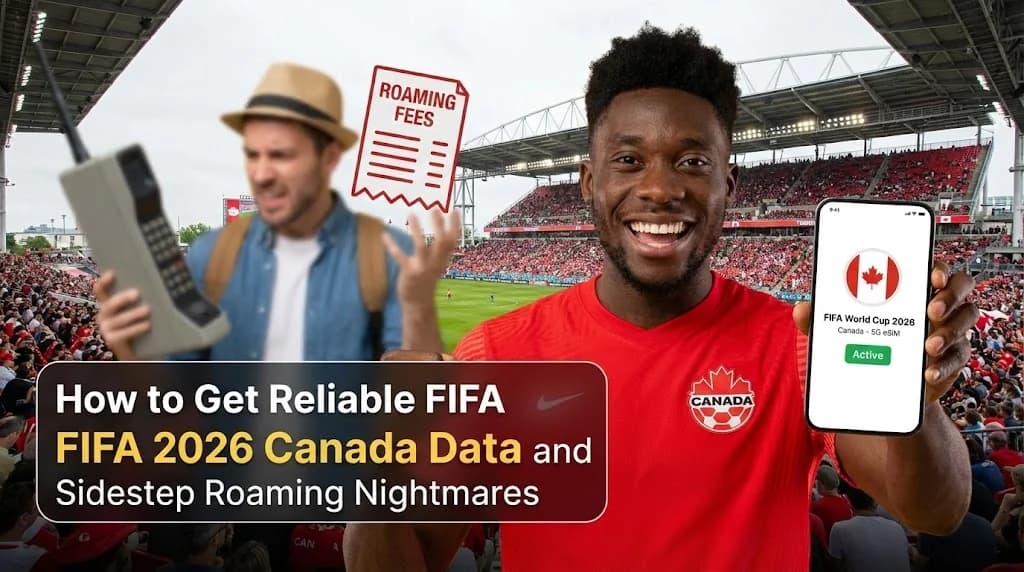
The roar of the crowd, the thrill of the match, the shared global celebration, traveling for the FIFA World Cup is an unforgettable experience. As the FIFA World Cup 2026 approaches, with matches scheduled across North America, including major Canadian cities like Toronto and Vancouver, seamless connectivity becomes as crucial as your match tickets. The last thing you want is to land at Toronto Pearson (YYZ) or Vancouver International (YVR), ready to navigate to your hotel or the stadium, only to find your phone has no service or is racking up astronomical roaming fees. Securing reliable FIFA 2026 Canada data is not just a convenience; it is essential for navigating unfamiliar cities, sharing real-time moments with friends and family, and managing your entire trip itinerary. This guide cuts through the confusion, drawing on practical travel insights to show you exactly how to stay online without breaking the bank. We will explore why your home plan probably is not the great deal you think it is, comparing options like eSIMs vs. international roaming, so you can focus on the football and the Canadian experience, not your phone bill.
- Understanding FIFA 2026 Connectivity Challenges in Canada
- Why Traditional Roaming is a FIFA 2026 Hazard
- eSIM for FIFA 2026: Your Smart Connectivity Play in Canada
- Choosing Your Cellesim eSIM Plan for the World Cup
- Activating Your Cellesim eSIM for Seamless Canadian Data
- Navigating FIFA 2026 Host Cities with Your eSIM
- Cost Comparison: eSIM vs. Roaming for FIFA 2026 in Canada
- Frequently Asked Questions
Canada eSIM Plans for FIFA 2026 from $5.50
Connect instantly in Toronto, Vancouver, and across Canada. Join 50,000+ happy customers in 200+ countries with Cellesim.
Get Your Canada eSIMUnderstanding FIFA 2026 Connectivity Challenges in Canada
The FIFA World Cup 2026 promises to be an epic event, drawing millions of fans to host cities across Canada, Mexico, and the USA (see official FIFA World Cup 2026 website: FIFA.com). In Canada, Toronto and Vancouver are set to host a significant number of matches, bringing with them unique logistical considerations, especially concerning mobile connectivity. High-density events like the World Cup often strain local network infrastructure, leading to slower speeds, dropped connections, and general service degradation for those relying on traditional methods.
For international visitors, simply arriving with your home country's SIM card and expecting flawless service through roaming agreements is a gamble. Roaming charges can quickly become prohibitive, turning the excitement of sharing match highlights or calling home into a financial burden. Furthermore, the sheer volume of visitors means that buying a local physical SIM card might involve long queues at airports or mobile stores, consuming valuable time that could be spent exploring or heading to a game.
"Staying connected during a major international event like the World Cup is no longer a luxury, it is a fundamental necessity for safety, navigation, and enhancing the travel experience."
Preparing your data strategy before you depart ensures you are ready from the moment you land. This foresight allows you to immediately access essential apps for transport, translation, and communication, making your FIFA 2026 experience in Canada as smooth as possible.
Why Traditional Roaming is a FIFA 2026 Hazard
Many travelers default to their existing mobile provider's international roaming packages, assuming it is the simplest solution. While convenient in theory, the reality of roaming during an event like the FIFA World Cup 2026 in Canada often tells a different story. Roaming charges are notoriously high, with costs per MB far exceeding local rates. A few days of relying on roaming for navigation, social media updates, and video calls can lead to a bill shock upon your return.
Even if your provider offers a daily roaming pass, these often come with limitations on high-speed data, throttling your connection after a small allowance. Imagine trying to stream a crucial match replay or find directions to the next fan zone, only to be hit with sluggish speeds or an unexpected data cut-off. These plans are designed for occasional use, not for the continuous data consumption typical of a World Cup traveler.
Beyond the cost, there is the issue of network priority. Roaming customers may not receive the same network priority as local subscribers, especially during peak times when stadiums and public spaces are crowded. This can translate to unreliable service when you need it most, such as looking up public transport schedules or connecting with fellow fans.
For a seamless FIFA 2026 experience in Canada, exploring alternatives that offer better value, higher data allowances, and reliable speeds is crucial. An eSIM provides a transparent, cost-effective solution that avoids these common roaming pitfalls, allowing you to sidestep the nightmares of unexpected bills and unreliable connectivity.
eSIM for FIFA 2026: Your Smart Connectivity Play in Canada
An eSIM, or embedded SIM, is a digital SIM card that allows you to activate a cellular plan from a provider without needing a physical SIM card. For travelers heading to Canada for the FIFA World Cup 2026, eSIMs represent the most practical and efficient way to stay connected. Here is why an eSIM is your smart play:
- Instant Activation: Purchase your Cellesim Canada eSIM online before you depart or even upon arrival. The activation is usually a quick QR code scan, getting you online within minutes. This avoids long queues at physical stores, especially during the busy World Cup period.
- Cost-Effective Data: eSIM plans are often significantly more affordable than traditional roaming, offering transparent pricing and generous data allowances. You can select a plan that fits your exact needs, from a few GB for basic navigation and messaging to larger packages for streaming and extensive social media use.
- Dual SIM Functionality: Most modern smartphones support eSIM alongside a physical SIM. This means you can keep your home SIM active for calls and texts (if desired) while using your Cellesim eSIM for all your data needs in Canada. You retain your existing number for essential contacts while enjoying local data rates.
- Flexibility and Control: With an eSIM, you are not tied to a contract. You can top up your data plan as needed directly from your phone, giving you complete control over your spending and usage. This flexibility is invaluable during a multi-week event like the World Cup.
- Wide Coverage: Cellesim partners with major local networks in Canada, ensuring you get strong 4G/5G coverage in cities like Toronto and Vancouver, at stadiums, and throughout your travels across the country.
Choosing Your Cellesim eSIM Plan for the World Cup
Selecting the right eSIM plan is key to a stress-free FIFA 2026 experience in Canada. Cellesim offers a range of data packages tailored to different travel needs and durations. Consider the following factors when making your choice:
- Duration of Stay: Are you visiting for a single match weekend, an entire group stage, or the full tournament? Cellesim plans vary in validity from 7 to 30 days or more, aligning with typical travel schedules.
- Data Usage Habits:
- Light User (2-5 GB): If you primarily need data for navigation, checking match scores, basic messaging (WhatsApp), and occasional social media updates.
- Moderate User (5-15 GB): For regular social media sharing, some video streaming, frequent map use, and voice/video calls.
- Heavy User (15+ GB): Ideal for extensive video streaming, uploading large files (e.g., match footage), frequent video calls, or using your phone as a hotspot. Our Smart Data Calculator can help estimate your needs.
- Budget: While all Cellesim eSIM plans offer superior value compared to roaming, you can choose a plan that fits your budget without compromising on connectivity.
- Coverage Areas: Ensure your chosen plan covers all the Canadian cities you plan to visit, particularly Toronto and Vancouver, and the routes between them. Cellesim’s Canada eSIM provides nationwide coverage.
For a multi-country FIFA 2026 journey spanning Canada, the USA, and Mexico, you might also consider a Global eSIM Plan from Cellesim, offering seamless connectivity across multiple destinations with a single package.
Activating Your Cellesim eSIM for Seamless Canadian Data
Activating your Cellesim eSIM for your FIFA 2026 trip to Canada is a straightforward process, designed to get you connected quickly. Follow these simple steps:
- Purchase Your eSIM Plan: Visit cellesim.com/en/esim-canada and select the data package that best suits your FIFA 2026 travel needs. Complete the purchase securely online.
- Receive QR Code: After purchase, you will immediately receive an email containing a QR code and manual activation details.
- Scan QR Code:
- On an iPhone: Go to Settings > Cellular/Mobile Data > Add eSIM. Choose "Use QR Code" and scan the code.
- On Android: Go to Settings > Network & Internet > SIMs > Add More or Download a SIM. Scan the QR code.
- Install and Label: Follow the on-screen prompts to install the eSIM. Label it clearly, perhaps "Canada FIFA 2026 eSIM," to distinguish it from your primary SIM.
- Enable Data Roaming (for eSIM): Crucially, once installed, enable "Data Roaming" for your new Cellesim eSIM line in your phone's settings. This allows the eSIM to connect to local Canadian networks without incurring international roaming charges from your home provider. Ensure your primary SIM has data roaming turned OFF to avoid accidental charges.
- Select eSIM for Mobile Data: In your phone's settings, choose your Cellesim eSIM as the preferred line for mobile data.
It is recommended to complete the purchase and QR code scanning *before* you arrive in Canada, preferably while connected to Wi-Fi. This ensures you are ready to connect the moment you land. For a more detailed guide, refer to our Complete eSIM Setup Guide or our Interactive Setup Guide.
Navigating FIFA 2026 Host Cities with Your eSIM
With your Cellesim eSIM active, you are equipped to navigate Toronto, Vancouver, and any other Canadian destination like a local. Reliable data is indispensable for a major event like the FIFA World Cup.
- Real-time Navigation: Use Google Maps or Apple Maps to find your way to stadiums, fan festivals, accommodations, and local attractions. Instant data ensures you get real-time traffic updates and public transport routes, saving time and reducing stress. For specific guidance, see our Toronto eSIM Guide or Vancouver eSIM Guide.
- Public Transport Apps: Canadian cities have excellent public transport systems. Your eSIM data allows you to download and use local transit apps (e.g., TTC in Toronto, TransLink in Vancouver) for schedules, route planning, and fare payment. For general Canadian travel inspiration, Destination Canada offers more insights.
- Match Day Essentials: Stay updated with live scores, team news, and stadium entry protocols through official FIFA apps and news sites. Share your match-day excitement instantly with friends and family back home via social media.
- Emergency Services: In any unforeseen situation, having a stable data connection is critical for accessing emergency information or contacting local authorities.
- Translation Tools: While Canada is bilingual (English and French), translation apps can enhance your experience, especially in diverse neighborhoods or when interacting with non-English speakers.
Reliable internet access during the FIFA 2026 tournament in Canada transforms your travel experience from potentially frustrating to incredibly smooth. From finding the best poutine spot to cheering on your favorite team, an eSIM ensures you are always connected.
Cost Comparison: eSIM vs. Roaming for FIFA 2026 in Canada
When planning your budget for FIFA 2026, understanding connectivity costs is essential. Here is a comparison of different options for a typical 10-day trip to Canada, assuming moderate data usage (around 10GB):
| Option | Estimated Cost (10 days) | Speed/Reliability | Setup | Flexibility |
|---|---|---|---|---|
| Cellesim eSIM (Canada) | From $20 - $40 | Full 4G/5G, High Priority | Instant (QR scan) | Easy top-ups, no contract |
| Traditional Roaming (Home Provider) | $100 - $150+ | Often throttled after limit, lower priority | Automatic | Limited, expensive extensions |
| Local Physical SIM (Canada) | $30 - $60 (plus SIM card fee) | Full 4G/5G, High Priority | Store visit, activation time, physical swap | Can top-up, tied to local provider |
This comparison clearly illustrates the cost-effectiveness and convenience of using a Cellesim eSIM. While a local physical SIM offers similar performance, the hassle of acquiring one, especially during a major event like the World Cup, can be a significant drawback. Roaming, conversely, is consistently the most expensive and least flexible option.
By opting for a Cellesim Canada eSIM, you not only save money but also gain immediate access to reliable high-speed data, enabling you to fully immerse yourself in the FIFA 2026 experience without worrying about connectivity.
For further insights into potential savings, you can utilize our Roaming Savings Calculator to compare costs based on your specific travel and data needs.
Ready for Seamless FIFA 2026 Connectivity in Canada?
Sidestep roaming nightmares and connect instantly for the World Cup. Join 50,000+ travelers in 200+ countries.
Start Your Connected JourneyTrusted by travelers worldwide. 24/7 Support.
Frequently Asked Questions
What is an eSIM and how does it work for FIFA 2026 in Canada?
An eSIM is a digital SIM embedded in your phone, eliminating the need for a physical card. For FIFA 2026 in Canada, you can purchase a Cellesim Canada plan online, scan a QR code, and instantly connect to local networks. This provides reliable data without expensive roaming fees or needing to swap physical SIMs.
Will my phone be compatible with an eSIM in Canada?
Most modern smartphones, typically those manufactured from 2018 onwards (e.g., iPhone XR/XS and newer, Samsung Galaxy S20 and newer, Google Pixel 3 and newer), support eSIM technology. You can easily check your device's compatibility using the Cellesim eSIM checker on our website.
How much data will I need for the FIFA 2026 World Cup in Canada?
Data needs vary based on your usage. For light use (maps, messaging, occasional social media), 5-10 GB might suffice for a week. Heavy users (streaming, video calls, frequent uploads) might need 15-30 GB or more. Consider your planned activities; our Smart Data Calculator can help estimate your specific requirements.
Can I use my Cellesim eSIM in both Toronto and Vancouver?
Yes, Cellesim's Canada eSIM plans offer nationwide coverage, meaning you can use the same eSIM seamlessly across all major Canadian cities, including Toronto and Vancouver, as well as other regions. This ensures consistent connectivity whether you are at a stadium, exploring a city, or traveling between locations.
How does an eSIM compare to buying a local SIM card in Canada for the World Cup?
Both eSIMs and local physical SIMs offer good local rates and speeds. The primary advantage of an eSIM is convenience: no need to find a store, wait in line, or physically swap cards. You can activate an eSIM instantly from anywhere, often before you even land, saving valuable time during your FIFA 2026 trip.
What if I also travel to the USA or Mexico for FIFA 2026 matches?
If your FIFA 2026 journey extends beyond Canada to the USA or Mexico, Cellesim offers regional or global eSIM plans that cover multiple countries. This allows you to maintain seamless connectivity across all host nations with a single eSIM, avoiding the need to purchase separate plans for each country.