Updated: 2026-02-16
You have just stepped off a long-haul flight. You are tired, perhaps a little disoriented, and your first priority is reliable data. You need to pull up your hotel address, confirm your arrival with family, or book a ride-share from the bustling arrivals hall. As you look around, you see the brightly lit kiosk selling local SIM cards, often with a queue of fellow travelers. This is the classic travel dilemma: do you join the line, or is there a more efficient path to connectivity? The debate of eSIM vs physical SIM begins right here, in this crucial moment of arrival. The choice you make can define the initial hours of your trip, either seamless and connected or frustratingly delayed. We will break down exactly what to expect from each option, drawing from countless trips and airport arrivals, to help you make the best eSIM for international travel for your needs. This choice profoundly impacts your initial ease of travel, highlighting the strong case for preparing your connectivity before you even land.
- The Airport SIM Card Kiosk: A Familiar Ritual with Hidden Costs and Delays
- The eSIM Advantage: Connectivity Before You Even Land
- Choosing Your Connectivity: A Comparison for Airport Arrivals
- Preparing for a Seamless Arrival: Activating Your eSIM Pre-Trip
- Optimising Data Usage for Your Initial Journey
- Beyond the Airport: Long-Term Benefits for Travelers
- Security and Performance: Digital vs. Physical at Your Destination
- Frequently Asked Questions
Connect Instantly with a Global eSIM
Skip the airport SIM queue and connect in 200+ countries. Join 50,000+ travelers who connect instantly with Cellesim.
Get Your Global eSIMThe Airport SIM Card Kiosk: A Familiar Ritual with Hidden Costs and Delays
For years, purchasing an international SIM card at the airport was the standard approach for many travelers seeking to avoid exorbitant global roaming fees. It felt like a proactive and straightforward solution. You would present your passport, select a data plan, and a local salesperson would often assist with the installation. However, like many long-standing habits, it is important to assess if this ritual remains the optimal choice in an era of advanced digital solutions. For numerous travelers, this airport decision now introduces unnecessary stress and expense.
The Perceived Pros: Tangible and Seemingly Simple
The primary appeal of the airport SIM kiosk lies in its immediacy and tangibility. You receive a physical product, and often, there is staff available to assist with the installation. For those less accustomed to digital setups, this can offer a degree of reassurance. You typically depart with a working connection (most of the time) and can commence your trip. This hands-on approach, while familiar, often overshadows the more efficient and cost-effective alternatives now available, potentially leading to a less optimal airport decision in the long run.
The Reality Check: The Downsides of Buying on Arrival at the Airport
Once the initial convenience is scrutinised, the drawbacks of the airport SIM card model become apparent. Having navigated dozens of airports, from Istanbul (IST) to Bangkok (BKK), the experience is rarely as smooth as it first appears. These challenges represent critical considerations for any traveler making their airport connectivity decision.
- The Inevitable Queue: After navigating immigration and baggage claim, the last thing most travelers desire is another line. SIM card kiosks frequently become bottlenecks, leading to delays of 30-60 minutes or even longer. This is valuable time that could be spent en route to your accommodation, directly impacting your immediate post-arrival experience as a traveler.
- The "Tourist Price" Mark-Up: Airport locations command premium real estate, and vendors are aware they serve a captive audience. The data plans offered are almost invariably more expensive than those found at local shops in city centers. This represents a significant "convenience tax," which can add substantial cost to your travel budget. These inflated airport SIM card prices mean you are often paying more for the same, or even fewer, data allowances, making it a less cost-effective airport decision for budget-conscious travelers.
- Language Barriers and Fine Print: While a salesperson might speak English, clearly explaining the intricacies of Fair Usage Policies, potential data throttling after a certain limit, or whether tethering is permitted, can be challenging. It is easy to agree without fully understanding the terms, resulting in a data plan that does not adequately meet your needs. For example, the detailed comparison of an Airport SIM vs eSIM highlights the potential complexities of local regulations and registration requirements, particularly for travelers navigating Istanbul Airport (IST). This lack of clarity can lead to unexpected roaming fees or suboptimal reception later in your trip.
- Paperwork and Privacy Concerns: Many countries mandate the registration of your SIM card with your passport details. This involves handing over your crucial travel document to be photocopied or scanned at a busy public counter, which raises security concerns for some individuals. This aspect of physical SIM acquisition at the airport introduces questions regarding data privacy.
- Limited Options: Airport kiosks typically partner with only one or two of the country's major network carriers. This limited selection prevents you from assessing the full market, potentially causing you to miss out on a provider offering superior coverage for the specific regions you plan to visit, thereby affecting your overall connectivity performance. For instance, at Suvarnabhumi Airport (BKK), choices might be restricted to a couple of major Thai networks, offering less variety compared to online eSIM options.
- Late-Night Arrival Challenges: Arriving at smaller airports or during off-peak hours (late evening or early morning) can mean kiosks are closed or understaffed. This situation leaves you without immediate connectivity, forcing reliance on expensive hotel Wi-Fi or a wait until morning, directly frustrating the start of your journey.
The eSIM Advantage: Connectivity Before You Even Land
Now, consider an alternative scenario. Your plane taxis to the gate, and while other passengers are contemplating finding Wi-Fi, you simply switch off Airplane Mode. Instantly, your phone connects to a local 4G or 5G network. You have data. You can message your family, verify train schedules, or load a map to your hotel before you have even deplaned. This represents the reality of utilising an eSIM for travel, a seamless experience that commences before you are confronted with any airport decision.
The Core Benefit: Instant, Stress-Free Activation for the Arriving Traveler
An eSIM (embedded SIM) is a digital SIM card integrated directly into your smartphone. There is no physical component to swap. The entire process is digital: you purchase a travel data plan online from a provider like Cellesim, receive a QR code via email, and scan it to install the data profile onto your phone. This can be completed from the comfort of your home before you even depart for the airport, allowing you to activate your eSIM before landing. The plan remains dormant until it detects a network in your destination country, allowing for advance setup. This is a transformative solution for travel connectivity, particularly for the modern traveler equipped with an eSIM compatible device, such as recent iPhone models.
Beyond Convenience: Key eSIM Strengths for Travelers at the Airport and Beyond
The advantages of an eSIM extend significantly beyond merely avoiding a queue at the airport. They address many common frustrations experienced by travelers, positioning eSIMs as a superior choice for your airport connectivity decision.
- True Cost-Effectiveness: The online marketplace for eSIMs is highly competitive. You can compare numerous data plans and providers for your specific destination, ensuring you secure the best possible price without any airport markups. This transparency translates into better value for your expenditure, often being considerably more affordable than typical airport SIM card prices. Cellesim offers competitive rates across over 127 countries (and overall coverage in 200+ countries), serving over 50,000 satisfied customers with robust data plans.
- Unmatched Flexibility: Planning a multi-country itinerary? Rather than purchasing a new physical SIM in each country, you can opt for a regional eSIM that covers an entire continent, such as Europe. Data plans can be easily topped up online if your allowance runs low, providing ultimate control and adaptability for your connectivity needs. This flexibility is a significant advantage in the eSIM vs. physical SIM debate.
- Enhanced Security: Your purchase is a secure online transaction. There is no requirement to hand over your passport or credit card at a foreign counter, thereby mitigating risks associated with identity theft. The entire process is private and digital, directly addressing security concerns sometimes linked to physical SIM acquisition at airport kiosks.
- Keep Your Home Number Active: This represents a substantial, yet frequently overlooked, advantage. As the eSIM manages your data connection, your physical SIM slot remains available for your primary number. This means you can continue to receive calls and crucial SMS messages (such as two-factor authentication codes from your bank) on your regular number without incurring expensive data roaming charges. This dual SIM functionality is a major benefit for seamless communication, offering eSIM a clear lead in the comparison for many travelers.
- Reliable Performance and Reception: eSIMs connect to local networks in the same manner as physical SIMs, providing equivalent 4G/5G speeds and coverage. A key differentiator is the ease with which you can switch between networks if one offers superior reception or performance in a specific area. If your primary eSIM is not performing optimally, you can swiftly purchase and activate another data plan from a different provider, affording you unparalleled control over your connectivity. This is particularly valuable when transitioning between urban centers and more rural regions.
Choosing Your Connectivity: A Comparison for Airport Arrivals
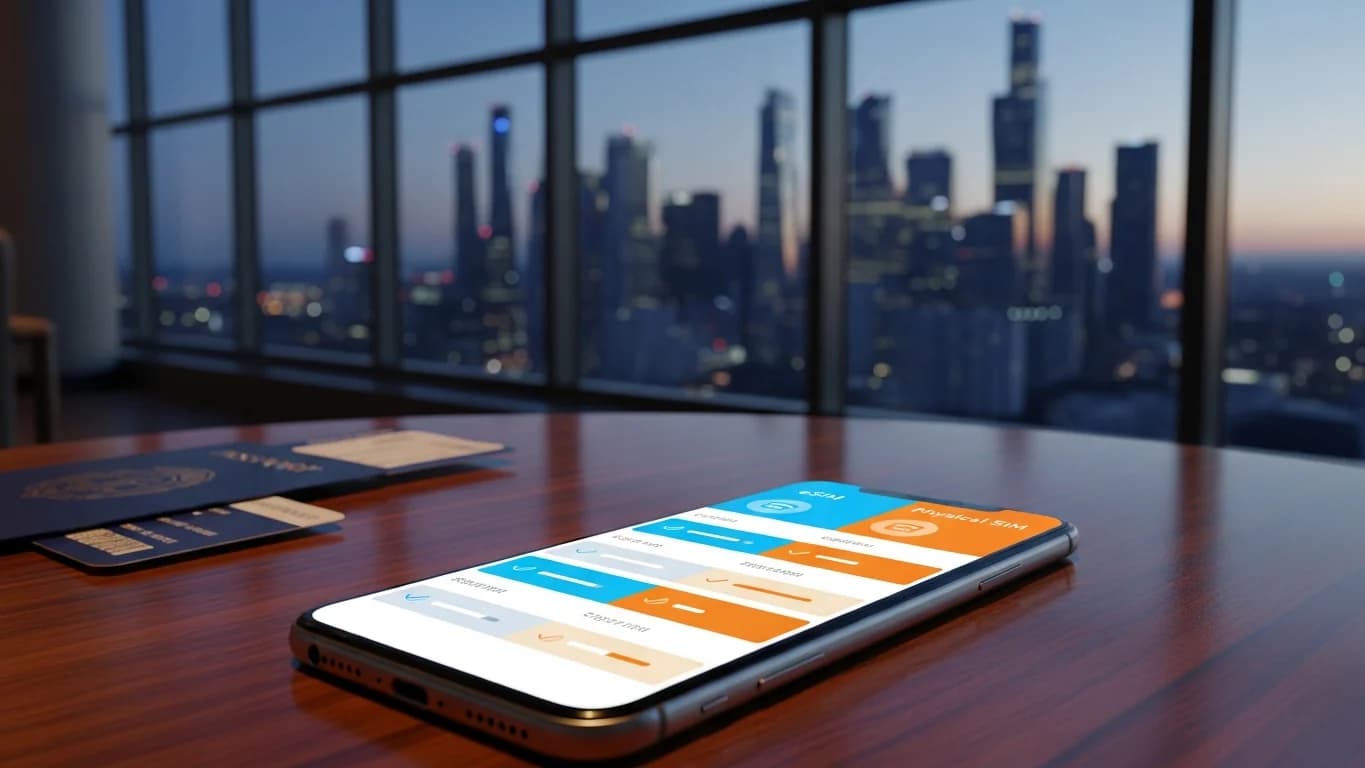
To provide a clearer framework for your decision, let us conduct a head-to-head comparison of eSIM vs. physical SIM across the factors that are most critical to travelers making their initial airport connectivity choice. This table offers a concise overview of the key pros and cons.
| Factor | Cellesim eSIM | Airport Physical SIM |
|---|---|---|
| Convenience & Speed | Instant activation before landing. No queues. | Requires kiosk visit, queue, ID check, manual install. Can take 30-60 min. |
| Cost | Generally more affordable; competitive online pricing. | Often includes "tourist tax"; higher than city centre prices. |
| Choice & Flexibility | Wide selection of plans (country/regional); easy top-ups. Cellesim covers 200+ countries. | Limited to 1-2 carriers at kiosk; less plan variety. |
| Phone Compatibility | Most smartphones from 2018 onwards (iPhone XS+, Pixel 3+, Samsung S20+). Check device compatibility. | Works with virtually any unlocked phone (older models included). |
| Keeping Home Number | Dual SIM functionality; home number active for calls/SMS. | Requires removing home SIM; cannot receive calls/SMS without roaming. |
| Security & Privacy | Secure online purchase; no passport details shared at counter. | Requires passport registration at public kiosk; potential data exposure. |
| Reception & Performance | Connects to local 4G/5G networks; easy to switch providers for optimal coverage. | Dependent on single carrier chosen; stuck with their network performance. |
Preparing for a Seamless Arrival: Activating Your eSIM Pre-Trip
The true power of an eSIM for airport arrivals lies in its ability to be prepared entirely before you leave home. This proactive approach eliminates stress and ensures immediate connectivity upon landing. The setup process is designed for simplicity and can be completed in just a few minutes.
Step-by-Step eSIM Installation Before Departure:
- Choose Your Destination & Plan: Visit the Cellesim website and select your destination (e.g., Turkey, Europe, or Asia) or a regional plan. Browse the available data packages based on your anticipated usage and trip duration.
- Purchase Securely: Complete your purchase through Cellesim's secure online platform. You will receive a confirmation email shortly after, containing your eSIM QR code and detailed installation instructions.
- Scan & Install: On your eSIM-compatible smartphone (ensure you have Wi-Fi connectivity), navigate to your phone's Cellular/Mobile Data settings. Select "Add eSIM" or "Add Data Plan" and scan the QR code provided in your email. Follow the on-screen prompts. For a comprehensive guide, refer to our complete eSIM setup guide or the interactive setup guide.
- Label Your eSIM: Once installed, label your new eSIM profile with a descriptive name, such as "Travel Data" or "France eSIM," to distinguish it from your primary SIM.
- Keep it Off Until Landing: Crucially, keep your new eSIM profile turned OFF or set to "Do Not Use for Data" until you land at your destination. This prevents accidental activation and ensures your data plan starts precisely when you need it.
Optimising Data Usage for Your Initial Journey
The first few hours after landing are critical for connectivity. You need enough data to navigate, communicate, and organise your initial steps. Understanding your data needs for this period helps in selecting the right eSIM plan.
How Much Data Do You Need for Airport & First Day Tasks?
- Navigation: Using Google Maps or Apple Maps to find your way to accommodation or public transport can consume 5-10MB per hour, depending on detailed navigation.
- Messaging & Communication: Sending messages on WhatsApp, iMessage, or other platforms is low data usage, typically a few MB per hour. Making voice calls over these apps (VoIP) uses more, around 0.5-1MB per minute.
- Ride-Sharing Apps: Booking an Uber, Lyft, or local equivalent uses minimal data for the transaction itself, perhaps 1-2MB.
- Quick Browsing & Email: Checking immediate emails or performing quick web searches might use 5-15MB.
- Social Media (Light Use): A brief scroll through social media consumes 10-30MB.
For your initial arrival and first day of basic connectivity, a plan offering 1GB to 3GB of data is typically sufficient for most travelers. This allows for essential tasks without concern. For longer trips or heavier usage (streaming, video calls), consider larger plans or the flexibility of Cellesim's easy top-up options. Our Smart Data Calculator can help estimate your specific needs.
"Having an eSIM active before landing transformed my arrival experience. No scrambling for Wi-Fi, no haggling for a SIM card. I was able to order a taxi and notify my host instantly. It's the only way I travel now."
Beyond the Airport: Long-Term Benefits for Travelers
While the airport decision focuses on immediate connectivity, an eSIM's advantages extend throughout your entire journey, particularly for those exploring multiple destinations or requiring sustained, reliable access.
Multi-Country Travel Made Simple
For itinerants traversing Europe, Asia, or Africa, the traditional approach of buying a new physical SIM in each country is inefficient and time-consuming. Regional eSIMs, such as the Europe eSIM for 42 countries, provide seamless connectivity across borders without the need for constant SIM swapping. This means consistent data as you cross from France to Germany, or from Thailand to Vietnam, all under a single, manageable plan. This flexibility is a critical differentiator when assessing eSIM vs. physical SIM for extensive travel.
Flexible Top-Ups and Cost Control
With an eSIM, running out of data mid-trip is a minor inconvenience, not a crisis. Cellesim offers straightforward online top-ups, allowing you to add more data to your existing plan within minutes, from anywhere with an internet connection. This eliminates the need to seek out local shops or deal with foreign currency, providing continuous control over your spending and usage. Compare this to the fixed nature of many airport SIM bundles, which often leave you buying a completely new card if your data runs out.
Integrating eSIM with Your Existing Devices
Modern travel often involves more than just a smartphone. Many travelers use tablets, laptops, or even smartwatches. The ability to use your eSIM for eSIM tethering means you can share your mobile data connection with other devices, transforming your phone into a personal hotspot. This functionality is invaluable for staying productive on the go, making an eSIM a versatile tool for all your digital needs, far beyond just initial airport connectivity.
Security and Performance: Digital vs. Physical at Your Destination
When comparing eSIM and physical SIM, the considerations of network performance and data security extend well beyond the airport terminal. Your chosen connectivity method impacts your experience throughout your trip.
Reliable Network Performance
Both eSIMs and physical SIMs connect to local cellular networks, meaning the underlying 4G or 5G speeds and coverage are generally identical. The key difference lies in the flexibility an eSIM offers. If you find yourself in an area with suboptimal coverage from one provider, an eSIM allows you to swiftly purchase and activate a plan from an alternative local network without needing to physically swap cards. This adaptability ensures you can maintain the best possible connection throughout your journey. For more details on how networks operate, you can consult resources like OpenSignal for global network performance insights.
Enhanced Digital Security
The digital nature of eSIMs inherently offers enhanced security. By eliminating the need to handle a physical card, the risks of loss, theft, or damage are removed. More importantly, the activation process bypasses the often-questionable practice of handing over your passport and personal details to a kiosk attendant in a foreign airport. All Cellesim transactions are secure, and your personal data remains protected, aligning with best practices for digital privacy. For official information on eSIM technology, the GSMA (the global association of mobile operators) provides comprehensive details.
Ready for Seamless Connectivity on Your Next Trip?
Ditch the airport queues and connect instantly upon arrival. Join 50,000+ happy travelers in 200+ countries.
Start Your Connected JourneyTrusted by travelers worldwide. 24/7 Support: [email protected]
Frequently Asked Questions
Can I use an eSIM if my phone also has a physical SIM?
Yes, most modern smartphones with eSIM capability support Dual SIM functionality. This allows you to keep your physical SIM (your home number) active for calls and SMS while using the eSIM for your travel data, preventing expensive roaming charges for data.
Is an eSIM really activated immediately upon landing?
A Cellesim eSIM plan becomes active the moment it connects to a supported local network in your destination country. You can install it days or weeks in advance, but it only consumes data or begins its validity period once it detects a network abroad.
Are eSIM data plans more expensive than local physical SIMs?
Generally, eSIM plans purchased online from providers like Cellesim are more cost-effective than physical SIMs bought at airport kiosks, which often carry a "tourist markup." While local SIMs in city centers can sometimes be cheaper, the convenience and pre-arrival setup of an eSIM often outweigh the minor price difference.
What if my phone isn't eSIM compatible?
If your device does not support eSIMs, you will need to rely on traditional physical SIM cards or international roaming. You can check your device's compatibility on the Cellesim eSIM checker tool before your trip.
Can I top up my eSIM data if I run out during my trip?
Yes, Cellesim eSIMs are designed for flexibility. If you deplete your data allowance, you can easily purchase a top-up package directly from the Cellesim website, allowing you to continue using your data plan without interruption.
Is Cellesim reliable for international travel?
Cellesim connects to top-tier local networks in over 200 countries, ensuring reliable 4G/5G connectivity. With over 50,000 satisfied customers and 24/7 email support at [email protected], Cellesim provides a robust solution for global travelers.