


For travelers heading to Morocco in 2026, an eSIM offers a straightforward and cost-effective solution for mobile data, eliminating the need for physical SIM cards and reducing international roaming charges. You can activate a local data plan before you even land, ensuring immediate connectivity for navigation, communication, and essential travel apps.
Morocco's Mobile Landscape: A Technical Overview
Morocco's telecommunications infrastructure has undergone significant modernization in recent years, with a strong push towards 4G LTE and an emerging 5G presence in major urban centers. The regulatory body, Agence Nationale de Réglementation des Télécommunications (ANRT), has overseen competitive spectrum auctions, which has spurred investment from the three primary operators: Maroc Telecom, Inwi, and Orange Maroc. This competitive environment generally translates to reasonable service quality, especially in densely populated areas.
When we talk about network performance, it's crucial to understand the underlying radio access network, specifically the frequency bands in use. In Morocco, you'll primarily encounter LTE bands such as B3 (1800 MHz), B7 (2600 MHz), and B20 (800 MHz) for 4G connectivity. The B20 band is particularly valuable for its propagation characteristics, offering better indoor penetration and wider rural coverage, while B3 and B7 provide higher capacity in urban areas. For 5G, the initial deployments are leveraging the n78 (3500 MHz) band, a global standard for mid-band 5G, offering a good balance of speed and coverage.
Understanding these bands is not just academic, it directly impacts your user experience. If your device supports these specific bands, you're more likely to achieve optimal performance. Conversely, a device lacking support for a prevalent band like B20 might struggle with signal indoors or outside city limits.
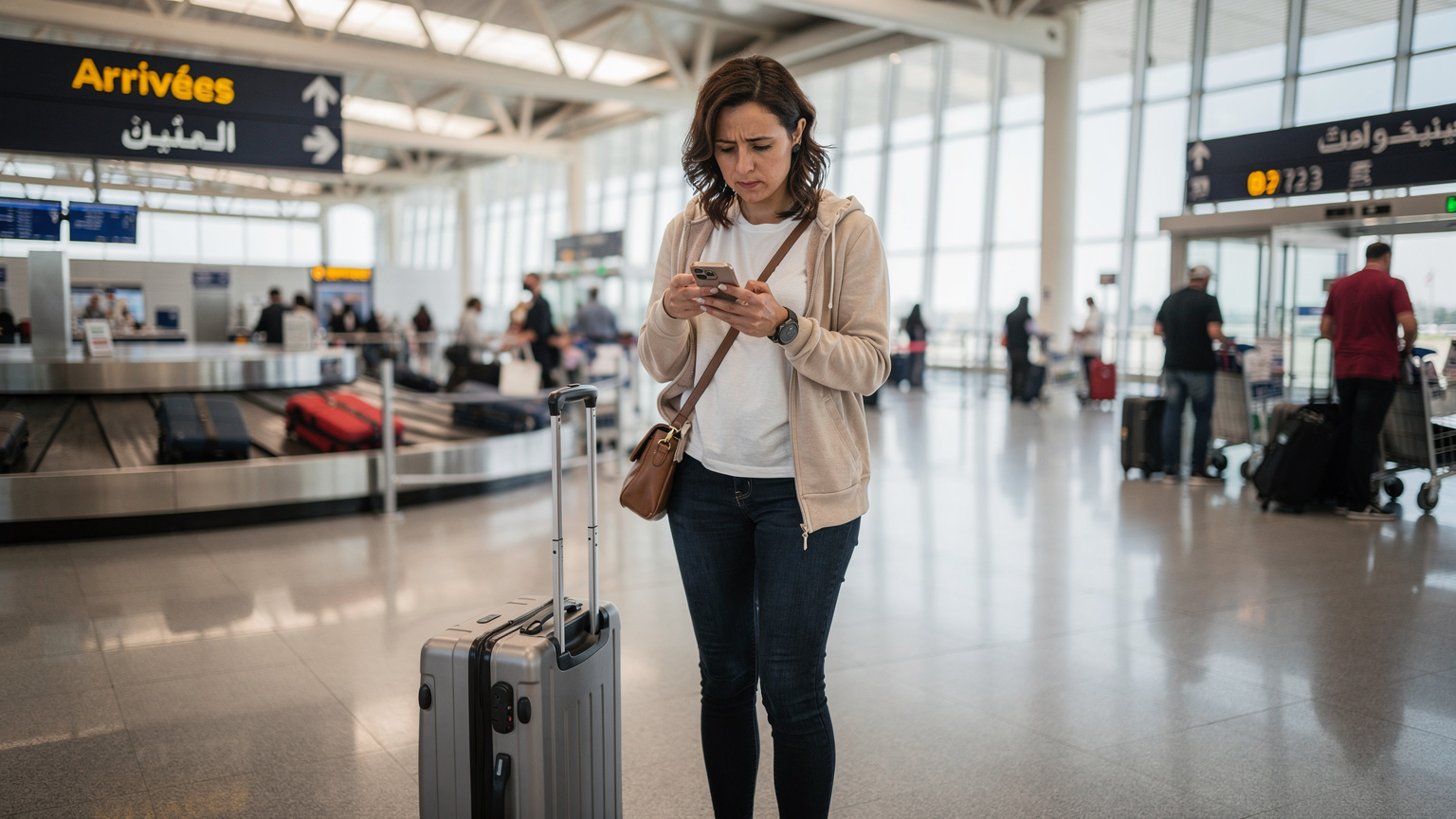
The Challenge of Coverage: Urban vs. Rural
While cities like Casablanca, Marrakech, Rabat, and Fez boast excellent 4G LTE coverage, with average download speeds often ranging from 30 Mbps to 80 Mbps and upload speeds of 10 Mbps to 25 Mbps, venturing into more remote regions, particularly the High Atlas mountains or certain parts of the Sahara Desert, will inevitably lead to a degradation of service. Here, you might find yourself on 3G (UMTS, typically B1 2100 MHz or B8 900 MHz) or even 2G (GSM 900 MHz) networks, where data speeds are significantly lower, sometimes barely reaching 1-5 Mbps for downloads.
This disparity highlights a common challenge in developing telecom markets, where the cost-benefit analysis for deploying high-capacity infrastructure in sparsely populated areas doesn't always justify the investment. Therefore, managing expectations about ubiquitous high-speed connectivity is key to a smooth travel experience.
Why an eSIM is Your Best Bet for Morocco
Gone are the days of fumbling with tiny physical SIM cards or hunting down local mobile stores immediately upon arrival. An eSIM, or embedded SIM, streamlines the process of getting connected, making it an ideal choice for international travelers. It's a digital SIM profile that's downloaded directly to your phone, allowing you to switch carriers or data plans with a few taps.
For those of us who appreciate efficiency, the benefits are clear. You can purchase and activate an Morocco eSIM from your couch weeks before your trip, ensuring that your phone is ready to connect the moment your plane touches down at Mohammed V International Airport (CMN) in Casablanca. This immediate connectivity is invaluable for calling a taxi, navigating to your Riad in the Medina, or simply letting family know you've arrived safely.
| Feature | eSIM | Physical SIM | International Roaming |
|---|---|---|---|
| Ease of Acquisition | Online purchase, instant download | Local store visit, passport registration | Automatic with home carrier |
| Activation Time | Minutes, pre-arrival | Hours (travel to store, wait, activation delay) | Instant, upon landing |
| Cost Efficiency | Competitive local rates, no roaming | Local rates, can be cheaper for long stays | Highest cost, significant bill shock risk |
| Flexibility | Switch plans/carriers easily | Requires new card for each carrier | None (tied to home carrier) |
| Physical Handling | None, fully digital | Tiny card, easy to lose/damage | None |
The Hidden Costs of International Roaming
While convenient, relying on your home carrier's international roaming plan is almost always the most expensive option. Data rates can be exorbitant, often exceeding $10 per MB in some cases, leading to astronomical bills. Even bundled roaming packages, while seemingly attractive, typically offer limited data at premium prices compared to local rates. For budget-conscious travelers or digital nomads who need consistent data for remote work, this is simply unsustainable.
Moreover, roaming plans often don't provide local phone numbers, which can be a minor inconvenience when trying to book local services or make reservations. The underlying issue is that your home carrier has to pay significant interconnect fees to Moroccan operators, and those costs are passed directly to you, often with a hefty markup. For a truly transparent and affordable experience, an eSIM solution is superior.
Choosing Your Moroccan eSIM Provider: The Cellesim Advantage
When selecting an eSIM provider for Morocco, several factors come into play: coverage, data allocation, validity period, and most importantly, transparent pricing. Cellesim specializes in offering reliable connectivity specifically tailored for international travel, leveraging partnerships with local network operators to ensure optimal service.
We focus on providing plans that align with typical traveler needs, from short-term tourist visits to extended stays for remote workers. Our direct relationships with Moroccan carriers mean we can often secure more competitive data rates than generic global roaming eSIMs, which might route your traffic through distant servers, introducing latency and potentially slower speeds.
Data Plans that Match Your Journey
Cellesim offers various data packages for Morocco, ranging from smaller bundles for light users (e.g., 1 GB for 7 days) to larger allowances for heavy data consumers (e.g., 20 GB for 30 days). Consider your typical data usage: if you're constantly streaming video, participating in video calls, or uploading large files, a higher data cap is advisable. For basic navigation, social media, and messaging, a modest plan might suffice. It's always better to slightly overestimate than to run out of data prematurely and face the hassle of topping up.
| Plan Type | Data Allowance | Validity | Typical Use Case |
|---|---|---|---|
| Lite Traveler | 3 GB | 7 Days | Maps, messaging, light browsing |
| Standard Tourist | 10 GB | 15 Days | Social media, moderate streaming, video calls |
| Digital Nomad | 30 GB | 30 Days | Heavy streaming, remote work, frequent uploads |
| Extended Stay | 50 GB | 60 Days | Long-term remote work, extensive data needs |
Local Moroccan Carriers: A Deep Dive into Network Performance
Morocco's mobile market is dominated by three major players: Maroc Telecom, Inwi, and Orange Maroc. Each has its strengths and weaknesses, primarily concerning network coverage and performance in different regions.
Maroc Telecom: The Incumbent Giant
Maroc Telecom (IAM) is the oldest and largest operator, boasting the most extensive network coverage, particularly in rural and remote areas. Their 4G LTE network primarily uses B3 (1800 MHz) and B20 (800 MHz), with some B7 (2600 MHz) in urban centers. This B20 presence is key for their superior rural reach. In major cities, you can expect download speeds averaging 40-90 Mbps, sometimes peaking over 120 Mbps in optimal conditions. Upload speeds typically range from 15-30 Mbps. Their 5G network, while still nascent, is expanding in Casablanca and Rabat, utilizing n78 (3500 MHz).
From a technical standpoint, Maroc Telecom generally offers the most robust backbone, often having more fiber backhaul to their cell sites, which reduces congestion. However, during peak tourist seasons in places like Jemaa el-Fna in Marrakech, even their network can experience some temporary capacity strain.
Inwi: The Challenger Brand
Inwi has aggressively expanded its network, particularly in urban and semi-urban areas, making it a strong contender. They also primarily utilize B3 (1800 MHz) and B7 (2600 MHz) for 4G, with a less extensive B20 footprint compared to Maroc Telecom. Their urban speeds are competitive, often matching or exceeding Maroc Telecom, with typical downloads between 35-85 Mbps and uploads from 12-28 Mbps. Inwi's 5G deployment is following a similar path to Maroc Telecom, focusing on high-demand urban areas.
Anecdotally, I've found Inwi to be quite reliable in cities like Fez and Tangier. Their network architecture seems well-optimized for urban density, offering consistent performance even during busy hours. However, as you move away from the main highways or into smaller towns, their coverage can become spottier than Maroc Telecom's.
Orange Maroc: The International Player
Orange Maroc, part of the global Orange group, offers a strong network, especially in major cities and along key transportation corridors. Like its competitors, Orange relies heavily on B3 (1800 MHz) and B7 (2600 MHz) for its 4G network. Their performance in urban centers is comparable to Inwi, with typical download speeds around 30-80 Mbps and uploads of 10-25 Mbps. Orange is also investing in 5G on the n78 band, prioritizing areas with high business and tourist traffic.
One notable aspect of Orange is its international peering agreements, which can sometimes translate to slightly lower latency for accessing international content, a small but noticeable benefit for those using VPNs or latency-sensitive applications. However, like Inwi, its rural coverage can be less comprehensive than Maroc Telecom's.
APN Settings & VoLTE/VoWiFi: A quick technical note: while most eSIMs configure APN settings automatically, certain Android devices (especially some older or less common models) might require manual APN entry. The correct APN for Moroccan carriers is usually just 'internet'. Also, VoLTE (Voice over LTE) and VoWiFi (Voice over Wi-Fi) support with eSIMs can be inconsistent. While all Moroccan operators support VoLTE for their native SIMs, it's not always guaranteed to work with a third-party eSIM profile, meaning your voice calls might drop to 3G during a call (CSFB, Circuit-Switched Fallback), impacting call quality or speed if you're simultaneously using data.
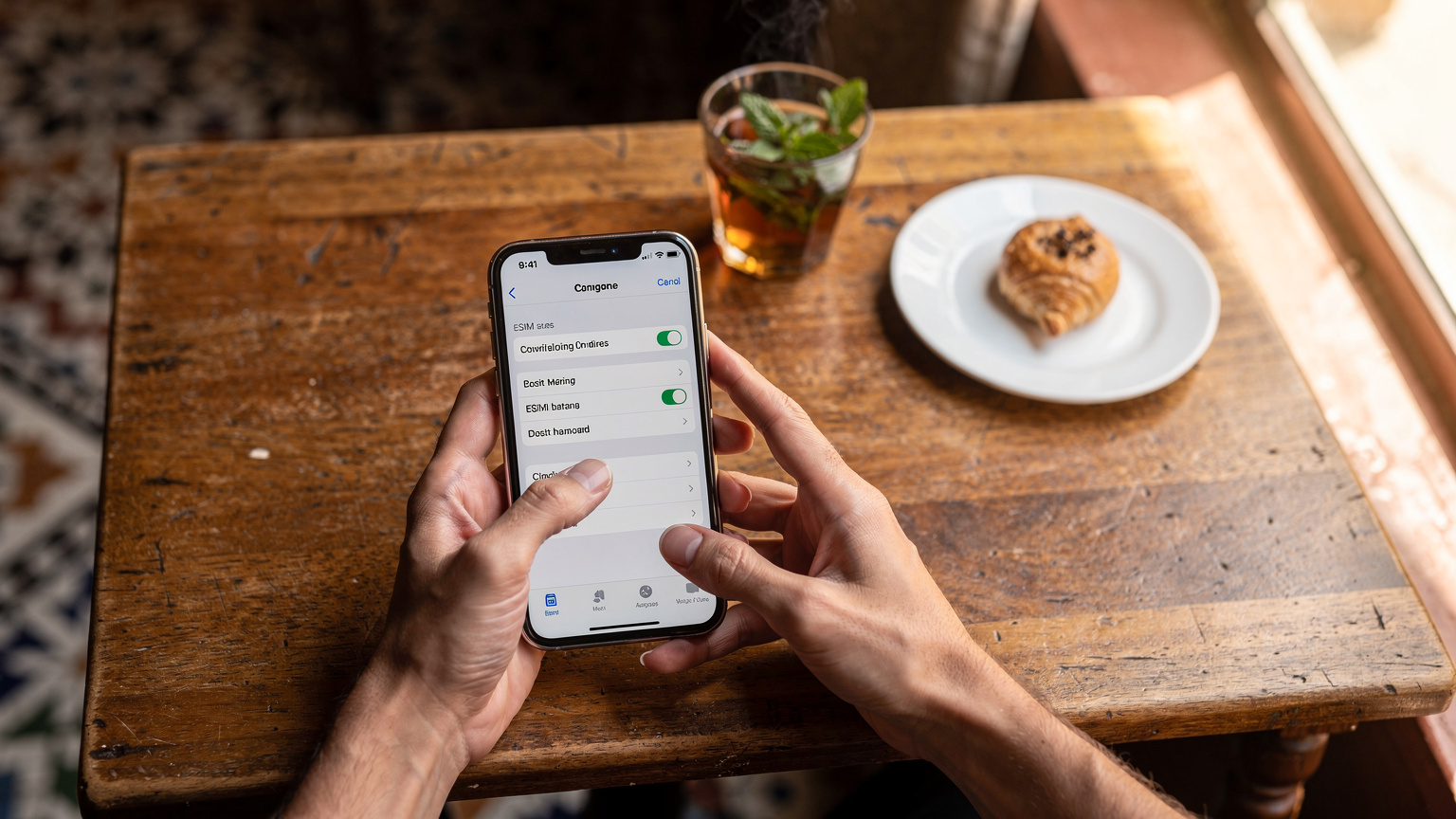
Activating Your eSIM: A Step-by-Step Guide for Morocco
The process of activating your eSIM is generally straightforward, but a few precise steps ensure a seamless experience. It's always best to complete the activation before you depart or while you still have a stable Wi-Fi connection.
- Purchase Your Cellesim Plan: Visit the Cellesim website, select Morocco as your destination, and choose a data package that suits your travel duration and data needs. Complete the purchase securely.
- Receive Your QR Code: After purchase, you'll receive an email containing a QR code. This code holds all the necessary network configuration data for your eSIM profile.
- Add eSIM to Your Device:
- For iPhone (iOS): Go to Settings > Cellular (or Mobile Data) > Add eSIM. Choose 'Use QR Code' and scan the code. Follow the on-screen prompts.
- For Android: The path varies slightly by manufacturer, but generally, it's Settings > Network & internet > SIMs (or Mobile network) > Add eSIM (or Download a SIM). Scan the QR code and follow the instructions.
- Label Your eSIM: Once added, your device will prompt you to label the new eSIM. A descriptive name like 'Morocco Travel' or 'Cellesim Morocco' helps differentiate it from your primary SIM.
- Set Data Roaming: For the eSIM to connect to the local Moroccan network, ensure 'Data Roaming' is enabled for your eSIM profile in your phone's settings. For your primary physical SIM, you'll want to disable data roaming to avoid unexpected charges.
- Select eSIM for Mobile Data: In your device's cellular/mobile data settings, select your newly added Morocco eSIM as the preferred line for mobile data. You can usually still use your primary SIM for calls and SMS, depending on your device's Dual SIM Dual Standby (DSDS) capabilities.
- Arrive in Morocco and Connect: Upon arrival, your phone should automatically connect to one of Cellesim's partner networks (Maroc Telecom, Inwi, or Orange Maroc). If it doesn't connect automatically, try restarting your phone or manually selecting the network operator in your cellular settings.
eSIM Compatibility: Checking Your Device
Not all devices support eSIM. Most flagship smartphones released from late 2018 onwards are eSIM compatible. This includes iPhone XS/XR and newer, Samsung Galaxy S20 and newer, Google Pixel 3 and newer, and many more. Before purchasing an eSIM, it's critical to verify that your specific phone model supports the technology. A quick search on your phone manufacturer's website or in your device settings will confirm this. If you are unsure, you can also check our Cellesim FAQ for a comprehensive list of compatible devices.
Troubleshooting Common eSIM Issues in Morocco
Even with careful setup, connectivity issues can arise. As an engineer, I've seen countless scenarios, and most are easily resolved with a systematic approach. The key is methodical diagnosis.
- No Service or Emergency Calls Only: This usually indicates a network registration issue. Try restarting your phone. If that doesn't work, go to your phone's cellular settings, find your Morocco eSIM, and manually select a network operator (try Maroc Telecom, then Inwi, then Orange Maroc). Sometimes, an automatic selection can latch onto a weaker signal or a congested cell.
- Data Not Working, But Signal Present: This often points to an APN (Access Point Name) configuration problem. While Cellesim eSIMs are designed to auto-configure, manual intervention might be needed. Check your eSIM settings for APN and ensure it's set to 'internet'. Some older Android devices are notorious for this quirk.
- Slow Data Speeds: If you have a signal but speeds are sluggish, it could be network congestion (common in tourist hotspots or during peak hours), or you might be connected to a lower-generation network (3G instead of 4G). Check your phone's status bar for the network type (4G, LTE, 3G, H+). If on 3G, try manually selecting a different carrier or moving to an area with better 4G coverage. Also, ensure your phone's preferred network type is set to 4G/LTE.
- Failed to Activate eSIM: This can happen if the QR code was scanned incorrectly or if there's a temporary server issue. Ensure you have a stable internet connection (Wi-Fi) when scanning the QR code. If multiple attempts fail, contact Cellesim support with your order details.
- VoLTE/VoWiFi Not Working: As mentioned, this is a common gotcha with third-party eSIMs. If you need reliable voice calls and your eSIM isn't supporting VoLTE, your calls will likely drop to 3G. For critical calls, consider using internet-based calling apps like WhatsApp, Signal, or Google Meet over your data connection.

Maximizing Your Morocco eSIM Plan: Tips for Data Conservation
Even with generous data bundles, it's wise to manage your consumption, especially if you're on an extended trip or have a limited plan. Data conservation isn't about deprivation, but smart usage.
- Download Offline Maps: Before you leave your hotel or a Wi-Fi zone, download offline maps for Marrakech, Fez, or any other cities you plan to explore. Google Maps and Maps.me both offer this feature, saving significant data for navigation on the go.
- Utilize Wi-Fi When Available: Most hotels, riads, cafes, and even some public spaces in Moroccan cities offer free Wi-Fi. Connect whenever possible for heavy data tasks like uploading photos, streaming video, or downloading app updates.
- Disable Auto-Play and Background Refresh: Many apps consume data in the background by auto-playing videos or refreshing content. Go into your app settings (or phone's data usage settings) and disable these features for non-essential apps.
- Stream in Lower Quality: If you're streaming video or music, opt for standard definition (SD) instead of high definition (HD) when using mobile data. The difference in data consumption is substantial.
- Monitor Data Usage: Regularly check your phone's data usage statistics (found in Settings > Cellular/Mobile Data) to identify which apps are consuming the most data. This helps you adjust your habits proactively.
eSIM for Business Travelers in Morocco: Staying Productive on the Go
Morocco is an increasingly popular destination for business and remote work, with a growing number of coworking spaces and digitally-enabled cafes in cities like Casablanca and Rabat. For the business traveler, reliable connectivity isn't a luxury, it's a necessity. This is where an eSIM truly shines, offering unparalleled flexibility and control over your mobile data environment.
Imagine needing to join a critical Zoom call from your hotel in Agadir or upload a large presentation from a coworking space in Casablanca. With an eSIM, you can quickly switch to a high-data plan if your current one is running low, or even add a second eSIM from a different carrier if you need redundant connectivity for absolute peace of mind. This kind of agility is simply not possible with a physical SIM.

Network Stability for Video Conferencing
For video conferencing, network stability and low latency are often more critical than raw download speed alone. While Moroccan urban networks are generally robust, you want to minimize packet loss. When selecting your eSIM, consider providers that partner with carriers known for strong indoor coverage in business districts. For example, in the new business hub of Casa Finance City in Casablanca, both Maroc Telecom and Orange Maroc typically offer excellent 4G LTE-Advanced speeds (using carrier aggregation, combining multiple frequency bands like B3+B7) that can handle demanding applications like Microsoft Teams or Slack calls without significant jitter.
It's also worth noting that many local carriers, like Maroc Telecom, are starting to offer IPv6-only services in certain segments of their network. While most modern applications handle this transparently, some legacy VPN clients or specific enterprise applications might experience quirks. Always test your crucial business applications early in your trip.
Future of Connectivity in Morocco: 5G and Beyond
Morocco is actively pushing towards widespread 5G adoption. While initial deployments are focused on high-density urban areas, the long-term vision involves expanding this next-generation technology across the country. 5G, particularly in the n78 (3500 MHz) mid-band, promises significantly higher theoretical speeds (often exceeding 500 Mbps download and 100 Mbps upload) and much lower latency (sub-10ms), which will unlock new possibilities for travelers and residents alike.
For the traveler, this means even faster downloads, smoother streaming, and more responsive cloud-based applications. For businesses, it opens doors for advanced IoT solutions and more efficient remote operations. Keep an eye on the coverage maps of Maroc Telecom, Inwi, and Orange Maroc as they continue to roll out 5G, as your Cellesim eSIM will seamlessly connect to these networks if your device is 5G-capable and the service is available.
The Role of eSIM in Future Networks
eSIM technology is inherently future-proof. As network technologies evolve from 5G to 6G, the ability to remotely provision and manage cellular profiles will become even more critical. This digital flexibility means that regardless of future network advancements, your Cellesim eSIM will remain a relevant and efficient way to access the latest connectivity options without needing physical hardware upgrades.
Final Thoughts on Morocco eSIM Connectivity
Navigating Morocco's vibrant landscapes, from the ancient ruins of Volubilis to the bustling markets of Marrakech, is an unforgettable experience. Having reliable mobile data through an eSIM transforms this journey, providing not just convenience but also a layer of safety and efficiency. It empowers you to explore with confidence, stay connected with loved ones, and manage your travel logistics effortlessly.
By understanding the nuances of Morocco's mobile networks, from specific LTE bands to the performance characteristics of individual carriers, you're better equipped to make informed decisions about your connectivity. An eSIM isn't just a technological upgrade, it's a strategic travel tool that ensures your focus remains on the rich cultural tapestry of Morocco, not on scrambling for a signal. So, pack your bags, get your Cellesim Morocco eSIM ready, and prepare for a truly connected North African adventure.
Frequently Asked Questions
Which Moroccan network provides the best rural coverage?
Maroc Telecom generally offers the most extensive coverage, particularly in rural and remote areas, due to its broader deployment of lower frequency bands like B20 (800 MHz) which propagate further and penetrate buildings better. Inwi and Orange Maroc primarily focus on urban and semi-urban areas.
Can I use my Cellesim eSIM for calls and texts in Morocco?
Cellesim eSIMs primarily provide data connectivity. While many messaging apps (WhatsApp, Signal) use data for communication, traditional voice calls and SMS through your eSIM might not be supported directly, or may rely on VoLTE which can be inconsistent with third-party eSIMs. It's often best to use internet-based calling apps.
What average speeds can I expect with an eSIM in Moroccan cities?
In major Moroccan cities like Casablanca, Marrakech, or Rabat, you can generally expect 4G LTE download speeds ranging from 30 Mbps to 80 Mbps, with peaks potentially over 100 Mbps in optimal conditions. Upload speeds typically fall between 10 Mbps and 25 Mbps, depending on the carrier and network congestion.
Do I need to register my eSIM in Morocco?
Unlike physical SIM cards which often require passport registration at a local store, eSIMs purchased from international providers like Cellesim do not typically require local registration in Morocco. Your eSIM profile is provisioned globally, simplifying the process for travelers.
What happens if I run out of data on my Morocco eSIM?
If you exhaust your data allowance, your connection will typically slow down significantly or stop working entirely. You can usually purchase a top-up or a new data plan directly through the Cellesim app or website. It's advisable to monitor your usage and top up before completely running out.
Is 5G available with an eSIM in Morocco?
Yes, 5G is being rolled out by Maroc Telecom, Inwi, and Orange Maroc, primarily in major urban centers like Casablanca and Rabat, utilizing the n78 (3500 MHz) band. If your device is 5G-compatible and your Cellesim eSIM plan supports 5G, you will be able to connect to these networks where available.