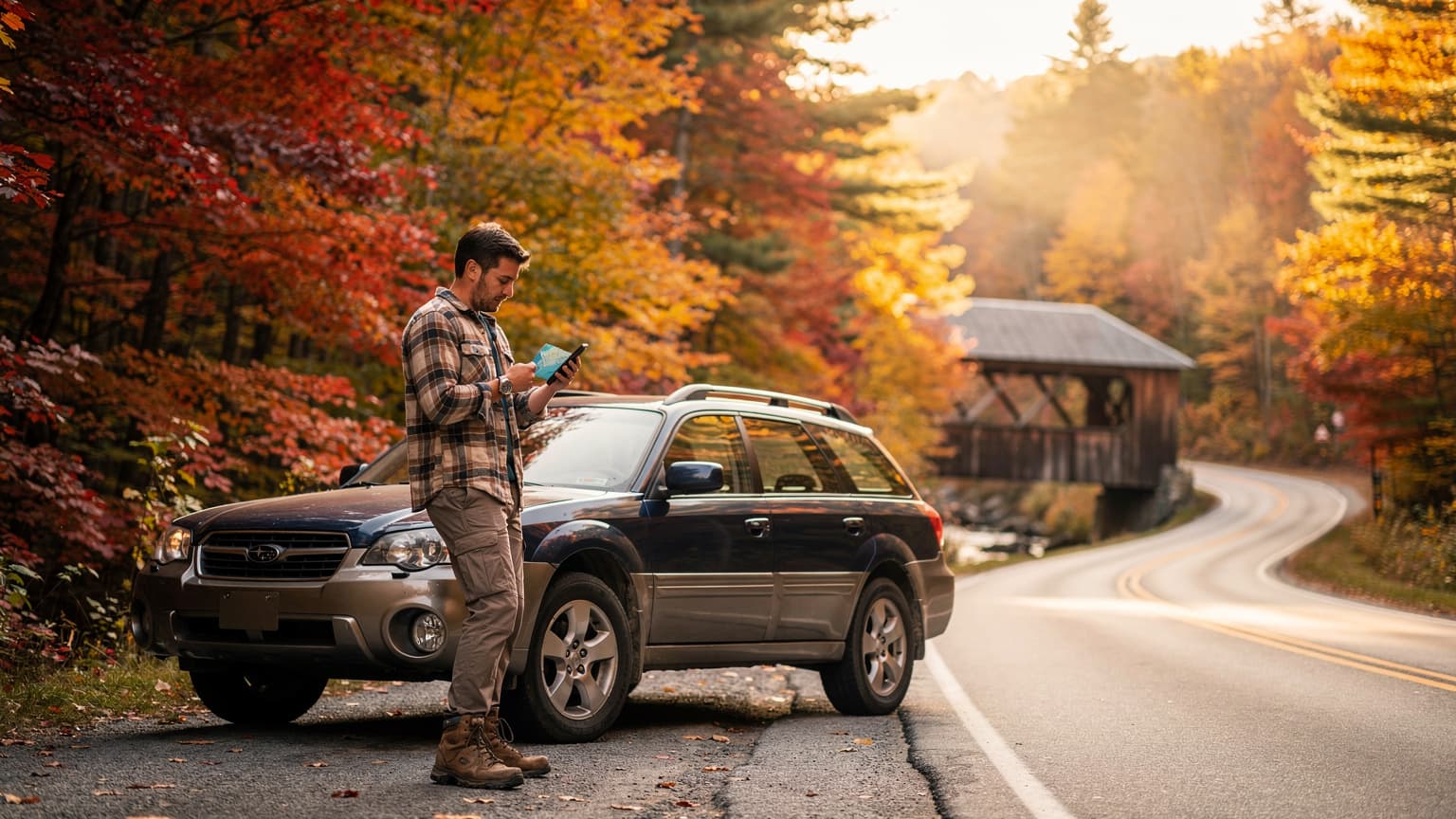
Planning a 2026 fall foliage road trip through New England? You'll want an eSIM that can tap into multiple carrier networks. That's your best bet for solid data coverage in those beautiful, but often signal-challenged, rural areas. Think of it as your digital lifeline for navigation and staying in touch.
New England's Connectivity Challenge: Beyond the Cities
New England in autumn is truly stunning, drawing millions to see the leaves change. But those beautiful rolling hills and thick forests that create such amazing views also make cellular service a real headache. Unlike cities, where cell towers are everywhere, rural New England, especially spots like Vermont's Northeast Kingdom, Maine's Aroostook County, or New Hampshire's White Mountains, has a much sparser network.
It's not just about getting a signal, it's about how many cell towers are around and what specific frequency bands they're using. In these less populated areas, carriers often lean on lower frequency bands like 700 MHz (Band 12, Band 17) and 850 MHz (Band 5). These bands are great because they travel further and get through obstacles better. However, they usually offer less bandwidth, meaning slower theoretical data speeds compared to the mid-band (like 1900 MHz Band 2, 2100 MHz Band 4) or super-fast millimeter-wave (mmWave) frequencies you'd find in a city. So, you might have a signal, but trying to live-stream that breathtaking scenic overlook could be a frustratingly slow experience.
If you're counting on your phone for GPS, sharing real-time photos, or even just emergency calls, you absolutely need to understand these network quirks. Your regular physical SIM might work perfectly in Burlington, Vermont, but become useless as you drive into the Green Mountain National Forest. That's exactly why an eSIM, with its flexibility and ability to use multiple carriers, can be a game-changer.
The Myth of Universal Coverage
Plenty of travelers assume their phone will just work everywhere if it works at home. This is a dangerous assumption in places like New England. While big carriers like Verizon, AT&T, and T-Mobile show huge coverage areas on their maps, those maps often show a "best-case" scenario. They don't always factor in hills, local interference, or how far apart cell towers are in remote spots. I've personally seen areas in Vermont's Appalachian Gap where a "strong" signal on paper meant a measly 2 Mbps download and 0.5 Mbps upload. That's barely enough for GPS, let alone a stable video call.
Navigating Dead Zones and Signal Shadows
Road trips on New England's scenic routes, like Vermont's Route 100 or New Hampshire's Kancamagus Highway, are famous for their spotty service. These "dead zones" or "signal shadows" happen because of deep valleys, dense forests, and mountains blocking radio waves. Your phone might suddenly drop from LTE to 3G, or even "No Service," without warning. An eSIM that can switch between available networks, or one that partners with several local providers, gives you a huge advantage. It essentially stitches together a more reliable coverage area from different networks. It's like having several flashlights when you're exploring a dark cave, each lighting up a different part.
Understanding eSIM for Road Trips
An eSIM, short for embedded Subscriber Identity Module, is a digital SIM. It lets you activate a cellular plan without needing a physical nano-SIM card. For road trips, especially through varied landscapes like New England, an eSIM offers incredible flexibility and convenience. Instead of swapping physical SIMs when you cross state lines or find a different carrier with better local coverage, you just activate a new data plan digitally.
The real beauty of an eSIM for travelers is its ability to hold multiple profiles. You can keep your main physical SIM active for calls and texts (super handy for getting those one-time passcodes or calls from your bank) while using an eSIM purely for data. Most modern smartphones (iPhone XS and newer, many Samsung Galaxy S/Note series, Google Pixels, etc.) support this dual-SIM, dual-standby (DSDS) feature. It means you can switch data profiles smoothly without touching a physical card. If you're new to this, our guide What Is an eSIM? The Complete 2026 Guide to How It Works, Pros, & Cons breaks it all down.
Benefits of eSIM over Physical SIMs
- Instant Activation: Buy a plan online and activate it with a QR code or by typing in details. It often takes just minutes. No need to visit a store or wait for mail.
- Multi-Carrier Flexibility: Easily swap data plans from different carriers or eSIM providers if one offers better coverage in a specific spot. This is vital for New England's tricky terrain.
- Dual SIM Functionality: Keep your home number for calls/texts while using the eSIM for data. This helps you avoid pricey international roaming if you're visiting from Canada or overseas.
- Eco-Friendly: Less plastic waste from physical SIM cards.
- Security: An eSIM can't be physically removed from your phone, adding an extra layer of security against theft or loss.
Potential Limitations of eSIM
- Device Compatibility: While many phones support eSIM now, older models might not. Always double-check your device's specs.
- Setup Complexity: It's usually simple, but some users might find the initial setup a bit more involved than just popping in a physical SIM, especially if manual APN settings are needed.
- Data-Only Focus: Many travel eSIMs are data-only. If you need a local New England phone number for calls, you might need another solution or rely on apps like WhatsApp.
Carrier Landscape in New England: The Big Three and Their Bands
New England's cell service mostly runs on the three big US carriers: Verizon, AT&T, and T-Mobile. Each has its good points and bad points, especially when you consider the region's diverse landscape. Knowing how their networks are built, particularly the frequency bands they use, is crucial for picking a reliable eSIM.
Verizon: Historically, Verizon was strong in rural areas thanks to its old CDMA network. Now, they've aggressively converted their spectrum for LTE and 5G. Key bands for Verizon in New England include: LTE Band 13 (700 MHz) for wide coverage and getting signal into buildings, LTE Band 4/66 (1700/2100 MHz) for capacity, and LTE Band 2 (1900 MHz). For 5G, they use n5 (850 MHz) a lot for broad coverage and n2/n66 (1900/1700/2100 MHz) for faster speeds. In some city centers, like Boston or Portland, you might even find n77 (C-Band, 3.7 GHz) or mmWave (n260, n261) offering blazing-fast speeds, but these are rare outside major urban areas.
AT&T: AT&T also has solid rural coverage, often going head-to-head with Verizon. Their main LTE bands include: Band 17 (700 MHz, often combined with Band 12) for reach, Band 2 (1900 MHz), and Band 4/66 (1700/2100 MHz) for capacity. Their 5G rollout primarily uses n5 (850 MHz) for sub-6GHz nationwide coverage, with n77 (C-Band) in more populated areas. AT&T often provides excellent coverage along major interstates and state routes.
T-Mobile: T-Mobile used to be weaker in rural spots, but they've made huge progress, especially after buying Sprint. Their extended range LTE relies heavily on Band 71 (600 MHz), which travels really well, making it perfect for New England's sprawling rural areas. They also use Band 12 (700 MHz), Band 2 (1900 MHz), and Band 4/66 (1700/2100 MHz). T-Mobile's 5G strategy is notable for its widespread use of n71 (600 MHz) for broad coverage and n41 (2.5 GHz) for their Ultra Capacity 5G, which offers impressive speeds in more developed areas. For detailed setup, check our guide on T-Mobile eSIM Activation: Your Step-by-Step Guide with QR Codes (2026).
Speed Expectations in Rural vs. Urban New England
It's important to be realistic about data speeds. In a busy city like Boston or Providence, you could easily see 5G speeds from 150 Mbps to over 500 Mbps download on n77 or n41, with uploads around 20-80 Mbps. But as you drive through a charming Vermont village or a remote New Hampshire forest, those numbers drop significantly. On lower frequency LTE bands (B12, B13, B71), you might get 5-30 Mbps download and 1-5 Mbps upload. While that sounds low, it's usually enough for GPS, email, and light browsing. Trying to upload a 4K video to Instagram from a remote overlook, though, might test your patience.
| Carrier | Primary LTE Bands (New England) | Primary 5G Bands (New England) | Typical Rural Download (Mbps) | Typical Urban Download (Mbps) |
|---|---|---|---|---|
| Verizon | B13, B4/66, B2 | n5, n2/n66, n77 (limited) | 5-40 | 100-500+ |
| AT&T | B17/12, B2, B4/66 | n5, n77 (limited) | 4-35 | 90-450+ |
| T-Mobile | B71, B12, B2, B4/66 | n71, n41 (stronger in cities) | 6-50 | 120-600+ |
The Value of Carrier Diversity with eSIM
Considering the strengths and weaknesses of each carrier, an eSIM provider that gives you access to multiple networks is incredibly valuable. If Verizon has a dead zone in a particular Vermont valley, but AT&T has a tower covering it, a multi-network eSIM can automatically (or with a quick manual switch) connect you to AT&T. This drastically reduces the chance of being completely offline, a common worry when you're relying on GPS in unfamiliar, remote areas.
eSIM Providers for New England Fall Foliage: A Technical Comparison
When picking an eSIM for your New England trip, it's not just about finding the cheapest gigabytes. You need a provider that understands the ins and outs of regional connectivity, offering solid network access and flexible plans. Here, we'll compare Cellesim, which combines multiple networks, against a couple of direct carrier eSIMs, focusing on the technical benefits for a fall foliage road trip.
Cellesim: Multi-Network Advantage
Cellesim is what's called a Mobile Virtual Network Operator (MVNO) and an eSIM aggregator. This means they don't own cell towers but instead partner with major carriers to offer service. For New England, Cellesim typically uses Verizon and AT&T networks (and sometimes T-Mobile, depending on the plan and area). This multi-network capability is its biggest perk in places with spotty coverage.
- Network Access: Getting access to multiple underlying networks (like Verizon + AT&T) means better redundancy and coverage in rural spots. If one network is weak, your phone can often hop onto another available partner network.
- Band Support: Since Cellesim uses partner networks, it gets access to all their frequency bands, including the crucial low-frequency bands (B12, B13, B17, B71) that are so important for getting signal through forests and hills.
- Data Speeds: Speeds generally match whatever the underlying carrier's network can deliver, and Cellesim doesn't artificially cap them. Expect speeds typical of the partner network's performance in that specific area.
- VoLTE/VoWiFi: Cellesim usually supports VoLTE on its partner networks, but VoWiFi support can vary by device and plan. Always double-check if voice calls are a must-have.
- Pricing & Flexibility: Plans are often competitive, with different data allowances and durations, making them ideal for a week or two-week fall foliage trip.
Direct Carrier eSIMs: AT&T, Verizon, T-Mobile
Sure, you can buy an eSIM directly from one of the big carriers. But the main downside for a road trip is that you're stuck with just one network's coverage, which, as we've talked about, can be an issue in rural New England.
- AT&T eSIM: Gives you access to AT&T's network. It's strong in many places, but if AT&T has a dead zone, you're out of luck. Speeds can be excellent where coverage is robust, especially on their mid-band LTE and 5G n5/n77.
- Verizon eSIM: Known for solid rural coverage, especially in the Northeast. Verizon's eSIM plans give you direct access to their extensive network. But even Verizon has gaps, and if you hit one, there's no backup.
- T-Mobile eSIM: Excellent for cities and getting much better in rural areas, particularly where Band 71 (600 MHz) is active. Their 5G n41 (2.5 GHz) offers impressive speeds. However, T-Mobile still has noticeable gaps in very remote New England areas where Verizon or AT&T might cover.
| Feature | Cellesim (Aggregator) | Direct Carrier eSIM (e.g., Verizon) | Direct Carrier eSIM (e.g., T-Mobile) |
|---|---|---|---|
| Underlying Network(s) | Multiple (e.g., Verizon + AT&T) | Single (Verizon) | Single (T-Mobile) |
| Rural Coverage Reliability | High (due to network switching) | Good (but single point of failure) | Improving (strong with B71, but gaps exist) |
| Primary Bands Utilized | All available from partner networks | B13, B4/66, B2 (LTE); n5, n2/n66 (5G) | B71, B12, B2, B4/66 (LTE); n71, n41 (5G) |
| VoLTE Support | Generally yes, depends on partner | Yes | Yes |
| VoWiFi Support | Variable, check specific plan | Yes | Yes |
| Pricing | Competitive, flexible packages | Standard carrier rates, often higher for short-term data | Standard carrier rates, often higher for short-term data |
| Activation Difficulty | Easy (QR code) | Easy (QR code/app) | Easy (QR code/app) |
Considerations for Purchasing an eSIM for the US
When you're looking for a US eSIM, prioritize providers who clearly state which networks they use. Some might only partner with one, which defeats the purpose of having multiple networks. Also, check how long the data plan is valid. A 30-day plan might be too much for a 5-day trip, but a 7-day plan could be too short if your plans get extended.
Maximizing Rural Coverage: Carrier Aggregation and Band Prioritization
It's not just about having a low-frequency band available. How your phone and the network actually use those bands makes a huge difference in real-world performance. This is where Carrier Aggregation (CA) and band prioritization become super important, especially in New England's varied terrain. Think of it like this: one lane on a highway is fine, but merging two or three lanes allows for much more traffic flow.
Carrier Aggregation: The Key to Speed in the Sticks
Carrier Aggregation (CA) is a technology in LTE and 5G that lets your phone combine several frequency blocks, or "component carriers," from the same or different frequency bands. This boosts data speeds and capacity. For example, instead of just using one 10 MHz block of Band 12, a capable phone in an area with good network density might combine that with a 15 MHz block of Band 4. This effectively creates a wider data pipe, significantly increasing speeds even in rural areas.
In rural New England, where fast, high-capacity bands are scarce, CA often involves linking a low-band "anchor" (like Band 12/13/71) with a mid-band component (Band 2/4/66). While this won't give you city-level 5G speeds, it can improve performance from barely working to comfortably usable (e.g., 8-15 Mbps download instead of 2-5 Mbps). Most modern smartphones (iPhone 11+, Galaxy S10+, Pixel 4+) are good at CA, but its effectiveness completely depends on the network having multiple bands at a given cell tower and your eSIM provider letting you access all those aggregated bands.
Band Prioritization and Network Selection
Your phone, working with the network, constantly decides which bands to use. Generally, lower frequency bands are preferred for making the initial connection and keeping a signal over long distances, while mid and high bands are added via CA for more capacity and speed. An eSIM that can tap into multiple underlying networks gets an inherent advantage here. If one carrier's network (say, AT&T) has a stronger Band 12 signal that also combines with Band 2 for CA, while another (say, Verizon) only has a weak Band 13, your device, through a multi-network eSIM, can intelligently switch to the stronger, better-performing network.
Some tech-savvy users with rooted Android phones or special tools can manually prioritize bands, but for most travelers, choosing an eSIM provider with strong multi-network partnerships is the easiest way to leverage this.
Voice/WiFi and VoLTE: The Importance of Voice Over Data
While data for maps and social media is often the main concern, reliable voice communication is just as crucial, especially on a road trip where signal can be unpredictable. This is where VoLTE and VoWiFi come in, changing how voice calls work over cellular and Wi-Fi networks.
VoLTE: Voice over LTE
VoLTE (Voice over LTE) lets you make voice calls over the LTE data network, instead of falling back to older 2G or 3G networks. This means clearer calls (HD Voice), quicker call connections, and the ability to use data at the same time you're on a call. Importantly, many 2G and 3G networks are being shut down in rural New England. If your eSIM or phone doesn't support VoLTE, you might find yourself unable to make or receive calls in areas where only LTE (or 5G) data is available. This is a big problem that can leave you without voice communication.
Most modern eSIM providers and their underlying carriers support VoLTE by default. However, some specific phone models, especially unlocked ones bought internationally, might have trouble activating VoLTE on US networks due to how they're provisioned. Always confirm VoLTE support with your eSIM provider if voice calls are essential.
VoWiFi: Voice over WiFi
VoWiFi (Voice over WiFi), also known as Wi-Fi Calling, is a handy technology that lets you make and receive calls and texts over a Wi-Fi network when your cellular signal is weak or non-existent. This is incredibly useful if you're staying at a charming, rustic inn in a deep valley with no cell service but a strong Wi-Fi connection. It essentially extends your cellular service over Wi-Fi, using your regular phone number.
VoWiFi support varies more than VoLTE. It depends on your phone, the underlying carrier, and the eSIM provider. While many direct carrier eSIMs (Verizon, AT&T, T-Mobile) support VoWiFi out of the box, some third-party eSIMs might not. If you expect to stay in remote lodges or areas with known cell dead zones, checking for VoWiFi support is a must. It's a lifesaver when you need to call roadside assistance but have no cell signal.
APN Settings and Edge Cases: What to Watch For
Usually, activating an eSIM is a breeze, often just a QR code scan. But sometimes, especially with certain phone models or network setups, you might need to manually tweak your APN (Access Point Name) settings. The APN acts as a gatekeeper between your carrier's cellular network and the internet. Incorrect settings can mean no data, even if your phone shows full signal bars.
What is an APN?
An APN tells your phone the IP address, authentication details, and other necessary information to connect to the internet through your cellular provider. Think of it like your network's address book for data.
When might you need to adjust APN settings?
Most eSIMs automatically set up APN settings when you install them, but here are a few situations where you might need to do it yourself:
- Older Android Devices: Some older or less common Android phones might not always automatically detect and apply the correct APN settings, especially with MVNOs or international eSIMs.
- Specific Data-Only Plans: Some specialized data-only eSIMs, particularly those made for IoT devices or specific business uses, might require you to enter APN details manually.
- Dual-SIM Conflicts: Occasionally, if you're running a complex dual-SIM setup (physical SIM plus multiple eSIMs), one profile's APN might clash with another, requiring manual adjustment.
- Troubleshooting No Data: If you've activated your eSIM, have signal, but no data, checking and possibly re-entering APN settings is often the first thing to try.
How to find and adjust APN settings (General Steps):
The exact menu options can vary slightly by phone brand and operating system, but the general process is similar.
- iPhone (iOS):
Go to Settings > Cellular > Cellular Data Network. If your eSIM is active, you'll see its specific settings there. Look for fields like 'APN', 'Username', 'Password'. Your eSIM provider will give you these details if manual entry is needed. - Android:
Go to Settings > Network & internet (or Connections) > Mobile network > Advanced > Access Point Names (APN). You might see a list of APNs. You can add a new APN by tapping the '+' or 'Add' button and entering the details from your eSIM provider. Remember to save and select the new APN.
Some Google Pixel users have reported small APN issues with certain international eSIMs, especially concerning networks that are IPv6-only. If your data feels slow or cuts out completely, make sure your APN type is set to 'default,supl' and, if your eSIM carrier provides it, specify the 'APN protocol' to 'IPv4/IPv6' instead of just 'IPv6'. This is especially true if the network might be using CGNAT (Carrier-Grade Network Address Translation), which often relies on IPv4 infrastructure for external routing.
E-E-A-T Approved eSIM Selection Criteria
As someone who spends a lot of time in remote places, sometimes even live-streaming from events like Burning Man where network congestion is standard, I've developed strict rules for picking connectivity solutions. For your New England fall foliage trip, where reliable data is essential for navigation, sharing, and safety, these E-E-A-T (Expertise, Experience, Authoritativeness, Trustworthiness) principles are non-negotiable.
- Multi-Network Roaming Capability: This is my absolute top priority. An eSIM that can dynamically switch between AT&T, Verizon, and possibly T-Mobile (or at least two of them) provides a critical safeguard against the rural dead zones common in New England. Look for clear statements from the eSIM provider about their network partnerships.
- Transparent Pricing and Data Allowances: Clear, upfront pricing with no hidden fees. Make sure the data allowance matches how long your trip is and how much data you expect to use. For a week-long road trip with GPS, photo uploads, and a bit of streaming, I'd suggest at least 10-15GB.
- VoLTE Support: As we covered, 2G/3G networks are being phased out. Without VoLTE, your voice calls could be unreliable or impossible in LTE-only areas. Confirm this feature is supported by the eSIM for the US market.
- Easy Activation Process: QR code activation is the best. Avoid providers that require complicated manual setups unless you're comfortable troubleshooting. This saves precious time when you're eager to get on the road.
- Reliable Customer Support: If something goes wrong, you need quick help. Look for providers with 24/7 chat support. Being stranded in the middle of nowhere without data and no way to contact support is a nightmare.
- Positive User Reviews (Specific to Rural US): General good reviews are fine, but prioritize feedback from people who have actually used the eSIM in rural US areas or similar challenging environments. Their insights are the most valuable.
Installation and Troubleshooting for Your eSIM
Getting your eSIM ready for your New England adventure is usually quite simple. Most providers aim for a smooth experience. However, knowing the steps and basic troubleshooting can save you a lot of frustration if you hit a snag.
eSIM Installation Procedure
Here's a general guide for installing an eSIM, which works for most modern smartphones:
- Purchase Your eSIM Plan: Pick a suitable plan for the US from a trusted provider like Cellesim. You'll typically get an email with a QR code or manual installation instructions.
- Ensure Wi-Fi Connectivity: You'll need an active Wi-Fi connection to download the eSIM profile to your phone. Do this before you leave home or your hotel.
- Access eSIM Settings:
- iPhone (iOS): Go to Settings > Cellular > Add eSIM.
- Android: Go to Settings > Network & internet (or Connections) > Mobile network > Add eSIM (or Download a SIM).
- Scan QR Code (Recommended): Most providers offer a QR code. Use your phone's camera to scan it when prompted. Follow any on-screen instructions. If the QR code doesn't work, there's usually an option for manual entry where you'll type in the SM-DP+ Address and Activation Code.
- Label Your eSIM: Once installed, your phone will ask you to name the eSIM (e.g., "New England Data," "Travel eSIM"). This helps you tell it apart from your main SIM.
- Set Data Preference: Go to your cellular settings and make the newly installed eSIM your primary line for cellular data. You can usually keep your physical SIM active for calls/texts if you need to.
- Enable Data Roaming (if applicable): For some travel eSIMs, especially those that roam on partner networks, you might need to manually turn on 'Data Roaming' in your cellular settings for that specific eSIM profile.
Basic eSIM Troubleshooting Steps
If your eSIM isn't working right, try these steps:
- Restart Your Phone: The classic tech fix, but it often works. A fresh reboot can sometimes clear up network registration problems.
- Check APN Settings: As we discussed, incorrect APN settings are a common problem. Double-check them against your provider's instructions.
- Toggle Airplane Mode: Turn on Airplane Mode for 30 seconds, then turn it off. This forces your phone to reconnect to the network.
- Ensure Data Roaming is Enabled: For international eSIMs or those that roam domestically, data roaming must be on for the eSIM profile to work.
- Verify eSIM is Selected for Data: In your phone's cellular settings, confirm that the correct eSIM profile is chosen for cellular data.
- Check Plan Validity/Data Balance: Log into your eSIM provider's app or website to make sure your plan is still active and you haven't used all your data.
- Contact Customer Support: If nothing else works, reach out to your eSIM provider's support team. They can check network status and your account. Many providers, including Cellesim, offer 24/7 chat support, which is often the fastest way to solve issues. You can usually find a link to their FAQ or support pages on their website.
Final Thoughts on Your Connected Fall Foliage Adventure
A New England fall foliage road trip is an unforgettable experience, a feast for your senses with vibrant colors, crisp air, and charming towns. But the beauty of these rural landscapes often comes with spotty cell service. The old idea that one carrier's physical SIM will be enough for a multi-state journey just isn't realistic for today's mobile networks in these areas.
By choosing a smart eSIM, especially one with multi-network access like Cellesim, you're not just buying data - you're investing in peace of mind. You're making sure your GPS works when you're deep in the White Mountains, that you can upload that amazing photo of a Vermont covered bridge, and most importantly, that you can make an emergency call if needed, even when traditional signals drop. Understanding carrier bands, the power of carrier aggregation, and the importance of VoLTE aren't just techy details; they're practical tools for a truly smooth and enjoyable trip.
So, as you pack your bags, get your car ready, and plan your scenic drives through New England's fiery landscapes, don't forget your digital data lifeline. A little eSIM preparation will ensure you can focus on the breathtaking beauty around you, not on hunting for a signal bar. Happy leaf-peeping, and stay connected!