Understanding Africa's Network Landscape
Africa's mobile network setup is incredibly varied. You'll find stark differences between big cities like Lagos and Johannesburg and the wide-open spaces of the Kalahari Desert. When we talk about staying connected, it’s not just about whether you get a signal, but how that signal is delivered, which really shapes your experience.
Many African countries have quickly adopted 4G LTE. 5G is still fairly new, mostly popping up in major cities. In South Africa, for example, Vodacom and MTN lead with solid LTE coverage (Bands 1, 3, 8, 20) and are rolling out 5G (n78, n1, n3). On the other hand, countries like Tanzania and Kenya still rely heavily on LTE Bands 3 and 7 for their main data, with older 2G/3G networks acting as a crucial backup in rural spots. This means making sure your phone supports the right bands is super important.
Because network development is so different from place to place, an eSIM gives you flexibility, but its performance really comes down to the local carrier it partners with. Your eSIM provider typically works with a local Mobile Network Operator (MNO) to give you service. Your phone then connects to the strongest compatible cell tower, ideally using LTE for data. If you’re heading to very remote areas, like for Norway's Mountain Hikes, you’ll face similar challenges with network availability.
Key Regional Differences in Connectivity
Africa isn't one big chunk, and each region has its own unique connectivity situation:
- Southern Africa (South Africa, Namibia, Botswana): This region is generally the most advanced. You'll find good 4G LTE in populated areas and along main roads. 5G is starting to appear in cities. Expect download speeds between 30-80 Mbps in urban centers, which will drop to 5-15 Mbps in smaller towns.
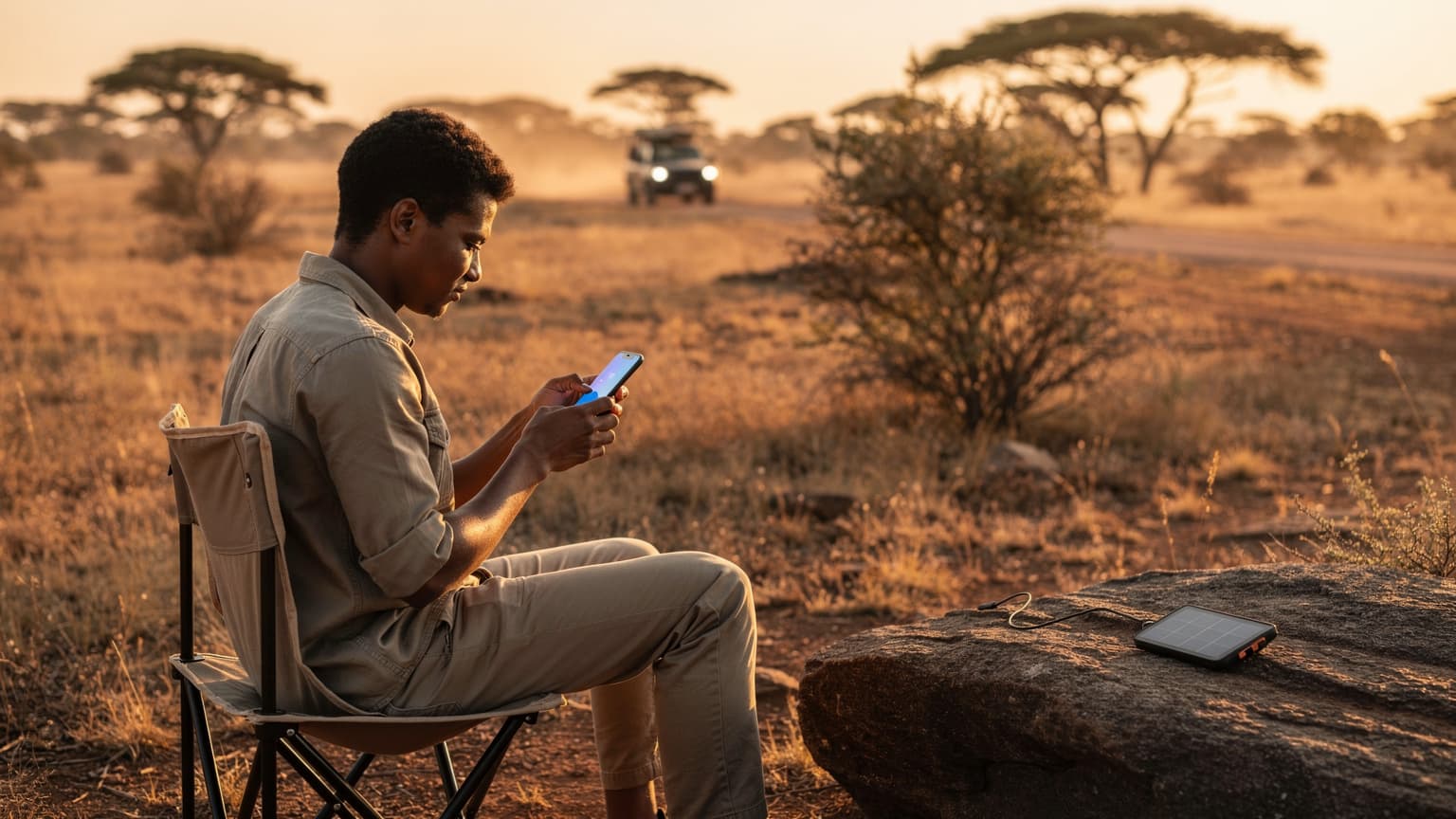
- East Africa (Kenya, Tanzania, Uganda, Rwanda): You'll get moderate to good 4G LTE in major towns and popular tourist spots (like national parks). Speeds can be 20-60 Mbps in cities, but expect a big drop-off in remote areas. Surprisingly, safari routes often have decent coverage from big players like Safaricom and Vodacom, especially on common bands like B3 (1800 MHz) and B7 (2600 MHz).
- North Africa (Egypt, Morocco, Tunisia): Urban and coastal areas have solid 4G LTE. Speeds can hit 40-100 Mbps in cities. However, desert and mountainous regions often have spotty service, frequently falling back to 3G.
- West & Central Africa: This area is more hit-or-miss. 4G LTE is mostly found in capital cities and along key business routes. 2G/3G is still common in rural areas. Data speeds can be very inconsistent.
Why an eSIM for African Safaris and Adventures?
If you're planning an African safari or a trip that crosses multiple countries, an eSIM can turn what used to be a connectivity nightmare into a smooth experience. Imagine landing in Nairobi, driving through the Maasai Mara, and then flying to Zanzibar, all without having to swap physical SIM cards or hunt down local vendors in each new place.
The main reason to get an Africa eSIM is how convenient it is. You activate it once, often before you even leave home, and it automatically connects to a partner network as soon as you arrive in any covered country. This means no more registering new SIMs, a process that can involve passport checks and frustrating delays, especially in countries with strict telecom rules (a big difference from how easy it is to activate an eSIM in places like Greece or Azerbaijan). It's also a great security feature because you keep your main phone number active for things like two-factor authentication or emergency calls, while using the eSIM just for data.
Beyond convenience, eSIMs are usually cheaper for multi-country trips compared to buying individual local SIMs. While a single local SIM might be cheaper for a long stay in one country, the total cost and effort for five or six countries quickly makes a multi-country eSIM the better choice. Plus, you avoid potential language barriers when buying and activating a local SIM.
Common Travel Scenarios Where eSIM Shines
- The East African Safari Circuit: Traveling from Kenya to Tanzania for a Serengeti safari, then perhaps to Uganda for gorilla trekking. An eSIM covers all these nations with one plan, giving you continuous GPS for apps like Maps.me (which works offline but is better with live traffic) and letting you instantly share wildlife photos.
- Southern Africa Road Trip: Driving from Cape Town, South Africa, through Namibia's Etosha National Park, and into Botswana's Okavango Delta. An eSIM lets you keep data access across these borders, which is crucial for booking places to stay, checking park entry rules, and staying safe.
- North African Cultural Immersion: Exploring the souks of Marrakech, the pyramids of Giza, and the ruins of Carthage. Your eSIM makes sure you can call Ubers, translate phrases, and find local restaurants without interruption.
The Technical Nuts and Bolts: Carrier Bands and Coverage
As a telecom engineer, I can tell you that an eSIM connecting you across borders isn't just magic software. It's all about radio frequency compatibility. Your phone needs to "speak the same language" as the local cell towers. This language is defined by cellular bands, which are specific frequencies set aside for mobile communication. If your phone doesn't support the right bands, even the best eSIM won't work.
Most modern smartphones, like the iPhone 18 and Galaxy S26, are global devices that support a huge range of bands. But some regional versions might be missing a few. Before you travel, check your phone's band support against the main LTE bands used in your destination countries. For instance, in many parts of Africa, LTE Bands 3 (1800 MHz), 7 (2600 MHz), 8 (900 MHz), and 20 (800 MHz) are vital. Band 20, a low-frequency band, is great for rural coverage, while Band 7 offers high capacity in cities.
Carrier aggregation (CA) is another factor. This tech lets your phone combine multiple frequency bands for faster theoretical speeds. While common in developed markets, CA isn't always fully deployed in Africa, meaning your top speeds might be limited even if several bands are available. Don't expect the same 300+ Mbps you might get in London or New York.
| Country | Primary 4G LTE Bands | Typical Urban Download Speed (Mbps) | Major Carriers |
|---|---|---|---|
| South Africa | B1, B3, B8, B20, (5G: n78) | 40-120 | Vodacom, MTN, Cell C, Telkom |
| Kenya | B3, B7, B20 | 25-70 | Safaricom, Airtel, Telkom Kenya |
| Tanzania | B3, B7 | 20-60 | Vodacom, Airtel, Tigo |
| Morocco | B3, B7, B20 | 30-90 | Maroc Telecom, Orange, Inwi |
| Egypt | B3, B7, B20 | 30-80 | Vodafone, Orange, Etisalat, WE |
APN Settings and Device Compatibility
Most eSIMs from good providers set up the Access Point Name (APN) settings automatically. However, some older Android phones or specific models (especially certain ones from the Chinese market) might need you to set the APN manually. If your eSIM says 'no service' even with a strong signal, check your APN settings. Your eSIM vendor usually provides the correct APN, which is almost always 'internet' or a specific carrier APN like 'data.live.com'. (Sometimes, it's something as simple as an accidental setting change, as explained in Why Your eSIM Shows No Service).
Also, make sure your device is unlocked. Phones locked to a specific carrier won't work with any eSIM that isn't from that original carrier, no matter where you are. This isn't as common in 2026, but it can still be a problem for older or subsidized phones.
Evaluating Multi-Country eSIM Providers
Picking the right multi-country eSIM for Africa means looking beyond just how many gigabytes you get. It’s about understanding who the provider partners with for networks, what kind of support they offer, and how they handle data in a region where connectivity can be a bit unpredictable.
When you're comparing providers, look for clear information about their local network partners. A provider that openly states, for example, 'Partners with Safaricom in Kenya and Vodacom in South Africa' gives you confidence because you know you'll be connecting to well-established, reliable networks. Generic phrases like 'local networks' can be a red flag, as it might mean they use smaller, less robust carriers.
Also, think about how long the data plans are valid and if you can easily top up. Many African trips last several weeks, so you'll want an eSIM that offers plans matching your travel duration or, at least, allows for easy, real-time top-ups if you use more data than you planned. Some providers even have regional bundles, like an 'East Africa' or 'Southern Africa' package, which are often cheaper than a global plan if you're staying in a specific sub-region.
What to Look For in a Reliable eSIM Plan
- Wide Country Coverage: Does the plan include all the specific countries you plan to visit? Some 'Africa' plans might leave out important nations.
- Trusted Local Partners: Do some research on the local carriers they mention. Are they known for good coverage and speed where you'll be traveling?
- Flexible Data Packages: Look for options for 7, 15, or 30+ days, with different data amounts (e.g., 5GB, 10GB, 20GB).
- Easy Top-Up Process: Can you easily add more data using the provider's app or website?
- Customer Support: 24/7 support is essential for troubleshooting issues, especially across different time zones.
Optimizing Your eSIM for Data Speeds and Reliability
Even if you pick a great eSIM, getting the best data speeds and reliable service across Africa needs a bit of effort on your part. Network conditions are rarely consistent; what works perfectly in a city might struggle in a national park.
First, always keep your phone's software updated. Firmware updates often include improvements to how your phone handles networks and uses different bands. Second, understand your phone's network mode settings. Most phones default to 'LTE/3G/2G auto,' which is usually fine. However, if you're in an area with weak LTE but strong 3G, manually forcing 3G can sometimes give you a more stable, though slower, connection (check Settings > Mobile Network > Preferred Network Type). On the flip side, if you're in a known LTE area but getting slow speeds, forcing 'LTE only' can prevent your phone from dropping to a congested 3G network.
Remember that data speeds are always "best-effort." While a carrier might advertise up to 100 Mbps, that's the absolute theoretical maximum. Real-world speeds depend on how busy the network is, signal strength, physical obstructions (like dense jungle foliage or thick city walls), and even the quality of the cell tower's internet connection. I've seen situations where a major carrier's B3 LTE tower in a small Tanzanian town struggled to deliver more than 8 Mbps because too many people were using it, while a remote B20 site offered a consistent 20 Mbps with fewer users.
| Optimization Technique | Benefit | Consideration |
|---|---|---|
| Manual Network Selection | Choose strongest available network partner if auto-switch is poor. | Requires knowledge of local carriers; can drain battery. |
| Preferred Network Type (LTE/3G/2G) | Force a specific generation for stability or speed. | 'LTE Only' might prevent calls if VoLTE isn't provisioned. |
| Data Roaming ON | Essential for eSIM to connect to partner networks. | Verify eSIM is active, not your home plan. |
| Disable Background App Refresh | Conserves data, reduces network traffic. | Some apps may not update without manual refresh. |
| Download Offline Maps | Reduces reliance on live data for navigation. | Requires upfront planning and storage space. |
Managing Data Consumption on the Go
Data can disappear quickly, especially when you're uploading high-resolution photos and videos from your safari. Here are some tips:
- Keep an Eye on Usage: Regularly check your data usage through your phone's settings or the eSIM provider's app. This helps you know when you might need a top-up.
- Use Wi-Fi: Whenever you find Wi-Fi at a hotel, lodge, or cafe, use it for big downloads, updates, or video calls. Just remember to be careful about public Wi-Fi security.
- Stream in Lower Quality: If you're watching videos, choose lower resolutions to save data.
- Update Apps Before You Go: Download all necessary app updates before you leave home or when you have a strong, unlimited Wi-Fi connection.
VoLTE and VoWiFi Gotchas: What You Need to Know
Voice over LTE (VoLTE) and Voice over Wi-Fi (VoWiFi) are standard features on most modern smartphones. They let you make high-quality voice calls using your data connection instead of older, traditional phone networks. But when you’re using an eSIM in Africa, these can be tricky.
Most data-only eSIMs don't support VoLTE or VoWiFi. This means you won't be able to make or receive calls directly using your eSIM line. Your primary SIM (your home number) will still work for calls and texts, but it will be roaming, and that will likely cost you a lot. This is a crucial difference: your eSIM handles data, and your home SIM handles traditional calls and SMS.
If you need to make calls on your travel line, you’ll either need an eSIM that specifically says it supports VoLTE, or you'll have to rely on apps like WhatsApp, Signal, or Google Meet, which use your eSIM's data connection. Even if an eSIM technically supports VoLTE, its availability depends on the roaming agreements with local carriers. Not all local carriers allow VoLTE for incoming roaming partners, even if their own customers use it.
Implications for Emergency Services and Local Contacts
Without VoLTE on your eSIM, calling local emergency numbers (like 999 in Kenya or 112 in South Africa) could be a problem if your primary SIM is off or has no roaming credit. Always have a backup plan, like a local’s phone or credit on a VoIP app. For example, in an emergency on safari, your lodge or tour operator will usually have satellite phones or reliable local lines, but personal connectivity is still important. This is a key part of safe travels, much like understanding local advisories for places like the United Kingdom.
Another common situation: trying to call a local guesthouse or tour guide. If they don't use WhatsApp or another VoIP app, you'll need a traditional calling method. This is where a phone with two SIMs (a physical SIM slot plus an eSIM, or two active eSIMs) comes in handy, letting you have a local voice SIM alongside your data eSIM.
Troubleshooting Common eSIM Issues in Africa
Even seasoned travelers can run into issues with eSIMs sometimes. While they're generally reliable, Africa's diverse network environment means your eSIM might not always work as expected. Knowing how to troubleshoot can save you a lot of stress.
- Restart Your Device: This is the first thing to try for almost any tech problem. A simple reboot often fixes temporary network registration issues.
- Check Data Roaming Settings: Make sure data roaming is turned on for your eSIM profile in your phone's cellular settings. People often forget this one.
- Verify APN Settings: Double-check that the Access Point Name (APN) is set correctly. While it's usually automatic, you might need to set it manually (especially on some Android models). Your eSIM provider will give you the correct APN.
- Manually Select Network: Instead of letting your phone pick a network automatically, try choosing one of your eSIM provider's partner networks manually. Sometimes your phone might try to connect to a weaker, non-partner network.
- Disable/Enable eSIM Profile: Turn your eSIM profile off and then back on in your phone's settings. This can force it to re-register with the network.
- Contact Support: If nothing else works, reach out to your eSIM provider's customer support. Have your order details and the specific country you're in ready.
Navigating CGNAT and IPv6-Only Networks
For advanced users, there's a subtle but important technical detail: Carrier-Grade Network Address Translation (CGNAT) and IPv6-only networks. Many mobile networks, especially those serving a huge number of users in developing regions, use CGNAT to save IPv4 addresses. This means your device won't have a unique public IPv4 address, which can affect certain specific applications like port forwarding or direct P2P connections. For most travelers, this isn't an issue, but if you work remotely and rely on specific VPN setups, it's something to be aware of.
Similarly, some African carriers are slowly moving to IPv6-only networks. While modern devices and apps handle this fine with IPv6-to-IPv4 translation, older apps or certain VPN clients might have problems. If a particular application isn't working, check if it's IPv6 compatible. This also applies to services for Family eSIM Plans, where parental control apps might be affected.
Cost Analysis: eSIM vs. Local SIMs
When you're planning your African trip, how much connectivity costs is often a big worry. Let's break down whether eSIMs or traditional local SIM cards are more cost-effective.
For a trip to just one country lasting more than a week, a local SIM card can often be the cheapest choice. For example, a 10GB data plan from Safaricom in Kenya might cost around KES 1,000 (about USD 7-8) for 30 days. That's tough to beat for a long stay in a single country. But if you need to travel to multiple countries, that convenience factor disappears.
The situation changes completely when you're crossing borders. Imagine a three-week trip through South Africa, Botswana, and Zambia. With local SIMs, you'd be looking at: buying a SIM in South Africa, maybe ZAR 150 (USD 8); then another in Botswana, BWP 50 (USD 3.50); then another in Zambia, ZMW 100 (USD 4). Each purchase means finding a shop, possibly waiting in line, showing your ID, and dealing with activation, which can easily take half a day per country. Plus, you end up with leftover data on each SIM you won't use. The total cost might look lower on paper, but the time and hassle cost is huge.
An Africa multi-country eSIM, covering 15-20+ nations, typically costs between USD 25-50 for 5-10GB of data over 30 days. While this is a bit more than the raw data cost of a single local SIM, this one-time purchase removes all the friction and uncertainty of repeatedly buying local SIMs. It's a premium for convenience and peace of mind, especially when you're on a tight safari schedule or trying to navigate unfamiliar cities.
| Factor | Multi-Country eSIM | Local Physical SIM (per country) |
|---|---|---|
| Initial Cost (Data) | USD 25-50 for 5-10GB (30 days) | USD 5-15 for 5-10GB (30 days) |
| Convenience | High (activate once, seamless border crossing) | Low (purchase, register, activate in each country) |
| Time Investment | Minimal (QR scan) | High (travel to store, wait, paperwork) |
| Network Reliability | Relies on partner roaming agreements (major carriers) | Direct access to local primary network |
| VoLTE/VoWiFi Support | Rarely included (data-only) | Usually included (local calls/SMS) |
| Primary Number Access | Maintains home number for calls/SMS | Replaces home number, potential for missed calls/SMS |
Hidden Costs and Benefits
Think about the "hidden costs" of local SIMs: taxi fare to a phone shop, possibly being overcharged by shady vendors, or the data you waste when you swap out a partially used SIM. Then there are the "hidden benefits" of an eSIM: always having data for ride-sharing apps (Bolt is very popular in many African cities), instant access to emergency info, and the ability to smoothly use navigation or translation tools. These things can really improve your travel experience and safety, and they often outweigh the small difference in cost per gigabyte.
Future-Proofing Your African Connectivity for 2027 and Beyond
Mobile network technology moves incredibly fast, and Africa is keeping pace. As we look ahead to 2027 and beyond, a few key trends will change how we stay connected on the continent.
5G Expansion: While 5G is currently limited, its deployment (mostly on the n78 band in most urban African markets) will continue to grow in major cities and business centers. This means even faster speeds and lower latency, though widespread rural 5G coverage is still years away. For travelers, this mainly means quicker downloads and smoother streaming in capital cities like Nairobi, Johannesburg, or Cairo.
Satellite Connectivity Integration: The rise of satellite-to-phone services from companies like Starlink, and even direct integration from Apple and Qualcomm, will provide internet in extremely remote areas. Think deep inside national parks or vast deserts where regular cell towers aren't feasible. Initially, this will be expensive and probably limited to emergency services or low-bandwidth messaging. Eventually, though, this technology will boost traditional networks for true "anywhere" connectivity. This could be a game-changer for safety in remote regions, much like how eSIMs offer peace of mind even when traditional signals are weak.
Greater eSIM Adoption: As more phone manufacturers get rid of physical SIM trays entirely, eSIM-only devices will become the norm. This will further push down the price of eSIM plans and increase competition among providers, leading to even better options for travelers. Activating an eSIM will become even simpler, almost like installing a new app.
Preparing for Your Next Adventure
When you're getting ready for your next African safari or multi-country trip, always:
- Check Device Compatibility: Make sure your phone supports eSIM and the necessary bands for where you're going.
- Research Providers: Look for providers with strong network partnerships and good reviews for the specific countries you'll visit.
- Understand Plan Details: Pay close attention to data limits, how long the plan is valid, and your top-up options.
- Consider a Backup: Even with an eSIM, carrying a local physical SIM for calls or a second eSIM for redundancy can be a smart move, especially for critical trips.
Africa is a continent full of unmatched beauty and adventure. With the right eSIM, you can focus on the stunning landscapes and vibrant cultures, confident that you'll stay connected every step of the way.
Frequently Asked Questions
Will my phone work with an eSIM in every African country?
Most modern smartphones are globally compatible with eSIM technology. However, network band support varies by country. Always check that your phone supports the primary LTE bands (e.g., B3, B7, B20) used by major carriers in your specific destination countries to ensure optimal connectivity.
Is an eSIM cheaper than buying local SIM cards in Africa?
For multi-country travel across Africa, an eSIM is generally more cost-effective and convenient than purchasing individual local SIM cards in each country. While a single local SIM might offer a lower per-gigabyte rate for extended stays in one nation, the cumulative cost and hassle of multiple local SIMs make the multi-country eSIM a superior choice.
Can I make phone calls with an African eSIM?
Most multi-country eSIMs for Africa are data-only and do not support traditional voice calls (VoLTE) or SMS. You will need to rely on VoIP apps like WhatsApp or Signal for calls over data, or use your primary SIM for roaming calls (which will incur significant charges). Some specialized eSIMs may offer calling, but this is less common.
What happens if my eSIM loses service in a remote area?
If your eSIM loses service in a remote area, first try restarting your phone and ensuring data roaming is enabled. Manual network selection can also help. In areas without any cellular coverage, no eSIM or physical SIM will work; consider satellite communication devices for extreme wilderness adventures. Your eSIM provider's support can assist with troubleshooting within network range.
How do I activate an eSIM for my trip to Africa?
Activating an eSIM is typically done by scanning a QR code provided by your eSIM vendor, either from your email or their app. Ensure you have a stable Wi-Fi connection during activation. Once installed, activate the eSIM profile in your phone's cellular settings before or upon arrival in Africa, and remember to enable data roaming for that profile.
Are there any specific phone settings I should adjust for an eSIM in Africa?
Beyond ensuring data roaming is on for your eSIM profile, you might occasionally need to manually configure the APN (Access Point Name) if your data isn't working. The correct APN is usually 'internet' or specified by your eSIM provider. Also, keep your phone's software updated and consider manually selecting a network if automatic selection is unstable.
See also: eSIM for Namibia
See also: Botswana eSIM
See also: Zambia eSIM