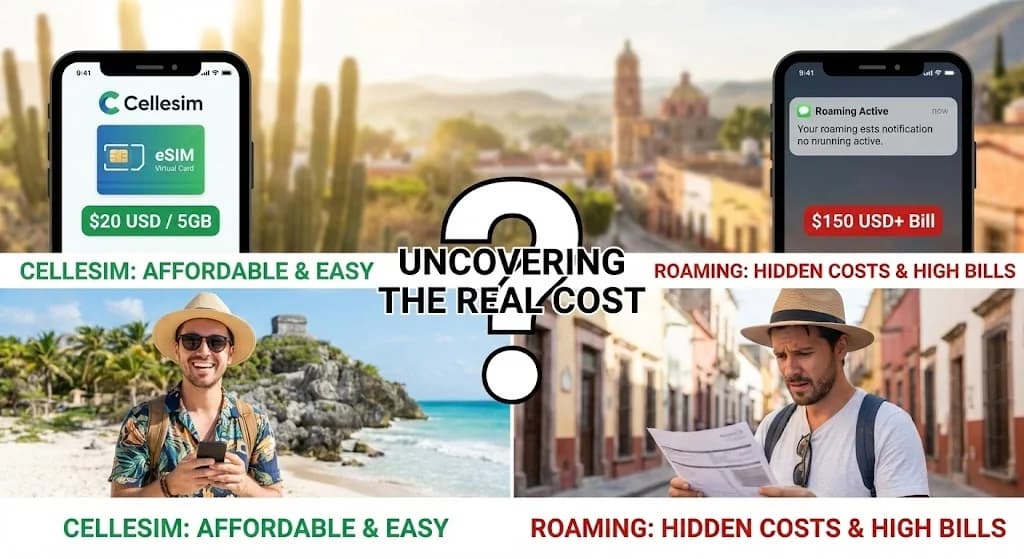
Venturing to Mexico promises a vibrant blend of culture, history, and stunning landscapes. From the bustling markets of Mexico City to the serene beaches of Tulum, staying connected is essential for navigation, sharing experiences, and keeping in touch with loved ones. However, the choice between using your home carrier's roaming services and opting for a modern solution like an eSIM can significantly impact your travel budget and convenience. This guide unveils the true costs and benefits, helping you make an informed decision for your Mexican adventure.
- The High Price of Traditional Roaming in Mexico
- Embracing eSIM: A Smart Alternative for Mexico Travel
- Cellesim vs. Roaming: A Detailed Cost Analysis for Mexico
- Choosing Your Ideal Cellesim Mexico eSIM Plan
- Activating Your Cellesim eSIM for Seamless Mexico Connectivity
- Exploring Network Coverage Across Mexico with eSIM
- Beyond Connectivity: Essential Mexico Travel Tips
- Frequently Asked Questions
Connect Instantly with a Mexico eSIM from Cellesim
Say goodbye to expensive roaming charges. Join 50,000+ happy customers in 200+ countries who trust Cellesim for reliable connectivity.
Get Your Mexico eSIMThe High Price of Traditional Roaming in Mexico
Many travelers assume their existing phone plan will work seamlessly in Mexico. While technically true for most major carriers, the "seamlessness" often comes with a hefty price tag. Traditional international roaming, while convenient for short messages, quickly becomes expensive for data usage, turning casual browsing or map navigation into a financial burden.
Your home carrier typically offers one of two scenarios for international usage:
- **Pay-as-you-go rates:** These are often exorbitant, with data costing several dollars per megabyte. A few minutes of video streaming or a modest social media session can easily rack up charges exceeding $50-$100 in a single day.
- **Daily roaming passes:** These packages offer a fixed amount of data, calls, and texts for a daily fee, often ranging from $10 to $15 per day. While seemingly more manageable, these costs add up rapidly over a week or two, making a two-week trip potentially cost over $140-$210 just for basic connectivity.
Beyond the direct costs, roaming can also come with hidden frustrations. Data speeds might be throttled, or you could be limited to 2G/3G networks, even in urban areas. This can make crucial tasks like ordering a ride-share, checking bus schedules, or translating menus frustratingly slow.
Embracing eSIM: A Smart Alternative for Mexico Travel
eSIM technology provides a modern, flexible, and cost-effective solution for staying connected internationally. An eSIM, or embedded SIM, is a digital SIM card that allows you to activate a cellular plan without needing a physical plastic card. For your trip to Mexico, an eSIM from Cellesim offers several distinct advantages over traditional roaming.
Immediate Connectivity: You can purchase and activate your Cellesim Mexico eSIM before you even leave home. Upon arrival, your phone connects to a local network automatically, eliminating the need to search for a local SIM card vendor at the airport or deal with language barriers. This means you can order your first ride or look up directions the moment you land.
Significant Cost Savings: Cellesim offers data plans specifically tailored for Mexico at local rates, which are dramatically lower than international roaming charges. You only pay for the data you need, without inflated daily fees or per-MB charges. Our Roaming Savings Calculator can help you visualize these savings.
Flexibility and Control: With an eSIM, you maintain full control over your connectivity. You can easily switch between your home network (for calls/texts if needed) and your Cellesim eSIM for data. Monitoring your data usage and topping up your plan is straightforward through the Cellesim app or website.
No Physical SIM Swapping: Forget about tiny SIM cards, ejection tools, or the risk of losing your primary SIM. eSIMs are entirely digital, making the process clean and hassle-free. Ensure your device is eSIM compatible before purchasing.
"Using an eSIM in Mexico was a game-changer. I landed, turned on my phone, and was instantly connected. No stress, no searching for SIM cards, just pure convenience."
Cellesim vs. Roaming: A Detailed Cost Analysis for Mexico
To truly understand the value, let's compare the financial implications of using Cellesim eSIM versus typical carrier roaming for a standard trip to Mexico. We'll consider a 7-day trip with moderate data usage (e.g., 5-10 GB for maps, social media, light streaming).
| Option | Price (7 days) | Data Allowance | Setup Difficulty | Pros | Cons |
|---|---|---|---|---|---|
| Cellesim eSIM | From $4.50 (e.g., 1GB for 7 days) | Flexible plans (1GB to 20GB+) | Instant, digital | Cost-effective, flexible, high speed, easy activation | Requires eSIM-compatible device |
| Carrier Roaming (Daily Pass) | $70 - $105 | ~0.5-1GB/day (throttled after) | Automatic (if enabled) | Uses existing number | Very expensive, data limits, potential throttling |
| Local Physical SIM | $15 - $30 | Varies (often 5-10GB) | Store visit, activation | Local rates, can get local number | Time-consuming, language barrier, may lose home number access |
View Cellesim Mexico Plans
As the table illustrates, Cellesim eSIMs present a clear financial advantage. For a week-long trip, the cost difference can range from $50 to over $100, which you could instead spend on delicious tacos, historical tours, or local souvenirs. Moreover, Cellesim offers a range of plans, allowing you to select precisely the amount of data you need, ensuring you are not paying for unused data or running out unexpectedly.
Choosing Your Ideal Cellesim Mexico eSIM Plan
The right eSIM plan depends on your individual travel style and data usage habits. Cellesim offers various options to cater to different needs:
- **Light User (1-3 GB):** If you primarily need data for maps, messaging apps (WhatsApp), and occasional email checks, a smaller data package for 7-15 days might suffice. This is ideal for travelers who spend most of their time sightseeing and rely on hotel Wi-Fi.
- **Moderate User (5-10 GB):** For those who frequently use social media, stream music, make video calls, or work remotely, a 5-10 GB plan for 15-30 days offers a good balance. This ensures you have ample data for daily activities without constant worry. Use our Smart Data Calculator to estimate your needs.
- **Heavy User (10+ GB):** If you plan to stream videos regularly, tether other devices, or upload large files, a larger data plan or even an unlimited data option (if available for Mexico) is recommended.
Consider the duration of your trip and your typical daily data consumption. Cellesim's flexibility means you can always top up your data plan if you find yourself needing more, directly from your phone.
Activating Your Cellesim eSIM for Seamless Mexico Connectivity
Activating your Cellesim eSIM for Mexico is a straightforward process, designed for travelers' convenience. You can complete the setup in just a few minutes, even before you depart.
- **Purchase your eSIM:** Visit cellesim.com/en/esim-mexico and choose the data plan that best suits your travel duration and data needs.
- **Receive your QR code:** After purchase, you will receive an email containing a QR code and manual installation details.
- **Install the eSIM:**
- On iOS: Go to Settings > Cellular/Mobile Data > Add eSIM. Scan the QR code or enter details manually.
- On Android: Go to Settings > Network & Internet > SIMs > Add more. Scan the QR code or enter details manually.
- **Activate the eSIM:** Once installed, ensure the Cellesim eSIM is turned on and set as your primary data line. You can keep your home SIM active for calls and texts, simply setting the Cellesim eSIM for data.
- **Connect upon arrival:** Once you land in Mexico, your phone will automatically connect to one of Cellesim's partner networks, providing instant internet access.
It is recommended to install your eSIM before your trip, perhaps while you still have a stable Wi-Fi connection. You can then activate the data plan once you arrive in Mexico.
Exploring Network Coverage Across Mexico with eSIM
When using a Cellesim eSIM in Mexico, you'll benefit from access to leading local mobile networks, ensuring reliable coverage whether you're in a bustling city or a more remote natural setting. Cellesim partners with top Mexican carriers such as Telcel, AT&T Mexico, and Movistar to provide robust 4G and 5G connectivity.
- **Major Cities:** In urban centers like Mexico City, Guadalajara, Monterrey, and Cancun, you can expect excellent 4G LTE and increasingly widespread 5G coverage, suitable for all your data needs, from navigation to video calls.
- **Tourist Destinations:** Popular tourist areas, including resort towns on the Riviera Maya (Playa del Carmen, Tulum), colonial cities (San Miguel de Allende, Oaxaca), and Pacific coast destinations (Puerto Vallarta, Los Cabos), generally offer strong 4G coverage.
- **Rural Areas:** Coverage in very remote or mountainous regions of Mexico might be more limited, similar to how local physical SIMs would perform. However, Cellesim's multi-network approach helps maximize the chances of finding a signal.
Before traveling to specific off-the-beaten-path locations, you might want to check network coverage maps provided by the local carriers (e.g., Telcel's coverage map) to get a better sense of signal strength.
Beyond Connectivity: Essential Mexico Travel Tips
While an eSIM ensures you stay connected, a few additional tips can enhance your Mexico travel experience:
- **Language Basics:** Learning a few basic Spanish phrases (hello, thank you, please, excuse me, where is...) goes a long way. Most tourist areas will have English speakers, but locals appreciate the effort.
- **Currency:** The official currency is the Mexican Peso (MXN). While credit cards are widely accepted in urban areas and tourist spots, carrying some cash for street vendors, small shops, or tips is always a good idea.
- **Transportation:** Mexico has an extensive and affordable public transportation system. In cities, ride-sharing apps like Uber or Didi (which require data connectivity) are popular and convenient. For intercity travel, ADO buses are comfortable and reliable.
- **Safety:** Like any travel destination, it is important to be aware of your surroundings. Keep valuables secure, avoid walking alone at night in unfamiliar areas, and use reputable transportation services. Consult official travel advisories from your government before departure.
- **Cuisine:** Don't miss out on Mexico's incredible culinary scene. From street tacos to high-end restaurants, explore the diverse flavors. Use your Cellesim eSIM to find highly-rated local eateries.
Ready for Cost-Effective, Reliable Connectivity in Mexico?
Stop overpaying for roaming. Get your Cellesim eSIM for Mexico and enjoy instant data from the moment you land.
Start Your Connected JourneyTrusted by 50,000+ travelers worldwide. 24/7 Support.
Frequently Asked Questions
Is an eSIM better than roaming in Mexico?
Yes, for most travelers, an eSIM offers significantly better value. It provides high-speed data at a fraction of the cost of carrier roaming, often with more generous data allowances and no hidden daily fees. You gain local network access and full control over your spending.
How much does a Cellesim eSIM for Mexico cost?
Cellesim offers various plans for Mexico starting from as low as $4.50 for smaller data packages and durations. Prices vary based on data allowance (e.g., 1GB, 5GB, 10GB) and validity period (e.g., 7 days, 15 days, 30 days). You can view all available plans on the Cellesim website.
Can I keep my original phone number with an eSIM in Mexico?
Yes, you can absolutely keep your original phone number. When using a Cellesim eSIM for data, your primary SIM (with your home number) remains active in your phone. You can usually choose to use your home SIM for calls and texts, and the eSIM for all data services.
What if I run out of data on my Cellesim Mexico eSIM?
If your data runs low, you can easily top up your existing Cellesim eSIM plan directly through the Cellesim app or website. This allows for seamless, continuous connectivity without needing to purchase a new eSIM or physically replace anything.
Which networks does Cellesim use in Mexico?
Cellesim partners with major local network providers in Mexico, including Telcel, AT&T Mexico, and Movistar, to ensure wide coverage and reliable 4G and 5G data speeds across the country.
Is my phone compatible with an eSIM for Mexico?
Most modern smartphones, especially those released in the last few years, are eSIM compatible. This includes many iPhone models (XR and newer), Samsung Galaxy phones, Google Pixel devices, and others. You can use Cellesim's eSIM Checker or consult your device's specifications to confirm compatibility.