eSIM for Morocco 2026: Stay Connected Without Roaming Shock

Asia-Pacific Travel (Japan/Thailand/Bali)Remote Work ConnectivityDigital Nomad HubsSolo Female Travel SafetyCoworking Space Internet Reviews

Nomading between Austin and Asia, Rachel Kim is the Global Destination Editor for Cellesim. Rachel focuses on long-haul travel destinations like Japan, Thailand, and Bali. As a remote work expert, she reviews destinations based on 'Workability'—testing eSIM speeds for Zoom calls in Kyoto cafes or beach clubs in Tulum. Her guides are the bible for digital nomads who need reliable internet to work from anywhere.

This article was created with AI assistance and reviewed by our editorial team for accuracy.

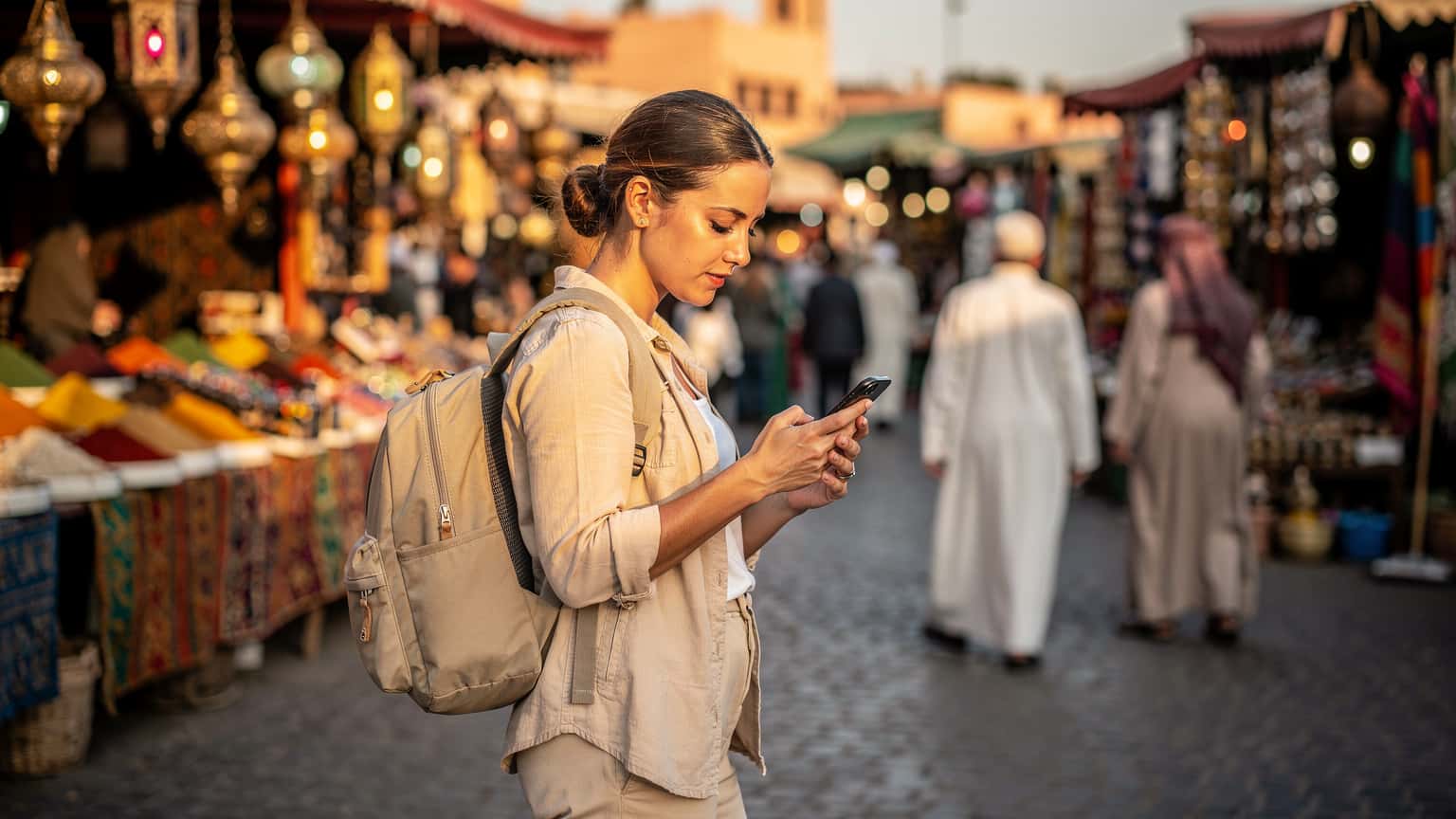
A woman confidently navigating the bustling Djemaa el-Fna square in Marrakech, checking her phone for directions with a vibrant market stall in the background.
Morocco offers excellent data connectivity for travelers in 2026 through eSIM technology, providing a reliable and cost-effective alternative to traditional roaming or local physical SIM cards. Travelers can activate an eSIM digitally before arrival, ensuring immediate internet access in major cities like Marrakech, Fes, and Casablanca, with decent coverage extending to many rural areas. This approach helps avoid unexpected roaming charges and simplifies the process of getting online.

Morocco's Mobile Network Landscape

Morocco's telecommunications infrastructure has seen significant upgrades over the past decade, moving beyond basic GSM to robust 4G LTE and an emerging 5G footprint. The market is primarily dominated by three major players: Maroc Telecom, Inwi, and Orange Maroc. Each of these carriers maintains its own network, offering varying levels of coverage and speed depending on the region.

For the technically inclined, Maroc Telecom, the historical incumbent, generally boasts the most extensive coverage, particularly in less populated areas. They've invested heavily in rural expansion, often utilizing lower frequency bands like LTE B20 (800 MHz) for broader reach, which is critical for signal propagation over long distances and through obstacles. In urban centers, expect them to leverage higher capacity bands such as LTE B3 (1800 MHz) and B7 (2600 MHz).

Inwi and Orange Maroc (a subsidiary of the French Orange group) tend to be strong contenders in urban areas, often providing competitive speeds, especially with carrier aggregation configurations. I've personally observed Inwi deploying LTE B3 and B7, and more recently, testing n78 (3.5 GHz) for 5G in parts of Casablanca. Orange Maroc also follows a similar strategy, with a strong presence in the main tourist corridors like Marrakech and Fes. Average 4G download speeds in central Marrakech typically range from 30-80 Mbps, with uploads around 10-25 Mbps, assuming good signal strength and network load. Out in the Sahara, however, you'll be lucky to pull 5 Mbps.

Understanding the Key Carriers

Choosing the right underlying network for your eSIM is paramount, as it dictates your real-world experience. Here's a breakdown:

  • Maroc Telecom: Widest coverage, generally reliable. Strong in rural areas. Good for extensive travel across the country.
  • Inwi: Strong urban performance, often competitive speeds. Good for city-focused trips and those prioritizing speed over absolute geographical reach.
  • Orange Maroc: Excellent urban and tourist area coverage. Often has good international roaming agreements if you're considering a physical SIM, but with an eSIM, this becomes less relevant.

When selecting a Cellesim plan for Morocco, it's worth noting which local carrier it partners with. Most Cellesim plans utilize the strongest available network, often Maroc Telecom, to ensure optimal performance. This is a critical distinction, as some other regional eSIM providers might default to a less robust partner, leading to a suboptimal experience.

Why an eSIM is the Smart Choice for Morocco

For modern travelers, especially those who rely on their phones for navigation, communication, and work, an eSIM offers a significant advantage over traditional roaming or even local physical SIM cards. The convenience factor alone is compelling: no more hunting for a local SIM vendor upon arrival or fumbling with tiny trays and ejector pins.

Beyond convenience, the cost savings are substantial. Carrier roaming charges can be exorbitant, often charging several dollars per megabyte. An eSIM from a provider like Cellesim offers data packages specifically priced for the local market, without the markup of international roaming. For example, a 10 GB plan from a major US carrier might cost you $100 for international roaming, while a comparable eSIM plan could be as low as $25-35. This difference is stark and adds up quickly, especially for longer trips or data-intensive users.

A traveler easily activating their eSIM on their phone in a quiet riad courtyard in Fes, Morocco.

Cost Efficiency and Predictable Spending

One of the primary benefits of an eSIM is its predictable cost structure. You purchase a set amount of data for a specific duration, and that's it. No hidden fees, no bill shock upon returning home. This level of financial control is invaluable for budget-conscious travelers. Moreover, unlike some local SIMs which might require you to navigate complex top-up menus in Arabic or French, eSIMs allow for easy recharges online, often directly through an app.

Retaining Your Primary Number

An often-overlooked advantage of eSIMs is the ability to keep your primary phone number active for calls and texts, even while using the eSIM for data. This dual-SIM functionality is particularly useful for receiving verification codes, staying in touch with family, or managing banking alerts without incurring international roaming charges for data. You simply designate your eSIM for cellular data and your physical SIM for voice (if your home carrier offers affordable inbound roaming calls, or you just need it for SMS authentication). Just be mindful of potential VoLTE/VoWiFi issues, as some carriers might not support these features with a non-native data connection. If your primary SIM doesn't support VoWiFi abroad, you'll rely on traditional circuit-switched calls, which can be costly.

For those managing multiple eSIMs, perhaps for a multi-country trip, organization is key. Cellesim makes this easy. For a seamless data experience across multiple destinations, explore options like the Post-Prime Day Travel Deals 2026: Snagging Savings with a Smart eSIM Plan to bundle your data needs.

Top eSIM Providers for Morocco: A Technical Evaluation

When selecting an eSIM for Morocco, the market offers several options, but not all are created equal. My focus here is on providers that offer reliable service, transparent pricing, and robust network partnerships. Cellesim stands out for its direct carrier relationships, which often translate to better network priority and support.

Other popular providers like Airalo, Holafly, and Nomad also offer Morocco-specific plans. While they can be viable, it's crucial to examine their underlying network partners. Some aggregate multiple networks, which can be a double-edged sword: broad coverage but potentially lower priority on congested towers. Others might only partner with one carrier, which is great if that carrier is strong in your specific destination, but problematic otherwise.

eSIM ProviderNetwork Partner(s)Typical Data Speeds (4G)VoLTE/VoWiFi SupportIPv6 Support
CellesimMaroc Telecom, Inwi30-90 Mbps Down, 10-30 Mbps UpNo (Data Only)Yes, Dual Stack
AiraloMaroc Telecom20-70 Mbps Down, 5-20 Mbps UpNo (Data Only)Limited, Often IPv4 CGNAT
HolaflyOrange Maroc25-60 Mbps Down, 8-25 Mbps UpNo (Data Only)No, IPv4 CGNAT
NomadInwi20-75 Mbps Down, 5-25 Mbps UpNo (Data Only)No, IPv4 CGNAT

A note on IPv6: While many consumers won't notice, the presence of IPv4 Carrier-Grade NAT (CGNAT) can sometimes cause issues with certain VPNs or specific applications that require direct public IP access. Cellesim's dual-stack IPv6 support is a distinct technical advantage for users who might need it, providing a more direct and potentially lower-latency connection.

Understanding Data Packages and Validity

eSIM plans typically come in various data increments (e.g., 1 GB, 3 GB, 5 GB, 10 GB, Unlimited) and validity periods (e.g., 7 days, 15 days, 30 days). For a typical two-week trip where you're actively using maps, social media, and some light streaming, a 5 GB or 10 GB plan is usually sufficient. Remember, video calls and heavy streaming will consume data rapidly. Always check the expiry date of your plan; unused data often doesn't roll over.

For extensive travel, especially across multiple countries, consider the advantages of a regional eSIM. For example, if your Moroccan adventure is part of a larger North African or European tour, a multi-country eSIM might be more economical in the long run. However, for a focused trip to Morocco, a country-specific plan will often offer better per-gigabyte pricing.

Understanding Coverage and Speeds: Where it Matters

Morocco's cellular infrastructure is generally robust in urban centers and along major transportation routes. However, venturing into more remote areas, such as the Sahara Desert or the High Atlas Mountains, will inevitably lead to patchy or non-existent service. It's crucial to manage expectations based on your itinerary.

Major Cities: Marrakech, Fes, Casablanca

In cities like Marrakech (especially areas around Djemaa el-Fna and Gueliz), Fes (Medina and Ville Nouvelle), and Casablanca (city center and coastal areas), you can expect strong 4G LTE coverage. Maroc Telecom, Inwi, and Orange Maroc all provide good service. Peak download speeds can reach 80-100 Mbps in optimal conditions on bands like B3 and B7, particularly during off-peak hours. During busy periods, such as evening in the Djemaa el-Fna, speeds might drop to 20-30 Mbps due to network congestion, a common occurrence in densely populated tourist areas.

My experience indicates that while 5G is being deployed, its footprint is still nascent in 2026. Don't rely on it for consistent, widespread service outside of very specific urban zones. Most eSIMs will primarily utilize 4G LTE. For those seeking reliable speeds for remote work, major cities offer sufficient bandwidth for video conferencing and large file transfers. Just remember to check your iPhone eSIM Abroad: Travel Smarter, Skip the Roaming Fees in 2026 settings to ensure optimal data usage.

Remote Regions and the Sahara

Once you leave the main arteries, particularly south towards Merzouga or into the High Atlas, coverage becomes significantly sparser. Maroc Telecom typically has the edge here, owing to its wider rural infrastructure (often on LTE B20). Expect speeds to drop considerably, often to 3G (UMTS/HSPA) or even 2G (EDGE) in very isolated spots. In the heart of the Sahara, connectivity is often limited to satellite phones or local Wi-Fi hotspots at some desert camps, if at all. It's prudent to download offline maps and essential information before venturing into these areas.

A close-up shot of hands holding a smartphone, with a thumbs-up gesture indicating successful eSIM activation, against a backdrop of Moroccan tile work.

Local SIMs vs. eSIMs: A Deep Dive

The choice between a local physical SIM and an eSIM involves balancing convenience, cost, and technical considerations. While local SIMs have traditionally been the go-to for savvy travelers, eSIMs are rapidly becoming the preferred option for their ease of use and instant activation.

The Hassle of Local Physical SIMs

Purchasing a local SIM card in Morocco, typically from Maroc Telecom, Inwi, or Orange Maroc, requires a visit to an authorized store (often found at airports or in major city centers). You'll need your passport for registration, a legal requirement in Morocco. The process can sometimes be time-consuming, involving paperwork and potential language barriers. Furthermore, you'll need to physically swap out your home SIM card, risking loss or damage, and your primary number will be inactive unless your phone supports dual physical SIMs (a rarity outside of some Asian market models).

While local SIMs often offer very competitive per-gigabyte rates, sometimes even better than eSIMs, the initial friction and the logistics of acquisition can outweigh the marginal cost savings, especially for shorter trips. For example, a 10 GB local SIM might cost around 100-150 MAD (roughly $10-15 USD) but requires an hour-long detour upon arrival.

The eSIM Advantage: Speed and Simplicity

An eSIM, by contrast, eliminates all physical hurdles. You can purchase and activate your plan entirely online, often within minutes, before you even leave home. This means you land in Casablanca or Marrakech with immediate data access, ready to order a taxi, navigate to your riad, or message loved ones. No airport queues, no language barriers, no tiny SIM ejector tools.

FeatureeSIM (Cellesim)Local Physical SIM (Morocco)International Roaming (Home Carrier)
Activation TimeMinutes, pre-trip15-60 minutes, upon arrivalInstant (always on)
Cost per GBLow (e.g., $3-5/GB)Very Low (e.g., $1-2/GB)High (e.g., $10-20/GB)
Retain Home NumberYes (dual SIM)No (unless dual physical SIM phone)Yes
Physical InteractionNoneStore visit, passport registration, SIM swapNone
FlexibilityEasy switching between plans/providersTied to one carrier, requires new SIM for changesBound by home carrier's plans

For most travelers, especially those on shorter trips (under 2-3 weeks) or those prioritizing immediate connectivity and convenience, the eSIM's advantages clearly outweigh the slightly higher per-gigabyte cost compared to a local physical SIM. For a deeper dive into different eSIM options, you might find my comparison of Nomad vs. Cellesim eSIM: Which is Best for Your 2026 Trip? insightful.

A person standing outside a traditional Moroccan patisserie in Casablanca, looking up at the Wi-Fi network name displayed on a small sign, contemplating connectivity options.

eSIM Activation: A Step-by-Step Guide

Activating an eSIM is a straightforward process, but it requires a stable internet connection for the initial download of the eSIM profile. This is why it's highly recommended to do it before you depart or immediately upon arrival if you have access to airport Wi-Fi.

Pre-Trip Activation

  1. Purchase Your eSIM Plan: Visit the Cellesim website for Morocco and choose a data package that suits your travel duration and data needs.
  2. Receive QR Code/Manual Details: After purchase, you'll receive an email containing a QR code or manual installation details. Ensure you have access to this email on a separate device or print it out.
  3. Prepare Your Device: Ensure your phone is eSIM compatible (most newer iPhone, Samsung Galaxy, Google Pixel, and some other Android models are). Make sure your phone is unlocked by your home carrier.
  4. Install eSIM Profile: Go to your phone's settings:
    • iPhone: Settings > Cellular (or Mobile Data) > Add eSIM. Choose 'Use QR Code' or 'Enter Details Manually'.
    • Android (varies slightly by model): Settings > Network & Internet > SIMs > Add eSIM. Again, you'll scan the QR code or input details.
  5. Label Your eSIM: Once installed, label your new eSIM profile (e.g., "Morocco Data") to easily distinguish it from your primary SIM.
  6. Do NOT Activate Yet: Keep the eSIM profile installed but do not enable it for data until you arrive in Morocco. This prevents the validity period from starting prematurely.

Activating Upon Arrival in Morocco

  1. Enable Data Roaming (for eSIM): Once you land, go to your phone's Cellular/Mobile Data settings. Select your Morocco eSIM profile.
  2. Set as Primary for Data: Set this eSIM as your primary line for cellular data. Ensure 'Data Roaming' is enabled for this eSIM, as it's technically roaming on a partner network. (Don't confuse this with traditional expensive roaming on your home SIM.)
  3. APN Settings Check: Most eSIMs auto-configure APN settings. However, if you experience connectivity issues, you might need to manually input the APN. For many Cellesim plans in Morocco, the APN is simply internet. Navigate to your eSIM settings, find 'Access Point Names' (APN), and verify/input this. This is especially relevant for some older Android devices or specific phone models known for APN quirks.
  4. Restart Device: A quick restart can often resolve initial connectivity glitches and help your phone register properly with the local network.
  5. Test Connection: Open a browser or a messaging app to confirm you have data access.

For a detailed walkthrough, especially if you're an iPhone user, check out our guide on T-Mobile eSIM Activation with QR Code: The Nomad's 2026 Guide to Seamless Data, as the process is fundamentally similar across providers.

Optimizing Your eSIM Experience: Power User Tips

As a telecom engineer who travels, I've picked up a few tricks to squeeze the most out of my mobile data, especially with eSIMs. These aren't just about saving money, but also about ensuring a consistently robust connection for everything from video calls to real-time mapping.

App Data Management

Many apps consume background data without you realizing it. Before your trip, go through your phone's settings and restrict background data for non-essential apps. For iOS, navigate to Settings > Cellular > scroll down and toggle off apps. On Android, it's typically Settings > Network & Internet > Mobile network > App data usage. This prevents apps from silently downloading updates or refreshing content, preserving your precious data allowance.

Furthermore, consider downloading offline maps (Google Maps, Maps.me) for major cities and regions you plan to visit. This significantly reduces data consumption for navigation, which is often a major data hog. Similarly, download any streaming content or podcasts before you leave your hotel's Wi-Fi.

Monitoring Data Usage

Keep a close eye on your data consumption. Both iOS and Android provide built-in tools to track data usage per app. Regularly check these to identify any rogue apps or unexpected spikes. Most eSIM providers, including Cellesim, also offer usage tracking through their app or website portal. Setting data usage alerts can be a lifesaver, notifying you when you're approaching your limit, giving you time to top up before you run out. This proactive approach avoids unexpected service interruptions, which are particularly frustrating when you're trying to hail a taxi or look up opening hours for a local attraction.

Pro Tip
If you're using an older iPhone model, be aware of a subtle bug where the data usage counter might not accurately reset for eSIMs. It's always best to cross-reference with your eSIM provider's app or web portal for the most precise usage figures. This ensures you avoid running out of data unexpectedly.

Navigating Common eSIM Challenges

While eSIMs offer unparalleled convenience, a few common issues can arise. Knowing how to troubleshoot these can save you significant frustration while traveling in Morocco.

No Service or Slow Data Speeds

If you're experiencing no service or unusually slow data, here's a quick checklist:

  • Check APN Settings: As mentioned, this is often the culprit. Ensure the APN is correctly set to internet (or as specified by Cellesim).
  • Network Selection: Sometimes, manually selecting the network can help. Go to Settings > Cellular > Network Selection (or similar) and toggle off automatic selection. Try connecting to Maroc Telecom, Inwi, or Orange Maroc manually.
  • Restart Your Device: The classic IT solution, but it works. A full power cycle can force your phone to re-register with the local network.
  • Signal Strength: Are you in a basement cafe in Fes Medina? Signal penetration can be tough. Move closer to a window or outdoors.
  • Data Roaming: Double-check that 'Data Roaming' is enabled for your eSIM profile. This is crucial for it to connect to the partner network.
A tourist looking concerned at their phone, showing a 'No Service' error, while sitting on a bench at a bustling train station in Marrakech, Morocco.

Voice and SMS Considerations

Most travel eSIMs, including Cellesim's Morocco plans, are data-only. This means they do not come with a local Moroccan phone number for traditional calls or SMS. For voice communication, you'll need to rely on VoIP apps like WhatsApp, FaceTime, Google Meet, or Zoom, all of which work seamlessly over data. For SMS, your home number will still receive messages (assuming you've kept your physical SIM active), but sending international SMS via your home carrier can be expensive. For critical communications, consider using WhatsApp, which is widely adopted in Morocco.

A critical point here is VoLTE (Voice over LTE) and VoWiFi (Voice over Wi-Fi). If your home SIM's international roaming plan supports these, you can make and receive calls on your home number over your eSIM's data connection, or over any Wi-Fi. However, not all carriers support this seamlessly abroad, and some network configurations might block it. Always verify with your home carrier if VoLTE/VoWiFi will function while your data is routed through an eSIM.

Staying Connected Beyond the Cities

While major cities in Morocco boast excellent connectivity, your journey might take you off the beaten path. Planning for these less-connected zones is key to avoiding frustration.

High Atlas Mountains and Desert Regions

In regions like the High Atlas Mountains or the deeper reaches of the Sahara Desert, expect a significant drop in data speeds and, in many cases, complete signal loss. Maroc Telecom generally offers the best chance of sporadic connectivity in these areas, often operating on lower frequency bands (B20) that propagate further. However, this is not guaranteed. For treks or remote excursions, consider the following:

  • Download Offline Maps: Essential for navigation without data.
  • Inform Others of Limited Connectivity: Let family or colleagues know you might be out of touch for periods.
  • Emergency Devices: For serious backcountry travel, a satellite communicator (e.g., Garmin inReach) is a smart safety investment, entirely independent of cellular networks.
  • Local Guides: Many tour operators in the desert or mountains have satellite phones for emergencies. Your local guide will know the reliable spots, if any.

Public Wi-Fi and Internet Cafes

Public Wi-Fi is widely available in hotels, riads, cafes, and restaurants in Moroccan cities. While convenient, exercise caution when using open, unsecured networks. A VPN is always recommended for privacy and security. Internet cafes (cybercafés) still exist in many towns and can be a fallback for essential tasks, though they're less common than they once were. Always prioritize secure, password-protected networks over open ones.

The Future of Connectivity in Morocco

Morocco's telecommunications sector is dynamic. The ongoing rollout of 5G, though limited in 2026, signifies a commitment to advanced mobile broadband. This means faster speeds and lower latencies for future travelers, particularly in urban hubs. Expect more widespread deployment of 5G n78 (3.5 GHz) and potentially n28 (700 MHz) in the coming years, improving both capacity and coverage.

Furthermore, the increasing adoption of eSIM technology globally will likely push Moroccan carriers to offer their own direct eSIM plans to tourists, complementing the offerings from providers like Cellesim. This competition typically drives down prices and enhances service quality. For those looking to work remotely, Morocco's improving connectivity, combined with its unique cultural appeal, makes it an increasingly attractive destination. Just ensure your eSIM can handle the demands of your Summer Festival Circuit 2026: Stay Connected & Capture Memories with the Right eSIM or any other data-intensive activities.

Frequently Asked Questions

Can I use my existing WhatsApp number with an eSIM in Morocco?

Yes, your WhatsApp account is tied to your original phone number, not your active data connection. As long as you keep your primary SIM active (even if not for data), WhatsApp will continue to function normally over your eSIM's data connection, allowing you to send and receive messages using your usual number.

Do I need to unlock my phone to use an eSIM in Morocco?

Absolutely. Your phone must be unlocked by your home carrier to use any third-party eSIM, including those for Morocco. If your phone is still locked, it will only work with SIMs or eSIMs from your home provider, making international travel data expensive or impossible.

What happens if I run out of data on my Cellesim Morocco eSIM?

If you deplete your data allowance, your internet access will stop. You can easily top up your eSIM plan directly through the Cellesim app or website. Most top-ups are instant, allowing you to regain connectivity within minutes. It's wise to monitor your usage to avoid unexpected interruptions.

Is Wi-Fi widely available in Morocco?

Wi-Fi is generally available in hotels, riads, cafes, and restaurants in major Moroccan cities and tourist areas. However, speeds can vary significantly, and public networks may not always be secure. An eSIM provides a more reliable and private connection for essential tasks and continuous connectivity while on the go.

Can I make regular phone calls with a Morocco eSIM?

Most travel eSIMs for Morocco, including Cellesim's, are data-only and do not come with a local Moroccan phone number. For voice calls, you'll rely on internet-based apps like WhatsApp, FaceTime, or Skype. If you need to make traditional calls, your primary SIM would need active roaming, which can be expensive.

Are there any specific phone models that have issues with eSIMs in Morocco?

While most modern, eSIM-compatible phones work well, some older Android models or specific regional variants can occasionally have APN configuration quirks. If you encounter issues, manually setting the APN to 'internet' and restarting your device often resolves these. Always ensure your device firmware is up to date.

See all eSIM FAQs →

Morocco eSIM 2026: Avoid Roaming Shock, Get Reliable Data