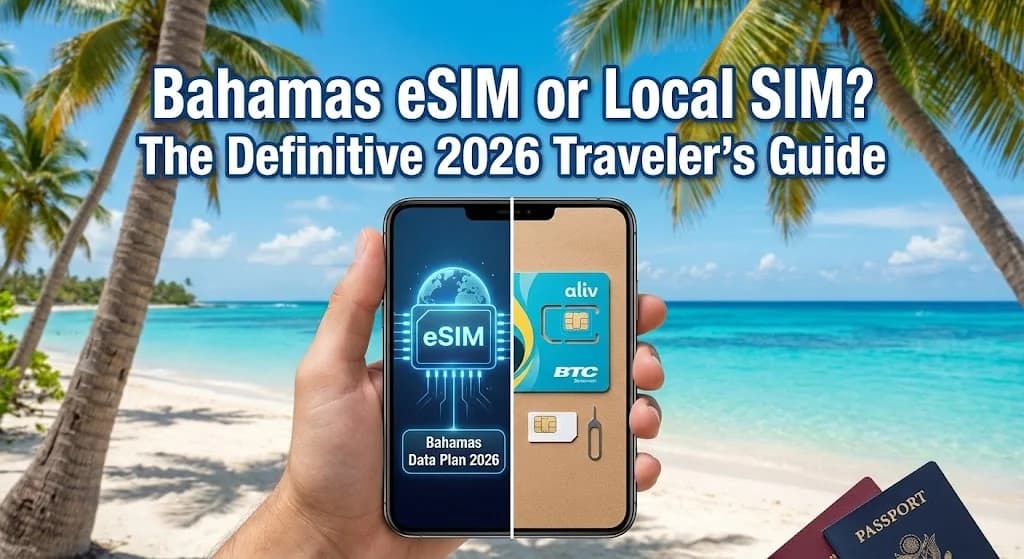
Venturing to the Bahamas, with its pristine beaches and vibrant culture, promises an unforgettable experience. However, staying connected while exploring these beautiful islands is crucial for navigation, sharing moments, and emergencies. The modern traveler faces a key decision: opt for the convenience of an eSIM or go for a traditional local physical SIM card? This guide provides a definitive comparison for 2026, helping you make an informed choice for seamless connectivity in the Bahamas.
- Navigating Connectivity in the Bahamas: eSIM vs. Local SIM Choices
- Why a Cellesim eSIM Enhances Your Bahamas Travel Experience
- Local Bahamas SIM Cards: What Travelers Need to Know
- A Direct Comparison: Bahamas eSIM, Local SIM, and Roaming
- Choosing the Right Data Plan for Your Bahamas Adventure
- Activating Your Bahamas eSIM: A Quick Setup Guide
- Smart Connectivity Practices for Your Bahamas Trip
- Frequently Asked Questions About Bahamas Connectivity
Bahamas eSIM Plans from $4.50
Connect instantly in the Bahamas. Join 50,000+ travelers who trust Cellesim for reliable, global connectivity.
Get Your Bahamas eSIMNavigating Connectivity in the Bahamas: eSIM vs. Local SIM Choices
When planning your trip to the Bahamas, setting up your phone for reliable internet and calls is a significant consideration. Historically, travelers relied on costly international roaming plans or purchasing a local physical SIM card upon arrival. The introduction of eSIM technology has provided a powerful third option, offering digital flexibility and often more competitive pricing.
Understanding the nuances of each option is key to selecting the best fit for your travel style and connectivity needs in the Bahamian archipelago. From the bustling streets of Nassau to the secluded cays, having a stable internet connection can significantly enhance your travel experience, whether you are checking ferry schedules, navigating with GPS, or sharing photos of the stunning turquoise waters.
Why a Cellesim eSIM Enhances Your Bahamas Travel Experience
An eSIM (embedded SIM) is a digital SIM card that allows you to activate a cellular plan from a provider without needing a physical SIM. For travelers heading to the Bahamas, a Cellesim eSIM presents several compelling advantages:
- Instant Activation: Purchase and activate your Cellesim Bahamas eSIM online before you even depart, or immediately upon arrival. There is no need to find a local store, wait in line, or deal with physical card swaps. This means you are connected the moment your plane lands at Lynden Pindling International Airport (NAS) in Nassau, or any other Bahamian entry point.
- Seamless Setup: Installation typically involves scanning a QR code, a process that takes minutes. This eliminates the hassle of handling tiny physical SIM cards, which can be lost or damaged. Learn more about the complete eSIM setup guide.
- Dual SIM Functionality: Most eSIM-compatible phones support both an eSIM and a physical SIM simultaneously. This allows you to keep your home country's number active for important calls or texts while using your Cellesim eSIM for data in the Bahamas. This is particularly useful for maintaining contact with banks or receiving two-factor authentication codes.
- Cost-Effective Data Plans: Cellesim offers competitive data packages tailored for various travel durations and usage needs. These plans can often be more economical than traditional roaming charges from your home carrier, providing transparency in costs without unexpected bills. Explore Cellesim's Bahamas eSIM options.
- Flexibility and Control: Manage your eSIM plan directly from your phone's settings. You can monitor data usage, top up, or switch plans as needed, giving you full control over your connectivity. This flexibility is ideal for dynamic travel plans across multiple islands.
Local Bahamas SIM Cards: What Travelers Need to Know
Purchasing a local physical SIM card from Bahamian providers like BTC or Aliv has long been a common approach for travelers seeking affordable connectivity. While viable, this option comes with its own set of considerations:
- Availability: Local SIM cards are primarily available at the airport upon arrival, at official carrier stores in major towns like Nassau or Freeport, or at authorized resellers. This requires an immediate stop after landing, potentially delaying your journey to your accommodation.
- Registration Process: Like many countries, the Bahamas requires identification for SIM card registration. You will need to present your passport and potentially fill out paperwork, which can be time-consuming.
- Physical Handling: You must physically remove your home SIM card and insert the new Bahamian SIM. Storing your original SIM securely is important to avoid loss. This process can be fiddly, especially for those not accustomed to it.
- Network Coverage: BTC (Bahamas Telecommunications Company) and Aliv are the primary mobile network operators in the Bahamas, offering 4G LTE services in most populated areas. Coverage can vary in remote islands and cays.
- Cost and Plans: Local SIMs offer various prepaid plans with data, calls, and texts. While typically cheaper than roaming, the initial purchase price of the SIM card itself, combined with the plan cost, might sometimes exceed the value of short-term eSIM plans, especially for brief visits.
"For a quick trip to the Bahamas, the ease of an eSIM is unmatched. I landed, turned off airplane mode, and was already connected. No searching for stores, no paperwork, just instant internet."
A Direct Comparison: Bahamas eSIM, Local SIM, and Roaming
To help you decide, here is a direct comparison of the key factors when considering your connectivity options for the Bahamas in 2026:
| Feature | Cellesim eSIM (Bahamas) | Local Bahamas SIM | International Roaming |
|---|---|---|---|
| Convenience & Setup | Instant, online, QR scan | Store visit, physical swap, registration | Automatic, no setup needed |
| Cost (Data Focused) | Transparent, competitive packages (e.g., from $4.50) | Initial SIM cost + plan, varying prices | Often very expensive ($10-15+/day) |
| Dual SIM Capability | Yes (keep home number active) | No (replaces home SIM) | Yes (uses home SIM) |
| Flexibility | Easy plan changes/top-ups, no commitment | Fixed plans, less flexible for short-term | Fixed by home carrier, limited control |
| Privacy | No physical card, less personal data shared locally | Requires passport for registration | Managed by home carrier |
| Best For | Most travelers, short/medium trips, instant connectivity | Longer stays, those preferring local numbers | Emergency use, short urgent messages only |
As the table illustrates, a Cellesim eSIM generally offers superior convenience and cost-effectiveness for the typical traveler to the Bahamas, especially for shorter stays. The ability to activate prior to departure and maintain your home number simplifies the entire process.
Find Your Ideal Bahamas eSIM Plan
Choosing the Right Data Plan for Your Bahamas Adventure
The amount of data you need for your Bahamas trip depends largely on your planned activities. Here's a general guide:
- Light User (1-3 GB for 7 days): Occasional map checks, messaging (WhatsApp), light social media browsing, checking emails. This is suitable if you plan to rely mostly on hotel Wi-Fi.
- Moderate User (5-10 GB for 7-14 days): Regular navigation, frequent social media updates, some video streaming, occasional video calls, light work tasks. This is ideal for most travelers who want to stay connected without constant Wi-Fi hunting.
- Heavy User (15+ GB for 14+ days): Extensive video streaming, daily video calls, tethering other devices, online gaming, heavy work usage. This plan is for those who cannot compromise on connectivity and may need to use their phone as a hotspot.
Consider using the Cellesim Smart Data Calculator to estimate your exact data needs based on your typical usage. Remember, having a bit more data than you think you need can prevent running out during critical moments.
Activating Your Bahamas eSIM: A Quick Setup Guide
Activating your Cellesim Bahamas eSIM is a straightforward process, typically completed in a few steps:
- Purchase Your eSIM: Visit cellesim.com/en/esim-bahamas and select the data plan that best suits your travel duration and usage requirements.
- Receive QR Code/Activation Details: After purchase, you will receive an email containing a QR code or manual activation details.
- Install eSIM:
- For iPhone users: Go to Settings > Cellular (or Mobile Data) > Add eSIM. Choose "Use QR Code" and scan the code provided by Cellesim. Follow the on-screen prompts.
- For Android users: Go to Settings > Network & internet > SIMs > Add more. Select "Download a SIM instead" and scan the QR code. Follow the on-screen instructions.
- Activate Data Roaming (for eSIM line): Once installed, ensure that "Data Roaming" is enabled for your Cellesim eSIM line in your phone settings. It is crucial to select the Cellesim eSIM as your primary line for cellular data when in the Bahamas to avoid unexpected roaming charges on your home SIM.
- Connect to Network: Your phone should automatically connect to a local Bahamian network. If not, try restarting your device.
Smart Connectivity Practices for Your Bahamas Trip
Beyond choosing between an eSIM and a local SIM, adopting smart practices can further enhance your connectivity and save costs during your Bahamas vacation:
- Monitor Data Usage: Keep an eye on your data consumption through your phone's settings or the Cellesim app. This helps prevent unexpected depletion of your plan.
- Utilize Wi-Fi When Available: Leverage free Wi-Fi at your resort, cafes, or public hotspots for large downloads or updates. Remember to use a VPN on public networks for security.
- Download Offline Maps: Before you travel, download offline maps of Nassau, Freeport, and other islands you plan to visit. This ensures you can navigate even without an active data connection.
- Disable Background App Refresh: Turn off background app refresh for non-essential applications to conserve data and battery life.
- Understand Roaming Costs for Your Home SIM: If you intend to use your home SIM for calls or texts, be fully aware of your carrier's international roaming rates. Our roaming savings calculator can help illustrate potential costs.
By combining the convenience of a Cellesim eSIM with these practical tips, your Bahamas travel experience will be enriched with reliable, hassle-free connectivity. For official travel advice and entry requirements, always check the Bahamas Ministry of Tourism website.
Ready for Seamless Bahamas Connectivity?
Join 50,000+ travelers in 200+ countries. Set up your Cellesim eSIM in minutes.
Start Your Connected JourneyTrusted by travelers worldwide. 24/7 Support: [email protected]
Frequently Asked Questions About Bahamas Connectivity
What is the main difference between a Bahamas eSIM and a local physical SIM?
A Bahamas eSIM is a digital SIM profile downloaded to your phone, offering instant activation and the ability to keep your home SIM active. A local physical SIM requires you to purchase and insert a physical card, often involving a registration process at a store in the Bahamas.
Will my phone work with a Cellesim eSIM in the Bahamas?
Most modern smartphones (iPhone XS/XR and newer, recent Samsung Galaxy, Google Pixel models, etc.) are eSIM compatible. You can easily check your device's compatibility using the Cellesim eSIM checker on our website before your trip.
Can I keep my original phone number if I use a Cellesim Bahamas eSIM?
Yes. With an eSIM, you can use your home physical SIM for calls and texts while using the Cellesim eSIM for data. This allows you to receive calls and messages on your primary number without incurring expensive data roaming charges.
What is the network coverage like with a Cellesim eSIM in the Bahamas?
Cellesim partners with leading local network providers in the Bahamas to ensure robust 4G/LTE coverage in populated areas, including Nassau, Freeport, and other major islands. Coverage may vary in very remote or uninhabited cays.
Is a Cellesim eSIM more expensive than a local SIM in the Bahamas?
Cellesim offers competitive data plans starting from $4.50, which are often comparable to or more cost-effective than a local SIM when factoring in the initial purchase cost of the physical SIM and the time saved. For short to medium trips, eSIMs typically offer better value and convenience than local SIMs or traditional roaming.
What if I run out of data on my Cellesim Bahamas eSIM?
If your data runs low or expires, you can easily purchase a top-up or an additional data package directly from the Cellesim website, often within minutes. This flexibility means you are never without connectivity for long.
See also: eSIM for Bahamas