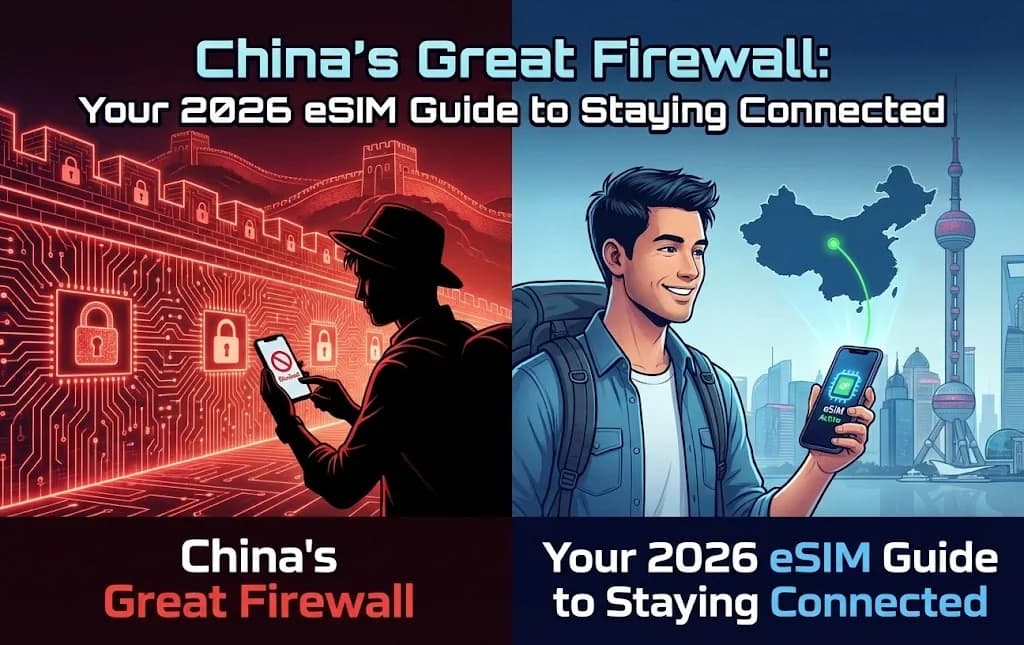
China's Great Firewall: Your 2026 eSIM Guide to Staying Connected
Navigate China's complex internet landscape with ease. This 2026 guide explains how an eSIM can provide unrestricted access, bypassing the Great Firewall for seamless connectivity.
You have just landed at Shanghai Pudong International Airport (PVG), buzzing with excitement for your 2026 adventure. You pull out your phone to message family on WhatsApp, check your hotel's location on Google Maps, and perhaps post a quick arrival photo on Instagram. But nothing loads. A strange digital silence greets you. This is the reality for many travellers encountering China's infamous Great Firewall (GFW) for the first time. Suddenly, the apps you rely on are inaccessible, and navigating a new country feels daunting. This is where planning your connectivity becomes crucial. For modern travellers, the answer is not a clunky, unreliable VPN; it is a seamless, powerful technology: the eSIM for China 2026. This guide will walk you through exactly how an international eSIM not only provides high-speed data but also acts as your key to unrestricted internet, bypassing the GFW effortlessly and ensuring you stay connected from the moment you arrive.
In This Article
Understanding China's Great Firewall for 2026 Travelers
eSIMs: Your Unrestricted Gateway to the Chinese Internet
Selecting the Ideal China eSIM Plan for Your 2026 Trip
Expected Network Coverage and Speeds Across China
Estimating Your Data Needs for China Travel
Simple Steps to Activate Your Cellesim China eSIM
Comparing Connectivity Costs: eSIM vs. Roaming vs. Local SIM
Essential Pro Tips for Digital Navigation in China
Frequently Asked Questions
Connect Seamlessly in China with Cellesim
Experience reliable, high-speed internet and bypass the Great Firewall with a Cellesim eSIM for China. Join 50,000+ happy customers in 200+ countries.
Understanding China's Great Firewall for 2026 Travelers | Cellesim eSIMThe Digital Silence After Landing in China | Cellesim eSIM
Understanding China's Great Firewall for 2026 Travelers
China's Great Firewall (GFW) is a complex system of internet censorship and surveillance that restricts access to a wide range of foreign websites and online services within mainland China. For travelers in 2026, this means that popular platforms like Google (including Search, Maps, Gmail), WhatsApp, Instagram, Facebook, Twitter, and many international news sites are typically inaccessible on local internet connections.
The GFW operates by blocking IP addresses, filtering DNS requests, and employing deep packet inspection to identify and block encrypted traffic from unapproved VPNs. Its primary goal is to regulate information flow and maintain internet stability within the country. Understanding this system is the first step in preparing for a connected trip, ensuring you can access the information and communication tools you rely on.
The Great Firewall is more than just a filter; it's an active barrier that shapes the digital experience for anyone connecting from within China's borders.
Key Info: Many essential travel apps, including Google Maps and WhatsApp, are blocked by the Great Firewall. Pre-planning your connectivity is crucial for a smooth trip.
eSIMs: Your Unrestricted Gateway to the Chinese Internet
Traditional methods of bypassing the GFW often involve installing a Virtual Private Network (VPN) app. However, many VPN services are frequently blocked or suffer from inconsistent performance due to the GFW's advanced detection capabilities. For 2026 travelers, an international eSIM offers a more robust and reliable solution.
Cellesim's eSIMs designed for China travel operate differently. Instead of routing data through local Chinese networks that are subject to the GFW, our eSIMs use intelligent data routing. Your internet traffic is directed through servers located outside mainland China, often in neighboring regions like Hong Kong or Singapore. This architecture ensures that your connection is not subjected to the GFW's censorship, providing you with unrestricted access to global internet services. You can use WhatsApp for messaging, Google Maps for navigation, and your preferred social media platforms without needing a separate, often unreliable, VPN application.
This method offers several advantages: consistent speeds, stable connections, and the convenience of not having to constantly switch or troubleshoot VPNs. It provides a seamless digital experience, making your travel in China less stressful and more enjoyable.
Selecting the Ideal China eSIM Plan for Your 2026 Trip
Choosing the right eSIM plan for your 2026 trip to China depends on your travel duration and data usage habits. Cellesim offers a range of flexible plans designed to cater to different needs.
Consider the following when making your selection:
Data Allowance: Are you a heavy data user who streams videos and makes video calls, or do you primarily need data for navigation, messaging, and occasional browsing? Cellesim offers plans from 1GB for short trips up to 20GB or more for extended stays. Use our Smart Data Calculator to estimate your needs.
Validity Period: Match the eSIM's validity period to your trip length. Plans typically range from 7 to 30 days.
Regional vs. Single-Country: If your 2026 itinerary includes other Asian countries alongside China, a regional eSIM plan like the Asia 20 Countries eSIM could be more cost-effective and convenient than purchasing multiple single-country eSIMs.
Top-Up Options: Ensure your chosen provider offers easy top-up options in case you run out of data during your trip. Cellesim allows seamless top-ups directly from your account.
For most travelers, a plan with 5-10GB of data over 15-30 days provides ample connectivity for typical travel activities. Always check the specific plan details on the Cellesim China eSIM page.
Expected Network Coverage and Speeds Across China
When using an international eSIM in China, your device will connect to local network partners. Major carriers in China, such as China Mobile, China Unicom, and China Telecom, offer extensive 4G LTE coverage across urban areas and most popular tourist destinations. 5G networks are rapidly expanding in major cities like Beijing, Shanghai, Guangzhou, and Shenzhen, providing even faster speeds.
With a Cellesim eSIM, you can expect to access these high-speed networks, ensuring smooth streaming, quick downloads, and reliable navigation. While network availability can vary in very remote or mountainous regions, within most travel corridors and cities, coverage is robust. Our eSIM technology is designed to intelligently switch between available networks to provide the best possible signal.
Before your trip, consider checking general network coverage maps for the specific regions you plan to visit. While Cellesim eSIMs provide GFW bypass, the underlying network performance will still be dependent on the local infrastructure. Learn more about how Cellesim's network operates globally.
Estimating Your Data Needs for China Travel
Knowing how much data you will need for your 2026 China trip can help you choose the most economical and appropriate eSIM plan. Data consumption varies significantly based on individual usage patterns.
Here are some estimates for common online activities:
Navigation (Google Maps): 5-10 MB per hour. Using offline maps can significantly reduce this.
Messaging (WhatsApp/WeChat): 1-2 MB per hour for text, 10-20 MB for voice calls, 50-100 MB for video calls.
Social Media (Instagram/Facebook/X): 100-200 MB per hour, depending on media consumption (videos/photos).
Email: Minimal, usually less than 1 MB per hour.
Web Browsing: 10-20 MB per hour.
Streaming (YouTube/Netflix): 500 MB - 1 GB per hour for standard definition. Best avoided on mobile data when possible.
For an average traveler relying on navigation, messaging, and occasional social media, 1-2GB per week is often sufficient. If you plan to work remotely, tether other devices, or frequently stream content, consider a larger data package (e.g., 10GB for a two-week trip). Always connect to Wi-Fi whenever available to conserve your eSIM data.
Activating your Cellesim eSIM for China is a straightforward process, designed for convenience. It is highly recommended to complete the activation steps before you depart for China while you still have a stable internet connection.
Purchase Your eSIM: Select your desired China eSIM plan from the Cellesim website (cellesim.com/en/esim-china).
Receive QR Code: After purchase, you will receive an email containing a QR code and detailed installation instructions.
Install eSIM: On your compatible smartphone, go to your cellular settings and select "Add eSIM" or "Add Cellular Plan." Scan the provided QR code. Ensure you are connected to Wi-Fi during this step. Do not activate the plan yet. For detailed steps, refer to our complete eSIM setup guide.
Enable eSIM Upon Arrival: Once you land in China, simply go back to your cellular settings, enable your Cellesim eSIM line, and ensure "Data Roaming" is switched ON for that specific eSIM.
Connect: Your phone will automatically connect to a local partner network, providing you with data access that bypasses the Great Firewall.
Pro Tip: Install your eSIM profile before leaving home. This saves time and avoids the stress of finding Wi-Fi upon arrival, allowing you to connect instantly. Always check your device's eSIM compatibility beforehand.
Comparing Connectivity Costs: eSIM vs. Roaming vs. Local SIM
Understanding the costs associated with different connectivity options in China is essential for budgeting your 2026 trip. Here is a comparison highlighting the value of an eSIM:
Option
Cost (per GB)
GFW Bypass
Setup Difficulty
Cellesim eSIM
From $2-5/GB
Yes
Easy (Online)
Carrier Roaming
$10-20+/GB
No
Automatic
Local Physical SIM
$1-3/GB (variable)
No
Moderate (In-store, registration)
As the table illustrates, traditional carrier roaming is often the most expensive option, and it does not offer Great Firewall bypass. Local physical SIM cards can be cheaper per GB but require purchasing and registering in China, which can be time-consuming and often involves language barriers. Crucially, local SIMs do not bypass the GFW, meaning you would still need a separate, potentially unreliable, VPN.
Cellesim eSIMs offer a balance of affordability, convenience, and essential GFW bypass, making them the superior choice for most international travelers to China in 2026. For a detailed calculation of potential savings, use our Roaming Savings Calculator or read our comparison of airport SIM cards vs. eSIMs.
Essential Pro Tips for Digital Navigation in China
Beyond securing your eSIM, a few additional tips can enhance your digital experience in China in 2026:
Download Offline Maps: Even with an eSIM, having offline maps (e.g., from Google Maps or Baidu Maps) downloaded before your trip can be a lifesaver, especially in areas with patchy coverage or when saving data.
Communicate Locally: While your Cellesim eSIM provides access to WhatsApp, consider installing WeChat if you plan to interact frequently with locals or use local services. WeChat is ubiquitous in China for messaging, payments, and many other functions. Read our guide on WeChat and Alipay in China.
Backup Communication: Inform family and friends about your connectivity plan. Have a backup method for urgent communication, like an international calling app over data or keeping your primary SIM active for SMS (with data roaming off to avoid charges).
Keep Your Home Number Active: Your Cellesim eSIM is for data. You can keep your primary SIM active to receive calls and SMS on your home number, just ensure data roaming is off for that line to prevent unexpected charges.
Charge Your Devices: Constant internet use, especially navigating or streaming, can drain your battery. Carry a portable power bank to ensure your phone stays charged throughout the day.
Pro Tip: Before your trip, configure your phone's Wi-Fi calling feature. With a Cellesim eSIM providing internet, you can make and receive calls on your home number over Wi-Fi without international roaming charges.
Ready for Unrestricted Connectivity in China?
Bypass the Great Firewall, stay connected with family, and navigate China effortlessly. Choose Cellesim for your 2026 adventure.
Trusted by 50,000+ travelers worldwide. Available in 24 languages. 24/7 Support.
The Digital Silence After Landing in China
You have just landed at Shanghai Pudong International Airport (PVG), buzzing with excitement for your 2026 adventure. You pull out your phone to message family on WhatsApp, check your hotel's location on Google Maps, and perhaps post a quick arrival photo on Instagram. But nothing loads. A strange digital silence greets you. This is the reality for many travellers encountering China's infamous Great Firewall (GFW) for the first time. Suddenly, the apps you rely on are inaccessible, and navigating a new country feels daunting. This is where planning your connectivity becomes crucial. For modern travellers, the answer is not a clunky, unreliable VPN; it is a seamless, powerful technology: the eSIM for China 2026. This guide will walk you through exactly how an international eSIM not only provides high-speed data but also acts as your key to unrestricted internet, bypassing the GFW effortlessly and ensuring you stay connected from the moment you arrive.
Understanding the Great Firewall: Why Your Usual Internet Won't Work
Before diving into the solution, it is essential to understand the problem. The Great Firewall of China (GFW) is a sophisticated system of internet censorship and surveillance. It blocks or heavily restricts access to thousands of websites and applications that are commonplace elsewhere in the world. For a tourist or business traveller, this can be incredibly disruptive. The digital tools you use for communication, navigation, and information are suddenly gone. This is a challenge that requires a specific solution, as traditional methods often fall short.
What is the Great Firewall (GFW)?
The GFW is not a single entity but a combination of technologies and legislation used by the Chinese government to regulate the internet domestically. Its primary function is to block access to selected foreign websites and to slow down cross-border internet traffic. The list of blocked services is extensive and includes Google (and all its services like Gmail, Google Maps, Google Drive), Facebook, Instagram, WhatsApp, X (formerly Twitter), YouTube, The New York Times, and many more. For travellers, the inability to access Google Maps for directions or WhatsApp to contact loved ones can turn a simple outing into a logistical nightmare. This censorship is the main reason why simply arriving with your home SIM card on a roaming plan often leads to frustration. For more technical details on how the GFW operates, you can consult resources like the Wikipedia entry on the Great Firewall.
The Problem for Travellers: Roaming vs. Local SIMs
Your first instinct might be to use your provider's international roaming plan. While convenient, these plans, such as AT&T's or Verizon's international day passes costing $10-$15 per day, are extremely expensive. A two-week trip could easily add over $140 to your phone bill. More importantly, when you roam in China, your data is typically routed through local Chinese network partners like China Mobile or China Unicom. This means your connection is subject to the same GFW restrictions as any local user. You are paying a premium price for a censored internet experience. Alternatively, buying a local physical SIM card might seem cheaper, but it comes with its own hurdles. You will need to find a vendor, present your passport for registration, and you will still be behind the Great Firewall, requiring a separate, often unreliable, VPN service. For a detailed comparison, explore our guide on Airport SIM vs eSIM.
The Traditional Solution: The Hassle of VPNs
For years, the go-to solution for bypassing the GFW was a Virtual Private Network (VPN). A VPN encrypts your connection and routes it through a server in another country, theoretically allowing you to access the open internet. However, in recent years, the Chinese government has cracked down heavily on VPN services. It is estimated that over 70% of commercial VPNs are now blocked or significantly throttled, making them unreliable. Finding one that works consistently is a gamble. They often suffer from slow speeds, sudden disconnections, and require a separate subscription and app, adding another layer of complexity and cost to your travel preparations. For a seamless experience, travellers in 2026 need a more integrated and reliable solution.
The Modern Solution: How an International eSIM Bypasses the Great Firewall
Imagine landing in Beijing, turning on your phone, and having Instagram, Google Maps, and your work email function instantly, just like at home. This is not a fantasy; it is the reality of using a specialised international eSIM. This technology has evolved to become the single most effective tool for travellers seeking unrestricted internet in China. It works by fundamentally changing how your phone connects to the internet abroad, rendering the Great Firewall irrelevant to your user experience. This method is not a hack or a workaround but a feature of premium global roaming architecture.
The Technology Explained: How eSIMs Reroute Your Data
The magic of a Cellesim eSIM for China lies in its data routing. While the eSIM connects your phone to a local Chinese network like China Unicom for a strong signal, the internet traffic itself does not go through the standard Chinese gateways. Instead, it is intelligently routed to servers located outside of mainland China, typically in regions with open internet like Hong Kong or Singapore. Think of it as your data taking a pre-approved diplomatic channel that bypasses all local checkpoints. Because your data request is processed in a location without internet censorship, the Great Firewall's rules and blocks are never applied to your connection. This architecture provides you with a direct, unfiltered pipeline to the global internet.
Unrestricted Internet Access, Natively
The most significant benefit of this approach is its seamlessness. There is no need to download, configure, or even think about a separate VPN app. Once your eSIM is active, the GFW bypass is automatic and inherent to the connection. You can open Google Maps to navigate the streets of Xi'an, post videos from the Great Wall to your Instagram story, and use WhatsApp to video call your family, all natively from your phone. This integration makes the experience identical to using data at home, removing a major layer of technical stress and allowing you to focus on your trip. This is particularly crucial for business travellers who need reliable access to tools like Gmail and Slack without interruption.
Is This Legal and Safe?
A common question is whether this method is legal. The answer is yes. You are using a legitimate international roaming service. This data routing is a standard practice for global telecommunication providers to ensure a consistent experience for their international customers. It is not about illegally circumventing laws but about using a service designed for global travellers. Your data is encrypted and secure, just as it would be on any major mobile network. From my experience testing various connectivity options, this eSIM-based approach is by far the most reliable and secure way for a tourist or business visitor to stay connected in China without compromising on access or speed. The GSMA, the global association of mobile operators, promotes eSIM as a secure standard for global connectivity.
With the understanding that an international eSIM is the superior choice for China, the next step is selecting the right plan. Not all eSIMs are created equal, and for China, the stakes are higher. A cheap eSIM that does not offer GFW-bypassing will leave you just as disconnected as a local SIM. Therefore, it is critical to evaluate plans based on features that are specifically tailored for the challenges of travelling in China. Making the right choice before your trip will save you time, money, and immense frustration.
Key Features to Look For
When comparing eSIM plans for your 2026 trip, prioritise these features:
Guaranteed GFW Bypass: This is non-negotiable. The provider must explicitly state that the service provides unrestricted access to the open internet (Google, WhatsApp, etc.).
Sufficient Data Allowance: Estimate your usage. A 10GB plan for around $25 is often perfect for a 15-day trip with regular map usage, social media, and browsing. Heavy users or business travellers might prefer a 20GB plan for about $45 to handle video calls and larger file transfers.
Network Quality: Look for providers that partner with top-tier Chinese carriers like China Unicom or China Telecom. This ensures you have reliable 4G/LTE coverage not just in major hubs like Shanghai and Shenzhen but also in more remote tourist areas.
Plan Validity: Ensure the validity period (e.g., 7, 15, or 30 days) covers your entire trip.
Clear Pricing: Choose a prepaid plan with no hidden fees to effectively avoid roaming charges in China.
Reading the Fine Print: What to Double-Check
Beyond the core features, a few details are worth checking. First, confirm if tethering (using your phone as a mobile hotspot) is permitted, which is useful if you are travelling with a laptop or with family. Second, understand that most travel eSIMs are data-only. They will not provide you with a local Chinese phone number for making traditional calls. However, this is rarely an issue since communication apps like WhatsApp, Telegram, and FaceTime Audio work perfectly over the data connection. Finally, check the provider's customer support options in case you run into any issues upon arrival.
Network Coverage and Speeds in China
China boasts one of the most extensive and advanced mobile networks globally. However, the quality of your experience with an eSIM hinges on the underlying local network partners. Major cities such as Beijing, Shanghai, Guangzhou, and Shenzhen offer excellent 4G LTE and increasingly widespread 5G coverage, providing fast speeds suitable for streaming, video calls, and large downloads. Even in smaller cities and popular tourist destinations like Xi'an or Guilin, 4G coverage is generally robust.
Cellesim typically partners with leading local carriers like China Unicom or China Telecom. These networks provide reliable service across most populated areas. While mountainous or very rural regions might experience spotty coverage, this is true for all providers. For most travellers sticking to urban centres and established tourist routes, you can expect consistent high-speed data. It is always wise to review OpenSignal reports for China to get an independent view of network performance by region.
How Much Data Do You Need for Your Trip?
Estimating your data needs for a trip to China can prevent you from running out mid-adventure or overpaying for data you will not use. Most travel eSIMs offer plans ranging from 1GB to 50GB. Here is a general guideline for typical usage:
Light User (1-3GB for 7-10 days): Checking emails, occasional map use, light social media browsing, and messaging via WhatsApp.
Moderate User (5-10GB for 10-15 days): Regular navigation, frequent social media, some photo uploads, occasional video calls, light streaming. This is suitable for most tourists.
Heavy User / Business Traveller (15-30GB+ for 15-30 days): Daily video calls, extensive streaming, large file transfers, tethering to a laptop, constant social media engagement.
Remember that even with GFW bypass, some services like high-definition video streaming from certain platforms might still be slower due to international data routing. You can use our Smart Data Calculator to get a more personalised estimate based on your planned activities.
Step-by-Step Guide: Setting Up Your eSIM for China Travel
The beauty of eSIM technology is its simplicity, but following the correct sequence of steps is key to a flawless experience. The process can be broken down into two distinct phases: preparation before you fly and activation when you land. Getting the first phase right while you have reliable Wi-Fi at home is the secret to a stress-free arrival. Let us walk through the exact steps to get your phone ready for your China trip.
Before You Leave Home: The Preparation Phase
This is the most critical stage. Do not wait until you are in China to set up your eSIM.
1. Check Device Compatibility: First, ensure your smartphone is compatible and unlocked. Most modern devices, like the iPhone 15 series, Samsung Galaxy S24, and Google Pixel 8, are eSIM-ready. You can verify your specific model on our complete list of eSIM supported devices or use the Cellesim eSIM Checker.
2. Purchase Your Plan: Choose and purchase your China eSIM plan online from Cellesim. You will instantly receive an email containing a QR code. Consider a plan specifically designed for China, Hong Kong, and Macao if your travel includes these regions.
3. Install the eSIM Profile: While connected to Wi-Fi at home or the airport, install the eSIM. On an iPhone, go to Settings > Cellular > Add eSIM. On Android, it is typically under Settings > Network & Internet > SIMs. Scan the QR code from your email. Your phone will download and install the data plan. Do not activate it yet; simply label it (e.g., "China Travel") and ensure it is turned off for now. For a visual walkthrough, our Interactive eSIM setup guide provides clear instructions.
On Arrival in China: Activation Phase
Once your plane lands, you are ready to activate your data.
1. Disable Your Primary SIM: To avoid accidental roaming charges from your home provider, turn off your primary SIM line in your phone settings.
2. Activate Your Cellesim eSIM: Go to your phone's cellular settings and switch on your "China Travel" eSIM. Ensure data roaming is enabled for this eSIM, as it is necessary for it to connect to the local partner network and reroute your data.
3. Connect to the Network: Your phone should automatically detect and connect to a local Chinese network, typically China Unicom or China Telecom. This usually takes a few minutes.
4. Test Your Connection: Open a blocked app like Google Maps or WhatsApp. If they load, you are successfully connected and bypassing the Great Firewall.
If you encounter any issues, restart your phone and recheck your settings. Cellesim offers 24/7 customer support via email at [email protected].
Cost Comparison: eSIM vs. Roaming vs. Local SIM
Understanding the financial implications of each connectivity option is crucial for budget-conscious travellers. Let us compare the typical costs and benefits for a 14-day trip to China with approximately 10GB of data usage.
Connectivity Option
Approximate Cost (14 days, 10GB)
GFW Bypass Included?
Ease of Setup
Local Phone Number
Cellesim eSIM
$25 - $45
✓ (Native)
Instant, digital
No (data only)
Carrier Roaming (e.g., AT&T, Verizon)
$140 - $210 (at $10-$15/day)
✗ (Subject to GFW)
Automatic (but limited)
Yes (home number)
Local Physical SIM
$15 - $30 (plus VPN cost)
✗ (Requires separate VPN)
Manual, in-person registration
Yes (local number)
Travel Wi-Fi Hotspot
$70 - $100 (rental fee)
Varies by provider
Physical device, daily charging
No
As the table illustrates, a Cellesim eSIM provides a clear advantage in terms of both cost-effectiveness and seamless GFW bypass, making it the most sensible choice for most international visitors to China. For a more detailed breakdown of roaming fees, check our Cellesim vs Roaming comparison.
Pro Tips for Navigating China's Digital Landscape | Cellesim eSIM
Pro Tips for Navigating China's Digital Landscape
Even with a Cellesim eSIM providing open internet access, a few additional tips can enhance your digital experience in China:
Download Offline Maps: While your eSIM ensures Google Maps works, downloading offline maps (for Google Maps or Baidu Maps if you prefer) for major cities before your trip can be a lifesaver in areas with weak signal or to save data.
Install WeChat: WeChat (微信) is ubiquitous in China. It is essential for communication, payments, and even booking services. Many local businesses operate primarily through WeChat. It is worth setting up an account before you go, as some features might require a local phone number or verification.
Pre-load Essential Apps: Download any apps you think you might need (e.g., translation apps, ride-hailing like Didi, hotel booking apps) before arriving, as access to app stores might be impacted if your GFW bypass is not immediately active.
Carry a Power Bank: Extensive use of data and GPS can drain your phone's battery quickly. A portable power bank is invaluable for staying connected throughout your day.
Always Have a Backup Plan: While eSIMs are highly reliable, it is always prudent to have a physical note of your hotel address in Chinese characters and key phrases.
Frequently Asked Questions
Does a Cellesim eSIM truly bypass the Great Firewall in China?
Yes, Cellesim eSIMs designed for China travel utilise intelligent data routing that directs your internet traffic through servers outside mainland China. This architecture ensures that your connection is not subject to the Great Firewall's censorship, allowing you unrestricted access to services like Google, WhatsApp, and social media.
Can I use WhatsApp and Google Maps with an eSIM in China?
Absolutely. With a Cellesim eSIM, you gain native access to all your favourite apps, including WhatsApp for messaging and calls, and Google Maps for navigation. You will not need to install or rely on a separate VPN, providing a seamless and familiar digital experience.
Is my phone compatible with an eSIM for China?
Most modern smartphones, typically those manufactured from 2019 onwards, support eSIM technology. This includes recent iPhone models (XS and newer), Samsung Galaxy S series (S20 and newer), and Google Pixel phones (3a and newer). You can easily check your device's compatibility on the Cellesim compatible devices page.
How do I activate my Cellesim eSIM for China?
The activation process is straightforward. After purchasing your plan online, you will receive a QR code via email. Scan this code in your phone's cellular settings while connected to Wi-Fi before you travel. Once you arrive in China, simply activate the eSIM in your settings and ensure data roaming is enabled for that line. Your phone will then connect to a local network with GFW bypass.
Will I get a local Chinese phone number with a Cellesim eSIM?
Cellesim travel eSIMs are primarily data-only plans. They provide high-speed internet access but do not include a local Chinese phone number for traditional calls or SMS. However, you can use VoIP apps like WhatsApp or FaceTime Audio over your eSIM data connection to communicate, and your home number remains active for receiving calls if you keep your primary SIM active without data roaming.
What if I need more data during my trip?
Cellesim offers convenient top-up options. If you find yourself needing more data, you can easily purchase an additional data package directly from your Cellesim account online. The new data will be added to your existing eSIM profile, ensuring uninterrupted connectivity throughout your stay in China.
UK Business Travel & Roaming Analyst - Cellesim UK
Based in London's financial district, James Sterling is the Lead Analyst for Cellesim UK. With the return of roaming charges post-Brexit, James specializes in corporate connectivity solutions. He rigorously compares the daily roaming fees of ma...
Planning your trip to Haiti Kanaval 2026? Our ultimate guide explains how a travel eSIM provides seamless, affordable internet, so you can stay connec...
We use cookies to keep Cellesim reliable and secure, improve user experience, provide social media features, and analyze how our website is used. Learn more.
Guest Checkout
--•-
-
Enter your details to continue with guest checkout. No account needed!