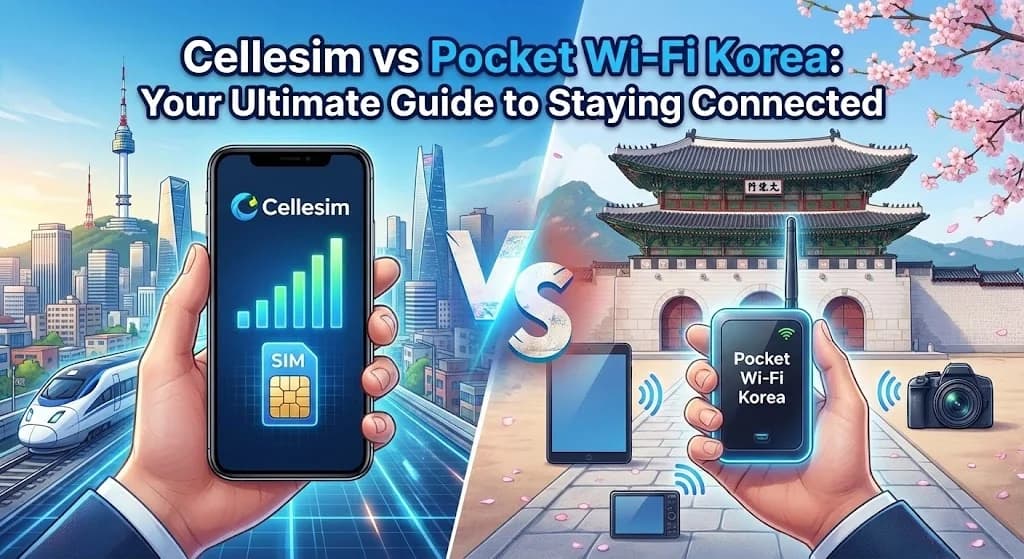
Venturing into the vibrant cities and picturesque landscapes of South Korea promises an unforgettable experience. From navigating Seoul's bustling streets to capturing the beauty of Jeju Island, staying connected is essential for maps, translation, sharing moments, and accessing local information. This guide provides a comprehensive comparison between two popular connectivity solutions for travelers: Cellesim eSIM and Pocket Wi-Fi, helping you determine the best option for your South Korean adventure.
- Understanding Your Connectivity Options for South Korea
- Cellesim eSIM: Seamless Digital Connectivity in South Korea
- Pocket Wi-Fi in South Korea: A Shared Connectivity Solution
- Cellesim eSIM vs. Pocket Wi-Fi: A Direct Comparison for Korean Travel
- South Korea's Network Landscape: Coverage and Speed for Travelers
- Data Needs for Your South Korean Journey
- Activation and Practicality: eSIM vs. Pocket Wi-Fi Setup in Korea
- Making Your Choice: When to Opt for Cellesim eSIM or Pocket Wi-Fi
- Frequently Asked Questions
Connect Instantly in South Korea with Cellesim
Experience reliable 4G/5G data across South Korea without the hassle of physical SIMs or rental devices. Join 50,000+ happy customers across 200+ countries.
Get Your South Korea eSIMUnderstanding Your Connectivity Options for South Korea
Before diving into the specifics of eSIM and Pocket Wi-Fi, it helps to understand the full spectrum of options available for staying online while traveling in South Korea. Traditionally, travelers relied on international roaming or purchasing a local physical SIM card upon arrival. While these options still exist, digital solutions like eSIMs and portable Wi-Fi devices offer more flexible and often more cost-effective alternatives. These modern choices prioritize convenience and accessibility, catering to different travel styles and data needs.
Cellesim eSIM: Seamless Digital Connectivity in South Korea
An eSIM (embedded SIM) offers a digital alternative to traditional plastic SIM cards. Instead of swapping physical cards, you activate a data plan by scanning a QR code or entering details into your compatible device. Cellesim provides eSIM plans specifically for South Korea, leveraging the country's robust mobile networks.
The primary advantage of a Cellesim eSIM for South Korea is its unparalleled convenience. You can purchase and activate your plan before you even leave home, ensuring you have internet access the moment your plane lands at Incheon International Airport. There is no need to visit a shop, stand in a queue, or carry an extra gadget. It integrates directly into your existing smartphone, allowing you to maintain your home number for calls and texts while using the eSIM for data.
Cellesim eSIMs connect to major local networks in South Korea, providing reliable 4G and often 5G speeds, comparable to what local users experience. This means smooth navigation with apps like Naver Maps, instant uploads to social media, and seamless video calls with family and friends.
Pocket Wi-Fi in South Korea: A Shared Connectivity Solution
Pocket Wi-Fi, also known as a portable Wi-Fi hotspot or Egg Wi-Fi in South Korea, is a small, battery-powered device that creates a personal Wi-Fi network. You rent the device, typically for the duration of your trip, and it allows multiple users and devices to connect to the internet simultaneously. Popular providers for Pocket Wi-Fi in South Korea include KT, SK Telecom, and LG U+.
One of the main draws of Pocket Wi-Fi is its shareability. If you are traveling in a group or with multiple devices (e.g., a phone, tablet, and laptop), a single Pocket Wi-Fi unit can provide connectivity for everyone. This can simplify billing and ensure all your gadgets are online. Most devices offer unlimited data plans, which is appealing for heavy internet users or those planning to stream a lot of content.
However, Pocket Wi-Fi comes with its own set of considerations. You typically need to pre-order the device and pick it up at designated counters at major airports like Incheon (ICN) or Gimpo (GMP), or sometimes at your accommodation. The device needs to be charged regularly, adding another item to your daily routine and potentially another power adapter to your luggage. Furthermore, you must return the device at the end of your trip, which requires planning to avoid late fees. For more information on local Wi-Fi options, you can consult resources from the official Korea Tourism Organization.
Cellesim eSIM vs. Pocket Wi-Fi: A Direct Comparison for Korean Travel
To help you decide, here is a detailed comparison of Cellesim eSIM and Pocket Wi-Fi based on key factors relevant to your South Korean journey:
| Feature | Cellesim eSIM | Pocket Wi-Fi | Local Physical SIM | International Roaming |
|---|---|---|---|---|
| Cost (e.g., 7 days/10GB) | From $4.50 (for smaller plans) | ~$30-50+ | ~$25-40 | $10-15+/day |
| Convenience | Instant, digital activation | Pickup/Return, carry device | Store visit, physical swap | Automatic, but pricey |
| Speed & Reliability | Full 4G/5G, local network | Full 4G/5G, local network | Full 4G/5G, local network | Varies, often throttled |
| Device Compatibility | eSIM-compatible phones only | Any Wi-Fi enabled device | Unlocked phones only | Any phone |
| Battery Life | Uses phone battery | Dedicated device battery (4-8 hrs) | Uses phone battery | Uses phone battery |
| Shareability | No (single device) | Yes (multiple devices) | No (single device) | No (single device) |
| Home Number | Keeps primary number active | No phone number | New local number | Keeps primary number active |
| Risk of Loss/Damage | Low (part of phone) | High (separate device) | Low (part of phone) | Low (part of phone) |
Cost-Effectiveness: While Pocket Wi-Fi initially seems attractive with its "unlimited" data plans, the daily rental fees can quickly add up, especially for longer trips. Cellesim eSIM plans for South Korea often provide a more cost-effective solution for individual travelers or couples, particularly for specific data allowances. Consider our roaming savings calculator to see potential savings compared to traditional roaming.
Convenience Factor: Cellesim eSIM excels in convenience. The entire process, from purchase to activation, is digital and can be completed from anywhere. There's no physical item to manage or return. Pocket Wi-Fi, conversely, requires pickup and drop-off, adding minor logistical steps to your travel itinerary. This can be particularly noticeable if you are arriving at an airport that has limited hours for rental desk operations or have tight connections. For a deeper dive into physical SIM alternatives, read our comparison on airport SIM card prices vs eSIM.
South Korea's Network Landscape: Coverage and Speed for Travelers
South Korea boasts one of the world's most advanced and widespread mobile networks. The country's three major carrier, SK Telecom, KT, and LG U+, offer extensive 4G LTE and rapidly expanding 5G coverage. Whether you are in a bustling metropolitan area like Seoul or Busan, exploring the historical sites of Gyeongju, or hiking in national parks, you can expect robust connectivity.
Cellesim partners with leading local networks in South Korea to ensure high-speed data access. This means Cellesim eSIM users benefit from the same reliable infrastructure as local residents, providing consistent performance for streaming, navigation, and communication. Pocket Wi-Fi devices also rely on these same underlying networks, delivering similar speeds and coverage, provided the device maintains a strong signal and has sufficient battery.
For travelers, both options generally provide excellent coverage. However, in extremely remote mountainous regions or deep subway tunnels, connectivity can occasionally be patchy regardless of the service. For the most up-to-date information on network performance, you can check independent analyses from services like OpenSignal.
Data Needs for Your South Korean Journey
Understanding your typical data consumption is crucial when choosing between a Cellesim eSIM and Pocket Wi-Fi. While Pocket Wi-Fi often comes with "unlimited" data, this can be an overkill for many travelers and doesn't always translate to better value.
- Light User (1-3 GB/week): Checking emails, occasional social media, light map usage.
- Moderate User (5-10 GB/week): Regular social media, frequent map usage, some video streaming, occasional video calls.
- Heavy User (10+ GB/week): Constant streaming, frequent video calls, large file uploads, working remotely.
Most travelers fall into the light to moderate categories. For instance, using Google Maps for an hour consumes about 5-10 MB, while an hour of standard-definition video streaming can use 500 MB to 1 GB. Cellesim offers various South Korea eSIM plans with different data allowances, allowing you to select a package that precisely matches your needs, preventing you from paying for data you won't use. To estimate your specific data requirements, utilize our Smart Data Calculator.
Activation and Practicality: eSIM vs. Pocket Wi-Fi Setup in Korea
The setup process for Cellesim eSIM and Pocket Wi-Fi differs significantly, impacting the practicality during your trip.
Cellesim eSIM Activation:
The Cellesim eSIM setup is entirely digital and typically takes just a few minutes. After purchasing a plan for South Korea, you will receive a QR code via email. You then go to your phone's settings, add a new cellular plan by scanning the QR code, and follow the on-screen prompts. Your eSIM can be activated before you depart or upon arrival, ensuring immediate connectivity. Our complete eSIM setup guide provides step-by-step instructions for various devices. For a more interactive experience, refer to our interactive setup guide.
Pocket Wi-Fi Setup and Management:
For Pocket Wi-Fi, the process involves a few more steps:
- Reservation: Book your device online in advance.
- Pickup: Collect the device from a designated counter at the airport or another location.
- Activation: Turn on the device and connect your phone(s) or other gadgets to its Wi-Fi network using the provided password.
- Charging: Keep the device charged daily; most units have a battery life of 4-8 hours.
- Return: Drop off the device at a designated counter before your departure.
While straightforward, these physical interactions add a layer of logistical management that eSIM bypasses entirely. Losing or damaging a Pocket Wi-Fi device can also result in significant replacement fees, adding an unforeseen cost to your travel budget.
"Using Cellesim eSIM for my recent trip to Seoul was a game-changer. I landed, turned on my data, and was instantly connected. No queues, no extra device, just seamless internet." - A satisfied Cellesim customer.
Making Your Choice: When to Opt for Cellesim eSIM or Pocket Wi-Fi
The best connectivity option for your South Korean journey depends largely on your personal travel style and priorities.
Choose Cellesim eSIM if you:
- Prefer a hassle-free, digital experience.
- Are a solo traveler or couple.
- Want to keep your home phone number active for calls/texts.
- Prioritize light packing and don't want to carry an extra device.
- Seek transparent pricing and wish to pay only for the data you need.
- Have an eSIM-compatible device.
Choose Pocket Wi-Fi if you:
- Are traveling in a large group or family with multiple devices that all need internet access.
- Require a dedicated, unlimited data source for very heavy usage across many devices.
- Don't mind the added responsibility of picking up, charging, and returning a separate device.
- Prefer a shared internet connection that doesn't consume your phone's battery directly for data.
For the majority of modern travelers heading to South Korea, the Cellesim eSIM offers a superior blend of convenience, flexibility, and cost-effectiveness. It aligns with the desire for instant, reliable connectivity without the added logistical burdens of a physical device. Embrace the future of travel connectivity and enjoy South Korea with peace of mind.
Ready for Seamless Connectivity in South Korea?
Experience the ultimate convenience of Cellesim eSIM for your trip. Get connected instantly.
Start Your Connected JourneyTrusted by 50,000+ travelers worldwide. 24/7 Support: [email protected]
Frequently Asked Questions
What is the main difference between Cellesim eSIM and a Pocket Wi-Fi for South Korea?
Cellesim eSIM is a digital SIM profile embedded in your phone, offering direct data connectivity without a physical card or separate device. Pocket Wi-Fi is a physical, portable hotspot device that creates a Wi-Fi network for multiple devices.
Is my phone compatible with Cellesim eSIM for use in South Korea?
Many modern smartphones support eSIM. You can check your device's compatibility by visiting our eSIM checker or reviewing our list of eSIM compatible devices on the Cellesim website.
Can I keep my original phone number active while using a Cellesim eSIM in South Korea?
Yes, with Cellesim eSIM, you can keep your primary SIM active for calls and texts from your home number while using the eSIM for mobile data. This allows you to stay reachable without incurring international roaming data charges.
Where can I pick up a Pocket Wi-Fi device in South Korea?
Pocket Wi-Fi devices are typically picked up at major international airports in South Korea, such as Incheon (ICN) or Gimpo (GMP), from the rental counters of local providers like KT, SK Telecom, or LG U+. Some services also offer delivery to hotels.
What happens if my Pocket Wi-Fi device runs out of battery or gets lost?
If a Pocket Wi-Fi device runs out of battery, your internet connection will cease until it is recharged. Losing or damaging the device can result in significant replacement fees charged by the rental company, which can add unexpected costs to your trip.
Is Cellesim eSIM reliable for 4G/5G coverage across all of South Korea?
Cellesim partners with major local networks in South Korea, ensuring reliable 4G and 5G coverage in most populated areas, including cities and popular tourist destinations. Coverage may vary slightly in very remote or rural regions, similar to local network performance.