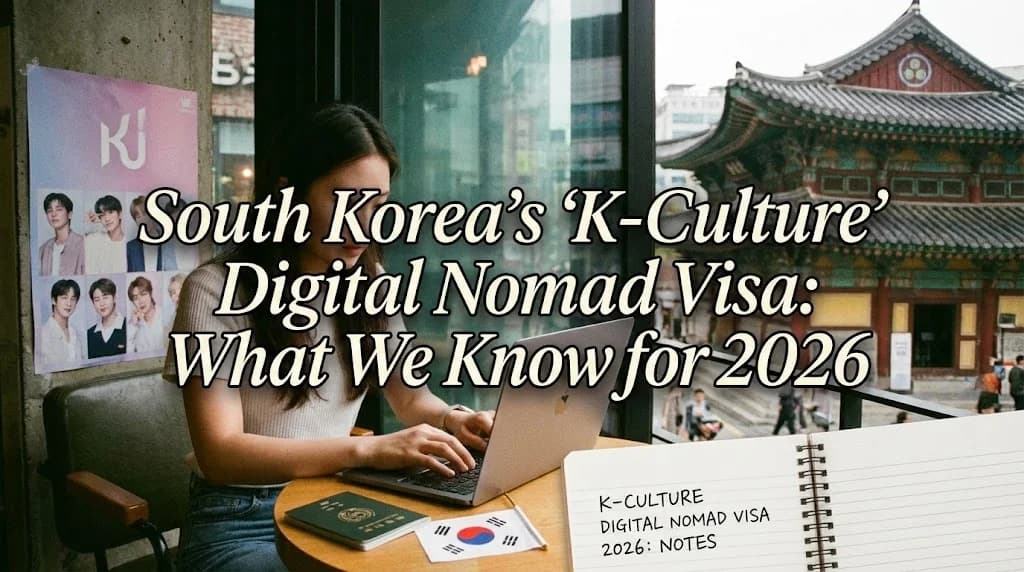
The vision of starting your workday in a vibrant Seoul café, the aroma of fresh coffee blending with the faint melody of a K-pop track, is becoming a tangible reality for remote professionals. Imagine dedicating your afternoons to project completion and your evenings to exploring ancient palaces or delving into the city's renowned culinary landscape. For many years, this lifestyle has been a cherished aspiration for remote workers, with visa limitations often posing a significant barrier. However, this is set to change.
The travel tech community is abuzz with the news that South Korea is actively developing a new digital nomad visa, slated for launch in 2026. This initiative is more than just another extended stay permit; it's a direct invitation to deeply engage with Korean culture, specifically through the global phenomenon of Hallyu, thus establishing it as a dedicated K-Culture Digital Nomad Visa. Before embarking on this exciting journey, understanding its implications and preparing adequately is essential, starting with reliable connectivity solutions like an eSIM for South Korea.
- Understanding the K-Culture Digital Nomad Visa: What to Expect
- Key Eligibility Requirements and Application Process for 2026
- Connectivity Essentials for Your K-Culture Journey: Why eSIM is Key
- Navigating Daily Life in South Korea as a Digital Nomad
- Embracing Hallyu: Cultural Immersion for Digital Nomads
- Cost of Living in South Korea: Budgeting for Your Nomad Lifestyle
- Setting Up Your Cellesim eSIM for Seamless South Korea Travel
- Beyond Seoul: Exploring South Korea with Constant Connection
- Frequently Asked Questions
South Korea eSIM Plans for Your K-Culture Journey
Connect instantly in South Korea. Join 50,000+ travelers who trust Cellesim for reliable connectivity in 200+ countries.
View South Korea eSIM PlansUnderstanding the K-Culture Digital Nomad Visa: What to Expect
South Korea's impending K-Culture Digital Nomad Visa is designed to attract a specific type of remote worker: those who not only seek professional opportunities but also wish to deeply engage with the nation's vibrant cultural landscape. Unlike generic digital nomad visas, this initiative is expected to emphasize cultural immersion, making Hallyu (the Korean Wave) a central theme. The visa aims to allow individuals to reside in South Korea for an extended period, potentially up to two years, enabling them to work remotely for companies outside the country while experiencing everything from K-pop and K-dramas to traditional arts and cuisine.
While the specifics are still being finalized for its 2026 launch, initial reports suggest that the visa will target creative professionals, tech innovators, and others who can contribute to South Korea's economy and cultural exchange. This move signals a broader trend among nations to attract a talented, mobile workforce, and South Korea is keen to differentiate its offering through its unique cultural appeal. It represents a significant shift from previous, more restrictive long-term stay options, providing a structured pathway for digital nomads to integrate into Korean society.
Key Eligibility Requirements and Application Process for 2026
Although the full details are pending, based on information from the Ministry of Justice and general digital nomad visa trends, prospective applicants for the K-Culture Digital Nomad Visa in 2026 should anticipate several key requirements. These typically include:
- Proof of Remote Employment: You will likely need to demonstrate stable remote employment with a company based outside South Korea, or proof of self-employment with international clients.
- Minimum Income Threshold: A significant financial requirement is expected, often set at a certain multiple of the host country's GNI per capita to ensure financial self-sufficiency. For South Korea, this could range from $30,000 to $50,000 USD annually, but specific figures for 2026 are yet to be confirmed.
- Health Insurance: Comprehensive health insurance covering the duration of your stay in South Korea will be mandatory.
- Clean Criminal Record: Applicants will need to provide a criminal record check from their country of origin.
- Accommodation Plan: While not always a strict requirement, having an initial plan for accommodation can strengthen an application.
The application process is expected to involve submitting documents to a South Korean embassy or consulate in your home country, followed by potential interviews. It is advisable to monitor the official website of the South Korean Ministry of Foreign Affairs (or a relevant government portal like Hi Korea) for the most accurate and up-to-date information as the 2026 launch approaches.
Connectivity Essentials for Your K-Culture Journey: Why eSIM is Key
For any digital nomad, reliable internet connectivity is not a luxury; it is a fundamental tool for work and daily life. In South Korea, a country renowned for its advanced digital infrastructure, an eSIM offers an unparalleled solution for staying connected from the moment you land. Traditional methods like physical SIM cards or international roaming come with various inconveniences that an eSIM effortlessly resolves.
With Cellesim, you can purchase and activate your South Korea eSIM plan before you even depart, ensuring you have immediate data access upon arrival. This eliminates the need to queue for a local SIM card at the airport or deal with language barriers in local phone shops. An eSIM also allows you to keep your primary phone number active for calls and messages from home, while using the eSIM for local data. This dual-SIM functionality is invaluable for maintaining personal and professional connections simultaneously.
| Option | Setup | Primary Number | Cost (per GB) | Flexibility |
|---|---|---|---|---|
| Cellesim eSIM | Instant Digital | Kept Active | Low (from $4.50) | High |
| Local Physical SIM | Airport/Store Visit | May Replace | Medium | Medium |
| Traditional Roaming | Automatic | Kept Active | High ($10-15/day) | Low |
Cellesim provides coverage across South Korea, leveraging local network partners to deliver fast 4G/5G speeds, crucial for video calls, large file transfers, and streaming K-dramas during your downtime. With Cellesim's South Korea eSIM plans, you can select data packages tailored to your usage, from a few gigabytes for light browsing to larger bundles for extensive work and entertainment needs.
Navigating Daily Life in South Korea as a Digital Nomad
Life as a digital nomad in South Korea, particularly in cities like Seoul or Busan, offers a blend of modern convenience and deep cultural heritage. Effective navigation requires understanding local customs and leveraging technology.
- Public Transportation: South Korea boasts an exceptionally efficient and extensive public transport system, especially in major cities. The T-Money card, a rechargeable public transport card, is indispensable for subway, bus, and even taxi fares. Your eSIM will be crucial for using navigation apps like Naver Map or KakaoMap, which are more accurate than Google Maps in South Korea.
- Language Barrier: While many younger Koreans and those in tourist areas speak English, learning basic Korean phrases significantly enhances your experience. Translation apps, powered by your Cellesim data, can be lifesavers for daily interactions, ordering food, or reading signs.
- Banking and Payments: South Korea is largely a cashless society. Credit cards are widely accepted, but mobile payment systems like Kakao Pay and Naver Pay are prevalent. Setting up a local bank account will be important for longer stays, and your eSIM ensures you receive SMS verifications for these services.
- Housing: Finding accommodation can be challenging. Options range from short-term Airbnbs to long-term studio apartments (officetels or onerooms). Websites like Zigbang or Dabang are popular, but often require Korean language proficiency or assistance from a local agent.
Embracing the convenience of South Korea's digital infrastructure with a reliable eSIM allows you to manage these aspects of daily life with greater ease and efficiency.
Embracing Hallyu: Cultural Immersion for Digital Nomads
The "K-Culture" aspect of the digital nomad visa is a unique selling point, inviting nomads to fully engage with the Korean Wave. This means more than just being a spectator; it involves active participation in the cultural fabric that defines modern South Korea. For the K-Culture digital nomad, opportunities for immersion are vast:
- K-Pop and Entertainment: Attend concerts, fan meetings, or visit entertainment agencies. Explore districts like Gangnam and Hongdae, centers of K-Pop culture.
- K-Dramas and Cinema: Visit filming locations, engage with online communities, and explore Korea's thriving film scene.
- Traditional Arts and Heritage: Balance modernity with tradition by visiting ancient palaces like Gyeongbokgung, exploring the Bukchon Hanok Village, or attending traditional performances. Consider taking classes in traditional crafts or music.
- Korean Cuisine: Dive into the diverse culinary landscape, from street food in Myeongdong to Michelin-starred restaurants. Cooking classes offer a deeper insight into Korean flavors.
- Community Engagement: Join local clubs, language exchange groups, or volunteer initiatives. This helps build a local network and deepens cultural understanding.
Your eSIM will facilitate this cultural journey, from booking event tickets and translating menus to sharing your experiences instantly with friends and family. It’s about leveraging technology to enhance your cultural exploration, making your K-Culture nomad experience richer and more connected.
Find Your Ideal South Korea eSIM Plan
Cost of Living in South Korea: Budgeting for Your Nomad Lifestyle
While South Korea offers an attractive lifestyle, understanding the cost of living is crucial for budgeting as a digital nomad. Major cities like Seoul can be expensive, particularly for accommodation, but diligent planning can help manage expenses.
- Accommodation: Rent is typically the largest expense. A studio apartment (officetel) in a desirable Seoul neighborhood can range from $700 to $1,500+ USD per month. Smaller cities or less central areas offer more affordable options. Deposit requirements can be significant (often "key money" deposits).
- Food: Eating out can be surprisingly affordable, especially at local restaurants or street food stalls (approx. $5-10 per meal). Groceries for home cooking are comparable to Western prices.
- Transportation: Public transport is excellent and inexpensive. A single subway ride is around $1-2 USD. A monthly T-Money pass or similar scheme can reduce costs further.
- Utilities and Internet: Utilities (electricity, gas, water) for a single person might total $100-150 USD per month. High-speed internet is usually included in rent or costs around $30-50 USD/month for a separate subscription, though your eSIM provides portable internet.
- Miscellaneous: This includes health insurance (mandatory for the visa), leisure activities, and personal expenses.
"Living in Seoul offers incredible opportunities, but it pays to be budget-savvy. Choosing a neighborhood outside the absolute city center can significantly cut down on rent, and local markets are fantastic for fresh, affordable produce."
A realistic monthly budget for a single digital nomad in Seoul might range from $1,800 to $3,000+ USD, depending on lifestyle choices. Factoring in an eSIM for consistent, cost-effective data helps stabilize your communication budget.
Setting Up Your Cellesim eSIM for Seamless South Korea Travel
Activating your Cellesim eSIM for your K-Culture digital nomad journey is a straightforward process, designed for instant connectivity.
- Check Device Compatibility: First, ensure your smartphone is eSIM-compatible. Most newer iPhone, Samsung, Google Pixel, and other flagship devices support eSIM technology. You can verify this using our eSIM Checker.
- Choose Your Plan: Visit the Cellesim South Korea page and select a data plan that aligns with your anticipated usage. Consider your work requirements and leisure activities. Our Smart Data Calculator can help estimate your data needs.
- Purchase and Receive QR Code: Complete your purchase. You will receive an email containing a QR code and manual installation instructions.
- Install Your eSIM: Scan the QR code with your phone's camera or enter the details manually via your device settings (typically under "Cellular" or "Mobile Data"). Follow the on-screen prompts. We also have an Interactive Setup Guide if you need visual assistance.
- Activate Data Roaming: Once installed, ensure "Data Roaming" is turned ON for your Cellesim eSIM line in your phone settings. Your Cellesim eSIM will connect to a local network provider, providing immediate internet access.
It is recommended to install your eSIM before you travel, or at least while you have a Wi-Fi connection. This guarantees seamless internet access as soon as your flight lands in South Korea.
Beyond Seoul: Exploring South Korea with Constant Connection
While Seoul serves as the vibrant heart of K-Culture and the primary hub for many digital nomads, South Korea offers a rich tapestry of experiences beyond its capital. The K-Culture Digital Nomad Visa encourages deeper exploration, and your Cellesim eSIM ensures you remain connected wherever your curiosity takes you.
- Busan: A coastal city known for its beautiful beaches, fresh seafood, and vibrant art scene. Perfect for a weekend escape.
- Jeju Island: A volcanic island paradise, designated a UNESCO World Heritage site, offering stunning natural landscapes, hiking trails, and unique local culture.
- Gyeongju: Often called "the museum without walls," Gyeongju is the ancient capital of the Silla Kingdom, filled with historical sites, temples, and royal tombs.
- Gangwon Province: Home to the rugged beauty of the Seoraksan National Park and ski resorts, offering outdoor adventures throughout the year.
Whether you're exploring ancient temples in Gyeongju, hiking the trails of Seoraksan, or relaxing on Jeju Island, your Cellesim eSIM provides reliable data coverage across the entire country. This constant connection enables you to navigate, share your experiences, and even conduct light work tasks from remote locations, truly embodying the freedom of the digital nomad lifestyle. For those planning to combine their South Korea experience with travel to other destinations, Cellesim also offers Global eSIM plans.
Ready to Start Your K-Culture Nomad Adventure?
Secure your seamless connection to South Korea's vibrant culture and thriving remote work scene.
Get Your South Korea eSIM NowTrusted by 50,000+ travelers worldwide. Available in 200+ countries with 24/7 Support.
Frequently Asked Questions
When will the K-Culture Digital Nomad Visa be officially launched?
The South Korean government has indicated plans to launch the K-Culture Digital Nomad Visa in 2026. Specific details and the exact launch date are expected to be announced closer to that time, likely via the Ministry of Justice or Ministry of Foreign Affairs.
What is the main difference between this visa and a regular long-term visa?
The K-Culture Digital Nomad Visa is specifically tailored for remote workers with an emphasis on cultural immersion. While regular long-term visas are often for employment or study, this visa allows you to work remotely for foreign companies while actively engaging with Korean culture and society for an extended period.
Can I work for a South Korean company with this visa?
Typically, digital nomad visas are designed for individuals working remotely for companies outside the host country. It is highly probable that working for a South Korean employer will not be permitted under the K-Culture Digital Nomad Visa. Always refer to the official visa guidelines for precise employment restrictions.
Is an eSIM really necessary for a digital nomad in South Korea?
While not strictly "necessary" in the sense that other options exist, an eSIM like Cellesim is highly recommended. It provides instant connectivity upon arrival, allows you to keep your primary number, offers flexible data plans, and ensures reliable access to essential navigation, translation, and communication apps vital for daily life and work.
How much data will I need for my digital nomad stay in South Korea?
Your data needs depend on your work and leisure activities. For extensive video calls, large file transfers, and frequent streaming, a higher data plan (e.g., 20GB+) is advisable. For lighter usage (email, browsing, maps), 5-10GB per month might suffice. Cellesim offers various packages to suit different requirements, and our Smart Data Calculator can help estimate your needs.
Will my current phone number still work if I use a Cellesim eSIM in South Korea?
Yes. When you use a Cellesim eSIM, your existing physical SIM card remains in your phone, allowing you to receive calls and texts on your home number. You simply designate the eSIM for mobile data, providing you with dual connectivity and the convenience of keeping both numbers active.