Updated: 2026-02-16
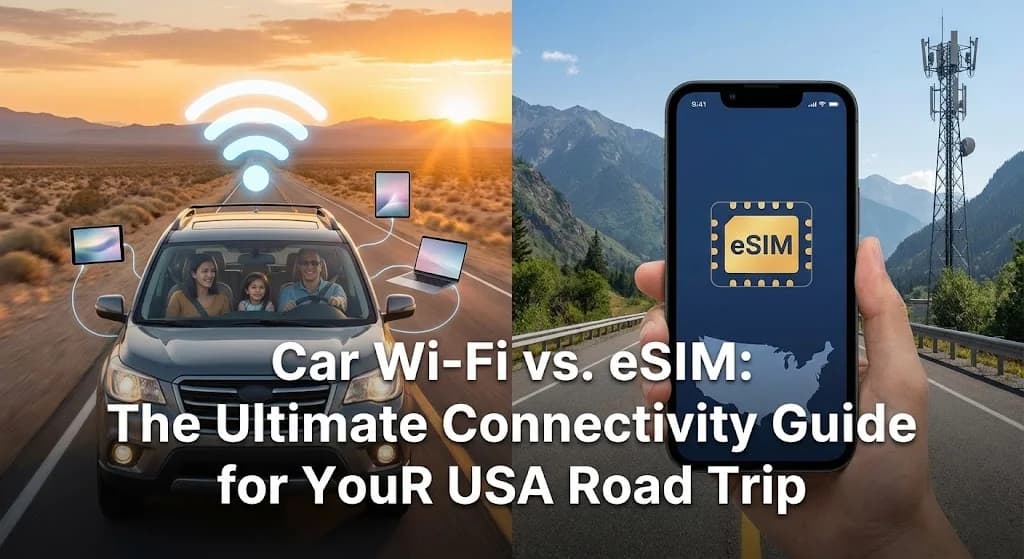
Picture this: You’re cruising down a scenic byway in Utah, the iconic red rock formations painting a stunning backdrop. Your playlist is perfect, the snacks are plentiful, but then you hit a dead zone. The GPS freezes, the music stops streaming, and the kids in the back declare a state of emergency because their tablets have gone dark. This isn't just an inconvenience; it's the modern road trip's biggest challenge. Staying reliably connected across the vast, beautiful, and sometimes remote landscapes of the United States requires a smart plan. The debate often boils down to two main contenders, and that's why we're here to settle the **car Wi-Fi vs. eSIM USA road trip** showdown once and for all. For travelers embarking on this adventure, choosing the right connection can make or break the experience. A powerful and flexible option like a travel eSIM for the USA can provide the freedom you need, but let's dive into the details to see how it stacks up against the built-in alternative for ensuring you have the best internet for your USA road trip. For those journeying from the UK to the USA, understanding these connectivity options is especially vital.
- The Modern Road Trip Dilemma for USA Travellers
- USA Road Trip Connectivity: Car Wi-Fi vs. eSIM at a Glance
- Deep Dive: Understanding In-Car Wi-Fi Hotspots for Your USA Road Trip
- Detailed Car Wi-Fi Provider Analysis for Your USA Road Trip
- The Cellesim eSIM Advantage for Your USA Road Trip
- Estimating Data Needs for Your USA Road Trip
- Cost Comparison: Car Wi-Fi, eSIM, and Roaming for USA Travel
- Seamless Setup: Activating Your Cellesim eSIM for USA Travel
- Maximising Connectivity: Pro Tips for Your USA Road Trip
- Making the Choice: Car Wi-Fi vs. eSIM for Your USA Road Trip
- Frequently Asked Questions
USA eSIM Plans from $4.50
Connect instantly across the vast landscapes of the USA. Join 50,000+ travelers who trust Cellesim for reliable connectivity.
Get Your USA eSIMThe Modern Road Trip Dilemma for USA Travellers
Navigating the United States on a road trip offers unparalleled freedom and adventure. From the deserts of Arizona to the mountains of Colorado, and the bustling cities of the East Coast, the diversity is immense. However, this vastness also presents a challenge: consistent internet access. While many vehicles now offer built-in Wi-Fi, and traditional roaming is an option, the modern traveler seeks a solution that balances cost, coverage, and convenience. The goal is uninterrupted navigation, streaming, and communication, making the choice between car Wi-Fi and an eSIM a central decision for any successful USA road trip. Understanding the nuances of each option is crucial for a smooth journey.
USA Road Trip Connectivity: Car Wi-Fi vs. eSIM at a Glance
Before we get into the nitty-gritty of keeping connected across the diverse terrain of the USA, here’s a high-level look at how these two in-car internet solutions compare. This table should give you a quick idea of which direction might be best for your specific USA road trip needs, helping you decide on your ultimate connectivity guide for international visitors.
| Feature | In-Car Wi-Fi Hotspot | Travel eSIM for USA |
|---|---|---|
| Cost Structure | Monthly subscription, often with a free trial that auto-renews at a high rate. Typically ranges from $15-$30 USD per month. | Prepaid, one-time payment. No hidden fees or recurring charges. Plans start from as little as $4.50 USD for several days. |
| Coverage Across USA | Tied to a single carrier (e.g., AT&T, Verizon) chosen by the car manufacturer. Can be patchy in rural USA. | Connects to multiple major local networks (e.g., AT&T, T-Mobile, Verizon), automatically switching to the strongest signal for superior USA-wide coverage. |
| Flexibility & Portability | Works only when the car is on. The internet is locked to the vehicle, meaning no connectivity outside the car. | Your connection is on your phone and goes with you everywhere, from the car to a hike in a national park to a cafe in a US city. This is key for a comprehensive USA road trip. |
| Ease of Setup for USA Travel | Often requires setup through the car's infotainment system and creating an account with the provider, potentially involving a call to customer service. | Instant. Purchase online, scan a QR code, and activate before you travel, even before you land in the USA. Our interactive setup guide makes it simple. |
| Data Limits & Throttling | "Unlimited" plans almost always have a high-speed data cap (e.g., 22GB or 50GB), after which speeds are severely throttled to unusable levels. | Clear, transparent data packages, including true unlimited options with no throttling, ensuring consistent high-speed data for your entire USA road trip. |
| Device Compatibility | Works with any Wi-Fi enabled device, but only within range of the car. | Requires an eSIM-compatible phone (check supported devices), but can easily share data via hotspot to any Wi-Fi device, like tablets or laptops, making it a versatile portable Wi-Fi for USA travel. |
Deep Dive: Understanding In-Car Wi-Fi Hotspots for Your USA Road Trip
Many new rental cars and personal vehicles from manufacturers like Ford, GM, and Chrysler come with a tempting feature: a built-in Wi-Fi hotspot. It sounds like the perfect solution for staying connected on a USA road trip. But what’s really going on under the hood when considering in-car Wi-Fi USA options?
How Does Car Wi-Fi Work for USA Connectivity?
Think of in-car Wi-Fi as a mobile router that’s permanently installed in your vehicle. It uses its own dedicated SIM card and antenna, which is typically more powerful than the one in your smartphone. Car manufacturers like Ford, GM, and Chrysler partner with a major cellular provider, usually AT&T or Verizon in the USA, to provide the service. You activate it through the car’s infotainment system, often starting with a free trial that seamlessly converts into a paid monthly subscription if you forget to cancel. This is one of the most common ways travelers end up with unexpected bills for data plans for road trips USA.
The Pros of Using Car Wi-Fi on a USA Journey
Let's be fair, there are a few scenarios where this integrated system shines:
- Seamless Integration: The best thing about car Wi-Fi is that it's just... there. It turns on with the ignition, and your devices can connect automatically. There are no extra gadgets to charge or remember to pack, offering immediate access to the internet.
- Stronger Antenna: A car's roof-mounted antenna can sometimes capture a weaker signal more effectively than a handheld phone, which *might* give you a slight edge in fringe coverage areas, especially useful in certain remote parts of the USA.
- Easy Multi-Device Connection: It’s designed to handle multiple connections simultaneously without draining any one person's phone battery. This is appealing for families with several tablets and laptops, ensuring everyone in the car stays entertained during long stretches of a USA road trip.
The Cons and Hidden Costs of In-Car Wi-Fi for USA Travel
Now for the reality check. The convenience of built-in Wi-Fi often comes with significant drawbacks that aren't obvious until you're deep into your USA road trip, leading many to search "car Wi-Fi worth it Reddit" and finding mixed reviews.
- Expensive Subscriptions: After the trial period, these plans can be costly, often running $20-$30 USD per month for a single vehicle. For a two-week USA road trip, you might be forced into a full month's subscription with a tedious cancellation process. For example, a 22GB AT&T data plan for car Wi-Fi can cost around $25-$30 USD per month, which might be overkill or insufficient depending on usage, and difficult to manage for short-term travel. This scenario often makes Cellesim a more cost-effective alternative to traditional roaming or car Wi-Fi.
- The Single-Carrier Trap: This is the biggest weakness for USA-wide travel. Your car is locked to one network. If your Ford is on the AT&T network and you drive into a part of rural Wyoming that is exclusively Verizon country, you have zero internet. You have no flexibility to switch, making it a risky choice for comprehensive USA road trip connectivity. Many Reddit users voice frustration over this limitation.
- It's Glued to Your Car: The moment you turn off the ignition and step out to explore a national park, your internet connection is gone. Need to look up trail information at the Grand Canyon viewpoint or find a restaurant while walking through downtown Savannah? You're out of luck unless you have a separate data plan on your phone. This significantly limits its utility as a portable Wi-Fi for USA travel.
- Deceptive "Unlimited" Plans: Be very wary of the word "unlimited." Most car Wi-Fi plans will throttle your speed to an unusable crawl (think 128 kbps, like dial-up) after you hit a certain data cap, such as 22GB or 50GB. That cap can be burned through surprisingly quickly with a couple of kids streaming Netflix in the back seat, especially on a long USA road trip. Before you commit, it's always wise to check if your phone is an eSIM compatible device, which opens up far more flexible options for best internet for USA road trip.
Detailed Car Wi-Fi Provider Analysis for Your USA Road Trip
Understanding the specifics of in-car Wi-Fi offerings from major US carriers is crucial for any prospective road tripper. While the convenience is undeniable, the details reveal significant limitations for extensive travel across the USA.
AT&T In-Car Wi-Fi (e.g., Ford, GM, Subaru)
AT&T is a dominant provider for built-in car Wi-Fi, partnering with brands like Ford (FordPass Connect) and General Motors (OnStar Wi-Fi for Chevrolet, Cadillac, Buick, GMC). Their plans often start with a trial, typically 1GB for 30 days or a certain number of months. Post-trial, typical plans might include:
- 2GB for $15 USD/month
- 5GB for $25 USD/month
- Unlimited Data for $30 USD/month (often with a high-speed data cap of 22GB or 50GB before throttling).
While AT&T boasts strong coverage in many urban and suburban areas of the USA, their reach can become spotty in remote regions, national forests, and less populated states, which are frequently part of scenic road trips (e.g., large parts of Montana, Nevada, or even parts of Utah). This single-network dependency means that if AT&T doesn't have a signal, your car Wi-Fi won't work, leaving you disconnected in vast areas of the country. For a detailed view of their network, refer to the official AT&T coverage map.
Verizon In-Car Wi-Fi (e.g., Chrysler, Dodge, Jeep, Ram)
Verizon also offers in-car Wi-Fi services, often found in vehicles from the Stellantis group (Chrysler, Dodge, Jeep, Ram) through their Uconnect system. Similar to AT&T, Verizon's plans typically begin with a trial, followed by monthly subscription options:
- 2GB for $15-$20 USD/month
- Unlimited Data for $20-$30 USD/month (with typical high-speed data caps before throttling).
Verizon is renowned for its strong network in many parts of the USA, particularly rural areas where other carriers might struggle. However, like AT&T, it is still a single-carrier solution. If you venture into a region where Verizon's signal is weak or non-existent, your in-car Wi-Fi will cease to function. This can be a significant drawback if your road trip takes you through diverse and remote landscapes. You can check their coverage on the Verizon coverage map.
The Cellesim eSIM Advantage for Your USA Road Trip
In contrast to the limitations of single-carrier car Wi-Fi, a Cellesim eSIM offers a powerful, flexible, and often more cost-effective solution for comprehensive connectivity across the USA. An eSIM leverages multiple local networks to ensure you always have the strongest signal available.
Multi-Network Coverage for Uninterrupted Travel
One of the primary advantages of a Cellesim eSIM for your USA road trip is its ability to connect to multiple major local networks. While car Wi-Fi is tethered to one provider (e.g., AT&T or Verizon), Cellesim partners with several top-tier US networks. This means your device automatically switches to the strongest available signal, providing superior coverage, especially in areas where one carrier might be weak. This flexibility is crucial when traversing vast and varied terrains, from dense urban centers to expansive national parks. Cellesim boasts coverage in over 200 countries, with robust options specifically for the United States.
True Portability Beyond the Vehicle
A road trip isn't just about driving; it's about exploring. When you stop to hike in Zion National Park, grab a meal in New Orleans, or navigate pedestrian-only zones in Washington D.C., your connectivity needs to come with you. An eSIM is embedded directly into your phone, providing a personal Wi-Fi hotspot in your pocket. This means you stay connected whether you're in the car or out exploring on foot. You can effortlessly look up directions, check opening hours, or share photos without losing your internet connection. This freedom significantly enhances the overall travel experience.
Transparent, Flexible, and Cost-Effective Data Plans
Cellesim offers a range of prepaid eSIM plans for the USA, designed to suit various travel durations and data needs. Unlike the often opaque and auto-renewing subscriptions of car Wi-Fi, Cellesim plans are transparent with no hidden fees or unexpected charges. You choose the data amount and validity period that works for you, giving you complete control over your budget. Plans often include options for true unlimited data, ensuring you never hit a throttling cap, which is a common issue with "unlimited" car Wi-Fi. This pay-as-you-go model ensures you only pay for what you need, making it a highly economical choice for your USA road trip.
Estimating Data Needs for Your USA Road Trip
One of the most common questions for road trippers is, "How much data will I actually need?" Overestimating leads to unnecessary costs, while underestimating results in frustrating disconnections. For a USA road trip, your data usage will likely be higher than a typical city break due to reliance on navigation, streaming for entertainment, and potentially working remotely.
- Navigation: Google Maps or Apple Maps can consume around 5-10 MB per hour of active navigation. If you pre-download maps, this usage significantly drops.
- Music Streaming: Streaming music at standard quality uses approximately 40-75 MB per hour. High quality can double this.
- Video Streaming: Watching Netflix or YouTube on the go is the biggest data drain. Standard definition consumes around 1 GB per hour, while HD can use 3 GB per hour or more.
- Social Media & Browsing: Casual browsing and social media activity might use 100-200 MB per hour. Heavy use with video playback increases this.
- Hotspot Usage: If you're sharing your phone's connection with tablets or laptops, factor in their usage, which can quickly add up.
For a typical 7-14 day USA road trip, especially with multiple users or streaming, a 20GB to 50GB plan (or even an unlimited option) is often recommended. Cellesim offers a Smart Data Calculator to help you estimate your specific needs based on your planned activities.
Cost Comparison: Car Wi-Fi, eSIM, and Roaming for USA Travel
When planning your USA road trip, understanding the true cost of connectivity is essential. Here's a comparative look at the typical expenses for car Wi-Fi, a Cellesim eSIM, and traditional international roaming.
| Option | Setup Cost (Approx.) | Typical Price (15 days) | Portability | Network Flexibility | Data Throttling Risk |
|---|---|---|---|---|---|
| Cellesim eSIM | Free (QR Code) | From $10-$30 USD (various plans) | Phone (goes everywhere) | Multi-network (best coverage) | Low (true unlimited options) |
| In-Car Wi-Fi | Free trial (often auto-renews) | $20-$30 USD (for 1 month) | Car only | Single-network (patchy) | High (after 22GB-50GB cap) |
| Carrier Roaming | Automatic | $10-$15 USD/day (or high per MB) | Phone (goes everywhere) | Home network deals | Moderate (speeds often limited) |
As this table illustrates, Cellesim eSIMs generally offer the most balanced solution in terms of cost-effectiveness, flexibility, and reliable coverage for the dynamic needs of a USA road trip. Using a roaming savings calculator can further highlight the financial benefits.
Find Your Ideal USA eSIM Plan
Seamless Setup: Activating Your Cellesim eSIM for USA Travel
One of the most appealing aspects of a Cellesim eSIM is its straightforward activation process. You can purchase and set up your eSIM even before you leave home, ensuring you have internet access the moment you land in the USA.
Step-by-Step Activation Guide:
- Check Device Compatibility: Ensure your smartphone supports eSIM technology. Most newer models are compatible. You can use our eSIM Checker for quick verification.
- Purchase Your USA eSIM Plan: Visit the Cellesim website and choose a plan that fits your data and duration needs for your USA road trip.
- Receive QR Code: After purchase, you will instantly receive an email with a QR code and detailed instructions.
- Install eSIM: Scan the QR code with your phone's camera (usually found in Settings > Cellular/Mobile Data > Add eSIM). Follow the on-screen prompts. This typically takes less than two minutes.
- Activate & Connect: Once installed, you can activate your eSIM from your phone's settings. We recommend activating it just before or upon arrival in the USA. For more detailed instructions, refer to our complete eSIM setup guide.
This process eliminates the need to find local SIM card vendors or deal with complicated car Wi-Fi subscriptions upon arrival, allowing you to focus on your adventure.
Maximising Connectivity: Pro Tips for Your USA Road Trip
Even with the best connectivity solution, a few strategies can enhance your online experience during a USA road trip:
- Download Offline Maps: Before hitting the road, download offline maps for all regions you plan to visit. This is invaluable in areas with spotty signal and saves data.
- Pre-download Entertainment: Ensure movies, podcasts, and music are downloaded to your devices. This keeps everyone entertained during long drives and prevents excessive data use.
- Utilise Wi-Fi Hotspots: When available and secure, use free Wi-Fi at hotels, cafes, or rest stops to download large files or update apps, conserving your eSIM data.
- Power Management: Constant data usage and hotspot tethering can drain your phone battery quickly. Carry a portable power bank or ensure your car charger is always accessible.
- Monitor Data Usage: Regularly check your eSIM data usage through your phone settings or the Cellesim app. This helps you manage your plan and top up if necessary. Our guide on how to check eSIM data usage provides more details.
"On a cross-country USA road trip, relying solely on car Wi-Fi felt like a gamble. Switching to an eSIM gave me constant connectivity, from Yellowstone trails to bustling city streets, making every stop seamless."
Making the Choice: Car Wi-Fi vs. eSIM for Your USA Road Trip
The decision between car Wi-Fi and an eSIM ultimately depends on your specific travel style and priorities for your USA road trip. If your journey is primarily confined to major highways and urban areas, and you don't mind losing connectivity when you step out of the car, then car Wi-Fi might offer a degree of convenience, albeit at a higher potential cost and less flexibility. However, for the vast majority of international travelers embarking on an extensive USA road trip, seeking true freedom and reliable connectivity, the eSIM is the superior choice.
An eSIM provides unparalleled flexibility with multi-network coverage, ensuring you stay connected across diverse landscapes. Its portability means your internet goes wherever you do, whether you're driving through a desert, hiking a mountain trail, or exploring a historic town. Combined with transparent, cost-effective prepaid plans, Cellesim offers a modern solution that aligns perfectly with the spirit of adventure and discovery that defines a USA road trip.
Ready for Uninterrupted USA Road Trip Connectivity?
Experience seamless internet across the USA with Cellesim. Instant activation, flexible plans, and multi-network coverage.
Start Your Connected JourneyTrusted by 50,000+ travelers in 200+ countries. 24/7 Support: [email protected]
Frequently Asked Questions
What is the main difference between car Wi-Fi and an eSIM for a USA road trip?
Car Wi-Fi is typically tied to a single network provider and only works within the vehicle. An eSIM, like Cellesim's, uses multiple local networks for broader coverage across the USA and provides portable internet on your phone, both inside and outside the car.
Can an eSIM provide internet outside the car during my USA trip?
Yes, absolutely. An eSIM is installed directly onto your smartphone, meaning your internet connection is available wherever your phone goes. This is ideal for exploring national parks, city walking tours, or any time you step away from your vehicle.
How does Cellesim's USA eSIM coverage compare to in-car Wi-Fi?
Cellesim eSIMs often offer superior coverage for USA road trips because they connect to multiple major local networks (e.g., AT&T, T-Mobile, Verizon), automatically switching to the strongest signal. In-car Wi-Fi is limited to a single carrier's network, which can have significant gaps in rural or remote areas.
Is an eSIM compatible with all smartphones for USA travel?
While most newer smartphones are eSIM compatible, it's not universal. You should always check if your device supports eSIM technology before purchasing. Cellesim provides an eSIM checker tool on its website to verify compatibility.
How much data should I get for a two-week USA road trip?
For a two-week USA road trip with typical usage (navigation, some streaming, social media), a data plan of 20GB to 50GB is generally sufficient. If you plan heavy video streaming or working remotely, consider an unlimited data plan. Cellesim offers various options to suit your needs.
Can I use my Cellesim eSIM to create a hotspot for other devices in the car?
Yes, if your phone supports personal hotspot functionality, you can use your Cellesim eSIM's data connection to create a Wi-Fi hotspot. This allows other devices, like tablets or laptops, to connect to the internet using your phone's eSIM data, just as you would with a physical SIM card.