Updated: 2026-02-16
Imagine this: your plane has just landed at Charles de Gaulle, a hub for millions of travellers. While everyone else crowds around the baggage carousel, anxiously waiting for luggage that might be delayed due to new logistical challenges or increased travel volumes expected in 2026, you're already breezing through customs, phone in hand, booking a ride to your hotel. This isn't a travel fantasy; it's the reality of mastering carry-on only travel, especially pertinent as we look ahead to the evolving travel landscape of 2026. It's about more than just saving time, it's about freedom, flexibility, and starting your trip without stress, fully prepared for the year's unique opportunities and considerations. This isn't just another checklist; this is your strategic guide, the ultimate carry-on packing list for 2026 designed for the modern, connected, and forward-thinking traveler. We'll cover not just what to pack, but the philosophy behind packing light and smart, focusing on versatility and essential tech that keeps you in control amidst the anticipated shifts in travel. The key is prioritizing what enables your journey, like figuring out how to stay connected while avoiding outrageous roaming charges from the moment you land, a critical consideration for 2026's global citizen.
- Mastering Carry-On Travel in 2026
- 2026 Travel Trends & Your Packing Strategy
- The 2026 Foundation: Smart Luggage & Organisation
- Airline Carry-On Policies for 2026: What to Expect
- Connectivity & Power: Essential Tech for 2026
- Cost Comparison: eSIM vs. Traditional Options for 2026
- Emerging Travel Technology for 2026
- Sustainable Essentials: Clothing & Toiletries for 2026
- Beyond the Basics: Documents & Preparedness for 2026
- Frequently Asked Questions
Stay Connected Anywhere with Cellesim eSIM
Skip the airport SIM queue and connect instantly in 200+ countries. Join 50,000+ happy travelers.
Explore All eSIM PlansMastering Carry-On Travel in 2026
As we navigate 2026, the world of travel continues to evolve, making carry-on only a strategic choice for efficiency and peace of mind. This approach isn't just about avoiding baggage fees; it's about embracing a travel style that offers unparalleled freedom and flexibility. Imagine landing at a busy international airport like Charles de Gaulle, a major hub for millions, and instead of waiting anxiously at a potentially delayed baggage carousel, you're already through customs and on your way to your accommodation. This streamlined experience is particularly valuable given the anticipated logistical challenges and increased travel volumes of 2026.
Travelling light and smart means you are always ready for spontaneous changes, unexpected connections, or navigating diverse travel environments, from urban centers to remote destinations. It equips you to respond to the dynamic shifts in travel, ensuring you remain agile and stress-free. This philosophy extends beyond just your physical belongings, encompassing your digital readiness. Ensuring seamless connectivity without excessive roaming charges from the moment you land is a critical part of this smart travel strategy for the global citizen of 2026.
2026 Travel Trends & Your Packing Strategy
The travel landscape in 2026 is shaped by several dynamic trends, each influencing how you should approach your carry-on packing. Understanding these shifts helps you optimize your experience and avoid common travel pitfalls.
- Micro-cations and Shorter Trips: The rise of shorter, more frequent getaways prioritizes efficiency. A carry-on is essential for quick transitions, allowing travelers to maximize every moment from plane to destination. This trend demands lightweight, highly adaptable bags and gear.
- "Bleisure" Travel: Combining business with leisure means your carry-on needs to be versatile. It must accommodate professional essentials alongside holiday attire, requiring clothing and tech that transitions effortlessly from a boardroom to a beach.
- Experiential Travel: Immersion in local culture and activities takes precedence. This means packing less 'stuff' and more 'readiness'. Durable, adaptable footwear for diverse terrains, minimal single-use items, and a focus on essential tools that enhance exploration are key.
- Major Global Events: With significant events like the Milan Cortina 2026 Winter Olympics drawing international crowds to Europe, specific packing considerations become vital. Anticipate diverse climates, potentially stricter security protocols, and the need for adaptable clothing, robust connectivity, and streamlined documents to navigate bustling environments efficiently.
These trends underscore the necessity of a thoughtfully curated carry-on packing list for 2026, prioritizing flexibility, resilience, and always-on connectivity.
The 2026 Foundation: Smart Luggage & Organisation
The right luggage and an effective organization method are fundamental to successful carry-on travel in 2026. Your choices here will significantly impact your packing efficiency, airport experience, and overall travel comfort.
The Bag Itself: Evolving Materials and Smart Features for 2026
Luggage design is continuously improving, with new materials and features tailored for the modern traveler:
- Hard-Shell Luggage: Typically made from polycarbonate or ABS plastic, 2026 models feature more recycled and bio-based materials, reflecting growing sustainability goals. These offer superior protection for fragile items and are water-resistant. Many come with robust spinner wheels for easy navigation through busy airports. Look for new models integrating subtle tracking capabilities or enhanced smart locking mechanisms.
- Soft-Shell Luggage: Crafted from durable fabrics like ballistic nylon, these bags are more flexible, often allowing them to fit into tighter overhead compartments. Expect advanced ripstop nylons and integrated RFID-blocking pockets as standard in 2026 designs. They usually feature convenient external pockets for quick access to travel documents or a jacket. The emphasis for soft-shell luggage in 2026 is on extreme lightweight design and improved weather resistance.
For ultimate minimalist travel, especially considering tightening airline weight limits, a high-quality, ultra-lightweight soft-shell backpack (approximately 35-45 liters) offers the most versatility. Such backpacks often qualify as a carry-on for even the most stringent budget airlines anticipated in 2026. Prioritize bags that meet common airline dimensions, typically around 22x14x9 inches (55x35x22 cm).
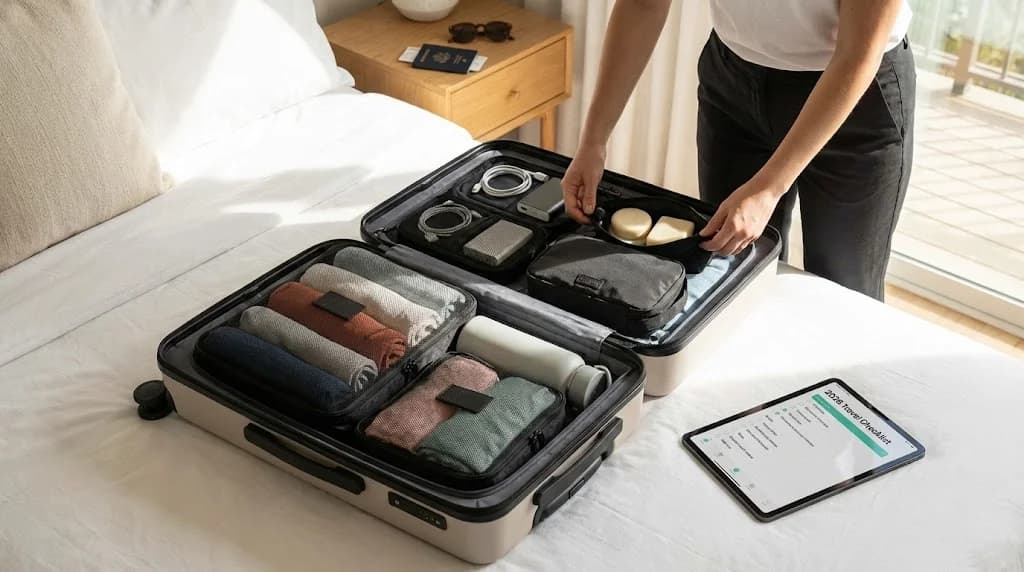
The Magic of Packing Cubes: Optimised for 2026 Efficiency
Packing cubes are indispensable for efficient travel. Their benefits are even more pronounced for the dynamic travel demands of 2026:
- Organisation: Assign cubes for different item type, tops, bottoms, underwear, or even specific outfits. In 2026, consider transparent or mesh-top cubes for quick visual inspection by security or customs without fully unpacking.
- Compression: Many packing cubes are designed to compress clothes, expelling excess air and creating valuable space. Opt for durable, lightweight materials that can withstand repeated compression, vital for managing your carry-on packing list for two weeks.
- Simplicity: They streamline unpacking and repacking. Simply lift the cubes into hotel drawers. This makes multi-stop trips throughout Europe in 2026 significantly easier.
Airline Carry-On Policies for 2026: What to Expect
The year 2026 is expected to introduce subtle yet significant shifts in airline carry-on policies. These changes are driven by factors like rising fuel costs, evolving aircraft designs, and a continued focus by budget airlines on maximizing ancillary revenue. Travelers must remain vigilant to avoid unexpected fees or the inconvenience of gate-checking their carry-on luggage.
A primary area of focus will likely be stricter enforcement of size and weight limits. While standard dimensions (e.g., 22x14x9 inches or 55x35x22 cm) for carry-on luggage remain prevalent, some airlines, particularly low-cost carriers, might introduce slightly smaller "personal item" allowances or even reduce standard carry-on dimensions on specific routes or aircraft models. Always verify the specific airline's policy immediately before your departure in 2026, especially if your itinerary involves multiple carriers.
Expect an increase in fees for exceeding limits and potentially for carrying a second, smaller "personal item" on some budget airlines that previously included it for free. The trend towards unbundling fares means more services will come at a cost. Furthermore, enhanced security protocols mean that scrutiny of liquids and electronics may become even more efficient, but travelers should always be prepared for manual inspections. The key for 2026 is preparedness: invest in compliant carry-on luggage, understand your airline's specific rules, and pack meticulously to prevent any last-minute surprises at the gate, particularly when navigating busy hubs like Paris Charles de Gaulle.
Connectivity & Power: Essential Tech for 2026
In 2026, your electronics are more than conveniences; they are integrated lifelines for navigation, communication, and information. A thoughtfully curated collection of advanced tech accessories ensures you remain connected, powered up, and informed throughout your travels.
The Enhanced eSIM Advantage for 2026
The eSIM (embedded SIM) eliminates the need to hunt for local SIM cards or endure exorbitant roaming charges. It's a digital SIM that allows you to activate a cellular plan directly on your device. For travelers in 2026, this technology is even more critical. You can purchase and install a data plan before you even depart. The moment you land, you simply activate your eSIM profile and gain instant connectivity. No fumbling with tiny physical cards, no risk of losing your home SIM.
Cellesim offers extensive global coverage in 200+ countries, supported by 50,000+ happy customers and 24/7 email support. This makes Cellesim a premier choice for global eSIM connectivity in 2026, significantly upgrading how you stay connected abroad without roaming fees. Before your trip, it is advisable to check if your phone is eSIM compatible. Most modern smartphones, including new models launching in 2026, are virtually guaranteed to support it, future-proofing your connectivity for years to come.
Power & Adapters: The Universal Lifeline for 2026 Devices
A robust power strategy is non-negotiable for 2026 travel, considering the increasing power demands of modern gadgets.
- Portable Power Bank: Essential for keeping devices charged on the go. Choose a model around 10,000-20,000mAh. Newer models for 2026 often feature faster charging capabilities (e.g., USB-PD 3.0) and multiple USB-C ports. Remember that airlines require power banks to be in your carry-on due to lithium-ion battery regulations.
- Universal Travel Adapter with PD: Replace multiple individual plugs with one high-quality universal adapter. Look for models with multiple USB-A and USB-C Power Delivery (PD) ports to fast-charge several devices simultaneously from a single outlet, a crucial feature for the diverse tech ecosystem of 2026.
- GaN Charger: Gallium Nitride (GaN) chargers are significantly smaller, lighter, and more efficient than traditional chargers. A compact, multi-port GaN charger can often replace bulky laptop bricks and phone chargers, saving significant space and weight in your 2026 carry-on luggage. New GaN technology in 2026 will likely offer even higher power output in smaller form factors.
Essential Gadgets You Won't Regret Packing for 2026
Beyond connectivity and power, these gadgets enhance your travel experience in 2026:
- Smart Noise-Cancelling Headphones: Indispensable for noisy flights, train rides, or finding quiet in bustling environments. Expect 2026 models to offer more advanced AI-driven noise cancellation and enhanced audio quality.
- Digital Luggage Scale with Smart Features: Avoid unexpected overweight baggage fees. Newer models might connect to your smartphone to track packing weight or suggest optimal weight distribution, saving money and stress when navigating strict 2026 airline policies.
- Advanced Item Tracker (e.g., AirTag 2.0 or similar): Slip one into your bag for peace of mind. Knowing you can track your carry-on provides an extra layer of security. For instance, if you're flying to London for a 2026 event, an eSIM for the United Kingdom active on landing allows you to immediately check your bag's location if it gets gate-checked, proving invaluable for swift recovery.
- E-Reader (Kindle/Kobo): A lightweight e-reader remains a staple for leisure, offering access to thousands of books. Consider models with adjustable warm light for comfortable reading during long 2026 flights or evenings.
Find Your Ideal eSIM Plan
Cost Comparison: eSIM vs. Traditional Options for 2026
Understanding connectivity costs is a vital part of smart travel planning for 2026. Here’s a comparison of common options for staying online while traveling, highlighting why an eSIM is often the most practical and cost-effective choice for carry-on travelers.
| Option | Avg. Cost (7 days, 5GB) | Data Speed | Setup Effort | Flexibility |
|---|---|---|---|---|
| Cellesim eSIM | From $5 - $20 | Full 4G/5G | Instant (Digital) | High (Multiple plans/countries) |
| Local Physical SIM | $15 - $30 | Full 4G/5G | Moderate (Store visit, ID needed) | Medium (Single country/region) |
| Carrier Roaming | $70 - $150+ | Often Throttled | None (Auto-activates) | Low (High cost, limited data) |
| Portable Wi-Fi Device | $30 - $60 (rental) | Varies by device | Moderate (Pickup/Return) | Medium (Extra device to carry) |
For the carry-on traveler of 2026, an eSIM offers a compelling balance of cost-effectiveness, high-speed data, and unparalleled convenience, eliminating the need for bulky devices or time-consuming visits to local shops. This allows you to focus on your journey rather than connectivity logistics.
Emerging Travel Technology for 2026
The landscape of travel technology is rapidly evolving, with 2026 poised to introduce even more innovative tools designed to streamline your journey and enhance your experience. Beyond the core tech previously discussed, several emerging technologies are worth considering for your carry-on.
- AI-Powered Travel Planning & Assistants: Expect more sophisticated AI-driven apps that not only plan your itinerary but also adapt in real-time to flight delays, suggest alternative routes, or recommend local experiences based on your preferences. Some might even integrate with smart wearables to monitor your stress levels or sleep patterns during travel. These tools can help generate a dynamic "carry-on packing list pdf" tailored to your precise itinerary, ensuring optimal packing for diverse activities across Europe or beyond.
- Portable Air Purifiers & UV Sanitizers: With ongoing global health consciousness, compact, personal air purifiers or UV-C sterilization wands are becoming more prevalent. These small devices can offer an extra layer of peace of mind for sanitizing surfaces in hotels or public transport, particularly relevant for navigating crowded spaces during major 2026 events. While not traditionally on a packing list, their size and growing utility make them a worthy consideration for health-conscious travelers.
- Augmented Reality (AR) Navigation & Translation: While still maturing, AR apps that overlay information onto real-world views are becoming more accurate. Imagine pointing your phone at a sign in a foreign language and seeing an instant translation appear, or navigating complex airport terminals like Paris Charles de Gaulle Airport with AR arrows guiding your path. Future versions in 2026 could be integrated into smart glasses, offering hands-free assistance. While you won't pack the AR glasses just yet, having a smartphone capable of leveraging these advanced applications is key.
These innovations highlight the continuous shift towards a more connected, intelligent, and personalized travel experience, underscoring why your carry-on packing list for 2026 needs to be tech-centric.
Sustainable Essentials: Clothing & Toiletries for 2026
Packing light for 2026 travel doesn't mean compromising on style or hygiene; it increasingly means choosing versatile, multi-purpose, and sustainably sourced items. This conscious approach is central to the ethos of the modern, responsible traveler.
The Versatile Wardrobe: A Sustainable Capsule for 2026
A capsule wardrobe, a small collection of essential items that can be mixed and matched to create multiple outfits, is ideal for carry-on travel. The key for 2026 is to stick to a neutral color palette (black, grey, navy, beige) and add color with one or two accent pieces or accessories, focusing on durable, eco-friendly fabrics.
- Tops: 3-4 shirts/tops made from merino wool or a synthetic blend. Merino wool is an excellent travel fabric, it's breathable, temperature-regulating, and naturally odor-resistant, allowing multiple wears before washing. In 2026, prioritize ethically sourced merino or recycled synthetic blends.
- Bottoms: Two pairs of versatile pants. One pair of comfortable travel pants or joggers (perhaps made from recycled materials) and one pair of smart-casual trousers or jeans that can be dressed up or down. Opt for quick-drying fabrics if you anticipate washing clothes on the go.
- Layers: Include one mid-layer (like a fleece or sweater made from recycled polyester) and one packable, waterproof/windproof jacket. Layering is crucial for adapting to changing weather conditions, especially with the unpredictable climate shifts expected in Europe during 2026.
- Underwear & Socks: Pack 4-5 pairs. Choose fast-drying, anti-microbial fabrics like merino wool or bamboo blends. These can be easily hand-washed and dried overnight, reducing the total quantity needed for an extended two-week carry-on trip.
- Shoes: Shoes consume significant space. Limit yourself to two pairs. Wear the bulkiest pair (e.g., comfortable travel sneakers designed for urban exploration) on the plane and pack a comfortable, stylish pair of flats or sandals that work for both sightseeing and dinner. Consider brands committed to sustainable manufacturing practices.
"Packing light forces you to prioritize, and prioritizing means bringing only what truly serves your journey. This philosophy minimizes environmental impact and maximizes travel freedom."
The TSA-Friendly & Eco-Conscious Toiletry Kit for 2026
Managing liquids is a key challenge for carry-on travel. The strategy for 2026 is to minimize them, with an added focus on sustainability. Remember the TSA's 3-1-1 rule (and similar international regulations): liquids must be in containers of 3.4 ounces (100ml) or less, all fitting within one quart-sized, clear, zip-top bag.
- Go Solid: Wherever possible, switch to solid toiletries. Solid shampoo bars, conditioner bars, solid perfume, toothpaste tablets, and even solid moisturizer bars save space, eliminate leak risks, and drastically reduce plastic waste, aligning perfectly with 2026 sustainability goals.
- Decant Everything Else: For any remaining liquids (such as reef-safe sunscreen or face wash), use small, reusable, leak-proof travel-sized bottles. Opt for those made from recycled plastic or silicone. Decanting is more economical and sustainable than purchasing single-use travel-sized versions of your preferred products.
- Multi-Purpose Products: Incorporate items like a tinted moisturizer with SPF or a lip-and-cheek stain. Minimizing individual items frees up valuable space for your other carry-on packing list essentials. Biodegradable wet wipes can also be useful for quick refreshes.
Beyond the Basics: Documents & Preparedness for 2026
A truly smart packer is prepared for the unexpected. This final category covers critical items that ensure your trip runs smoothly, even if you encounter a snag, with a forward-looking perspective for 2026.
Digital and Physical Documents: Your Redundancy Plan for 2026
Never rely on a single copy of anything important. For all critical document, passport, visas, driver's license, international vaccine certificates (increasingly relevant for 2026 travel), hotel confirmations, flight detail, you should have a robust redundancy plan:
- The Physical Original: Always keep primary documents secure and accessible, ideally in an RFID-blocking wallet or travel pouch.
- A Digital Scan: Save secure digital copies to a cloud service (e.g., Google Drive, Dropbox) and also download them to your phone for offline access. An encrypted USB-C drive can serve as an additional physical backup.
- A Physical Photocopy: Store a physical photocopy separately from the original. This could be in a different part of your carry-on or with a trusted travel companion.
This comprehensive redundancy plan can be a lifesaver if your wallet or phone is lost or stolen, especially when navigating customs or dealing with unexpected situations in 2026. For digital nomads or those who need to maintain their home number while traveling internationally, learning how to manage your numbers is vital. Consider reading how to keep your number when using a travel eSIM for peace of mind.
Additionally, carry a small, basic first-aid kit with pain relievers, band-aids, antiseptic wipes, and any personal prescription medications (with original prescriptions if required by customs). Check the official WHO travel advice for any specific health recommendations for your destination in 2026. A small sewing kit and a few safety pins can also be incredibly useful for minor clothing repairs.
Ready to Travel Light & Smart in 2026?
Master your next adventure with seamless connectivity and a perfectly packed carry-on.
Start Your Connected JourneyTrusted by 50,000+ travelers worldwide. Available in 200+ countries.
Frequently Asked Questions
What are the key benefits of carry-on only travel in 2026?
Carry-on only travel in 2026 offers significant advantages, including avoiding checked baggage fees, eliminating lost luggage risks, saving time at airports, and providing greater flexibility for last-minute itinerary changes. It streamlines your journey, allowing you to move quickly and efficiently through destinations.