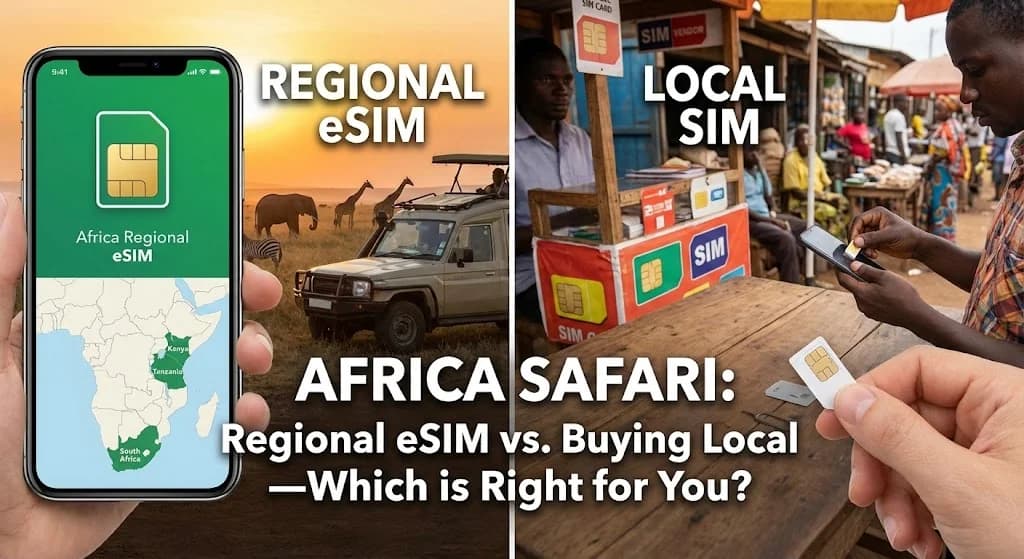
You have just stepped off the plane at Jomo Kenyatta International Airport in Nairobi, the gateway to your Kenyan safari. The air is different, the energy is electric, and the adventure is about to begin. But first, a small, modern problem: you have no internet. Your pre-arranged driver is not where you expected, and you cannot call them. You cannot pull up a map to your hotel. You are disconnected. This is the first critical decision every traveler faces, and it is especially crucial on a multi-country trip. The debate over the best Africa safari regional eSIM vs local SIM is not just about technology; it is about starting your trip with seamless ease or a frustrating quest for a tiny piece of plastic. Before you even pack your bags, it is essential to check if your phone is eSIM compatible, as this will be the single biggest factor in your decision.
This guide cuts through the noise. We are not just listing specs; we are breaking down the real-world experience of using both options across the diverse landscapes of Africa, from the plains of the Serengeti to the waterways of the Okavango Delta. We will explore the costs, the convenience, the coverage, and the hidden hassles to help you make the right choice for your specific adventure.
- Quick Comparison: Regional eSIM vs. Local SIMs for Your African Safari
- eSIM vs. Physical SIM: The Foundational Choice for African Travel
- Deep Dive: The Regional Africa eSIM Experience
- Deep Dive: The Local SIM Card Approach for African Travel
- Network Coverage on Your African Safari: What to Expect
- Understanding Your Data Needs for an Africa Safari
- Cost Considerations: Regional eSIM vs. Local SIM for Your Safari Budget
- Activating Your Africa Safari eSIM: A Step-by-Step Guide
- Making the Right Choice: Tailoring Connectivity to Your African Safari
- Frequently Asked Questions
Connect Across Africa with Cellesim eSIM
Get instant, reliable data in 29 African countries. Join 50,000+ happy customers who trust Cellesim for seamless travel.
Get Your Africa eSIM NowQuick Comparison: Regional eSIM vs. Local SIMs for Your African Safari
For those who want the key takeaways at a glance, here is how the two options stack up against the factors that matter most on an African safari.
| Feature | Regional Africa eSIM | Local SIM Cards |
|---|---|---|
| Convenience | Excellent. Buy and install before you travel. Active upon landing. | Poor. Requires finding a store, paperwork, and potential language barriers. |
| Multi-Country Use | Seamless. One plan covers multiple countries automatically. | Frustrating. Requires a new SIM card in each country. |
| Time-Saving | Excellent. Saves hours of airport or city time. | Poor. Can take 1-2 hours per country to purchase and activate. |
| Cost | Good. Competitive pricing, transparent costs, no surprise roaming charges. | Variable. Can be cheaper for long stays in a single country, but costs add up. |
| Coverage | Very Good. Partners with top networks in each country. | Excellent. You can choose the single best network in that specific country. |
| Phone Number | Data-only. Keep your primary number for calls/texts via Wi-Fi calling. | Provides a local number, which can be useful for local calls. |
eSIM vs. Physical SIM: The Foundational Choice for African Travel
Before diving specifically into regional versus local options for an Africa safari, it is crucial to understand the fundamental difference between an eSIM and a traditional physical SIM card. An eSIM, or embedded SIM, is a digital SIM profile pre-installed or downloaded onto your device. It eliminates the need for a physical, swappable chip, making it an increasingly popular choice for modern travel, especially for those venturing to diverse locations like Africa. In contrast, a physical SIM is a small, plastic card that you insert into a tray in your phone.
For African travel, the choice between these two forms impacts everything from device compatibility to the ease of switching between networks. For an Africa travel eSIM, compatibility is key; most newer smartphones support eSIM technology. This allows for dual SIM functionality, where your existing home SIM (physical or eSIM) can remain active for calls and texts, while your data for your African safari runs off the new eSIM. This distinction is vital for travelers heading to Kenya, Tanzania, or across Africa, offering a blend of convenience and connectivity. Physical SIMs, while ubiquitous, present challenges like loss, damage, and the hassle of swapping them out, which can be particularly inconvenient when moving between countries during an extensive African adventure.
Deep Dive: The Regional Africa eSIM Experience
An Africa travel eSIM is a digital SIM card that you download and install on your phone. A *regional* eSIM takes this a step further by offering a single data plan that works across multiple African countries. Think of it as a connectivity passport, you cross a border, and your phone simply switches to a local partner network without you doing a thing. This is particularly advantageous when planning an ambitious safari that might take you from the wildlife-rich plains of the Serengeti in Tanzania to the unique ecosystems of the Okavango Delta in Botswana, seamlessly moving between destinations.
How a Regional eSIM Works in Practice
Before you leave home, you purchase a regional plan online. You will receive a QR code via email. Following a simple set of instructions from our interactive setup guide, you scan this code to install the eSIM profile on your phone. You keep it turned off until you land at your first African destination. The moment you land at Jomo Kenyatta International Airport in Nairobi or any other major hub and switch it on, it connects to a local network, and you have data. When your safari takes you from Kenya to Tanzania, for example, the eSIM automatically registers on a Tanzanian network like Vodacom or Airtel once you cross the border. No SIM swapping, no store visits, no configuration changes. This global connectivity solution, like those offered by Cellesim Global eSIM Plan, is designed to ensure you remain connected throughout your entire Africa safari.
Pros of a Regional eSIM for Safari Travel
- Unbeatable Convenience: This is the number one advantage. You are connected the second you land. No hunting for a Vodacom or Safaricom kiosk at the airport, no navigating currency conversions under pressure, and no wasting the first precious hour of your trip in a phone store, especially vital after a long flight into a city like Nairobi.
- Seamless Border Crossings: For a classic multi-country safari (e.g., Kenya & Tanzania, or Botswana, Zimbabwe & Zambia), this is a game-changer. Your WhatsApp messages to your next guide or lodge will send without interruption as you cross from the Maasai Mara to the Serengeti. This multi-country eSIM for Africa ensures continuous connectivity, critical for real-time updates on wildlife sightings.
- Enhanced Security: You do not need to hand over your passport for registration in multiple stores, reducing privacy risks. There is also no physical SIM to lose, and your primary SIM stays securely in your phone. This added layer of security provides peace of mind when traveling through diverse regions of Africa.
- Keep Your Home Number Active: Because your physical SIM slot is free (or your primary eSIM remains active), you can still receive calls and texts on your regular number. This is crucial for two-factor authentication from your bank or messages from family, allowing you to manage essential communications while enjoying your Africa safari. Learn more about keeping your number with a travel eSIM.
Cons of a Regional eSIM for Safari Travel
- Data-Only Plans: Most travel eSIMs are data-only. You will not get a local African phone number for traditional calls or SMS. However, this is easily solved with apps like WhatsApp, FaceTime Audio, or Skype, which use data. This approach is generally sufficient for the modern Africa safari traveler.
- Coverage Depends on Partners: While eSIM providers partner with major networks, you do not always get to choose the *single best* network in a rural area. That said, coverage from top-tier partners is generally excellent in tourist areas and national parks, ensuring reliable connectivity for your African safari. Cellesim, for instance, carefully selects partners to provide comprehensive eSIM network coverage in Africa.
Deep Dive: The Local SIM Card Approach for African Travel
The traditional method involves buying a physical SIM card from a local mobile operator in each country you visit. This is how travelers stayed connected for years, and it is still a viable, if increasingly cumbersome, option for those planning an African safari, particularly if staying within one country like Kenya or Tanzania for an extended period. This approach provides a local SIM card for Africa directly from the source.
The Process on the Ground with Local SIMs
Upon arrival in, say, Arusha, Tanzania, your first task is to find an official mobile provider store (e.g., Vodacom, Airtel, Tigo). You will need your passport for mandatory SIM registration (a legal requirement in many African nations). You will then choose a data bundle, pay in local currency, and have the agent activate the SIM. If your trip then takes you to Rwanda, you repeat this entire process in Kigali with a provider like MTN. This can be time-consuming and often involves navigating busy airports like Jomo Kenyatta International Airport or city centers in Nairobi.
"While local SIMs can be cheap, the time and effort to acquire one in each country can quickly add up, especially on a tight travel schedule." - Lonely Planet
Pros of Buying Local SIMs for Safari Travel
- Potentially Lower Cost Per Gigabyte: If you are a heavy data user and staying in one country for several weeks, buying a large local data bundle can sometimes be cheaper on a per-GB basis. This can be an attractive option for budget-conscious travelers exploring a single African nation like Kenya in depth.
- Access to the #1 Network: You can research and choose the provider with the absolute best reputation for rural coverage in that specific country (e.g., Safaricom in Kenya is known for its extensive reach, particularly beneficial in areas like the Serengeti or for getting a data plan for an Africa safari). This targeted approach ensures optimal connectivity.
- Local Phone Number: Having a local number can be handy for making direct calls to local guides, restaurants, or lodges without using data apps. This is becoming less of a necessity as most businesses now use WhatsApp, but it can still be useful in remote areas of Africa where internet access might be limited.
Cons of Buying Local SIMs for Safari Travel
- Massive Time Sink: This is the biggest drawback. Expect to spend at least an hour at each airport or in each new city finding a store, waiting in line, and going through the registration process. For a three-country trip, that is half a day of your vacation spent on phone admin, cutting into precious safari time in Kenya or other destinations.
- The Multi-Country Reset: Your Kenyan SIM card becomes a useless piece of plastic the moment you cross into Tanzania. This means you are disconnected at the exact moment you might need to coordinate with a new driver or check into a new lodge, making a multi-country eSIM Africa a more appealing choice.
- Registration Hassles & Language Barriers: While English is widely spoken in tourist areas, explaining the specific data bundle you need can still be challenging. Furthermore, SIM registration laws can be strict and the process confusing for a first-timer, especially after a long journey to Africa. Always check official government travel advice for specific country requirements, such as the UK Foreign Travel Advice portal.
- Risk of Scams: Unofficial vendors may overcharge tourists or sell improperly registered SIMs that stop working after a day. It is crucial to use official stores, which are not always available at smaller border crossings or airstrips, adding a layer of risk to your safari connectivity.
Explore Cellesim Africa eSIM Plans
Network Coverage on Your African Safari: What to Expect
Connectivity in Africa, especially in safari regions, can vary significantly. While major cities and towns generally have robust 4G/LTE networks, venturing into national parks and remote reserves often means relying on more localized infrastructure. Regional eSIM providers like Cellesim partner with leading local networks in each country to offer the best available coverage. For instance, in Kenya, partners would typically include Safaricom or Airtel, known for their extensive reach. In Tanzania, Vodacom is a strong performer, while in Botswana, Mascom and Orange provide reliable services.
When planning your safari, it is important to manage expectations regarding speed and availability in truly remote areas. You might experience 3G or even 2G in very isolated camps, which is sufficient for messaging but not for streaming. However, in most popular safari destinations and lodges, you can expect decent 4G connectivity, especially if your provider has chosen strong local partners. A local SIM might give you the theoretical advantage of picking the absolute best network in a single country, but a regional eSIM mitigates this by providing consistent, good-quality access across multiple borders without the hassle of switching.
Understanding Your Data Needs for an Africa Safari
One of the most frequently asked questions for those planning an Africa safari is about data consumption. What are the typical data needs for an Africa safari traveler? Unlike city breaks, a safari often involves periods of limited connectivity, making efficient data usage paramount. Most safari-goers will primarily use data for essential navigation (Google Maps, offline maps), communication with guides and loved ones (WhatsApp, email), quick web searches for information about wildlife or destinations like the Serengeti, and perhaps some light social media sharing. Streaming videos or large file downloads are generally discouraged due to bandwidth limitations in remote areas and the desire to conserve data.
A typical safari traveler might use anywhere from 1GB to 5GB per week for these activities. A multi-country eSIM Africa data plan is usually structured to offer various data packages (e.g., 5GB, 10GB, 20GB) for different durations (7, 15, 30 days). For example, a 10GB plan for 30 days would likely suffice for most travelers on a two-week safari across Kenya and Tanzania. While local SIM cards in Africa might offer slightly larger data bundles for a lower price per GB, the convenience of a regional eSIM means you are not constantly monitoring usage or scrambling for top-ups at every border crossing. Prioritizing essential communication and navigation over entertainment is a smart strategy for managing your Africa safari data plan effectively.
Cost Considerations: Regional eSIM vs. Local SIM for Your Safari Budget
When planning an African safari, understanding connectivity costs is crucial for budget management. While local SIM cards often advertise very low per-gigabyte rates, the overall cost can quickly escalate, especially on a multi-country trip. Each new country means a new SIM purchase, typically involving an activation fee, the cost of the SIM card itself, and then the data bundle. These small fees, combined with the time spent, can add up to a significant expense both financially and in terms of lost safari experience.
Regional eSIMs, on the other hand, offer transparent pricing. You buy one package for your entire trip, covering multiple countries. While the per-GB cost might sometimes be marginally higher than the cheapest local offer in a single country, the savings in time, convenience, and avoided multi-country setup costs often make it the more economical choice for a true safari experience. Moreover, traditional international roaming from your home provider is almost always the most expensive option, often incurring daily charges or exorbitant per-MB rates that can lead to bill shock. For a realistic comparison of potential savings, consider using a roaming savings calculator.
| Option | Average Cost (14 days, 10GB) | Convenience | Multi-Country Trip |
|---|---|---|---|
| Cellesim Regional eSIM | From $25 - $45 | Excellent | Seamless |
| Local SIM (per country) | $15-$30 per country (total $30-$60 for 2 countries) | Low (time-consuming setup) | Hassle in each country |
| Home Provider Roaming | $10-$15 per day (total $140-$210+) | Automatic | Very expensive |
Activating Your Africa Safari eSIM: A Step-by-Step Guide
One of the significant advantages of a regional eSIM for your African safari is the simplicity of activation. Unlike physical SIMs, which require a visit to a store, paperwork, and often a degree of technical fumbling, an eSIM can be set up entirely before you even board your flight. This means you are ready to connect the moment your plane lands.
Simple Activation Steps for Cellesim Africa eSIM:
- Purchase Your Plan: Visit cellesim.com and select the Africa regional eSIM plan that best suits your data needs and trip duration.
- Receive QR Code: After purchase, you will receive an email containing a QR code and detailed instructions.
- Scan and Install: Before you travel (or just before departure), go to your phone's settings, find the "Add eSIM" or "Add Cellular Plan" option, and scan the QR code. Follow the on-screen prompts to label your new eSIM (e.g., "Africa Travel") and set it for data. Ensure your home line remains active for calls if desired.
- Activate on Arrival: Once you land at your destination in Africa, simply turn on your new eSIM line for data (typically by going to Cellular/Mobile Data settings and selecting your eSIM profile). Your phone will automatically connect to the best available local network.
- Enjoy Connectivity: You are now connected for navigation, messaging, and sharing your safari adventures without interruption.
For a more detailed walkthrough, refer to Cellesim's complete eSIM setup guide.
Making the Right Choice: Tailoring Connectivity to Your African Safari
The decision between a regional eSIM and local SIM cards for your African safari ultimately depends on your specific travel style, itinerary, and priorities. If you are embarking on a classic multi-country safari, moving between destinations like Kenya, Tanzania, and South Africa, the regional eSIM offers unparalleled convenience and time savings. It removes the stress of sourcing new local SIMs at every border, allowing you to focus on the breathtaking wildlife and landscapes.
However, if your trip is focused on a single country for an extended period (e.g., a month exploring only South Africa), and you are willing to dedicate time upon arrival to visit a local provider, a local SIM might offer a slightly better per-gigabyte value. For most safari travelers, who prioritize seamless, uninterrupted connectivity across diverse landscapes and often have packed itineraries, the regional eSIM emerges as the superior choice. It is a modern solution for a modern adventure, ensuring you stay connected, safe, and stress-free.
Ready for Seamless Connectivity on Your African Safari?
Join 50,000+ travelers in 200+ countries. Set up your Africa eSIM in 2 minutes and connect instantly.
Start Your Connected Safari JourneyTrusted by travelers worldwide. 24/7 Email Support: [email protected]
Frequently Asked Questions
Which African countries are covered by the Cellesim regional eSIM?
Cellesim's Africa regional eSIM covers 29 countries, including popular safari destinations such as Kenya, Tanzania, South Africa, Botswana, Zambia, Uganda, and Rwanda. This extensive coverage ensures you stay connected across multiple stops on your safari.
Can I make calls and send SMS with an Africa regional eSIM?
Cellesim regional eSIMs for Africa are primarily data-only. This means you will not get a local phone number for traditional calls or SMS. However, you can easily use data-based apps like WhatsApp, FaceTime Audio, Skype, or other VoIP services for communication, keeping your original number active for calls via Wi-Fi calling.
Is my phone compatible with an eSIM for an African safari?
Most newer smartphone models from Apple (iPhone XR/XS and later), Samsung (Galaxy S20 and later), Google Pixel (Pixel 3 and later), and other manufacturers support eSIM technology. It is always recommended to check your device's compatibility before purchasing. You can use Cellesim's eSIM checker for quick verification.
When should I activate my Africa safari eSIM?
You can purchase and install your Cellesim Africa eSIM before you depart. It is best to activate the eSIM for data once you land at your first destination in Africa. This ensures you have immediate connectivity upon arrival without incurring charges prematurely.
How much data do I need for an African safari?
Data usage varies, but for a typical safari traveler primarily using navigation, messaging, and light browsing, 1GB to 5GB per week is often sufficient. Consider a 10GB plan for a two-week multi-country trip. You can estimate your needs with Cellesim's smart data calculator.
What if I encounter connectivity issues during my safari?
Cellesim partners with top local networks to ensure reliable coverage. However, if you experience any issues, Cellesim provides 24/7 email support at [email protected]. It is advisable to have your eSIM profile details and device information ready for quicker assistance.
See also: eSIM for Tanzania
See also: eSIM for Rwanda
See also: eSIM for Zambia
See also: Uganda eSIM
Heading there? Compare data plans on our Botswana eSIM page and install before you fly.