Planning a trip, whether for a week or two, often involves navigating a crucial question: how much mobile data will you actually need? In an era where connectivity is fundamental for navigation, communication, and sharing experiences, accurately estimating your data requirements can save you both stress and money. This guide provides a clear framework for understanding your usage patterns and selecting the right eSIM plan for your 7 or 14-day adventure, ensuring you stay connected without overspending or running out of data at an inconvenient moment.
- Understanding Your Digital Footprint for Short Trips
- Estimating Daily Data Needs for 7 or 14-Day Journeys
- Tailoring Your Data Plan: 7-Day vs. 14-Day Scenarios
- Optimizing Your Data Usage on Shorter Trips
- Cellesim eSIMs: Seamless Connectivity for Your 7 or 14-Day Adventure
- Monitoring and Topping Up Your eSIM Data While Traveling
- Cost Comparison: eSIM vs. Roaming for Short-Term Travel
- Frequently Asked Questions
Connect Effortlessly on Your Next Trip
Explore Cellesim's flexible eSIM plans, designed for every traveler. Join 50,000+ happy customers across 200+ countries.
Shop All eSIM PlansUnderstanding Your Digital Footprint for Short Trips
Your personal data consumption habits are the primary factor in determining how much data you will need. A 7 or 14-day trip often presents unique usage patterns compared to daily life at home. Travelers typically rely more heavily on specific data-intensive applications such as mapping and communication tools, while cutting back on activities like extensive video streaming.
Consider these key activities and their approximate data consumption:
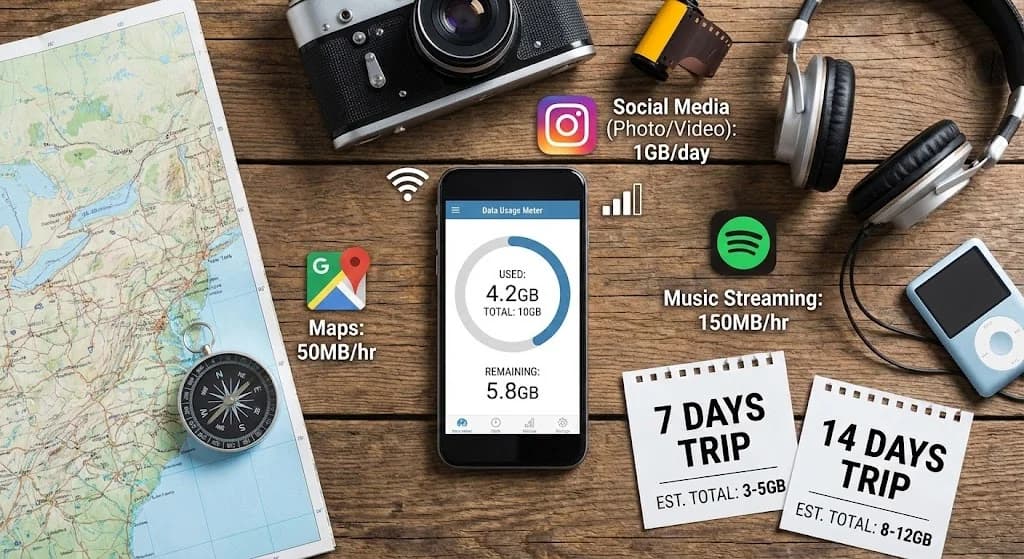
- Navigation (Google Maps, Apple Maps): Around 5-10 MB per hour. Essential for exploring new cities, finding attractions, and locating your accommodation.
- Messaging (WhatsApp, iMessage): Text-based messages consume very little data (kilobytes). Photo and video sharing increases usage significantly, potentially 1-5 MB per photo/short video.
- Social Media (Instagram, Facebook, TikTok): Highly variable. Browsing feeds can use 20-100 MB per hour. Watching videos or uploading stories quickly increases this to hundreds of MBs per hour.
- Email: Minimal data for sending/receiving text emails. Attachments increase usage. Generally, 1-5 MB per hour for basic checks.
- Web Browsing: Roughly 10-50 MB per hour, depending on the complexity of websites visited (e.g., image-heavy travel blogs versus text-only news sites).
- Video Calls (FaceTime, Zoom, WhatsApp): One of the highest data consumers. Expect 200-500 MB per hour for standard definition, and even more for HD calls.
- Music Streaming (Spotify, Apple Music): Around 40-150 MB per hour, depending on audio quality settings.
- Video Streaming (YouTube, Netflix): The most data-intensive activity. Standard definition video can consume 500 MB to 1 GB per hour. High definition (HD) can use 1.5-3 GB per hour.
Estimating Daily Data Needs for 7 or 14-Day Journeys
To accurately plan your eSIM, consider how your data usage changes when you travel. For a 7 or 14-day trip, your priorities shift from home-based entertainment to on-the-go utility and communication.
Here’s a breakdown of typical daily data consumption profiles for travelers:
| Activity Level | Description | Estimated Daily Data | Ideal for (Trip Length) |
|---|---|---|---|
| Light User | Mainly maps, messaging, email checks, occasional social media. | 200-300 MB | 7-day trips |
| Moderate User | Daily navigation, regular social media, some photo uploads, occasional video calls. | 500-800 MB | 7 to 14-day trips |
| Heavy User | Frequent social media, extensive browsing, several video calls, light video streaming. | 1-2 GB | 14-day trips |
| Power User | Constant connectivity, heavy video streaming, large file uploads, work-related tasks. | 2 GB+ | Any duration requiring constant high usage |
Multiplying these daily estimates by your trip duration provides a clearer picture. For example, a moderate user on a 7-day trip might need 3.5 GB to 5.6 GB, while the same user on a 14-day trip would look at 7 GB to 11.2 GB. It's often prudent to round up to the nearest whole gigabyte when selecting a plan.
Tailoring Your Data Plan: 7-Day vs. 14-Day Scenarios
Choosing an eSIM plan involves balancing cost with peace of mind. Here’s how to approach plan selection for different trip lengths:
For a 7-Day Trip:
For most travelers, a 7-day trip can be well-managed with a plan ranging from 3 GB to 10 GB. If you plan to heavily rely on Wi-Fi at your accommodation or cafes, 3-5 GB might suffice. If you foresee frequent navigation, consistent social media sharing, and a few video calls, opting for 5-10 GB provides a comfortable buffer. Cellesim offers specific eSIM plans for Italy or Indonesia, for instance, that cater to shorter durations.
"Having sufficient data on a short trip is not just about staying connected, it's about convenience and making the most of every moment. An eSIM ensures you're never scrambling for Wi-Fi."
For a 14-Day Trip:
A two-week journey typically requires a more robust data package. A starting point of 10 GB to 20 GB is often recommended for moderate users. This allows for sustained daily activities without constant concern about running out of data. If your trip involves working remotely, extensive research, or frequent video calls with family back home, consider plans in the 20 GB+ range. Remember that Cellesim offers plans with various data allowances and validity periods to match your exact travel needs.
Optimizing Your Data Usage on Shorter Trips
Even with a well-chosen eSIM plan, implementing data-saving strategies can extend its longevity and prevent unexpected overages. These tips are especially useful for 7 or 14-day trips where you want to maximize your data value:
- Download Offline Maps: Before you leave, download maps of your destination using apps like Google Maps. This allows for GPS navigation without consuming mobile data, saving hundreds of MBs daily.
- Prioritize Wi-Fi: Whenever reliable Wi-Fi is available (at your hotel, airport, or cafes), connect to it. Use this time for data-heavy tasks like uploading photos, downloading updates, or streaming videos.
- Disable Background App Refresh: Many apps consume data in the background even when not actively in use. Turn this off in your phone's settings for apps you don't need real-time updates from.
- Limit Automatic Downloads/Updates: Configure your phone and app store settings to only download updates or sync media over Wi-Fi.
- Optimize Streaming Quality: If you must stream video or music, reduce the quality settings in the app. Standard definition (SD) uses significantly less data than High Definition (HD).
- Turn Off Auto-Play Videos: Many social media apps auto-play videos as you scroll. Disable this feature in the app settings.
- Compress Photos/Videos: If uploading to social media or sending via messaging apps, use options that compress media files to reduce their size.
- Monitor Usage Regularly: Keep an eye on your data consumption through your phone's settings or the Cellesim app. This helps you adjust your habits if you are using more data than anticipated.
Cellesim eSIMs: Seamless Connectivity for Your 7 or 14-Day Adventure
Cellesim offers a modern, convenient solution for staying connected on your 7 or 14-day trip. An eSIM eliminates the need for physical SIM cards, allowing for instant activation and seamless switching between local networks.
Key Advantages for Short-Term Travel:
- Instant Activation: Purchase and activate your eSIM before you even land, ensuring you have data from the moment you arrive. This is particularly beneficial for avoiding airport queues and navigating an unfamiliar city.
- Flexibility: Cellesim offers various data packages suitable for different trip lengths and usage levels. You can choose a plan that perfectly matches your 7 or 14-day requirements.
- Cost-Effective: Generally, eSIMs offer more competitive rates for data than traditional roaming charges from your home provider. Use our Roaming Savings Calculator to see the difference.
- Dual SIM Functionality: With an eSIM, you can often keep your primary SIM card active for calls and texts while using the eSIM for data, maintaining your home number for important contacts. Learn more about using an eSIM and a regular SIM concurrently.
Ensure your device is eSIM compatible before purchasing. Most modern smartphones support eSIM technology. You can quickly check your phone's compatibility using our eSIM Checker.
Monitoring and Topping Up Your eSIM Data While Traveling
Even with careful planning, sometimes travel plans change or you find yourself using more data than anticipated. Monitoring your data usage and knowing how to top up are essential for uninterrupted connectivity on your 7 or 14-day trip.
- Check Your Device Settings: Both iOS and Android phones allow you to track data usage. Navigate to your cellular settings to see how much data you've consumed and which apps are the biggest users. You can often set data warnings or limits here.
- Cellesim App/Dashboard: Cellesim provides a user-friendly app or online dashboard where you can easily view your remaining data balance. This is the most accurate way to track your Cellesim eSIM usage.
- Receiving Alerts: Cellesim will typically send you notifications when your data balance is running low, giving you ample time to react.
- Topping Up Your Plan: If you find yourself needing more data, Cellesim makes it straightforward to purchase a top-up directly through the app or website. This process is usually instant, allowing you to continue your activities without interruption. For a detailed guide, refer to what happens if I run out of data.
Cost Comparison: eSIM vs. Roaming for Short-Term Travel
When traveling for 7 or 14 days, the choice between an eSIM and traditional roaming significantly impacts your budget. Understanding the cost differences is crucial for smart travel planning.
| Option | Typical Cost (7 days, 5GB) | Speed & Coverage | Setup & Flexibility |
|---|---|---|---|
| Cellesim eSIM | From $5 - $20 (region-dependent) | Local network full 4G/5G | Instant, online, flexible plans |
| Home Provider Roaming | $70 - $140 ($10-20/day) | Often throttled, inconsistent | Automatic, but costly, limited control |
| Local Physical SIM | $15 - $30 (for ~5GB) | Local network full 4G/5G | Requires purchase in-country, physical swap |
As the table illustrates, Cellesim eSIMs often present the most cost-effective and convenient solution for short-term international travel. Roaming charges can quickly accumulate, turning a brief video call or a few map searches into a substantial expense. Local physical SIMs offer good value, but the time spent locating and purchasing one in a foreign country can be valuable time lost on a 7 or 14-day trip. Moreover, a physical SIM means removing your home SIM, which might interrupt calls or messages to your primary number.
For more detailed insights into cost savings, explore Cellesim's Global Mobile Data Price Report.
Ready for Effortless Connectivity on Your Trip?
Don't let data worries overshadow your travel experience. Get a Cellesim eSIM and enjoy seamless internet from day one.
Start Your Connected JourneyTrusted by 50,000+ travelers in 200+ countries. 24/7 Support.
Frequently Asked Questions
Is 5GB enough data for a 7-day trip?
For most balanced travelers, 5GB is typically sufficient for a 7-day trip. This allows for daily navigation, regular social media use, occasional video calls, and music streaming without constant concern. If you plan to stream high-definition video frequently, you might need more.
How much data do I need for 14 days of travel?
For a 14-day trip, a moderate user should consider a data plan between 10GB and 20GB. This range comfortably supports daily navigation, social media, messaging, and occasional video calls. Heavy streaming or remote work would require 20GB or more.
Can I top up my Cellesim eSIM if I run out of data?
Yes, Cellesim allows you to easily top up your data plan directly through your account dashboard or the Cellesim app. This ensures you can instantly add more data and stay connected without interruption, even if your usage patterns change during your trip.
Is it cheaper to use an eSIM or international roaming for short trips?
Generally, using a Cellesim eSIM is significantly cheaper than international roaming from your home provider for short trips of 7 or 14 days. Roaming charges can be very high per MB, whereas eSIM plans offer fixed, competitive rates for larger data bundles.
How quickly can I set up a Cellesim eSIM before my trip?
Setting up a Cellesim eSIM is a quick and straightforward process, often taking just a few minutes. You can purchase and activate your eSIM from anywhere with an internet connection, even before you depart, ensuring you're ready to connect the moment you arrive at your destination.
Will an eSIM work in all countries for my 7 or 14-day trip?
Cellesim offers eSIM coverage in over 200 countries, making it a versatile option for almost any destination for your 7 or 14-day trip. Always check the specific country or regional plan details on the Cellesim website to confirm coverage for your chosen destination.
Heading there? Compare data plans on our Turkey eSIM page and install before you fly.