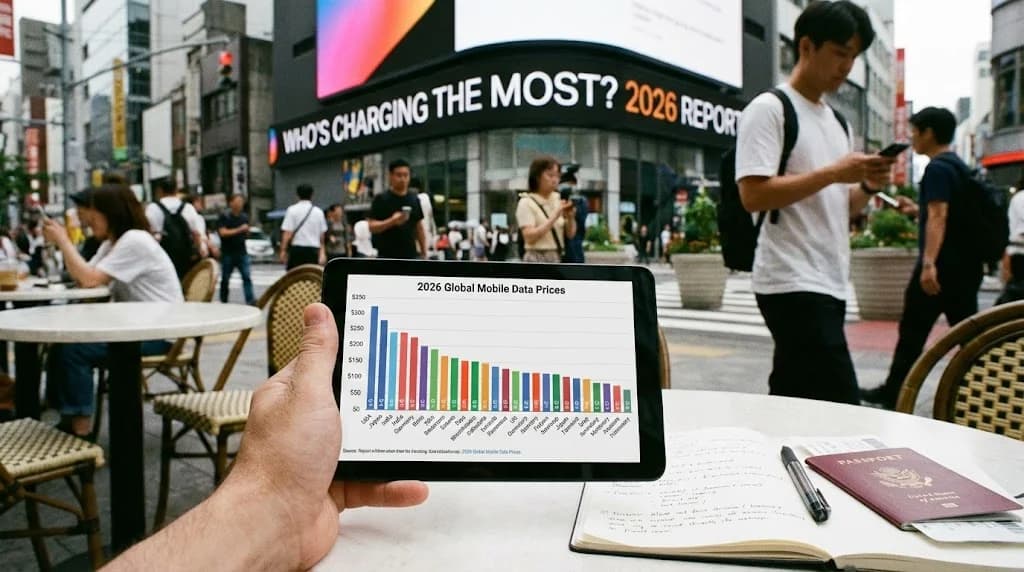
The plane’s wheels touch down, you switch off airplane mode, and that familiar wave of relief washes over you, you’ve arrived. But it’s often followed by a second, less welcome feeling: data dread. That first notification from your home carrier about exorbitant roaming rates can instantly sour the start of a trip. What you pay for a gigabyte of data can vary wildly, from the price of a coffee to the cost of a fancy dinner.
- The Foundational Factors Driving 2026 Mobile Data Costs
- Infrastructure and Network Investment: The Cost of Connectivity
- Market Competition: The Ultimate Price Driver for Mobile Data
- Geographical Challenges and Population Density: Impact on Coverage Costs
- The 2026 Price Landscape: Identifying the Most Expensive Countries for Data
- Where Data is Exceptionally Affordable in 2026: Value Destinations
- Cellesim's Solution: Bypassing High Global Data Prices
- Practical Strategies to Avoid Expensive Roaming in 2026
- Future Trends: What's Next for Global Mobile Data Pricing?
- Frequently Asked Questions
Global eSIM Plans from Cellesim
Connect instantly in 200+ countries with affordable data. Join 50,000+ happy customers who trust Cellesim for seamless connectivity.
Get Your Global eSIMThis is the reality of the global mobile data price 2026 landscape, a complex map of digital haves and have-nots. Understanding this landscape is the first step in outsmarting it. We will break down which countries top the charts for expensive data, explain the surprising reasons why, and give you a clear strategy on how to avoid roaming charges and stay effortlessly connected.
The Foundational Factors Driving 2026 Mobile Data Costs
Ever wondered why you can stream hours of video for a few dollars in Italy, but just checking your email feels like a luxury in parts of the Caribbean or Africa? The cost of 1GB of data is not arbitrary. It is a product of infrastructure, competition, geography, and policy. Understanding these factors is key to predicting your connectivity costs and finding smarter alternatives, especially as we look at the trends for 2026 and beyond.
Infrastructure and Network Investment: The Cost of Connectivity
The foundation of mobile data is physical infrastructure: robust fiber optic cables running under oceans and across continents, cell towers dotting landscapes, and advanced 5G networks proliferating in urban centers. Countries with modern, extensive, and well-maintained infrastructure, often supported by significant government or private Mobile Network Operator (MNO) investment, can offer data more efficiently and cheaply. In contrast, nations that are still building out their networks, especially in remote or difficult terrain, face higher costs per user, which are passed directly on to consumers.
A country with heavy investment in fiber-to-the-tower (FTTT) and a widespread deployment of 5G infrastructure will almost always offer cheaper, faster data than one relying on older microwave backhaul or outdated 3G/4G systems. These foundational elements are critical. Building and maintaining them represents a substantial investment for telecommunications companies, influencing the final data plan costs. For instance, the average cost to lay a kilometer of fiber optic cable can vary significantly by terrain, impacting the overall network expense.
Market Competition: The Ultimate Price Driver for Mobile Data
This is perhaps the single biggest factor influencing the cost of 1GB data. In a country with four, five, or even more Mobile Network Operators (MNOs) all fighting aggressively for customers, prices are driven down significantly. Consider highly competitive markets like India or France, where even in 2026, prices are expected to remain extremely low due to ongoing 'data wars'. Operators frequently introduce aggressive promotions and bundled packages to attract and retain subscribers, leading to more affordable rates for everyone.
Conversely, in countries with a duopoly (two main providers) or a monopoly (a single state-owned or private entity), there is little incentive to lower prices. Many small island nations or countries with restrictive regulations fall into this category, leading to some of the highest international data roaming costs in the world. This is a classic supply-and-demand scenario where limited choice inflates prices for everyone, especially travelers who are often seen as a captive audience. This lack of competition directly contributes to scenarios where specific regions are labeled as having the 'most expensive mobile data in the world'.
Geographical Challenges and Population Density: Impact on Coverage Costs
It is far more cost-effective to provide coverage to a small, densely populated country like Singapore or Malta than it is to cover a vast, sparsely populated nation like Canada or Australia. The cost of building and maintaining a cell tower and connecting it to the core fiber optic network is roughly the same whether it serves 10,000 people in a city block or 100 people in a remote village. Therefore, in countries with low population density, the cost per user skyrockets.
Mountainous terrain, dense jungles, or an archipelago of scattered islands also dramatically increase the investment needed for comprehensive coverage, a cost that inevitably trickles down to data plans. This is a perfect example of how one of our favorite travel hacks to save money, getting off the beaten path, can sometimes lead to higher connectivity costs if you are not prepared. For 2026, these geographical challenges remain fundamental drivers of the 'most expensive data' problem in certain regions. For example, deploying infrastructure across the vast Canadian Shield or numerous Indonesian islands presents unique logistical and financial hurdles.
The 2026 Price Landscape: Identifying the Most Expensive Countries for Data
While the exact rankings shift slightly year to year, influenced by new 5G rollouts, infrastructure investments, and market dynamics, the same regions and types of countries consistently appear at the top of the list for the most expensive mobile data countries 2026. Based on current trends and projections, here is where you can expect to pay a premium to stay online, often encountering the 'most expensive data plans' globally.
Sub-Saharan Africa: Persistent High Costs for 1GB Data in 2026
Several nations in this region consistently rank as having the most expensive mobile data. Countries like São Tomé and Príncipe, Chad, Equatorial Guinea, and Malawi have historically charged upwards of $20-$30 per gigabyte. For 2026, while efforts are being made to expand infrastructure, these costs are predicted to remain high due to a combination of factors: limited existing fiber optic networks, low competition among Mobile Network Operators (MNOs), and challenging geography making network expansion incredibly costly. In these nations, the average cost of 1GB data is often prohibitive for the local population, and even more so for international travelers. For example, in 2026, travelers to Equatorial Guinea might still find average 1GB data costs exceeding $25, reflecting the deep-seated infrastructure challenges and sparse competitive landscape. The World Bank's reports on digital infrastructure development often highlight these disparities. You can find more information on global connectivity efforts via organizations like the International Telecommunication Union (ITU).
Remote Island Nations: Isolated & Expensive Connectivity in 2026
The logistical challenge of connecting a small, isolated island to the global internet is immense. Places like Saint Helena in the Atlantic, the Falkland Islands, and several Pacific island nations (e.g., Kiribati, Tuvalu) face enormous costs for submarine cable connectivity, if they have it at all. Many rely on expensive satellite backhaul, technology that, while improving, still carries a significant premium compared to terrestrial fiber optic cables. This directly translates to some of the highest mobile data pricing factors on the planet. For travelers to these unique destinations in 2026, planning connectivity in advance is not just a good idea; it is essential, as the cost of 1GB data could easily surpass $15-$20, making 'most expensive data plans' the only option. Even with advancing 5G technology elsewhere, these remote outposts are still catching up on basic connectivity. For options, browse our Caribbean eSIM plans.
North America: The Developed World's Pricey Outliers in 2026
This may come as a surprise to some, but both Canada and the United States have some of the highest mobile data prices among developed nations, a trend expected to continue into 2026. While their infrastructure is excellent, with widespread 5G networks and extensive fiber optic backbones, the market is dominated by a few major Mobile Network Operators (MNOs). This limited competition leads to less price pressure than in Europe or Asia. For instance, the average cost of 1GB data in Canada for 2026 is projected to remain well above the global average, often exceeding $10-$15.
If you are traveling from a country with cheap data, the cost of a basic plan in the U.S. can be a real shock. This is why a United States eSIM is often a traveler's best friend, offering access to these premium networks at a fraction of the cost of traditional international data roaming, allowing you to bypass the 'most expensive data provider' for visitors. For detailed reports on mobile pricing across the globe, consult resources like Cable.co.uk's global mobile data pricing research.
Developed but Pricey Outliers: High Quality, High Price in 2026
Do not assume that a wealthy, modern country automatically means cheap data. Switzerland and, to some extent, Japan are known for high-quality networks, including advanced 5G rollout and robust fiber optic infrastructure, but also premium pricing. High operational costs, coupled with a market that often values quality and reliability over rock-bottom prices, keep the cost per gigabyte relatively high compared to their neighbors. In 2026, the average cost of 1GB data in Switzerland is likely to hover around $8-$12, a significant amount when compared to Western European counterparts. Similarly, while Japan offers unparalleled speeds, its mobile data pricing factors mean 'most expensive data plans' are common for tourists not utilizing local alternatives or eSIMs, reflecting a market where convenience and service quality command a premium.
Where Data is Exceptionally Affordable in 2026: Value Destinations
For every wallet-emptying data plan, there is a country where connectivity is astonishingly affordable. These destinations demonstrate what happens when the market dynamics work in the consumer's favor, leading to some of the cheapest mobile data 2026 offers.
Asia: The Epicentre of Affordable Data in 2026
India has long been the poster child for affordable data, with 1GB often costing just a few cents. This phenomenon, which began with the entry of Reliance Jio, is expected to continue into 2026, ensuring India remains among the global leaders for low-cost connectivity. This market is characterized by hyper-competition among multiple Mobile Network Operators (MNOs) who have invested heavily in 4G and 5G networks, driving prices down dramatically. Similarly, other countries in Asia like Pakistan, Vietnam, Nepal, and Sri Lanka offer very low prices. In 2026, you can expect to find 1GB of data for well under $1 in these countries, often as low as $0.10-$0.50, due to strong competition and widespread fiber optic infrastructure allowing for efficient data delivery. This makes them ideal for travelers seeking the 'cheapest internet data'. Consider an Asia regional eSIM for seamless travel across these cost-effective regions.
Europe: A Balance of Quality and Affordability in 2026
In Europe, you will find some of the best balances of price and quality, with robust 5G networks and extensive fiber optic backbones. Italy is famously one of the cheapest markets in the Western world, with intense competition among MNOs like TIM, Vodafone, WindTre, and Iliad leading to incredible deals. You can often get massive data bundles for under €10, a trend predicted to persist in 2026. France and Spain are also highly competitive, offering excellent value for money. Even countries like Ukraine (despite ongoing challenges), Israel, and some CIS nations are known for remarkably cheap data. In 2026, for example, a traveler in Italy might easily secure 50GB of data for under €15. This makes a country-specific plan like an eSIM for Italy an incredible value proposition, giving you access to these low local rates without the hassle of a physical SIM card and avoiding high international data roaming costs. For broader coverage, a Europe eSIM is an excellent choice.
Cellesim's Solution: Bypassing High Global Data Prices
Understanding the global mobile data price report for 2026 reveals a clear opportunity for travelers: to avoid inflated roaming charges and expensive local SIMs in many regions, an eSIM offers a compelling alternative. Cellesim provides a seamless, cost-effective way to stay connected in over 200+ countries, turning expensive connectivity into an affordable, instant experience.
With a Cellesim eSIM, you can purchase data plans for specific countries or regions before you even depart, often at rates comparable to or even better than local SIM cards in many of the 'expensive' countries listed. Activation is digital, eliminating the need to search for local shops, navigate language barriers, or swap physical SIM cards. This means you activate your data plan the moment you need it, ensuring connectivity from the minute you land.
Choosing an eSIM is not just about cost savings; it is also about convenience and control. You retain your primary SIM for calls and texts while using the eSIM for data, separating your personal and travel connectivity. This dual SIM functionality is supported by most modern smartphones. You can check if your device is compatible using our eSIM checker.
Practical Strategies to Avoid Expensive Roaming in 2026
Navigating the complex world of mobile data pricing in 2026 requires smart strategies. Here are some actionable tips to ensure you stay connected without breaking the bank, regardless of your destination:
- Research Destination-Specific Data Costs: Before you travel, do a quick search for average 1GB data prices in your destination. This report provides a good starting point, but local market dynamics can change. Knowing the baseline helps you evaluate options.
- Prioritize eSIMs for International Travel: An eSIM from providers like Cellesim is often the most straightforward and cost-effective solution for data abroad. It avoids roaming charges, offers competitive rates, and provides instant activation. Learn more about eSIM setup.
- Utilize Wi-Fi Whenever Possible: For tasks that require significant data, such as video calls or large downloads, always try to connect to free and secure Wi-Fi networks in hotels, cafes, or public spaces.
- Monitor Your Data Usage: Be mindful of data-heavy apps and background updates. Adjust your phone settings to restrict background data for certain apps and disable automatic downloads for media. Our Smart Data Calculator can help estimate your data needs.
- Consider Regional Plans for Multi-Country Trips: If you are visiting several countries within a region (e.g., Europe, Asia, Caribbean), a regional eSIM plan can be more economical and convenient than purchasing individual country plans. For example, the Europe eSIM covers 42 countries.
- Avoid Carrier Roaming Unless Necessary: While convenient, traditional international roaming can be exorbitantly expensive, particularly in countries identified in this report as having high data prices. Use our Roaming Savings Calculator to see how much you can save.
Future Trends: What's Next for Global Mobile Data Pricing?
The landscape of mobile data pricing is constantly evolving. As we look towards 2026 and beyond, several key trends will continue to shape where data is expensive and where it is cheap, impacting the global mobile data price 2026 and beyond:
- 5G Expansion: The continued rollout of 5G networks will bring faster speeds and potentially more data capacity, which can, in competitive markets, drive prices down further. However, the initial investment costs for 5G can also temporarily elevate prices in some regions.
- Satellite Internet: Technologies like Starlink and other low-Earth orbit (LEO) satellite constellations promise to bring internet access to remote and underserved areas. While still premium, the increasing availability of satellite internet could offer alternative, albeit potentially more expensive, connectivity options in regions where terrestrial mobile data is scarce or costly. This could particularly impact the 'remote island nations' category.
- Wholesale eSIM Markets: The growth of the eSIM ecosystem, particularly with wholesale agreements, will likely increase competition among virtual network operators (MVNOs) and eSIM providers. This increased competition should generally lead to more affordable and flexible data plans for consumers globally.
- Government Regulation: Policy decisions regarding spectrum allocation, MNO mergers, and consumer protection will continue to play a critical role. Governments can either foster competition, leading to lower prices, or inadvertently create monopolies, resulting in higher costs.
The interplay of these technological advancements and regulatory frameworks will determine the future of mobile data costs. While some regions may always face higher prices due to inherent challenges, the overall trend points towards greater accessibility and affordability, driven by innovation and competition, especially through solutions like eSIMs.
Ready for Seamless, Affordable Connectivity?
Bypass high roaming fees and connect instantly in 200+ countries.
Start Your Connected JourneyTrusted by 50,000+ travelers worldwide. 24/7 Support.
Frequently Asked Questions
Why is mobile data so expensive in some countries?
Mobile data prices vary widely due to factors like infrastructure development, market competition among network operators, and geographical challenges. Countries with less competition, extensive remote areas, or high investment costs for new technologies tend to have higher data prices.
Which countries have the most expensive mobile data in 2026?
Based on current trends for 2026, countries in Sub-Saharan Africa (e.g., São Tomé and Príncipe, Chad), remote island nations (e.g., Saint Helena), and surprisingly, developed nations like Canada and the United States, consistently rank among those with the highest mobile data costs per gigabyte.
Where can I find the cheapest mobile data globally in 2026?
Asia, particularly India, Pakistan, and Vietnam, continues to offer some of the cheapest mobile data in the world due to intense market competition and widespread infrastructure. Many European countries like Italy and France also provide excellent value for money.
How can I avoid high international data roaming charges?
The most effective way to avoid high roaming charges is by using an eSIM from a provider like Cellesim. eSIMs offer local rates and flexible data plans in over 200 countries, allowing you to connect affordably without swapping physical SIM cards or incurring unexpected fees from your home carrier.
Will 5G make data cheaper globally?
The expansion of 5G networks generally brings greater capacity and efficiency. In highly competitive markets, this can lead to lower data prices as operators vie for customers. However, in less competitive or developing markets, the high investment cost of 5G rollout might initially keep prices stable or even increase them.
Is my phone compatible with an eSIM?
Most modern smartphones, especially those released in the last few years, are eSIM compatible. Devices from Apple (iPhone XR and newer), Samsung (Galaxy S20 and newer), Google Pixel (3a and newer), and many other brands support eSIM technology. You can easily check your device's compatibility using the Cellesim eSIM checker on our website.
See also: Nepal eSIM
See also: eSIM for Ukraine
See also: Malta eSIM
See also: Malawi eSIM