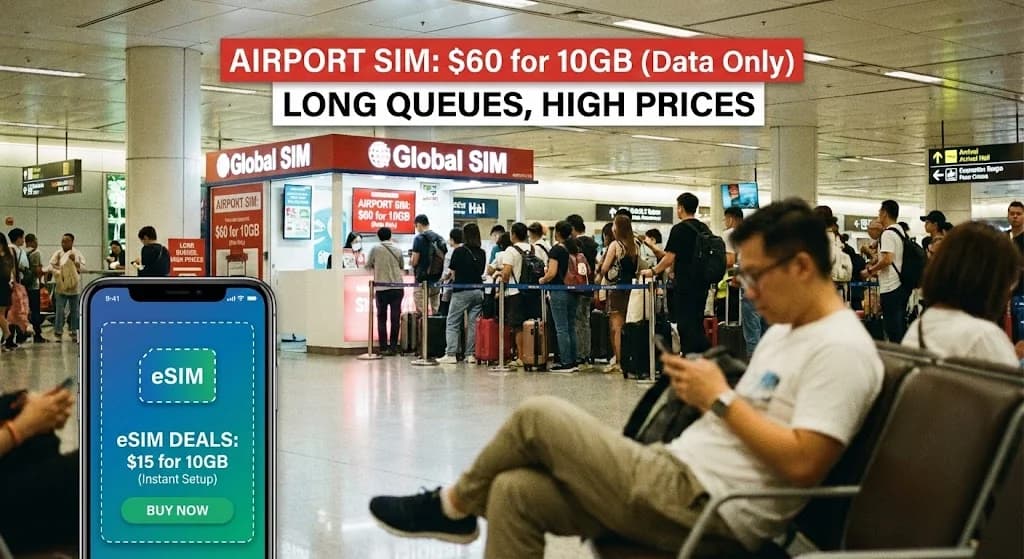
Arriving in a new country and needing immediate connectivity is a universal travel experience. The temptation to grab a local SIM card from a vendor right at the airport can be strong, promising instant access to maps, messages, and social media. However, this immediate gratification often comes with a hidden premium, what many seasoned travelers refer to as the "Airport Convenience Tax." This article explores why opting for an airport SIM often leads to higher costs and fewer benefits compared to the flexible, cost-effective solution that Cellesim eSIMs offer.
- Understanding the Airport Convenience Tax
- The Hidden Costs of On-Arrival Connectivity
- eSIM: The Smart Alternative for Savvy Travelers
- Cost Comparison: eSIM vs. Airport SIM vs. Roaming
- Navigating Data Needs for Your Trip
- Activating Your Cellesim eSIM Before You Fly
- Beyond the Airport: Seamless Connectivity Everywhere
- Frequently Asked Questions
Connect Instantly, Skip the Queues
Get your Cellesim eSIM before you travel and avoid the airport rush. Join 50,000+ happy customers in 200+ countries.
Explore All eSIM PlansUnderstanding the Airport Convenience Tax
The "Airport Convenience Tax" is an unofficial premium travelers pay for the immediate availability of services within an airport terminal. This phenomenon is not limited to SIM cards; it applies to everything from bottled water to currency exchange rates. For SIM cards, this tax manifests in several ways: inflated prices, limited plan options, and often less transparent terms compared to what you would find outside the airport or online.
Travelers arriving after a long flight are often tired and in a hurry to get connected. This urgency is precisely what airport vendors capitalize on. They know you need data for navigation, contacting loved ones, or booking ground transportation. This demand allows them to charge more for basic data plans that might be half the price elsewhere.
The true cost of an airport SIM extends beyond its sticker price, encompassing lost time, limited flexibility, and potential overspending.
Unlike a traditional physical SIM card which requires a visit to a store, documentation, and often a waiting period, an eSIM offers a digital solution. It removes the need for physical interaction and allows for pre-trip setup, eliminating the airport transaction entirely.
The Hidden Costs of On-Arrival Connectivity
Beyond the higher upfront price, several other factors contribute to the hidden costs associated with purchasing a physical SIM card at the airport:
Price Markups
Airport retailers face higher operating costs, including rent and staff wages, which are then passed on to the customer. This means a 10GB data plan might cost $30 at the airport, while an equivalent plan online or from an eSIM provider like Cellesim could be $15-20. These markups significantly erode your travel budget, especially for longer trips or multiple destinations.
Time is Money
Queuing at an airport SIM counter can take anywhere from 15 minutes to over an hour, depending on the airport and time of day. This is valuable travel time that could be spent getting to your accommodation, exploring, or simply relaxing. For business travelers, this delay can be particularly costly, impacting schedules and productivity.
Limited Choices and Flexibility
Airport vendors typically offer a limited selection of plans, often from a single provider. You might not find a plan that perfectly matches your data needs or trip duration. This can lead to either purchasing more data than you require (overspending) or running out of data mid-trip and having to find another solution, potentially at another inflated price.
For example, if you are visiting Italy, an airport SIM might offer a 30-day plan when you only need 10 days of data. With Cellesim, you can select specific eSIM Italy plans tailored to your trip duration and data usage, ensuring you only pay for what you need.
eSIM: The Smart Alternative for Savvy Travelers
eSIM technology has transformed how travelers connect abroad, offering a superior alternative to traditional physical SIMs, particularly those sold at airports. An eSIM is a digital SIM profile embedded in your phone, allowing you to activate a cellular plan without needing a physical card.
Flexibility and Choice
Cellesim offers a wide range of eSIM plans covering 200+ countries and regions. You can compare different data packages, validity periods, and prices from the comfort of your home, choosing the plan that best suits your travel style and budget. This level of choice is virtually impossible to find at an airport counter.
Instant Activation, Zero Queues
One of the most significant advantages of an eSIM is its seamless setup. You can purchase and install your Cellesim eSIM before you even leave home. Upon arrival at your destination, simply activate the plan through your phone settings, and you are instantly connected. No queues, no paperwork, no language barriers.
Transparent Pricing
When you purchase an eSIM online, all prices, data allowances, and validity periods are clearly displayed. There are no hidden fees or surprise charges. This transparency allows for better budgeting and avoids the "convenience tax" often associated with airport purchases.
Moreover, Cellesim makes it easy to manage your data. If you need to check your usage or top up, you can do so directly from your account. Learn more about how to check eSIM data usage and top up.
Cost Comparison: eSIM vs. Airport SIM vs. Roaming
To illustrate the "Airport Convenience Tax" more clearly, let's compare the typical costs and benefits of different connectivity options for a one-week trip.
| Option | Price (7 days, est.) | Setup | Flexibility | Initial Wait |
|---|---|---|---|---|
| Cellesim eSIM | From $4.50 | Instant | High (data plans) | 0 mins |
| Airport SIM | $25 - $40 | Physical install | Limited (store offer) | 15 - 60 mins |
| Carrier Roaming | $70 - $140+ | Automatic | Low (daily charges) | 0 mins |
As this table demonstrates, Cellesim eSIMs consistently offer a more cost-effective and convenient solution than both airport SIMs and traditional international roaming. Our Roaming Savings Calculator can provide a more personalized estimate of how much you can save.
For more insights on avoiding roaming charges, read our guide on how to avoid roaming charges and stay connected abroad.
Navigating Data Needs for Your Trip
Understanding your data usage is crucial to avoid overpaying. Airport SIM plans might force you into larger, more expensive packages. With Cellesim, you can choose a plan that closely aligns with your actual needs.
- Light User (1-3 GB/week): Ideal for occasional map checks, messaging, and light social media.
- Moderate User (5-10 GB/week): Suitable for regular browsing, some video streaming, and frequent social media use.
- Heavy User (10+ GB/week): Best for those who rely heavily on video calls, streaming high-definition content, or using their phone as a hotspot.
Consider using our Smart Data Calculator to estimate how much data you will need for your specific travel activities. This helps you select the most economical Cellesim plan and avoids the "convenience tax" of buying an unnecessarily large airport SIM package.
Find Your Ideal eSIM Plan
Activating Your Cellesim eSIM Before You Fly
The strategic advantage of an eSIM lies in its pre-travel activation capability. This completely bypasses the airport SIM counter and its associated "convenience tax."
Here's a simplified guide to getting connected:
- Check Compatibility: Ensure your device supports eSIM technology. Most modern smartphones do. You can use our eSIM Checker or review our eSIM Compatible Devices list.
- Choose Your Plan: Visit cellesim.com and select a plan for your destination and data needs.
- Purchase and Receive QR Code: Complete your purchase, and Cellesim will instantly send you an email with a QR code or manual activation details.
- Install eSIM: Scan the QR code with your phone (or enter details manually) to install the eSIM profile. Do this before you travel, in a stable Wi-Fi environment.
- Activate on Arrival: Once you land, simply enable your Cellesim eSIM line in your phone settings and turn on data roaming for that line. You'll have instant internet access.
For a detailed walkthrough, consult our complete eSIM setup guide or the interactive setup guide.
The GSMA projects that eSIM penetration will reach 50% of all connected devices by 2025, underscoring its growing importance in global connectivity.
By taking these steps, you avoid the pressure of an airport purchase, secure better value, and ensure a smooth start to your trip.
Beyond the Airport: Seamless Connectivity Everywhere
The benefits of an eSIM extend far beyond avoiding the airport convenience tax. eSIMs offer enhanced flexibility, allowing you to switch between plans or providers easily, add multiple eSIM profiles for different countries, and keep your primary number active for calls and texts while using the eSIM for data. This dual SIM functionality is invaluable for staying connected with your home contacts while enjoying affordable local data abroad.
Whether you're traveling for business or family travel, the ability to manage your connectivity digitally offers peace of mind and substantial savings. No more fumbling with tiny physical SIM cards, searching for SIM ejection tools, or worrying about losing your home SIM. With Cellesim, your phone becomes a truly global device, ready for any adventure.
Ready for Seamless, Cost-Effective Travel?
Say goodbye to airport SIM queues and hidden fees. Connect instantly with Cellesim eSIM.
Start Your Connected JourneyTrusted by 50,000+ travelers worldwide. 24/7 Support: [email protected]
Frequently Asked Questions
What is the main difference between an airport SIM and an eSIM?
An airport SIM is a physical plastic card purchased at the airport, often at inflated prices and with limited plan options. An eSIM is a digital SIM profile downloaded to your phone, offering greater flexibility, better pricing, and instant activation without needing a physical card or queueing.
Can I use my Cellesim eSIM with my existing phone number?
Yes, one of the key advantages of an eSIM is its dual SIM functionality. You can keep your primary physical SIM card active for calls and texts on your home number while using the Cellesim eSIM for mobile data abroad. This allows you to stay connected for both local data and essential home communications. For more details, refer to our guide on keeping your number with an eSIM.
Are Cellesim eSIMs compatible with all smartphones?
Cellesim eSIMs are compatible with most modern smartphones released in the last few years, including many models from Apple, Samsung, Google, and more. However, compatibility can vary by device and region. We recommend checking our eSIM Compatible Devices page or using our eSIM checker to confirm your phone's compatibility before purchase.
How do Cellesim eSIM prices compare to international roaming?
Cellesim eSIMs are significantly more affordable than traditional international roaming plans offered by home providers. Roaming charges can quickly accumulate, often costing $10-$20 per day for limited data. Cellesim offers flexible data packages at a fraction of that cost, providing substantial savings for travelers. Our Roaming Savings Calculator can help you quantify these savings.
When should I activate my Cellesim eSIM?
You can purchase and install your Cellesim eSIM anytime before your trip. Most travelers prefer to install it at home, then activate the data plan upon arrival at their destination. This ensures instant connectivity as soon as your plane lands, avoiding any delays or stress related to getting online. Activation is usually as simple as turning on the eSIM line in your phone settings and enabling data roaming for that line.
What if I need more data during my trip?
One of the benefits of Cellesim eSIMs is the ease of topping up. If you find yourself running low on data during your travels, you can simply log into your Cellesim account online and purchase additional data packages. The top-up will be applied to your active eSIM profile almost instantly, ensuring uninterrupted connectivity.
Can an eSIM save me money even if I find a cheap SIM outside the airport?
While local SIMs outside the airport might be cheaper than airport SIMs, an eSIM often still provides superior value. You save the time and cost of travel to a local store, potential language barriers, and the need for physical documentation. eSIMs offer competitive pricing and the convenience of activation from anywhere, maximizing your travel efficiency and budget.