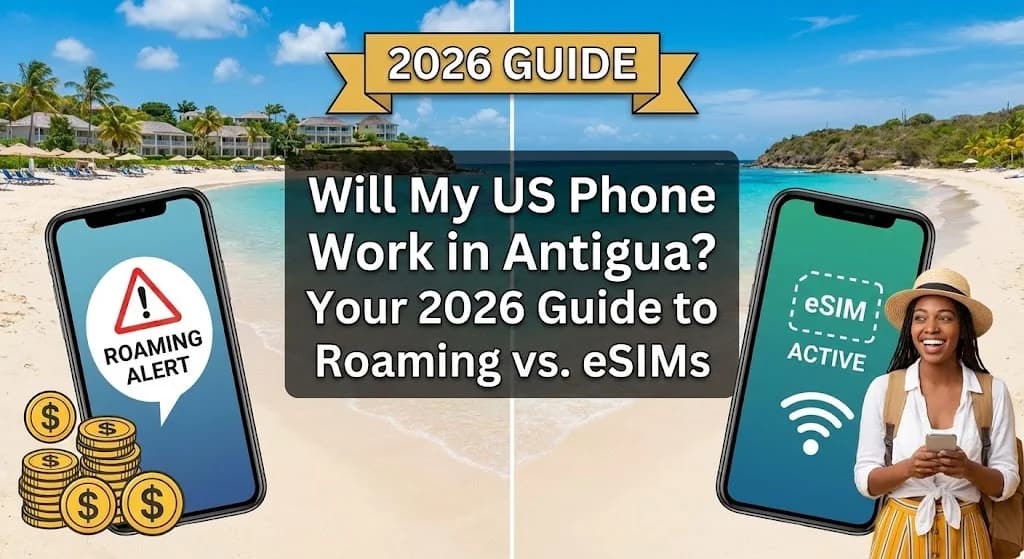
For US travelers planning a tropical escape to Antigua in 2026, staying connected is often a key concern. The question, "Will my US phone work in Antigua?" leads to an important discussion about connectivity options. While your US phone is technically compatible, the real challenge lies in finding an affordable and reliable way to get online without incurring excessive roaming charges. This guide explores the differences between relying on your US carrier's international roaming and opting for a modern eSIM solution like Cellesim, ensuring you stay connected throughout your Antiguan adventure.
- Understanding US Carrier Roaming in Antigua
- The eSIM Advantage for US Travelers in Antigua
- Comparing Connectivity: US Roaming vs. Cellesim eSIM in Antigua
- How to Set Up Your Cellesim eSIM for Antigua
- Optimizing Data Usage for Your Antigua Trip
- Staying Connected Beyond Data: Calls and Texts in Antigua
- Choosing the Right Cellesim eSIM Plan for Your Antigua Trip
- Frequently Asked Questions
Antigua and Barbuda eSIM Plans from $4.99
Skip the airport SIM queue. Join 50,000+ happy customers in 200+ countries who connect instantly with Cellesim.
Get Your Antigua eSIMUnderstanding US Carrier Roaming in Antigua
When you travel internationally with your US phone, your carrier typically offers roaming services, allowing you to use your device on partner networks abroad. In Antigua, this means your phone will connect to a local Antiguan network, but all your data, calls, and texts will be billed through your US provider. This convenience often comes at a steep price.
Most US carriers, including Verizon, AT&T, and T-Mobile, have international roaming plans or pay-per-use rates. While some offer daily passes or monthly add-ons, these can quickly accumulate, especially during longer trips or with significant data usage. Daily passes might range from $10 to $15 per day, adding hundreds to your bill over a week or two. Pay-per-use rates can be even more prohibitive, with data costing upwards of $20 per MB.
Hidden fees and unexpected charges are common complaints among travelers who rely solely on roaming. Even seemingly minor background data refresh or app updates can consume significant megabytes, leading to bill shock upon return. Additionally, roaming speeds can sometimes be throttled, meaning your internet experience might be slower than what local users enjoy.
The eSIM Advantage for US Travelers in Antigua
eSIM technology provides a modern, flexible, and often more cost-effective alternative to traditional roaming for US travelers visiting Antigua. An eSIM is a digital SIM card embedded directly into your phone, eliminating the need for a physical card. This allows you to activate a local data plan for Antigua without removing your primary US SIM card.
The primary benefit of an eSIM is instant connectivity. You can purchase and activate your Cellesim plan for Antigua before you even leave home, or while waiting for your luggage at V.C. Bird International Airport (ANU). This means you're connected the moment you land, able to order a taxi, navigate to your accommodation, or contact loved ones without searching for a local SIM card vendor or relying on expensive roaming.
Cellesim eSIMs offer transparent pricing, allowing you to choose a data package that perfectly fits your travel needs and budget. There are no hidden fees, and you maintain control over your spending. Furthermore, with an eSIM, you can keep your US phone number active for calls and texts from home, while using the eSIM for all your data needs. This dual-SIM functionality is a significant convenience for many travelers.
To confirm if your device supports eSIM technology, you can use our eSIM Checker or review the comprehensive list of eSIM compatible devices.
Comparing Connectivity: US Roaming vs. Cellesim eSIM in Antigua
To make an informed decision, let's compare the key aspects of using your US carrier's roaming service versus a Cellesim eSIM for your trip to Antigua.
| Feature | US Carrier Roaming | Cellesim eSIM |
|---|---|---|
| Cost (approx. 7 days, 5GB) | $70 - $105+ | From $10 - $25 |
| Data Speed | Potentially throttled | Full 4G/5G speeds |
| Setup | Automatic (on arrival) | Instant (QR code/manual) |
| Flexibility | Limited plan options | Variety of plans & top-ups |
| Keep US Number | Yes (primary for all) | Yes (primary for calls/SMS) |
| Local Number | No | No (data only) |
As the table illustrates, a Cellesim eSIM typically offers a significantly more cost-effective and flexible solution for data connectivity in Antigua. While roaming provides the simplicity of automatic connection, the financial implications often outweigh this convenience for most travelers.
"Before my trip to Antigua, I always dreaded the roaming bill. Switching to an eSIM with Cellesim was a game-changer. I had fast, reliable internet from the moment I landed, and I knew exactly what I was spending." - A recent Cellesim customer.
For a deeper dive into how Cellesim compares to traditional roaming, you can read our detailed guide: Cellesim vs. Roaming.
Instant
Setup
200+
Countries
50,000+
Users
How to Set Up Your Cellesim eSIM for Antigua
Setting up your Cellesim eSIM for Antigua is a straightforward process designed for simplicity, even for first-time eSIM users. Here’s a brief overview:
- Purchase Your Plan: Visit the Antigua and Barbuda eSIM page on Cellesim.com and select the data package that suits your trip duration and usage needs.
- Receive Activation Details: After purchase, you'll receive an email with a QR code and step-by-step installation instructions.
- Install the eSIM:
- For iPhone: Go to Settings > Cellular (or Mobile Data) > Add eSIM. Choose "Use QR Code" and scan the code from your email.
- For Android: Go to Settings > Network & internet > SIMs > Add more (or +) > Download a SIM instead. Scan the QR code.
- Activate Your eSIM: Once installed, label your eSIM (e.g., "Antigua Travel") and ensure "Data Roaming" is enabled for this new eSIM profile in your phone's settings. Crucially, remember to select your Cellesim eSIM for mobile data usage while in Antigua.
Optimizing Data Usage for Your Antigua Trip
While Cellesim eSIMs offer generous data allowances, smart data management can help ensure you don't run out of data prematurely and avoid needing a top-up. Here are some strategies:
- Utilize Wi-Fi: Whenever available at your hotel, resort, or local cafes, connect to Wi-Fi for heavy data activities like streaming videos, downloading updates, or uploading large files.
- Download Offline Maps: Before you leave, download offline maps of Antigua on apps like Google Maps. This allows you to navigate without consuming mobile data.
- Adjust Streaming Quality: If you stream music or video, reduce the quality settings in the app to consume less data.
- Disable Background App Refresh: In your phone settings, turn off background app refresh for non-essential apps. This prevents them from using data when you're not actively using them.
- Monitor Usage: Regularly check your data usage through your phone's settings or the Cellesim portal to keep track of your consumption.
How much data you'll need depends on your activities. A casual traveler checking emails and social media might use 1-3 GB per week, while someone heavily relying on navigation, video calls, or streaming could easily consume 5-10 GB or more. Our Smart Data Calculator can help you estimate your data needs based on your planned activities.
Staying Connected Beyond Data: Calls and Texts in Antigua
When using a data-only eSIM like Cellesim in Antigua, your traditional cellular calls and SMS texts will still rely on your primary US SIM card. This means any calls made or texts sent through your US number will be subject to your US carrier's roaming rates, which can be expensive.
However, an eSIM provides excellent data connectivity, which opens up a world of possibilities for calls and texts:
- VoIP Apps: For calls and messages, popular Voice over IP (VoIP) applications like WhatsApp, FaceTime Audio/Video, Skype, Zoom, or Google Meet are your best friends. These apps use your Cellesim data to function, allowing you to make calls and send messages to anyone, anywhere, at no extra cost beyond your data plan.
- Keep Your US Number for Critical Contacts: You can keep your US SIM active to receive important calls or texts from your bank or specific contacts, but be mindful of accepting calls as roaming charges may apply. Many phones allow you to specify which SIM is used for calls versus data.
For most travelers, relying on VoIP apps for communication provides a seamless and cost-effective experience. It ensures you can connect with family, friends, and local businesses in Antigua without worrying about escalating traditional call and text charges.
Choosing the Right Cellesim eSIM Plan for Your Antigua Trip
Cellesim offers a range of eSIM plans for Antigua, designed to cater to different travel durations and data requirements. When selecting your plan, consider these factors:
- Trip Duration: Cellesim plans typically come with various validity periods, from 7 days to 30 days or more. Choose a plan that covers the entirety of your stay in Antigua.
- Estimated Data Usage: Refer to your data usage habits and the Smart Data Calculator to determine how much data you'll likely need. Plans often start from 1 GB and go up to 20 GB or more.
- Flexibility for Top-ups: If you're unsure, you can start with a smaller plan and easily top up your Cellesim eSIM if you find yourself needing more data during your trip. This offers peace of mind without overcommitting upfront.
For a typical week-long trip to Antigua with moderate social media use, mapping, and occasional video calls, a 3-5 GB plan is often sufficient. If your activities include extensive browsing, constant navigation, or working remotely, a larger data package would be more appropriate.
Visit the Antigua and Barbuda eSIM page to browse the available plans and find the perfect fit for your unforgettable Antiguan getaway.
Ready for Seamless Connectivity in Antigua?
Join 50,000+ travelers in 200+ countries. Set up your Cellesim eSIM in 2 minutes.
Start Your Connected JourneyTrusted by travelers worldwide. 24/7 Support.
Frequently Asked Questions
Can I use my Cellesim eSIM for calls and texts in Antigua?
Cellesim eSIMs primarily provide data connectivity. While you cannot make traditional cellular calls or send SMS texts directly through the eSIM's number, you can easily use VoIP apps like WhatsApp, FaceTime, or Skype for calls and messages over your Cellesim data connection. Your primary US number can remain active for calls/texts, subject to your US carrier's roaming rates.
Is my US phone compatible with an eSIM for Antigua?
Most modern smartphones from major manufacturers like Apple (iPhone XS and newer), Samsung (Galaxy S20 and newer), Google (Pixel 3 and newer), and others are eSIM compatible. You can quickly check your device's compatibility using our eSIM Checker on the Cellesim website.
Will I lose my US phone number if I use an eSIM in Antigua?
No, you will not lose your US phone number. An eSIM operates in conjunction with your physical SIM (your US SIM). Your US number remains active, allowing you to receive calls and texts. You simply switch your mobile data usage to the Cellesim eSIM profile while in Antigua.
How much data do I need for a trip to Antigua?
The amount of data you need depends on your usage habits. For light use (maps, emails, social media), 1-3 GB for a week might suffice. For moderate use (some streaming, video calls), 5-10 GB is more suitable. Heavy users or digital nomads might opt for larger plans. Our Smart Data Calculator can help you estimate your specific needs.
Can I activate my Cellesim eSIM before arriving in Antigua?
Yes, you can install your Cellesim eSIM on your phone before you even leave the US. Simply turn off your Cellesim eSIM's data roaming or switch your mobile data back to your primary SIM until you arrive in Antigua. Once you land, activate your Cellesim eSIM and enable its data roaming to get connected instantly.
What if I run out of data on my Cellesim eSIM in Antigua?
If you deplete your data allowance, you can easily top up your existing Cellesim eSIM plan directly from your account. This process is quick and ensures you remain connected without interruption. Details on how to check your usage and top up can be found in our guide.
See also: eSIM for Antigua and Barbuda